r/calculus • • Oct 03 '21 Bravo

Discussion “My teacher didn’t show us how to do this!” — Or, a common culture shock suffered by new Calculus students.

1.2k Upvotes

A common refrain I often hear from students who are new to Calculus when they seek out a tutor is that they have some homework problems that they do not know how to solve because their teacher/instructor/professor did not show them how to do it. Often times, I also see these students being overly dependent on memorizing solutions to examples they see in class in hopes that this is all they need to do to is repeat these solutions on their homework and exams. My best guess is that this is how they made it through high school algebra.

I also sense this sort of culture shock in students who:

  • are always locked in an endless cycle of “How should I start?” and “What should I do next?” questions,
  • seem generally concerned about what they are supposed to do as if there is only one correct way to solve a problem,
  • complain that the exam was nothing like the homework, even though the exam covered the same concepts.

Anybody who has seen my comments on /r/calculus over the last year or two may already know my thoughts on the topic, but they do bear repeating again once more in a pinned post. I post my thoughts again, in hopes they reach new Calculus students who come here for help on their homework, mainly due to the situation I am posting about.

Having a second job where I also tutor high school students in algebra, I often find that some algebra classes are set up so that students only need to memorize, memorize, memorize what the teacher does.

Then they get to Calculus, often in a college setting, and are smacked in the face with the reality that memorization alone is not going to get them through Calculus. This is because it is a common expectation among Calculus instructors and professors that students apply problem-solving skills.

How are we supposed to solve problems if we aren’t shown how to solve them?

That’s the entire point of solving problems. That you are supposed to figure it out for yourself. There are two kinds of math questions that appear on homework and exams: Exercises and problems.

What is the difference? An exercise is a question where the solution process is already known to the person answering the question. Your instructor shows you how to evaluate a limit of a rational function by factoring and cancelling factors. Then you are asked to do the same thing on the homework, probably several times, and then once again on your first midterm. This is a situation where memorizing what the instructor does in class is perfectly viable.

A problem, on the other hand, is a situation requiring you to devise a process to come to a solution, not just simply applying a process you have seen before. If you rely on someone to give/tell you a process to solve a problem, you aren’t solving a problem. You are simply implementing someone else’s solution.

This is one reason why instructors do not show you how to solve literally every problem you will encounter on the homework and exams. It’s not because your instructor is being lazy, it’s because you are expected to apply problem-solving skills. A second reason, of course, is that there are far too many different problem situations that require different processes (even if they differ by one minor difference), and so it is just plain impractical for an instructor to cover every single problem situation, not to mention it being impractical to try to memorize all of them.

My third personal reason, a reason I suspect is shared by many other instructors, is that I have an interest in assessing whether or not you understand Calculus concepts. Giving you an exam where you can get away with regurgitating what you saw in class does not do this. I would not be able to distinguish a student who understands Calculus concepts from one who is really good at memorizing solutions. No, memorizing a solution you see in class does not mean you understand the material. What does help me see whether or not you understand the material is if you are able to adapt to new situations.

So then how do I figure things out if I am not told how to solve a problem?

If you are one of these students, and you are seeing a tutor, or coming to /r/calculus for help, instead of focusing on trying to slog through your homework assignment, please use it as an opportunity to improve upon your problem-solving habits. As much I enjoy helping students, I would rather devote my energy helping them become more independent rather than them continuing to depend on help. Don’t just learn how to do your homework, learn how to be a more effective and independent problem-solver.

Discard the mindset that problem-solving is about doing what you think you should do. This is a rather defeating mindset when it comes to solving problems. Avoid the ”How should I start?” and “What should I do next?” The word “should” implies you are expecting to memorize yet another solution so that you can regurgitate it on the exam.

Instead, ask yourself, “What can I do?” And in answering this question, you will review what you already know, which includes any mathematical knowledge you bring into Calculus from previous math classes (*cough*algebra*cough*trigonometry*cough*). Take all those prerequisites seriously. Really. Either by mental recall, or by keeping your own notebook (maybe you even kept your notes from high school algebra), make sure you keep a grip on prerequisites. Because the more prerequisite knowledge you can recall, the more like you you are going to find an answer to “What can I do?”

Next, when it comes to learning new concepts in Calculus, you want to keep these three things in mind:

  1. When can the concept be applied.
  2. What the concept is good for (i.e., what kind of information can you get with it)?
  3. How to properly utilize the concept.

When reviewing what you know to solve a problem, you are looking for concepts that apply to the problem situation you are facing, whether at the beginning, or partway through (1). You may also have an idea which direction you want to take, so you would keep (2) in mind as well.

Sometimes, however, more than one concept applies, and failing to choose one based on (2), you may have to just try one anyways. Sometimes, you may have more than one way to apply a concept, and you are not sure what choice to make. Never be afraid to try something. Don’t be afraid of running into a dead end. This is the reality of problem-solving. A moment of realization happens when you simply try something without an expectation of a result.

Furthermore, when learning new concepts, and your teacher shows examples applying these new concepts, resist the urge to try to memorize the entire solution. The entire point of an example is to showcase a new concept, not to give you another solution to memorize.

If you can put an end to your “What should I do?” questions and instead ask “Should I try XYZ concept/tool?” that is an improvement, but even better is to try it out anyway. You don’t need anybody’s permission, not even your instructor’s, to try something out. Try it, and if you are not sure if you did it correctly, or if you went in the right direction, then we are still here and can give you feedback on your attempt.

Other miscellaneous study advice:

  • Don’t wait until the last minute to get a start on your homework that you have a whole week to work on. Furthermore, s p a c e o u t your studying. Chip away a little bit at your homework each night instead of trying to get it done all in one sitting. That way, the concepts stay consistently fresh in your mind instead of having to remember what your teacher taught you a week ago.
  • If you are lost or confused, please do your best to try to explain how it is you are lost or confused. Just throwing up your hands and saying “I’m lost” without any further clarification is useless to anybody who is attempting to help you because we need to know what it is you do know. We need to know where your understanding ends and confusion begins. Ultimately, any new instruction you receive must be tied to knowledge you already have.
  • Sometimes, when learning a new concept, it may be a good idea to separate mastering the new concept from using the concept to solve a problem. A favorite example of mine is integration by substitution. Often times, I find students learning how to perform a substitution at the same time as when they are attempting to use substitution to evaluate an integral. I personally think it is better to first learn how to perform substitution first, including all the nuances involved, before worrying about whether or not you are choosing the right substitution to solve an integral. Spend some time just practicing substitution for its own sake. The same applies to other concepts. Practice concepts so that you can learn how to do it correctly before you start using it to solve problems.
  • Finally, in a teacher-student relationship, both the student and the teacher have responsibilities. The teacher has the responsibility to teach, but the student also has the responsibility to learn, and mutual cooperation is absolutely necessary. The teacher is not there to do all of the work. You are now in college (or an AP class in high school) and now need to put more effort into your learning than you have previously made.

(Thanks to /u/You_dont_care_anyway for some suggestions.)


r/calculus • • Feb 03 '24

MOD ANNOUNCEMENT REMINDER: Do not do other people’s homework for them.

106 Upvotes

Due to an increase of commenters working out homework problems for other people and posting their answers, effective immediately, violations of this subreddit rule will result in a temporary ban, with continued violations resulting in longer or permanent bans.

This also applies to providing a procedure (whether complete or a substantial portion) to follow, or by showing an example whose solution differs only in a trivial way.

https://www.reddit.com/r/calculus/wiki/homeworkhelp


r/calculus • • 2h ago

Pre-calculus Civil engineer who hasn't done calculus in 15 years, recommend a text book?

4 Upvotes

I have this idea of having a textbook with pen and paper, slow learning calculus and solving problems in the evening 20-30 minutes.

For context my favourite course at university was Vector Calculus (Vector Calculus (MAST20009) — The University of Melbourne Handbook) which was very analytical and was based on applying calculus concepts to problem solve different functions.

I assume I'd need a good refresher before diving deep into Vector Calc (Calculus 3 back in my day).

Thank you!


r/calculus • • 2h ago

Integral Calculus Why does the domain of f inverse not include (0,1]?

Thumbnail
gallery
1 Upvotes

r/calculus • • 7h ago

Self-promotion I built a free OpenStax Calculus 1 book visualizer (breaks dense chapters into bite-sized visual steps) — looking for feedback

2 Upvotes

Hey everyone — I originally started building a general book visualizer as a side project to break long, dense reading into bite-sized visual steps.

When I tested it on technical material, I found it worked especially well for math—breaking multi-step explanations and derivations into focused beats makes it much easier to follow without getting lost in a wall of text.

Because of that, I put together an OpenStax Calculus 1 Book Visualizer on FlowyTales covering the core Calc 1 flow (Functions & Graphs, Limits, Derivatives, Applications of Derivatives, Integration, etc.):

https://flowytales.com/stem-reader?book=calculus-volume-1&chapter=1#stem-cover

It’s completely free in the browser with no sign-up or paywall required. (As long as I keep finding hosting that I can afford.)

Since it started as a general book visualizer that clicked with math, I’d really appreciate feedback from people actually studying or teaching Calc 1:

Does it look useful ? (if No, is it "better watch youtube video then this" or "idea is good but it needs some work")

(I’ve also been testing it on OpenStax College Physics 2e—if this approach holds up for math, I'm curious what other STEM subjects it could help with.)


r/calculus • • 7h ago

Differential Calculus AP calculus daily challenge #175

Post image
1 Upvotes

r/calculus • • 1d ago

Engineering Failed calc 2

44 Upvotes

I failed Calc 2 this semester, and I'm going to retake it next semester as my only class because most of the classes I need to move forward with my degree require Calc 2 as a prerequisite. So, regretfully, I'll be behind more. To catch up, I want to take Calc 3 this summer semester so at least I'll be caught up with math before I transfer to a 4-year university. Will Calc 3 over the summer be too much? Also, I'll probably be working once or twice during the summer semester. Advice would be much appreciated.


r/calculus • • 1d ago

Pre-calculus Helpp!, Is there any tips to memorize negative angle?

Post image
131 Upvotes

r/calculus • • 21h ago

Vector Calculus Integrating functions vs differential forms.

Thumbnail reddit.com
2 Upvotes

r/calculus • • 1d ago

Differential Calculus I’m think about self studying Calc AB, any tips?

4 Upvotes

r/calculus • • 1d ago

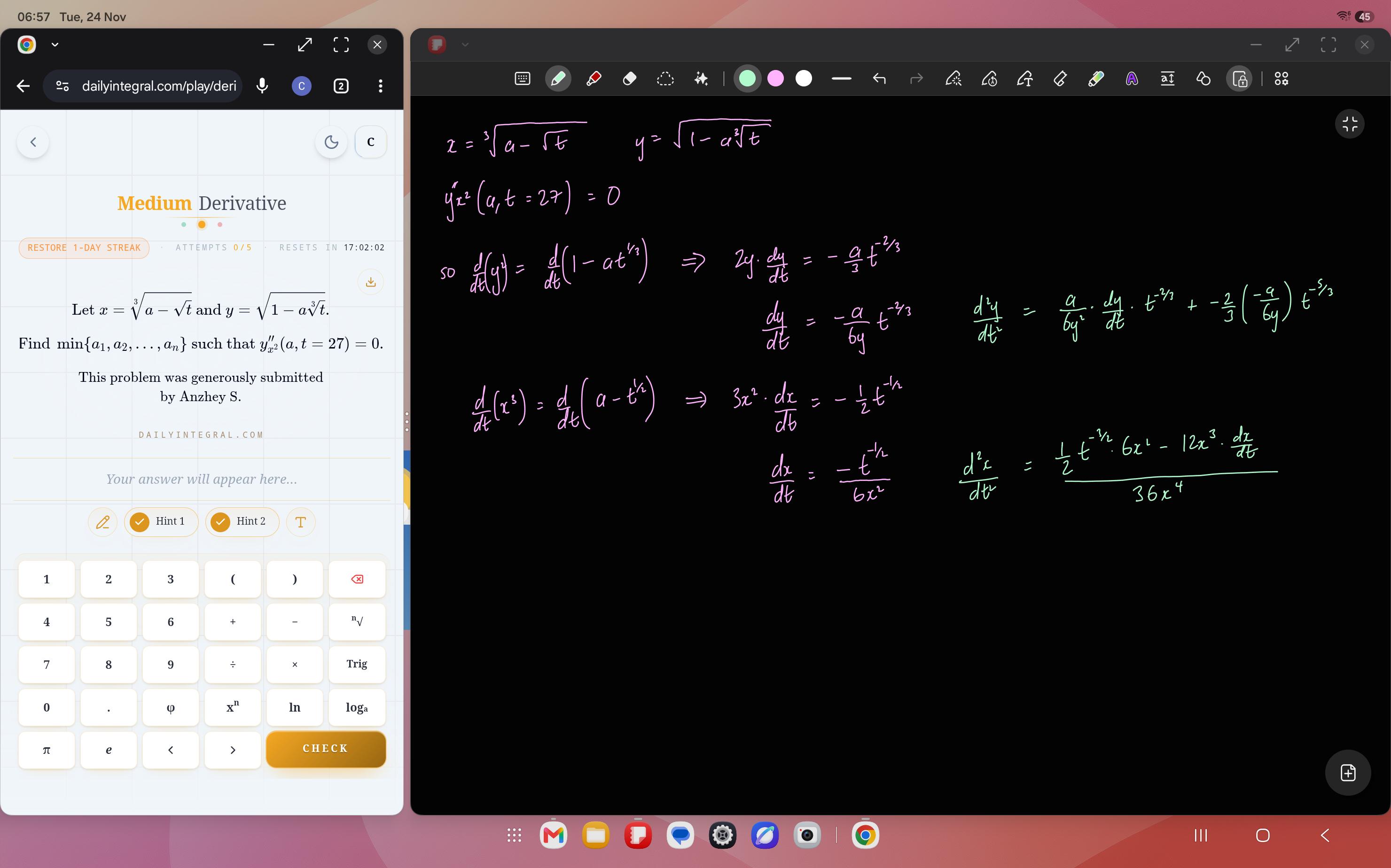
Differential Calculus Parametric derivative Spoiler

Post image
8 Upvotes

Having a bit of trouble with today's medium derivative. My thinking is to now produce dy/dx by multiplying dy/dt and dt/dx but not sure where to go from there.


r/calculus • • 1d ago

Differential Calculus Related Rates - how do you go from volume to surface area?

Thumbnail gallery
5 Upvotes

Just pretty much asking the same thing. If you guys could help that would be awesome!! I want to have this down before thanksgiving break is over.


r/calculus • • 2d ago

Pre-calculus is Khan Academy good for learning the basics of High School level Calculus?

8 Upvotes

So im in my gap year right now and I would like to use Khan Academy as a refresher of sorts to help refresh my mind on Calculus so when I go into university I can be more prepared. I also was going to do the same with other subjects such as Chemistry, Physics, and Advanced Functions.


r/calculus • • 2d ago

Differential Calculus AP calculus daily challenge #173

Post image
9 Upvotes

r/calculus • • 3d ago

Pre-calculus I bought Calculus by Spivak, was it a good choice?

16 Upvotes

I'm brazilian, and paid the equivalent of seventy dollars for it, but now I'm kind of regretting my decision bacause there are lots of national calculus books that cost like 50 or 40. I chose Spivak because I've heard that the book doesn't have some of the flaws that the brazilian books usually do, but it was too expensive and now amazon won't let me cancel te purchasse, so I'll have to send it back went it arrives so I can get my money back, but should I do it? Or is it really that good that it's worth the price?


r/calculus • • 2d ago

Engineering Best calculus book to get ready for calc 1 after taking AP pre-calc?

5 Upvotes

Taking AP pre-calc now in high school. Plan to take calc 1 in freshman year for engineering. What's book(s), courses and/or videos would you recommend for me to get started now to be ready for Fall 2027.

Thanks in advance for any help on this!


r/calculus • • 4d ago

Multivariable Calculus Help with a derivative in Electrodynamics, physics

Thumbnail
gallery
89 Upvotes

So, I'm studying electrodynamics and I was using my professor notes and I reached this part, and well. I, obviously, tried to deduce this by myself since it was like a simple derivative, well, i have been like 1 hour trying to understand why d^2u/dr^2 has that form in my professors notes.

Thank you to anyone that can help me


r/calculus • • 5d ago

Differential Calculus Do videos like this actually work?

Post image
1.5k Upvotes

If they do then this has to be the greatest ROI of all human history😭


r/calculus • • 4d ago

Differential Calculus Has anyone taken Roger Williams University's self-paced Distance Calculus?

6 Upvotes

I'm considering taking Calculus I and Calculus II through Roger Williams University's Distance Calculus program over winter break.
I'm interested in the self-paced format because I want the flexibility to work through both courses at my own speed. My goal is to complete both courses within approximately 6–8 weeks and earn an A in each class.
I have a few questions for anyone who has used this program:
Has anyone taken Calculus I or II through Roger Williams Distance Calculus?

How long did it actually take you to complete each course?

Is it realistic to finish both courses within 6–8 weeks?

Can you enroll in Calculus I and II simultaneously, or do you have to finish Calculus I first?

How difficult are the exams, assignments, and overall coursework?

Is it realistic to earn an A in both courses?

Has anyone successfully transferred these credits to another university?

How quickly does Roger Williams send out official transcripts after completing a course?

I'm also open to hearing about other accredited universities that offer genuinely self-paced online Calculus I and II courses that can be completed relatively quickly.
Any advice, personal experiences, or recommendations would be greatly appreciated!


r/calculus • • 4d ago

Differential Calculus Any insight on how to answer this question (9b)

7 Upvotes

I was able to do 9.a et c but I'm having a hard time wording 9b's answer.
My answer was that near P the graph period is very small thus making it oscillate a lot. the x given are too far from P for them to be considered to find the tangent at P


r/calculus • • 4d ago

Infinite Series NUMERICAL SERIES

7 Upvotes

Guys what is the best resource to study numerical series? there are just so many criterias and Im losing it


r/calculus • • 4d ago

Integral Calculus Coming back to calculus after 15 years, app courses or straight to a textbook?

7 Upvotes

I took Calc 1 and 2 in college a long time ago and forgot most of it. Right now I'm using Khan's AP Calculus AB course as a refresher, and limits went fine, but it feels thin once I hit related rates. I'm leaning toward Stewart or MIT OCW 18.01.

For people who came back after years away, what did you use, and did the app-style courses go deep enough?


r/calculus • • 4d ago

Differential Calculus Help with optimization

Thumbnail reddit.com
2 Upvotes

r/calculus • • 5d ago

Differential Calculus Hi! Learning Calculus and Need Help

7 Upvotes

I’m in calc 1 in college and am not too used to struggling with math. However, calculus is kicking my ass, and I am having trouble understanding what’s going on. Does anybody know a good first year series that I can watch to see if a different explanation helps?