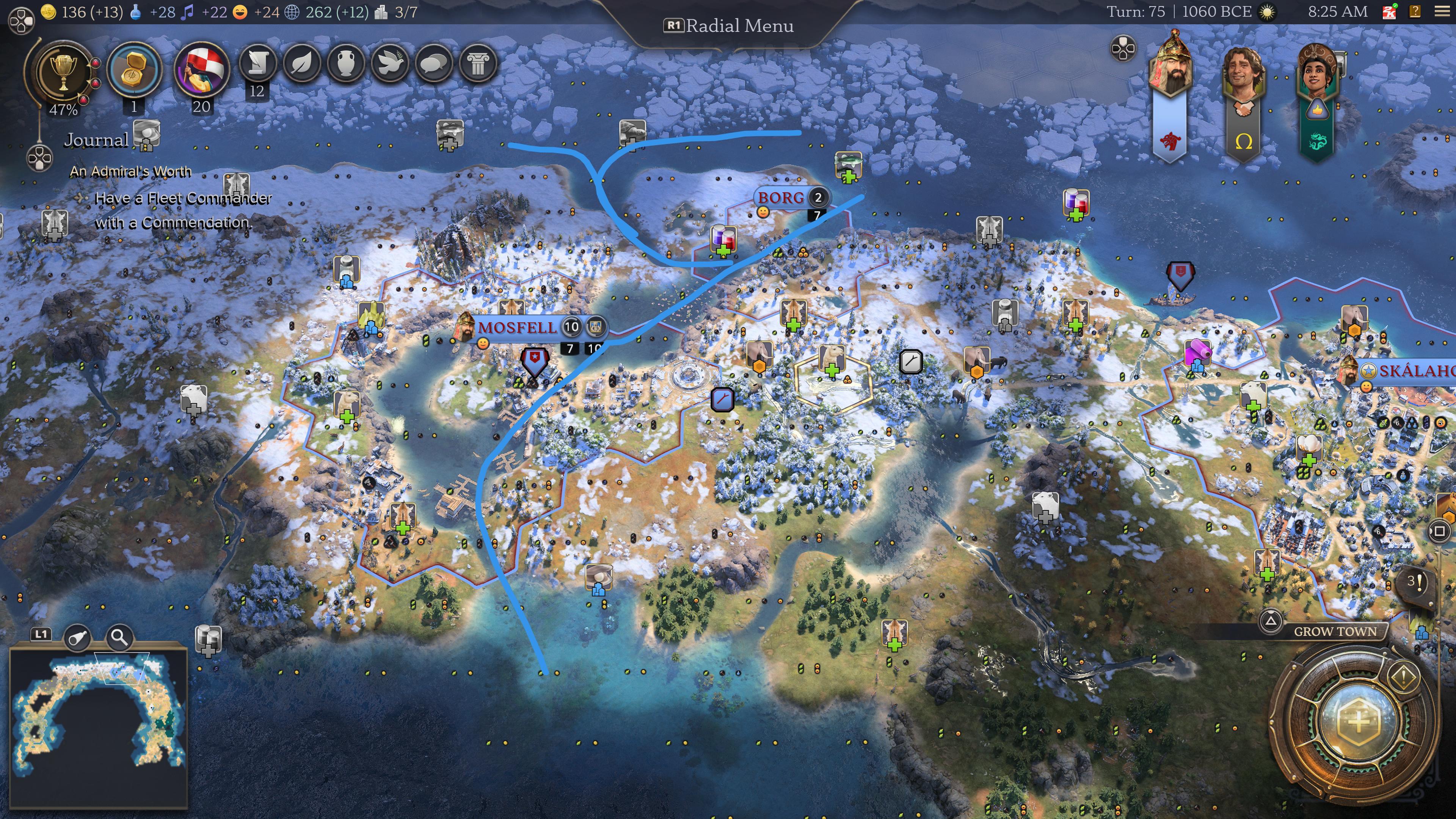
Howdy folks. Since the game has been out for a while, and it is at the stage where both potential new players and returning players are expressing interest and want to know more about the game, I figure I'd share my perspectives on it. This is not meant to convince anyone to play or not play per se, but rather just to have more context to make a decision. These are my thoughts, and others will have different opinions. An important note: I play exclusively singleplayer, so cannot speak to how multiplayer functions.
- Playthroughs are more unique. One of the benefits of Civ7 having a TSL Earth release, is that I realize much more I don't need it as much as previous Civ iterations. One of the best aspects of Civ7, is that every civ is at its apex during the age (unless one plays with time-tested civs). For me at least, this allows a lot more variety in gameplay - no longer and I just following a standard set of research, building, expansion, etc. protocols. Instead, no matter what civ I play, the choices matter, and impact how the game plays out. The changing of ages also adds greatly to this. By the start of the new age, I can decide to keep going down the same path I was on, or given the circumstances, choose an entirely new path. Perhaps I realized that against my opponents, I needed to be a lot more tech-focused. Perhaps I have made too many enemies and now need a war-focused civ. It frankly fits with how history unfurls, and adds to my immersion in the game.
- Multiple paths to achieving objectives. Need to generate gold? Trading can work, building up your settlements can work, warring can also work. Rather than having one method of yield-generation being essentially a must (or in fact, a combination), it is entirely possible to go in different paths in Civ7 and still achieve goals. In the exploration age in particular, there are so many ways to generate relics that match different playstyles. Focusing on expanding your own number of settlements in distant lands and converting them can work; or just focus on sending missionaries all over. This creates so much more variability with the game, reducing the amount of railroadiness. I find that I can truly opt for different playstyles that materially differ, while still attaining objectives, versus again, having to basically go back to the same road over and over again.
- Game beats do not become tiring. Instead of committing to something for all the turns of the game, by breaking up into different ages, Civ7 gives the player different things to aim for, and by the time one achieves it, maintaining it does not become a drag - as they only need to do so for the age. For me, this is especially true with the 'religious victory' of the exploration age. I absolutely enjoy spreading my religion, but not for the whole game. By having the religious race end at the end of the exploration age, I have yet to be tired of it. It then becomes exciting to move into the next age, where the efforts of the religious spread still plays a role. Yes, I do believe the changing of ages is one of the best things to come out of Civ7. I have completed more Civ7 games, than probably all previous titles I have played combined, all the way back since the 90s. Most of the time, I barely can finish the middle/renaissance ages in previous iterations, whereas here, I consistently play through to the end, and very much looking forwards to next year's update to close out the four ages.
- Influence makes politics in Civ7 so much more refined. The fact that it governs both positive and negative interactions is actually a surprisingly great way to mediate how one continues relationships with AI (and other players). By making negative interactions pegged to something tangible, decisions become very important. One does not simply
walk into Mordor betray other civs. Better to think carefully how to use Influence to either force positive or negative interactions. Even using Influence to cancel out negative interactions is such a great addition. Are you going to just use influence to bring things back to a 'normal' state with other civs? Or will you accept their sanctions, and throw your own sanctions at each other in a war of attrition? - Civ design is unique, yet equal. To say all civs are balanced, is hard. But the fact that the civs are designed on similar principles, yielding like opportunities, makes it easier for me to enjoy the different civilizations. I do not feel compelled beforehand to be clear on what my next playstyle, I'd want to be, at least not as much, before choosing a civ. With military options, building/improvement options, civic options for each civ, one can come into a game with more choices on how things can play out. If I am surrounded by enemies early, opting for the civ's unique units do not feel like I am simply not playing the civ, rather it is always a part of how the civ is designed. This is a great departure from previous Civ iterations, and something I really enjoy. On that note, in conjunction with leaders, the opportunities are also aplenty, but it does not feel like one is 'not playing the civ' if one decides to opt for just some but not all of the civ's uniqueness. Even if one decides to not research ANY civic in the civ's unique civic tree, it still feels like one is truly playing that civ, just by going for the other unique features of said civ. Traditions particularly fall within this space. For example, opting for Akhet I instead of Kemet I for Egypt (+food or +culture), should the need to decide between the two arises, feel like a design choice due to different synergies available, rather than a design oversight.
- Civ transitioning is now my headcanon. I really do not think I can go back to one civ through the ages y'alls. XD To me, civ-switching is done right in Civ7, it does not feel like a gimmick, but natural progression of history. It makes sense that each civ should be at its apex to not simply be a city-state, during the age; and transitions into another by the end of it. I do get that age transitions are not 'hardcoded' across all civs all at once across the world, as that is unrealistic, but nonetheless, broadly our own history are divided up amongst ages that largely fit across the world. So it is nice to see that in action.
- Naming mismatch is a bit jarring to me. This is the only thing that really stands out to me, not only with the leader + civ matching, but also civ names between one age and the next. It does feel odd to have an Asian leader leading a European civ, then transition into civ of a wholly different culture. It does feel odd for me, but is a rather minor point, one that I have been conditioned to accept anyways since the first Civ games where you have all these different civs of different cultures spawning next to each other, on continents of wildly different names than where they are found.
- QOL updates still need to happen. While the game has been in a very solid spot for me for a very, very, very long time (even before legacy paths became triumphs), there are still more QOL changes needed. For example, the 'game setup' screen still needs to come before the civ and leader selection screens - no point in selecting civs and leaders, if then loading a saved configs overwrite all that. These and other changes are still needed.
Overall, I think the biggest difference in mindset for me playing this versus previous Civ iterations, is that in previous iterations, I come into the game with a specific goal - if I choose Egypt, it could be to build the most wonders or whatever. Whereas for Civ7, it is all about starting a new world and seeing how things play out, no matter what civ and leader I choose. Both are fun, just in different ways.
That's all from me. You may notice that for the most part, it is positive. Well, I am a simple man, and perhaps that is a big part of it. It is very easy for me to enjoy games, and so so far I have really enjoyed Civ7. I love all the unique aspects of it. At least for me, here's hoping that the developers keep all of these cool features for Civ7 and make them stand out even more!