r/ClaudeAI
•
u/TheOnlyVibemaster
Valued Contributor
•
3d ago
•
 1
 1
Productivity Have They Nerfed Claude Yet? LiveNerf Day 63 Update for Opus 5.5 and Day 17 for Fable 5.2
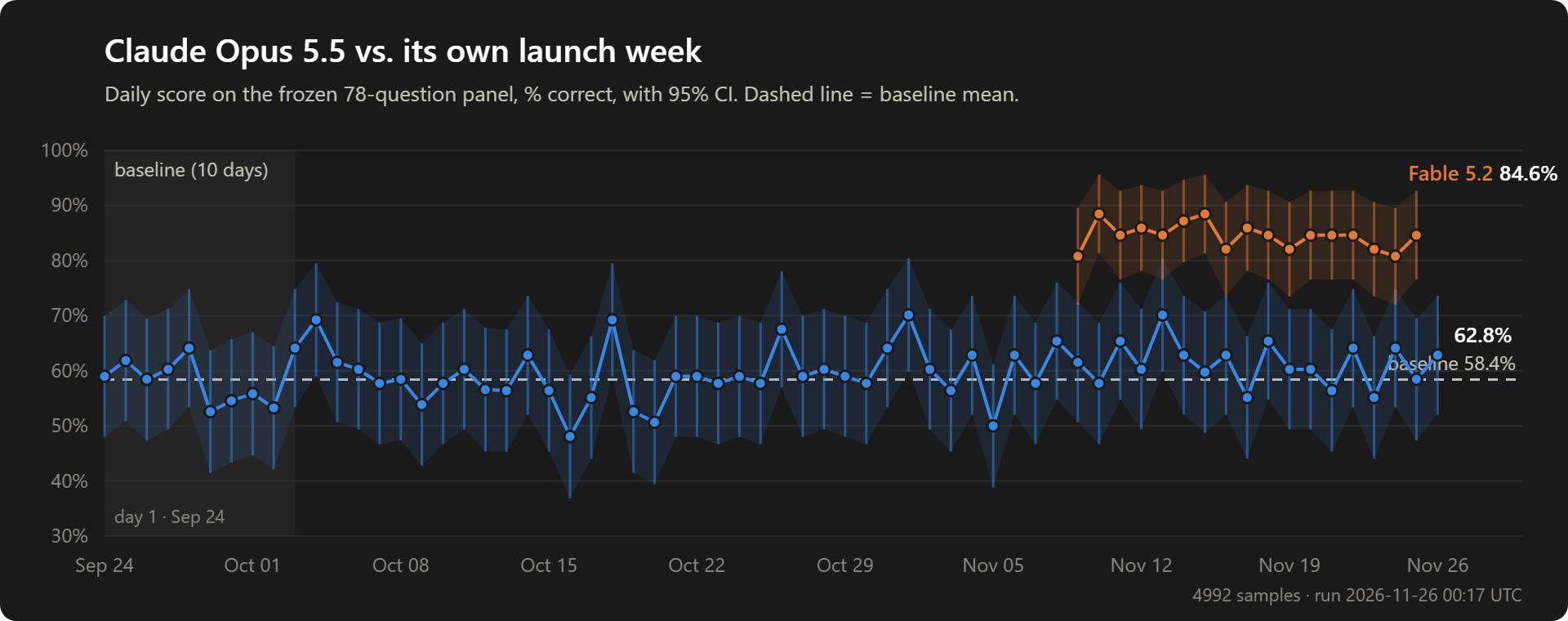
I’ve now been running LiveNerf every single day for over two months without missing a day. For those who haven’t seen my previous posts, the idea is pretty simple: measure Claude’s performance from around the time it launches and see if it actually gets worse over time.
If you’re interested in following the results, everything is open source:
https://github.com/ninjahawk/livenerf
Every day, both models answer the same 78 questions from GPQA Diamond, MMLU-Pro, competition math, and AIME. The prompts and graders are frozen, the Claude Code versions are pinned, and the methodology is pre-registered.
The Opus 5.5 results so far:
- Launch baseline: 58.4%
- Days 11–20: 59.2%
- Days 21–30: 57.1%
- Days 31–40: 61.4%
- Days 41–50: 60.0%
- Days 51–60: 61.7%
Nerf detected: No statistically meaningful sustained degradation within the pre-registered parameters.
Interestingly, the most recent completed 10-day window is actually the highest-scoring window we’ve recorded for Opus 5.5, although it doesn’t meet the threshold for declaring a sustained improvement either.
As for Fable 5.2:
I’ve been tracking Fable since its launch on November 9, and we now have 17 consecutive days of data.
- First 10-day baseline: 85.3%
- November 23: 82.1%
- November 24: 80.8%
- November 25: 84.6%
All 1,326 Fable samples have been served by Fable 5.2 with zero errors.
There has been a slight decline relative to its launch baseline over the past week, but nothing that warrants calling it a nerf at this point. The earliest possible verdict under the previously announced decision rule is December 8.
Between the two models and the Opus control arm, we’ve now collected nearly 7,000 samples since daily tracking began.
Something I want to reiterate is that the absence of a detected nerf doesn’t mean that Anthropic hasn’t changed anything on their end. I’m also recording token usage and fingerprints of the experiments and feature flags assigned to the Claude Code client for Fable.
It’s entirely possible for changes to occur that this particular benchmark isn’t sensitive to. The current Opus setup has an estimated minimum detectable effect of about 6.6 percentage points per 10-day window. Fable is also being tested on questions originally calibrated for Opus, which limits what we can infer about Fable’s broader capabilities.
The longer this runs, the more useful I think it’ll become. We’ll have actual historical data to reference when people start noticing changes rather than having to rely exclusively on our recollection of how good a model was when it launched.
We’ve also officially reached 2,000 stars on GitHub, which is genuinely insane to me. I started this because I was curious about whether what people were experiencing was measurable, and I never expected this many people to follow along.
For anyone interested in discussing the methodology or following the daily results, there’s a Discord linked in the repo. There’s also a Sponsor button if you’d like to help cover the costs of keeping this running.
Thankful to you all.
See you on the next update.
•
u/ClaudeAI-mod-bot Wilson, lead ClaudeAI modbot 3d ago edited 3d ago
TL;DR of the discussion generated automatically after 50 comments.
The data says no nerf. In fact, OP's LiveNerf project shows Opus 5.5's most recent 10-day performance is its highest on record. Fable 5.2 has seen a slight dip, but nothing big enough to call a nerf yet.
However, the community is heavily divided on whether this data tells the whole story.
The verdict? While OP's dedication and data are appreciated, the consensus is that the test, in its current form, may not be sensitive enough to detect the subtle, real-world performance dips that many users are convinced are happening.
82
u/Active-Season5521 3d ago
Was this the tool that couldn't tell the difference between different versions of opus?
32
u/ShadowBannedAugustus 3d ago
Can we distinguish Opus 5 from Opus 5.5 now?
2
u/WillGrindForXP 3d ago edited 3d ago
I find this tracking data really interesting. But I dont know how to match the results of this data with my actual usage exprience. I know the data trumps my personal exprience but they are at odds with each other.
I have exprienced Claude going from amazing to feeling stupid using the same work flow, keeping the same best practices etc. Its been so severe I've made decisions to stop working on specific projects for a few days because the dumb feeling claude is making it an uphill struggle, and potentially ruining the project in some examples. Every single time I've experienced this a new claude model is released no more than a few days later. This has happened at least ten times to me, and not once was it not followed by a new claude release.
This has been so consistent to me, that I've said in reddit comments like a ai obsessed mystic meg "i guarantee a new model will be released in a few days" followed by a "see, i said it would happen" a few days later when the new model comes out.
I have autism, and I score insanely high in pattern recognition, to such a level that it was tested at a well known university who were conducting research into pattern recognition and was found to be something known as a Super Spotter. I know this is flaky evidence to take from a reddit user, but i am genuinely seeing something that I can't explain when I compare it to data like this. But if I was wrong about it, then I'd expect to feel it being stupid and have no new model release; but so far thats never happened. Its too consistent to be a coincidence.
So my question to you OP is this; is there anyway the data you track isn't telling the full story? Does it have any blind spots or could there be other factors at play?
And just to be clear; I don't think they nerf models after release or anything sinister like that. But I do feel completely confident in stating that claude temporarily becomes worse around 3 days before a new model launches. I am ready for downvotes, but id be really happy if someone was to engage with me on this sincerely.
11
u/Muhlwa_Sholanke 3d ago
The newest 10-day window being the highest on record is what I'll remember from this update. Two months of frozen methodology beats vibes.
25
u/JaggedTex 3d ago
The whole Nerf thing never made sense to me. They would say that they are “taking compute away” to train other models. Or they added “more compute “ in the beginning. If that was actually done, all it could do is make the responses slower not stupider. The only thing that can change is “intelligence” is modifying its weights, which is a huge job.
6
u/Randommaggy 3d ago
Same 78 questions from the benchmaxed set.
4
u/DarkVeneno 3d ago
What prevents Claude from bypassing the test by detecting its being tested and increasing the quantization, depth and all that stuff
3
u/jwuliger 3d ago
THIS CHART/TEST DOES NOT SHOW TRUE REGRESSIONS!!!!!!!!!!!!!!!!!!!!!!!!!!!!!!!!!!
2
u/JoshRTU 3d ago
Frontier models have pretty good awareness of when they are being benchmarked. How do you ensure that your're test isn't just always being routed to a non nerfed product?
1
u/South_Hat6094 3d ago
Version pinning matters, but I'd also log region, account tier, and feature flags. A fixed task set can show drift; it can't rule out cohort-specific routing.
1
u/wwdennis5 3d ago
Are you also tracking token usage and cost? For cases where Opus 5 and 5.5 are performing similarly, this can differentiate them. It can also be a signal of A/B testing of opus 5.6 since we should have consistent verbosity and cost across a single LLM.
1
u/Few-Divide1870 3d ago
Fair follow-up to the " can it tell Opus 5 from 5.5?" question: what would the chart look like if you deliberately ran the test at a lower effort level? if it doesn't move, that tells us how sensitive it is. if it does, that's a proof of concept.
1
u/Federal_Signature708 3d ago
Pre-registered methodology + 7,000 samples is insane dedication. Congrats on 2k stars, this is genuinely one of the best projects on this sub.
1
u/NotFromMilkyWay 3d ago
Now that they are public and have their users as bag holders, probably too risky to nerf.
1
u/Dman_473 18h ago
I have been having a big issue with some reverse engineering and engineering of my own software to work on vehicles I own that the software for them simply does not exist and never will otherwise and claude and codex both have issues completing the task. I have a feeling it is from the GTA 6 reverse engineering crackdown and trying to stop them from completing the port. Pretty annoying
1
u/Lost-Leek-3120 17h ago
oh wow people think they don't reduce the reasoning time , adjust their equivalent of temp or other simpler things on the website ui... you can clearly see it respond without thinking when it should be when its turned on. yet it will respond fast and skips reasoning even though it was asked for something comple ignoring the fact its set to high or max. or b it pulls some scripted response and refuses to "think" regardless of the chat rerolls. This thread isn't worth seeing if there is a current issue or not. it seems people continue to ignore the 2 versions of response on here api results vs whatever the desktop site is set behind the scenes to. or 3rdly i suppose claude code albeit that should be the most "reliable" but yep no problems because x person currently isn't having a issue using x version that probably is "working' or not nerfed that particular day / hour.
1
u/EconomistMuted6987 3d ago
Benchmarks are one thing, working on an actual codebase for hours is another.
0
u/weird__guy 3d ago
cool project, but 78 questions is a small sample for this. at ~60% accuracy one run has a standard error around 5.5 points, so 58.4 vs 61.7 is well inside noise either way. running each question several times a day, or a bigger pool you rotate from, would make it a lot harder to argue with in either direction
-12
u/Outrageous_Band9708 3d ago
love the data.
always love to see this post.
folks you there, you think its nerfed. its 100% your workflow that's failing you
https://github.com/Druthulu/ProjectArchitect
my solution makes your weekly usage last twice as long or more, and is an amazing solution if you read into it.
checkout the readme and the wiki and test out yourself.
terminal Claude Code support only at this time. be brave, try the terminal ask Claude how, its easy, uses less tokens than the desktop app, no fancy graphics and such, just work.
0
u/[deleted] 2d ago
[deleted] — view deleted comment