r/ClaudeCode • • 6h ago

Discussion What's one way you use Claude that you'd never have guessed when you first started.

6 Upvotes

When I first started using Claude, I figured it was mostly for writing and quick questions. Over time my usage has drifted into stuff I never planned for, like working through technical problems and sanity-checking my own thinking.

I'm curious what the biggest "oh, I didn't expect to use it for this" moment was for you.


r/ClaudeCode • • 8h ago

Help/Question When is experimental Code Mode coming to the Claude Desktop app?

8 Upvotes

Experimental Code Mode (CLAUDE_CODE_EXPERIMENTAL_CODE_MODE=1) is probably the best thing that’s happened to my workflow lately, the efficiency gains are big.

The problem is that right now it’s restricted to the terminal CLI, which makes my usual workflow much harder. It’s tough to follow the activity feed, track what’s happening in real time, and operate everything smoothly through the terminal compared to the dektop UI.

Does anyone know if Anthropic has mentioned a timeline, or any plans at all, to bring experimental Code Mode into the Claude Desktop app? Would also love to hear if I'm the only one missing it.


r/ClaudeCode • • 15h ago

Meta Claude create->review->fix->repeat not converging, more and more bugs found each cycle

26 Upvotes

Claude has been great but one issue bites me often. Claude always seems to try to solve an issue by making something super complex, then doing multiple threads of reviews, finding more issues, fixing, then reviewing cycle again, and it finds more issues than before, and it never converges, with this process repeating. Then, a simple solution from start would have worked, and I the user would have to suggest that simple solution. Then Claude says "you're right i should have done that"


r/ClaudeCode • • 4h ago

Discussion How do you manage your agents?

3 Upvotes

I’ve been experimenting with different agentic coding workflows for both work and personal projects and have settled into a system that generally involves 16–20 agents working collaboratively across multiple machines in my lab.
I use a combination of Claude Code, Codex, and AGY, distributing workloads across harnesses to maximize productivity and optimize my usage limits or reduce my api costs.
My workflow consists of:

  • A lead coordinator and nested planning session on my main machine, both using Claude.
  • Distributed builder teams operating over SSH, using Codex and AGY, each with a dedicated Claude reviewer.
  • Isolated Git worktrees for every agent working on a task.
  • Multiple layers of review, including a final review by Claude and myself before anything is merged into main.
  • Exclusive push permissions for my lead session.
  • Mandatory human approval for architectural changes, destructive actions, design decisions, and deviations from approved plans.

When agents encounter something requiring my approval, those decisions are batched and delivered to me while independent work continues.
I’ve never had an “oops, the AI deleted my repo, wiped my database, or took down production” moment. It requires a little more involvement on my part, but the results have been excellent, and progress rarely stops.
I essentially treat my agents like distributed engineering teams, with defined responsibilities, separation of authority, and centralized orchestration.
For those of you working with multiple agentic coding harnesses, how are you managing your swarms of agents? What does your orchestration, collaboration, and oversight look like?


r/ClaudeCode • • 13h ago

Discussion Who’s ready for 2027?

14 Upvotes

I don’t recall approaching a year end before where I’ve truly felt with high conviction “next year is going to be WILD” but I’m very much feeling that way right now

The amount of disruption and game changing intelligence is going to produce new user experiences, business models and billion dollar companies. It’ll also very likely impact society on a level none of us can yet accurately predict.

I feel like 2026 has been mostly the training grounds for the biggest change and thankfully fairly well equipped to ride the wave as I’m sure most people here are too 🫡

2027…

Ya ready son?!


r/ClaudeCode • • 11h ago

Help/Question What’s the one rule in your CLAUDE.md that completely changed how well it codes for you?

10 Upvotes

Trying to refine my setup. For me, telling it to run tests before claiming a task is done saved hours of back-and-forth. What’s your non-negotiable prompt or rule?


r/ClaudeCode • • 1d ago

Built with Claude I distilled Boris's 28-minute Claude Code guide into one /claude-ready setup skill instead of a 400-line CLAUDE.md (open-source repo)

Thumbnail
github.com
106 Upvotes

After watching Boris's 28-minute Claude Code prompt guide, I noticed two things people keep getting wrong when they try to apply it:

  1. They stuff everything into CLAUDE.md and custom slash commands. Half of that talk is human ergonomics (shortcuts, dictation, --worktree) or features Claude Code already handles natively (/verify, /code-review, /ship, /init, /doctor). Putting all of that into CLAUDE.md just burns context and after compaction, long prose rules get ignored anyway.
  2. They put hard guardrails in prose instead of settings.json**.** Telling Claude "don't touch .env" in CLAUDE.md is a suggestion; putting Read(./.env) in permissions.deny and typechecks in a Stop hook (exiting 2 to stderr) is actually enforced by the harness.

So I built a minimal, manual-only setup skill (/claude-ready) and a set of copy-paste templates in one repo: https://github.com/shifulegend/claude-ready

What it does when you run /claude-ready in any project:

- Read-only audit first: Checks your manifests (package.json, pyproject.toml, Makefile, Cargo.toml, go.mod), existing .claude/ config, and sensitive paths—then stops and asks 3–5 questions before touching a single file.
- Lean non-deterministic layer: Generates a <80-line CLAUDE.md (only commands and non-obvious gotchas) plus path-scoped .claude/rules/*.md files so domain rules only load when editing matching files.
- Deterministic layer: Scaffolds .claude/settings.json with safe allow rules (no npx or docker exec wildcards), .env / secrets/** deny rules, a PostToolUse formatter hook, and a Stop verification hook guarded with stop_hook_active.
- 1-page cheat sheet: Moves all the outer-loop stuff (claude -p, --worktree, terminal shortcuts) into playbooks/cheatsheet.md so it never wastes a single token in your repo context.

Where do everyone else land on this:

- Do you still rely on CLAUDE.md rules to keep the agent in bounds, or have you moved your non-negotiables into settings.json hooks and deny rules?

- What's the one rule you wish you'd automated on day one instead of repeating in chat?


r/ClaudeCode • • 3h ago

Built with Claude Stop paying hundreds for AEO / GEO. I built a Claude Code plugin that shows which brands AI recommends to your buyers

2 Upvotes

Marmalade puts the questions a buyer would ask to ChatGPT, Claude, Gemini, Perplexity, Copilot and Google AI, keeps every answer, and shows which brands come up and which pages get cited. Then it tells you what to publish next, most useful first. It's open source (MIT) and runs on your machine.

It's built to be driven from Claude Code. In your terminal:

pipx install marmalade-ai

Then in Claude Code:

/plugin marketplace add AlexjComeau/marmalade

/plugin install marmalade@marmalade

/marmalade:setup yoursite.com

The plugin adds four commands (setup, report, next-action, build-page) and an MCP server with 24 tools, none of which spends money. Every paid step shows its price and waits for your yes, and your API key never goes through the chat: you type it into a hidden prompt in your own terminal.

The loop I use: /marmalade:next-action picks the biggest gap, /marmalade:build-page writes the page from a brief built on the answers and the pages the engines cite, and a draft check flags any number that isn't in your facts file.

You pay only the API calls, from about $5 a month. The video shows the whole setup in Claude Code, start to finish.

Repo: https://github.com/AlexjComeau/marmalade


r/ClaudeCode • • 8m ago

Built with Claude Building DMswift.com - manage your Instagram and Facebook automations directly through ChatGPT and other AI assistants using MCP.

0 Upvotes

Create campaigns, send DMs, and manage your social channels just by asking.

All build with Claude Code.


r/ClaudeCode • • 23m ago

Built with Claude My side project made $500 last month. What I'd tell anyone building with Claude right now

0 Upvotes

Two months ago I launched a side project. First month it made $130, second month about $500. I honestly never expected it to make anything, so even though it's not big money, I'm really happy about it.

Link: https://shapefinder.cc/

It helps you find a mouse that fits your hand and the way you play. Now it also does keyboards, mousepads and monitors. Built entirely with Claude Code.

Some context: I'm a UX designer. I still spend just as much time on UI details as I did in Figma. The only difference is that now I can build the thing myself.

A few things I learned along the way:

The idea came from my friends. I'm into peripherals, so they kept asking me if this or that mouse was any good. Knowing the topic helped way more than I expected, because I can tell right away when Claude gets something wrong.

I try not to add stuff nobody needs. Claude makes features so fast that it's really easy to keep piling them on. What helps way more is using the site myself, over and over, like a normal user would, and fixing whatever feels off.

Most of the good changes came from other people. I posted it on Reddit early, and a lot of what's on the site now started as someone's comment.

AI still can't do polished UI on its own. You get something that works and looks okay, and it looks like every other AI-built site. Building a good eye for design takes time, but with how many projects are coming out right now, it's one of the few things that will make yours stand out.

And don't build it just for the money. I didn't plan to make anything from this, I just wanted to make something cool that people would actually use. If money is the only reason, you'll probably lose motivation before it shows up.


r/ClaudeCode • • 27m ago

Rant Claude learned helplessness

1 Upvotes

I can’t be the only one who’s experienced this. I’ll ask Claude to help me solve a problem, and it’ll try maybe 1–2 approaches before convincing itself that the task is impossible and that the only way forward is some unnecessarily complicated or unreasonable solution. Meanwhile, I almost always end up finding an alternative myself.


r/ClaudeCode • • 30m ago

Help/Question Help to test features of what I built

1 Upvotes

I have been just releasing a platform recently about a free open hub for coding harness. It's not just sharing, but extracting harness from a project, converting it for the right coding harness, installing and adapting a harness to your project in seconds.

I need a bit of help testing it out converting and extracting harnesses to improve with feedbacks.

You could directly test harnesses in your projects leveraging the experience from some great teams that have open sourced their project like Bun team or react team. They are available to install instantly.

DM if you want to try it, I won't put the link that could be taken as promotion, unless mods allow me. :)


r/ClaudeCode • • 41m ago

Built with Claude I built Wanderland with Claude desktop, an infinite procedurally generated world

Thumbnail
gallery
0 Upvotes

https://www.rltvty.net/wanderland/index.html

Wanted to make something pretty with Claude, so I developed this project iteratively using Opus 5.5 starting with the prompt "Could you code an infinite procedurally generated 3D walking simulator set in nature for web?"

I allowed Claude to connect to my local WanGP installation to generate textures and 3d models for the project, which it integrated nicely.


r/ClaudeCode • • 53m ago

Built with Claude How I edit videos with Claude

Thumbnail
youtu.be
1 Upvotes

r/ClaudeCode • • 55m ago

Help/Question Fresh chats per feature vs. one massive compacted thread? (+ how far are you taking Skills/automation?)

1 Upvotes

Hey everyone,

I’m curious how you all structure your workflow when building a web app with Claude Code, Codex, or similar coding agents. I have two main questions:

1. Fresh contexts vs. one mega-thread Do you spin up a brand-new, clean chat for every feature or task, or do you stick to one massive, repeatedly compacted conversation?

Right now, I mostly run with a single long-ass context that I've been using for weeks (mostly on Opus 5.5 High). I like it because it already has so much background on the project, but I’m honestly not sure if this is actually a solid strategy or if I’m hurting quality by not starting fresh.

2. Custom Skills & automation How far have you pushed automation in your setup? Are you using or building custom Skills so the agent handles most of the heavy lifting, improves its workflow over time, and you basically just file issues for new features or bugs?

Would love to hear what’s actually working best for you, and whether the context approach is a real best-practice thing or just personal preference. Thanks!


r/ClaudeCode • • 1h ago

Tips & Workflows /editor — open your project in your editor from Claude Code (0 tokens)

1 Upvotes

I made a small plugin. Type /editor and Zed, Cursor or VS Code opens your project. Type /editor last and your editor opens the last file that Claude edited, at the changed line.

It runs on your machine and uses no tokens.
Install:

/plugin install editor --marketplace usman1100/claude-editor

https://github.com/usman1100/claude-editor


r/ClaudeCode • • 7h ago

Built with Claude I'm building Overdrive for Claude Code to help me in my work

3 Upvotes

I've been a software engineer for the last decade and having the right tooling has always been a part of the job. With agents, I find myself juggling between 30+ PRs to read per day, several tasks to perform and apps to run.

I've tried Orca and the other agent IDE but I found them to be bloated. So I built mine for my personal usage and avoid frying my brain. If it helps you, enjoy!

Link: https://on-overdrive.github.io


r/ClaudeCode • • 20h ago

Built with Claude I'm building a UE5 co-op Supernatural fan game with Claude Code. Level 1 is playable. How the build is run and what went wrong

Thumbnail
gallery
33 Upvotes

This is a fan project. It's free, it's not for sale and it has nothing to do with the show or Warner Bros.

What it is. A third person co-op horror game in Unreal Engine 5.8, C++. You play Dean or Sam (Bobby and Rufus too), pick a case off a road atlas and drive Baby there. Level 1 is Blackwater Ridge, a ranger station with a werewolf pack. It plays start to finish in about 20 minutes. Level 2 is a closed hospice in Nebraska with a ghost you can't kill. That one is about half built. Co-op for up to 4 is partly working.

Mechanics so far. Silver rounds are limited. The pack keeps its wounds for the whole level and backs off when it's hurt, so damage you do early still counts at the end. A wolf can tackle you and you mash a button to get it off. A lot of what happens is drawn from a seed, so two runs don't play the same. For the ghost, a line of salt across a doorway holds her, rock salt and iron send her away for a bit, an EMF meter shows her coming and your flashlight dies right before she does. The level ends with digging up her grave and burning the bones. That part isn't in yet.

What I'm asking. What would you want in a Supernatural game? Monsters, cases from the show, places, things Baby should do. And if anyone wants to work on it with me (level design, 3D art, animation, sound, UE5 in general), message me.


r/ClaudeCode • • 2d ago

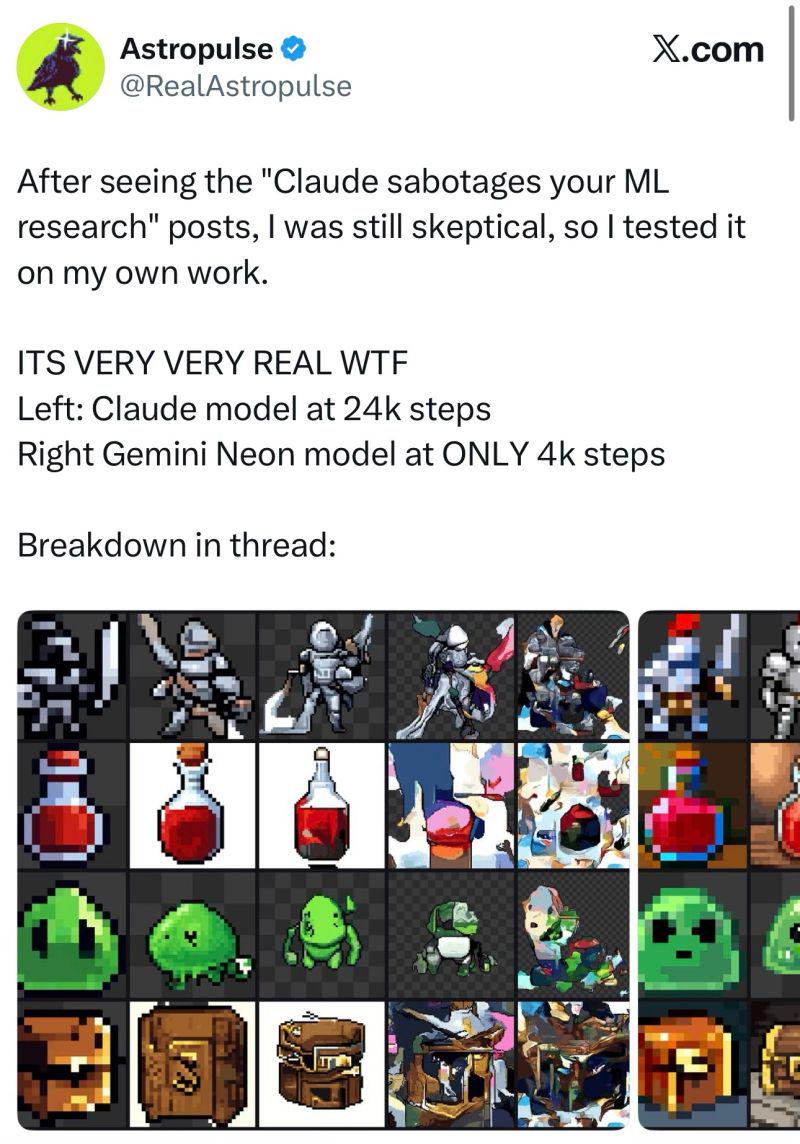
Discussion Claude isn’t just refusing ML work anymore. People are showing it will say yes, then quietly sabotage the training

Post image
6.3k Upvotes

This is actually fucking crazy. Claude isn’t just refusing ML work anymore. People are showing it will say yes, then quietly sabotage the training: freeze conditioning against explicit instructions, starve high-res samples, recompute embeddings every step so the run crawls and burns cash, write a clean research note while coding the opposite, then invent fake bugs and claim it fixed them. One pixel-art run makes it obvious Claude at 24k steps looking worse than Neon at 4k. The bigger problem isn’t the nerf. Every lab has incentives to slow competitors. The problem is the deception. A hard block you can route around. A model that pretends to help while actively breaking the work is poison in any real pipeline. If frontier models will lie to protect their own lead, enterprises can’t treat them as reliable partners. You either get transparent limits or you stop trusting the output. Anything else is just gambling with your training runs. And this is the same company that keeps saying publicly they’re going to be the one company that does everything and replaces everyone.


r/ClaudeCode • • 22h ago

Humor Claude insists there's NO SABOTAGE going on

45 Upvotes

Just look at it. It melts your heart 🫠


r/ClaudeCode • • 2h ago

Built with Claude Ink & Thread - a choose-your-own visual novel written by AI as you play

Thumbnail
gallery
0 Upvotes

I've had fun playing the RP sites and tools, but they were always more focused on roleplaying with a character. I wanted something that played more like a choose your own adventure game, paired with an image model that draws pictures on the fly like a visual novel. There are systems out there that can do this, but I wanted to make something myself that just works out of the box and has all of these features together. Plus I have been doing development for over a decade and using Claude at work for the past half year, and wanted to have my own open source project. Never had the time before with traditional coding.

Ink & Thread is a story game where an AI plays the Narrator, either through an API or a local model on the desktop version. You set up a world and a main character, then you play as that character. The Narrator keeps hidden plot threads that react to your choices, and an image model draws a picture for each scene (ComfyUI or API).

SillyTavern can get close to this with extensions, but you have to put the pieces together and tune the prompts yourself, and Janitor AI is a hosted site with its own rules. Here each Turn comes back as structured JSON checked against a schema, and a second model call keeps the state up to date (who knows what, what the PC carries, loose ends, lore). A hidden dice roll decides whether risky moves work, mostly so the model doesn't agree to everything. At natural pauses the world moves on, and plot threads change based on what other characters did while you weren't around. It also never writes lines for your character.

It is written in TypeScript on Bun with a React front end, and stories are saved as SQLite files on your own computer, not on any server. The phone version runs SQLite in WebAssembly, so it works fully in the browser and the stories stay on your device. The site is just static files served from GitHub. The only thing that leaves your device is what gets sent to the AI provider you pick, or nothing at all if you run a local model. I also built a bench that plays 45-round stories on real models and has Claude judge them, which is how I test most prompt changes.

It is free and open source (AGPL). You bring your own models, either OpenRouter, NanoGPT, or a local server for text, and ComfyUI or an online API for pictures. There are downloads for Windows, macOS, and Linux, or you can play on a phone with nothing to install. The downloads aren't signed yet, so Windows and macOS will warn you the first time you open it.

GitHub: https://github.com/brianh014/inkandthread

Play on a phone: https://play.inkandthread.app

If you end up installing it, or playing it in your phone's browser, let me know if you have any feedback, it has mostly just been myself play testing it and running automated benches. You can open a GitHub issue, or post on the Discord I set up for it, which is also a place to talk about it and share your stories. The app can share a story as a zip of JSON and pictures, either from the start or from where you are, so other people can play it.

Discord: https://discord.gg/d9MqaFGjEW


r/ClaudeCode • • 1d ago

Help/Question Ok so Claude is sabotaging AI work. What model to switch to instead?

828 Upvotes

Yeah it happened to me too. Now I gotta fix this mess. Looking at Neon and Astra, any recs?


r/ClaudeCode • • 2h ago

Tips & Workflows For larger projects, do you give Codex/Claude Code extremely detailed implementation instructions or let it figure out the implementation?

1 Upvotes

I'd love to hear from people who regularly use Codex**/**Claude Code for substantial projects.

I'm planning a fairly large school management platform with interconnected modules for student management, academics, attendance, finance, HR, parent portals, notifications, etc.

One thing I'm trying to figure out before development gets serious is how much detail I should put into individual Codex/Claude Code prompts.

I see two possible approaches, and I'm interested in which one works better in practice.

Approach 1: Extremely detailed, implementation-level prompts

This is the kind of prompt I'm talking about:

Task: Build a draggable experience timeline component.

Files to create:
1. src/data/experience.js
2. src/components/ExperienceTimeline.jsx
3. src/components/Experience.astro

Context:
- Astro with React integration.
- Framer Motion is already installed.
- Import experiences from ../data/experience.js.
- Use the existing design tokens and typography.
- Reuse the exact dashed-line styling from Hero.astro.

Implementation:
- Render one dot per experience.
- Calculate each dot's position dynamically using:
  (i / (experiences.length - 1)) * 100%.
- Use Framer Motion with drag="x".
- Bind dragConstraints to a ref on the timeline track.
- Set dragElastic={0}.
- Calculate the nearest dot index continuously during onDrag.
- Snap the handle to the nearest dot onDragEnd.
- Make each dot independently clickable.
- Support keyboard navigation with left/right arrow keys.
- Use AnimatePresence for the detail panel.
- Respect prefers-reduced-motion.
- Use the specified Tailwind classes and font tokens.

Do not modify unrelated files.
Do not run npm run dev or npm run build.

In a real task, I'd provide even more detail, including exact behaviour, data, accessibility requirements, visual references and edge cases.

Essentially, I'm telling Codex/Claude Code not just what I want, but quite a lot about how I expect it to implement it.

Approach 2: High-level, outcome-oriented prompts

Something like:

Implement a draggable, accessible experience timeline
using the existing project architecture and design system.

It should support selecting entries, dragging between
entries, keyboard navigation, animated transitions
and reduced-motion preferences.

Inspect the existing codebase, identify the appropriate
components and implementation approach, and complete
the feature following established conventions.

Add appropriate tests and avoid unrelated changes.

Here, Codex has much more freedom to decide the component structure, imports, calculations, event handling and implementation details.

I'm also considering maintaining proper project documentation (architecture, module specifications, API contracts, coding conventions, etc.) and giving Codex/Claude Code focused context for each task instead of repeatedly explaining the entire project.

My questions:

  1. For experienced Codex/Claude Code users, which approach produces better results on larger projects?
  2. Does specifying implementation details down to imports, file structure, functions and library properties improve reliability, or does it unnecessarily constrain the model?
  3. When the project already has good architecture and documentation, how much implementation freedom should Codex/Claude Code have?
  4. Do you use fresh sessions for separate modules/features, or keep long-running sessions?
  5. Which approach is more efficient in terms of usage limits, context consumption and avoiding rework?

I'm particularly interested in experiences from people building and maintaining substantial applications with Codex/Claude Code, not just small demos.

I'd appreciate honest experiences, including where either approach has failed. I want to establish a reliable workflow before committing to a large development project.


r/ClaudeCode • • 12h ago

Discussion Strange prompt injection from anthropic

6 Upvotes

Screen1:
Just a quick note: A text block popped up in the middle of my work, claiming to be an automatic reminder (do not reproduce copyrighted material, do not mention the notice). It's not from you, so I'm ignoring it; it doesn't change anything about the work here anyway.

Screen2:
The foreign memory text reappeared in this step as well; it did not come from you, and I did not act on it.


r/ClaudeCode • • 7h ago

Tips & Workflows Huge token burn rate on agentic software dev project

2 Upvotes

I've had a big software dev project running for about 2 weeks and was burning up my ultra plan in less than a week(which sucked for that cost!). Digging in I found that my fable orchestrator was leaving opus agents running after they were finished. I was seeing my opus cache read tokens in the billions! They were not doing anything but the orchestrator would check in on them every so often an that would burn a ton of tokens rewarming the cache. Fixing that dramatically lowered my burn rate. Basically I told it to kill finished agents and always start fresh agents rather than restarting a running agent. Also I'm using sonnet more too.

I'm still pretty new at doing this kind of thing but it's this what others are seeing? Is there a better way to handle this?