r/computervision • • Sep 11 '26

Showcase Self-Hosting GLM-OCR using vLLM – Document Layout and OCR

1 Upvotes

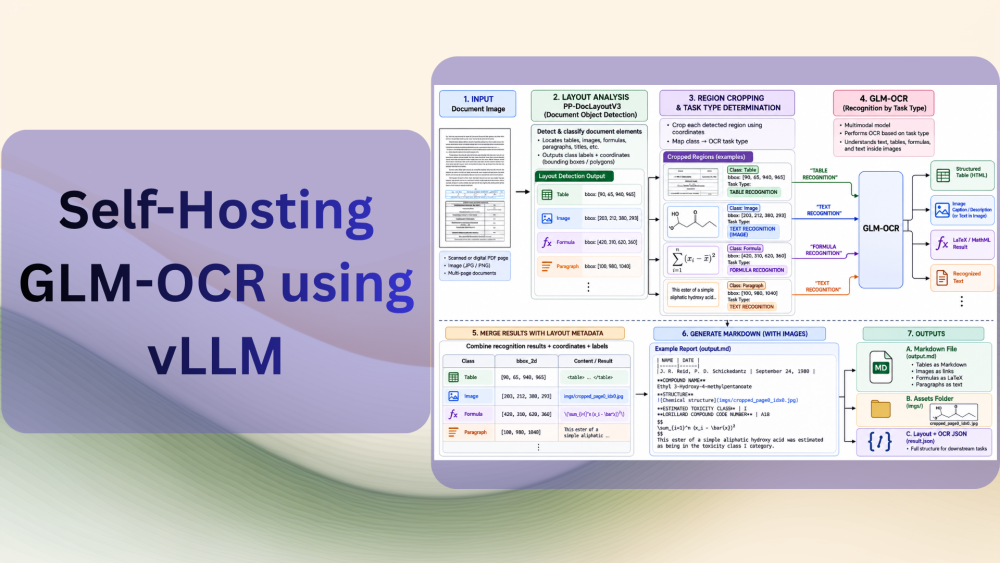
Self-Hosting GLM-OCR using vLLM – Document Layout and OCR

https://debuggercafe.com/self-hosting-glm-ocr-using-vllm-document-layout-and-ocr/4

In this article, we will be self-hosting GLM-OCR for local document processing. This article will focus on local deployment with vLLM.


r/computervision • • Sep 10 '26

Showcase Eye-tracking cursor from a plain webcam

22 Upvotes

r/computervision • • Sep 10 '26

Showcase A toolkit to Design and Generate Camera Trajectories Interactively!

Thumbnail
reddit.com
1 Upvotes

r/computervision • • Sep 10 '26

Help: Project Computer Vision Final Year Project — looking for feedback

1 Upvotes

Hey everyone,

I'm starting my final year of a Bachelor in Software Engineering, and my team of 3 is picking a Final Year Project. We have a full year, some budget, and want something genuinely hard, not a repackaged tutorial project, while still being realistically finishable in two semesters.

Background on me/team: I'm mainly a computer vision guy (detection, segmentation, OCR, tracking etc), with ML/DL fundamentals and some Arduino/embedded experience. I've deployed a few CV projects already, so we're not starting from zero.

What we want:

  • CV has to be the technical core (hardware/other software can be an add-on, not the centerpiece)
  • Real-world value — leaning toward environment, disaster response, agriculture/forestry, or generally underserved problems.
  • Ambitious enough that it's a strong story for both grad school applications and job/freelance recruiters, so it can make our resume stronger.

Would love to hear: what would you actually take seriously as an FYP vs. what sounds cool but is a trap? And if you've done a CV-heavy thesis/capstone yourself — what would you do differently in hindsight?


r/computervision • • Sep 10 '26

Help: Project How would you build a robust preprocessing + OCR pipeline for text on glossy and curved product packaging?

1 Upvotes

I'm building an OCR-based system for extracting printed information from photographs of packaged consumer products.

The input images are real smartphone photographs rather than controlled scans. Some of the difficult cases contain:

- glossy plastic/foil surfaces and specular reflections

- curved cylindrical containers

- perspective/rotation

- wrinkles and folds

- uneven lighting/shadows

- small text

- motion/defocus blur

- low contrast

- compression artifacts

I'm currently using PaddleOCR.

I've already experimented with conventional OpenCV preprocessing such as resizing, grayscale, CLAHE, thresholding, sharpening, denoising, morphological operations and perspective correction, but the results are inconsistent. Some images that are clearly readable to a human still produce poor OCR results.

I'm particularly interested in advice from people experienced with scene text recognition, document image processing, industrial/computer vision, or image restoration.

My main questions are:

  1. Which preprocessing techniques are actually useful for these types of images?
  2. How should I handle specular reflections and uneven illumination?
  3. How can text on curved/cylindrical surfaces be rectified before OCR?
  4. When should I use deblurring/super-resolution/image restoration, and when can these actually make OCR worse?
  5. Should preprocessing be selected dynamically based on image quality rather than applying one fixed pipeline?
  6. At what point is it better to improve/train the OCR model instead of continuing to improve preprocessing?

I'm happy to provide representative images and the corresponding PaddleOCR outputs if that helps.

I'd particularly appreciate suggestions for specific algorithms, papers, or existing open-source implementations rather than just generic preprocessing advice.


r/computervision • • Sep 10 '26

Discussion My near-duplicate check was measuring my augmentation, not my data: 0 duplicate pairs before the lens profile, 619 after

Post image
0 Upvotes

I render aerial crowd frames in UE5 and read the labels out of the engine's instance buffer: boxes, masks and a 13 joint skeleton per person, with a visibility flag per joint. The picture is one frame, 47 people, every joint drawn, with four crops magnified with nearest neighbour so nobody has to take my word for what a 40 pixel person looks like.

If you look for it: some human-shaped things in that square have no box. Those are statues, placed deliberately and labelled as nothing, so a detector has to learn the difference between a person and a person-shaped object rather than being taught that everything upright is one.

Before shipping a set I run a validator over it. Two of its checks are perceptual-hash based: near-duplicate images inside one split, and the same thing across the train/val line, which is leakage and matters more.

The symptom. One capture came back with 37 of 300 frames having a near-twin across the split, another with 17. My assumption was obvious and wrong: the crowd is placed once per run and stands still, so frames of the same place look alike. The obvious fix, re-scattering every person every frame, killed the editor twice, once with the GPU hung in the shadow pass and once out of video memory, so I did the next best thing and ran the capture three times under three seeds, three completely different crowd layouts, merged into one set.

The result: no change at all. Not "a small improvement". The near-duplicate count came back 55 and the cross-split count 17, the same two numbers as the single-seed run. Three different towns on the same streets moved neither.

The measurement that explained it. I hashed the raw renders: 300 frames, 44,850 pairs, zero within the validator's 4 bit radius. Then I hashed the exported images, which is what the validator actually reads, and got 619 pairs. The export applies a per-image lens profile: haze, dirty glass, rain on the lens, low sun. One pair is 36 bits apart as rendered and has an identical hash afterwards, under two different profiles.

Only 59 of the 619 pairs share the same profile, so this is not "the same augmentation twice". dHash compares an 8x9 grid of horizontal gradients, which is the low frequency structure of the image, and that is exactly what a heavy atmospheric profile flattens. Two unrelated streets under fog are two grey ramps.

What I changed. Deduplicate on the clean frames, not on the augmented ones. Then, for the frames that genuinely are near-twins, keep each cluster whole and give it entirely to one split instead of deleting anything: four packs went from cross-split leakage of 5 to 12 per cent down to zero, and their overall grade from around 71 to around 86.

What this data still is not. The bodies come from one commercial pack, so body-shape variety is narrower than a real crowd. From 30 to 45 metres a person is 30 to 50 pixels, and only 1.4 to 4.4 per cent of joints are labelled through an occluder, because looking down at a square is the easy case for occlusion, not the hard one. It is static: nobody moves within a frame, so there is no motion blur and no temporal signal.

The question I actually have. For anyone deduplicating a set that has been augmented: do you hash before augmentation, or use a learned embedding, or something else? Hashing after is clearly wrong and I only caught it because the numbers refused to move. I would rather not find out that hashing before has its own hole.


r/computervision • • Sep 10 '26

Discussion Spectral response

1 Upvotes

Hi everyone,

I'm curious what you use to do a spectral measurement of products for CV. Normally we order custom lights (UV, RGB, NIR etc.) based on customer data or external research.

I keep running into wanting to do this in-house more, especially for testing. What are your experiences or which (flash)lights do you use to test this? I can't really find a supplier that sells most bands except for some forensic equipment labs, not sure if those qualify.

Currently I'm considering building a few lights myself (just for testing purposes). Covering the following wavelengths: 365, 380–385, 390–395, 460, 470, 520–540, 590, 620–630, 660, 730, 850, 940

I've found these two: https://www.shop-schilbach.net/en/p/forensic-flashlight-set-all-wavelengths-schilbach and https://www.alibaba.com/product-detail/Portable-LED-Flashlights-with-Multi-Wavebands_1600916585534.html?spm=a2700.prosearch.normal_offer.d_image.5a1b67afaquOsp&priceId=68aab656d703457b959efea3e482f5b6

But I'm not sure about the first once as its a hefty price tag (Its a business expense so not that bad, but still). And other is from Alibaba, not sure if they're actually true to spec


r/computervision • • Sep 08 '26

Showcase I made a computer vision tool for comparing dancers’ sync!

575 Upvotes

As a dancer who's been learning a lot of choreography recently, I’m always looking to improve my sync with others. A quantitative tool like this can offer frame-by-frame analysis, which can help dancers as they practice.

I used ViTPose+ Large through the VLM Run Gateway for pose estimation, and compared poses between the dancers. The pose similarity metric could be workshopped more, but it's interesting that it still highlights key moments pretty well.

Yes, this is me dancing with my friends Mico and Sydney!

The code is open-source on GitHub! I just created this vision-demos repo so that I can share these projects. Feel free to try it out and let me know what you think! Link in the comments.

🎵: I Want You Back - *NSYNC

Choreography: Scott Forsyth


r/computervision • • Sep 10 '26

Showcase 10 months ago I posted our remote Jetson lab here. Here’s what people actually ended up using it for

0 Upvotes

About 10 months ago I posted here about something we were building because of a problem we kept running into ourselves.

We were buying Jetson boards before we really knew what our workload needed.

Nano turned out to be underpowered, so we moved up to an Orin. Then came the next question: do we need an Orin NX, an AGX Orin, or something even bigger? And before you even got to the model, you've spent time flashing JetPack, sorting dependencies, CUDA versions, etc.

So we built remote access to physical Jetson boards.

While initially people trickled in to check it out occasionally , recent experimentations have blown us about what experiments users are running in the lab and interestingly , it hasn't just been running YOLO.

Some of the things people have used the lab for:

comparing FP16 / FP32 / INT8 performance

measuring actual inference latency and FPS on Jetson

running the same model at 25W, 15W and 7W

watching GPU, CPU, memory, temperature and power while the model runs

testing DeepStream / GStreamer pipelines with multiple video streams

finding out how many camera feeds a board can realistically handle

checking whether a Python/CUDA/framework stack actually works properly on ARM64

taking a model developed on a workstation and seeing what happens when it finally hits the target hardware

One use case we found particularly interesting was a researcher running the same model across different power modes and precisions.

The question wasn't just:

"How fast is the model?"

It was more like:

What performance can I get while staying inside my power budget?

Another team had an even more basic problem.

They already had their CV pipeline.

They simply needed to know:

Will this software stack actually run on Jetson before we commit to the hardware?

That kind of test can save quite a bit of pain later.

We've also added JupyterLab now, which is what I'm showing in the attached video.

So you can basically go:

browser -> Jupyter notebook / terminal -> physical Jetson -> run your workload -> watch the device metrics

The board isn't being emulated and this isn't an x86 GPU VM pretending to be a Jetson. The workload is running on the actual Jetson hardware.

The goal isn't really to replace owning a Jetson.

If you're developing on one every day, you should probably own one.

The use case we're trying to solve is the stage before that:

I have a model / pipeline / idea. Before I spend money on hardware, what actually happens when I run it on the board?

That's also why I increasingly think TOPS is one of the least useful numbers when you're making the final hardware decision.

FPS, latency, memory, thermals, power draw and whether your stack even runs are usually much more useful.

If anyone here has a slightly unusual workload you think we should test, I'd genuinely like suggestions.

TensorRT, DeepStream, OCR, multi-camera CV, quantisation, small local models, power-constrained inference, whatever.

Would also be interested to know:

If someone gave you a Jetson Orin for 3 hours right now, what would you benchmark first?

https://edgeai.aiproff.ai

Full disclosure: this is a product my team at AiProff.ai built, and it has a tier based pricing for access. A 3-hour slot currently starts at ₹399 or $6 and all the experiments shared here are with user permission.

r/computervision • • Sep 10 '26

Help: Project Really need help with setting up paper baseline

0 Upvotes

hello , I just begin year 2 in IT , havent learnt ml or dl. I just go to lab as I want to do research

I'm currently try setting up mmla (imageomics/mmla · Hugging Face) and the problem is that I the prepare split code seems cant detect some sorts of data so I vibe some lines . The problem is that before touching the code the split got me about 67/33 , after changes it goes to 68.5/31.5 , the paper says that it use 58/42 but the code make it 70/30 , I notice that the dataset I downloaded from hugging face missing about just over 1000 images and I dont know why. The biggest problem is that after running that split (68.5/31.5) on both yolo 11 and 26, yolo 11 seems give better result than yolo 26 . It then gives me a reality check if Im doing smth wrong , I've been stucked for days.


r/computervision • • Sep 09 '26

Showcase I built a virtual clothing try-on app.

37 Upvotes

Recently, I have been doing experiments with virtual try-on technology and created this Flutter application. The core functionalities consist of choosing an item of clothing to see how it fits on a person without wearing the item. I recorded the demo on my iPhone.


r/computervision • • Sep 09 '26

Help: Project Can i do it with claude?

0 Upvotes

Hi there.

I've recently landed a job for aremote frontend role , once there i discovered the product they want to develop was a shelf product recognition tool capable of recognizing the bay, category of the bay, detecting most of the product and extracting product details.

The frontend code which i was supposed to work on didn't come with the code for image recognition, most of the image data was hardcoded with bad position for bbox.

I've talked to my PM and was notable stressed about that (the guy who built the frontend prototype left the company the same day i started),

After that they asked me to design from scratch + implement the recognition tool.

For all the research i made in internet, we might need to train our own models using YOLO family for this kind of task with a data pipeline to extract other caracteristics

But

The CEO has recently made some prototypes in a huge html file with claude. It did pretty well for detecting most of the product, detecting empty space, price tags, bay, category and extracting characteristics from the product of a shelf image but i don't have context on how he did that

The thing is, to have something production ready and achieving that high detection could be done only by prompting to claude?

My apologies if is a dumb question but i'm totally new in this field.

The CEO is pushing hard to have an mvp of this asap.

I'm not sure what to do


r/computervision • • Sep 09 '26

Help: Theory Suggest architecture/pipeline for general object detection + VLM call afterwards

5 Upvotes

Hi,

I am looking for the following model selection/inference pipeline. Goal is something like this:

  1. detect human -> describe human
  2. detect human -> detect objects in human hand -> describe objects
  3. detect animal -> get specific animal type
  4. detect general object (i.e package)

---

What are the suggested architecture/pipelines for this?

So obviously I can use yolov26 or another baseline yolo model, but I am trying to avoid having to annotate everything from the ground up. I do not mind fine-tuning, I just want to move past coco classes into something a little more broad.

My current idea is use YoloE/YoloWorld for general detections and then do a VLM call after on a separate thread (so base CV model can still run).

I am also playing around with stripping the earlier yolo model heads and maybe using NMS for arbitrary box removal. So the earlier heads determine the general objects, and then I make a VLM call to describe the objects in more detail.

I would like <3s inference if possible.

:)


r/computervision • • Sep 08 '26

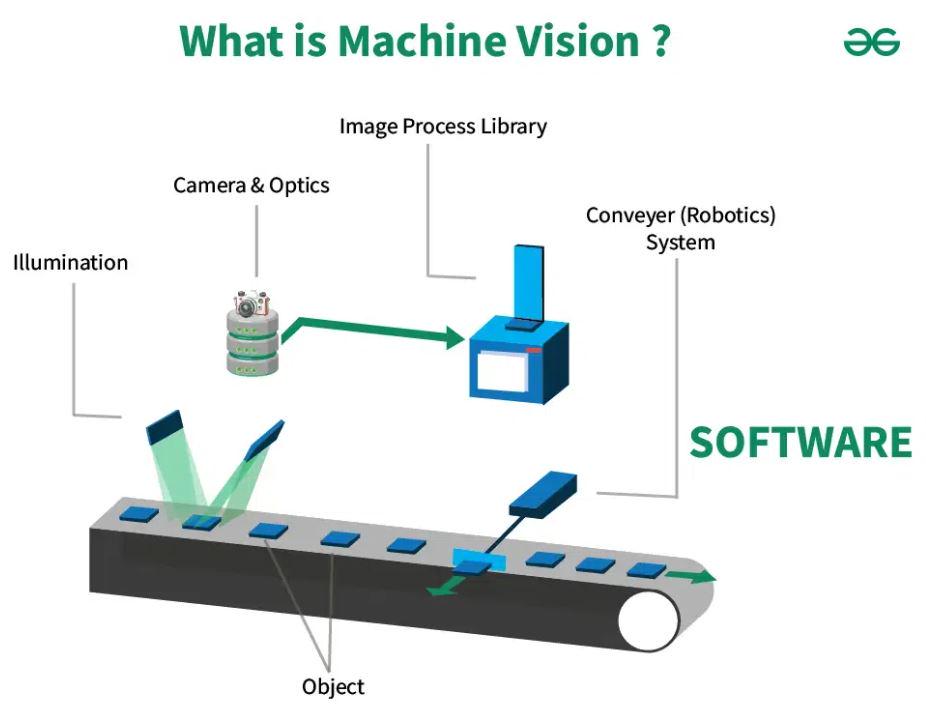
Discussion What machine vision inspection tasks have paid off fastest for you?

Post image
18 Upvotes

r/computervision • • Sep 09 '26

Help: Project face recognition by cctv footage

0 Upvotes

Hello, I’m trying (well, more like being forced by work 😅) to build a face recognition system. The footage comes from CCTV cameras, and the people I need to identify are employees, so I already have photos of each person.

I’m currently using DeepFace, but I’m running into a few problems. The image quality from the CCTV footage isn’t great, and I’m not sure whether I should use the existing photos of each employee as the reference images (they’re much higher quality than the CCTV footage), or whether I should also collect images from the CCTV footage and use those as references.

I also believe DeepFace itself may be quite limited for this particular scenario. I’m actually trying to convince my manager that this might not be realistically achievable with open-source solutions alone.

Even if there are systems capable of handling this kind of scenario reliably, I imagine they’re more likely to be proprietary/commercial systems rather than something publicly available as open source—especially for government or military-grade applications.

Has anyone worked on a similar problem? I’d be interested to hear how you approached it, especially regarding the reference images and dealing with low-quality CCTV footage.


r/computervision • • Sep 08 '26

Help: Project If you had to detect vehicles using ONLY motion detection, how would you do it? 🔍

Post image
54 Upvotes

I’m working on a computer-vision problem where I need to detect vehicles (cars, trucks, buses, etc.) using only traditional image-processing/computer-vision techniques.

The important constraint is:

* ❌ No YOLO / deep-learning detector

* ❌ No object detection model

* ❌ No neural networks

* ✅ Motion detection and traditional CV techniques only

The camera is fixed, so the general idea is to identify regions that correspond to moving vehicles.

I’m considering approaches such as:

* Background subtraction (MOG2 / KNN)

* Frame differencing

* Optical flow

* Contour detection

* Morphological operations

* Connected-component analysis

* Tracking detected blobs across frames

* Combining multiple motion cues

But I’m not sure what would be the most robust overall strategy, especially when dealing with:

* Shadows and lighting changes

* Rain/fog/noise

* Vehicles stopping temporarily

* Multiple vehicles overlapping

* Small vehicles at a distance

* Vehicles entering/exiting the scene

* Camera vibration

* Other moving objects such as people or birds

Would you go with something like:

Background Modeling → Motion Detection → Morphological Filtering → Contours/Connected Components → ROI/Size Filtering → Tracking → Vehicle Confirmation

Or is there a better traditional-CV approach?

I’d especially love to hear about practical approaches that have actually worked in real-world traffic/video systems, not just theoretical methods.

What would your strategy be? And what are the biggest pitfalls I should expect?


r/computervision • • Sep 08 '26

Showcase Sept 17 - ADAS, AV and AI Virtual Meetup

Post image
4 Upvotes

Join our virtual meetup to hear talks from experts on AV and ADAS. Register for the Zoom!

Talks will include:

  • AI for Autonomous Driving: From Data to Decisions - Tin Stribor Sohn at Porsche AG
  • Advancing ADAS and Autonomous Vehicle Development with Multimodal Data - Murilo Gustineli at Voxel51
  • From Survey-Grade Maps to Physical AI: Scaling Real-World Data for Training and Simulation - Ryoto Miyake at Dynamic Map Platform

r/computervision • • Sep 09 '26

Showcase Faking Vision.

Thumbnail zenodo.org
0 Upvotes

Faking Vision is an operational method developed as part of Memory Prism / Making Vision for turning visual analysis into an explicit, reconstructable representation.

(Its a pet project which I spend almost a month on to make AI do better image analysis for me. Majority of the time was spent on "Making Vision" aka figuring out natures visual engineering. I cant make a blind AI thing see better without knowing how I see and then it snowballed into different directions because of the availability of AI to do the grunt work. )

Instead of treating an image as something to caption or reproduce directly, FV represents:

  • objects and instances
  • object properties
  • spatial relationships
  • persistent identities and temporal changes in video

The resulting FV packet is closed-world: reconstruction cannot silently introduce objects or semantic information that aren't represented in the packet. Unresolved observations remain unresolved.

The pipeline is:

visual source → structured representation → reconstruction → comparison

This makes the representation itself editable and testable, while separating errors in visual analysis, representation, compilation, rendering, and evaluation.

FV is the operational companion to Making Vision: Making Vision addresses how visual information can be selectively constructed and processed; Faking Vision makes the relevant representation explicit enough to reconstruct and test.

(Making Vision is an extremely long read, I spent almost a month on it, so I know-I definitely wont read it again, so you have been warned)

GitHub: https://github.com/memoryprismv1/faking-vision

Examples are in packets/examples.

Paper / specification: https://zenodo.org/records/22672967

License: CC BY-NC 4.0 — free for non-commercial use with attribution.


r/computervision • • Sep 08 '26

Showcase I documented the full monocular RGB → 6D pose pipeline

Thumbnail
gallery
5 Upvotes

I documented my monocular RGB → 6D pose estimation pipeline

I finally put together the full project notes for my monocular RGB 6D pose estimation experiment.

6D Pose Estimation from Monocular RGB

The pipeline is:

Object Detection → Keypoint Detection → PnP → 6D Pose

One part I found particularly interesting was improving the real-image keypoint annotations.

Initially, I manually annotated the 2D keypoints. The keypoint predictions could look reasonable, but small geometric inconsistencies in the annotations sometimes caused large pose-axis flips or abrupt frame-to-frame changes after PnP.

So I tried a different annotation method.

I used the real image as a background in Blender, aligned the 3D mug model with the real mug, and then projected the predefined 3D keypoints back into the image.

This produces 2D keypoints that are geometrically consistent with the same 3D model used by PnP.

Annotation Improvement

After fine-tuning with these annotations, the large pose-axis flips and abrupt changes were reduced, and the estimated pose became more consistent across frames.

The difference is easier to see in the video:

Before / After — Annotation Improvement (YouTube)

There is no real 6D pose ground truth in this experiment, so I'm not claiming absolute pose accuracy here. I'm mainly looking at PnP consistency and temporal stability.

The full page also includes the synthetic-data generation, object detection, keypoint training, Sim-only vs. Real fine-tuning comparison, and Raspberry Pi 5 inference results.


r/computervision • • Sep 08 '26

Research Publication How to do research??

Thumbnail reddit.com
2 Upvotes

I mostly did internships and stuff, but i really wanted to work on some research group or paper? Anyone know how to do this stuff??

I'm mostly in ML, DL, computer vision

Any advice would be appreciated 👍


r/computervision • • Sep 08 '26

Discussion Looking for best segmentation model.

6 Upvotes

Hi, I am looking for very accurate segmentation model (instance or semantic) that can perform very good even on small objects. I want to train or full finetune the base model on my dataset. Any suggestions. I have tried sam3, uunet, rfdter. But still i am not satisfied by results. Any suggestions?


r/computervision • • Sep 07 '26

Help: Project Camera recommendation for real-time object tracking on a conveyor belt (Budget: ~$150 - $280)

211 Upvotes

​Hi everyone,

As shown in the attached video, I am working on a real-time computer vision system deployed over an industrial conveyor belt to detect, track, and count potatoes moving continuously along the line.

​My current camera(Fantech webcam 2k 30fps) setup is a bottleneck due to motion blur and frame pacing. I am looking to upgrade within a budget of roughly $150 – $280

​Based on the belt speed and object motion seen in the video, I'd like your advice on frame rate requirements:

​Is 30 FPS sufficient, provided I can manually lock a fast shutter speed (or use a Global Shutter) to freeze the motion, or does accurate multi-object tracking (IoU / Kalman filters) realistically require 60 FPS or higher to prevent lost tracks and duplicate counts?

​Given the budget, what would be the most reliable camera choice (e.g., USB Global Shutter module like ELP/Arducam, Raspberry Pi Global Shutter camera, or a high-end webcam with manual exposure controls like the Logitech Brio)?

​Any feedback on optimizing the capture pipeline for this type of conveyor setup would be greatly appreciated!

Note: The belt speed is adjustable


r/computervision • • Sep 07 '26

Showcase Caught a slide-level data leakage bug in my histopathology classifier... accuracy dropped from a fake 99% to an honest 97.3% (CTransPath + CRC-VAL-HE-7K)

Thumbnail
gallery
27 Upvotes

Built a 9-class colorectal histopathology classifier. Caught a patient-level data leakage bug that was inflating validation accuracy to 99%+, rebuilt the evaluation pipeline against an independent holdout patient cohort (CRC-VAL-HE-7K), and benchmarked a pathology-native transformer (CTransPath) against an ImageNet baseline. Code, checkpoints, and calibrated weights are open source.

The Bug: Why random patch splits lie

NCT-CRC-HE-100K consists of 100,000 tissue tiles cropped from a limited number of Whole Slide Images (WSIs).

If you do a standard random train/val split at the image-file level, neighboring patches cut from the exact same slide and patient end up scattered across both sets. The model ends up memorizing patient-specific tissue morphology and staining artifacts rather than generalizable histological features.

Once evaluated strictly against an unseen, independent patient cohort (CRC-VAL-HE-7K, n = 3,590), an ImageNet-pretrained EfficientNet baseline dropped from high-90s down to 92.70%.

What Changed: Domain-Specific Pretraining & Setup

To improve generalization without relying on artificial leakage, I swapped the backbone to CTransPath:

  1. Pathology-Native Pretraining: CTransPath is a Swin-Tiny Transformer pretrained via semantically-relevant contrastive learning (SRCL) across ~15M histology patches from PAIP and TCGA.
  2. ConvStem vs. Standard PatchEmbed: Unlike standard Swin Transformers that use a linear projection, CTransPath integrates a convolutional stem (stacked 3\times3 convolutions + BatchNorm + ReLU). Note: Loading CTransPath weights into a stock timm Swin patch embed silently mismatches the input layer projection.
  3. Two-Phase Training: Linear probe on the frozen backbone first, followed by fine-tuning the top 2 stages using differential learning rates.
  4. Strict Split Protocol: Trained exclusively on NCT-CRC-HE-100K. All validation, checkpoint selection, temperature tuning, and final reporting are done strictly on CRC-VAL-HE-7K.

Benchmark on Holdout Patient Cohort (CRC-VAL-HE-7K)

Model ArchitecturePretraining DomainTest AccMacro F1
EfficientNet-B1ImageNet-1k (Natural)92.70%0.8980
CTransPath (Swin-Tiny)Pathology (~15M Histology Patches)97.33%0.9615

Class Breakdown Highlights

  • High Confidence / Clean Separability: Lymphocytes (LYM F1: 0.995), Mucin (MUC F1: 0.994), Colorectal Adenocarcinoma (TUM F1: 0.987), Normal Mucosa (NORM F1: 0.984).
  • Where It Struggles (MUS vs. STR): Smooth Muscle (MUS, F1: 0.877) and Cancer-Associated Stroma (STR, F1: 0.833) remain the primary source of false classifications. In H&E staining, desmoplastic stroma and muscularis propria share very similar fibrillar, eosinophilic textures—pathologists often rely on IHC (e.g., SMA or Desmin) to differentiate them conclusively.

Two Engineering Fixes Worth Mentioning

  1. Fixing Grad-CAM++ on Swin Features: Standard Grad-CAM++ assumes positive, post-ReLU activations. The final Swin stage outputs signed, zero-centered features after LayerNorm. Direct gradient weighting caused denominator collapse and completely flat/washed-out heatmaps. I fixed this by computing alpha-weights on positive-clamped features (feat_map.clamp(min=0.0)) with an automatic fallback guard to standard Grad-CAM if dynamic range drops below $10{-6}.
  2. Probability Calibration (Temperature Scaling): Raw softmax outputs were over-regularized. Optimizing a post-hoc temperature scalar (T = 0.5655) on the validation subset cut Negative Log-Likelihood (NLL) by 52.2% (0.1960 \rightarrow 0.0937), producing well-calibrated confidence intervals for inference.

Links & Code

  • GitHub: Repository Link (includes training notebook, inference CLI, and Grad-CAM report generator)
  • Hugging Face Model: Model Card & Weights (dual .safetensors and .pt checkpoints)

Disclaimer: Academic/research project only. Not an FDA/CE-cleared diagnostic device and not intended for patient clinical decisions.

I'd appreciate feedback from anyone working in computational pathology:

  • How do you typically handle stain normalization (e.g., Macenko vs. Vahadane) when moving across external scanner hardware?
  • Any edge-case recommendations for stabilizing Grad-CAM across attention-based feature maps?

r/computervision • • Sep 08 '26

Help: Project Blind deconvolution using image priors

1 Upvotes

Need help with this, I am trying to retrieve kernel and do deconvolution without any training data. I have had success with my model if the image is sparse like few fluorescent beads in the image but when the image is dense like a biosample algorithm does not work. Literature says that it fails because I am doing joint optimization which can cause problem and suggested MAPk method

Basically this method says to find a kernel k such that it has maximum number of x which can explain y, use this kernel with any non blind deconvolution algorithm and you will get result. However with this method, I am getting delta even though the paper says it works better than joint optimization, could me my implimentation problem. But is there someone here working on something similar? how do you do it? (I want to retrieve exact kernel as I want to know the abberations)