r/computervision • • Sep 27 '26

Help: Project "Newspaper Crime News Analysis” a good research project topic? Looking for suggestions

3 Upvotes

Hey everyone! I would love your help with my research project. I'm planning to work on newspaper crime news analysis, where I will collect crime-related news from Marathi newspapers and analyze the data to identify patterns based on factors such as location, type of crime, and time period.

Do you think this is a good topic for a research project? Please let me know your thoughts and suggestions. I would really appreciate your thoughts, suggestions, and any ideas for improving the project. Thank you!


r/computervision • • Sep 27 '26

Showcase An image-guided drone simulation: detecting, aligning with, and picking up boxes

8 Upvotes

I’m building a simulation in which a drone uses camera images to detect boxes, align its position and orientation, and pick them up.

The video shows the camera/recognition view and estimated values on the left, alongside an external view of the drone on the right. Bounding boxes, keypoints, and estimated position offsets show how the image processing relates to the drone’s movement.

During approach, the drone estimates its position and orientation relative to the box from the camera image. Just before pickup, it compares the current contour with a reference contour for fine alignment. It then picks up the box and carries it to its assigned delivery gate.

In this run, boxes 0, 1, and 2 are delivered in numerical order to Gates W, E, and S, respectively. The full simulation takes about 7 minutes 22 seconds and is shown at 8× speed, so the video is about 55 seconds long. You can slow down the playback if you’d like to inspect the details.

I’d welcome feedback on whether the visualization makes the image-guided alignment process easy to follow, and on how I could explain it more clearly.

Next, I plan to increase the number of boxes and add delivery optimization that considers both delivery order and travel distance.


r/computervision • • Sep 26 '26

Showcase Synthetic ground truth for 3D reconstruction: 3,879 Unreal Engine frames, 35.7 million points, and the error I found in my own depth

95 Upvotes
Every frame my Unreal Engine capture plugin renders comes with a depth map in metres and the camera's pose and intrinsics. I wanted to see how far that gets you with no reconstruction algorithm at all, so I fused 13 captures straight from those files: lift every pixel with its depth, place it with the recorded pose, drop anything labelled (the people are re-placed every frame), average into 10 cm cubes. 3,879 frames, 35.7 million points, 45 to 112 seconds per map. No feature matching, no pose estimation.


Then I checked whether the frames agree with each other. Take a frame, project its depth into the nearest frame that sees the same place using only the recorded poses and intrinsics, and compare with the depth that frame recorded. The median difference is 5 to 15 mm at median distances of 25 to 60 m.


The part I didn't expect: that median is almost exactly what rounding produces. My depth.npy files are float32, but they hold half-float values, because the render target was 16-bit. There are never more than 1,024 distinct values between one power of two and the next, so the steps are 2 cm between 20 and 41 m. Simulating rounding alone at 2 cm gives a median of 5.2 mm. The Paris flyover measures 5.1. So the poses are more precise than the depth can show. The fix is a render target change that's in the plugin source now; every capture in the video predates it.


Where frames disagree most: vegetation (wind or LOD, I haven't separated the two), the sea on the beach (the surface moves, and that pair is fog at noon against clear at 7 am), and tower faces seen almost edge-on. One I can't explain: a flat quarry floor where two frames disagree by more than 5 cm across a whole patch. If you've seen that before, I'd like to know what it was.


A gotcha I only noticed while writing it up: a flipped axis passes this check. Every frame is mirrored the same way, so they still agree with each other. You only catch it by comparing the map with a rendered frame.


The viewer is plain WebGL2 with eye-dome lighting. The points are stored in the order of the first frame that saw them, so the replay in the video is just drawing more of them each frame.


If you work on MVS, NeRF or SLAM with synthetic data: would a per-scene consistency number like this change which dataset you pick? And what would you want exported besides the per-frame camera JSON? COLMAP and transforms.json are the obvious ones.

r/computervision • • Sep 27 '26

Help: Project Help for thesis

0 Upvotes

Hey everyone! I would love your help with my thesis. I'm planning to work on this project: '3D Reconstruction using Gaussian Splatting + Interactive Visualization (Cross-Disciplinary Focus)'. Do you think it's a good topic? Please let me know your thoughts and suggestions


r/computervision • • Sep 27 '26

Research Publication Looking for Language guided medical image segmentation dataset with professional verified text.

1 Upvotes

I am go through lot of language based medical image segmentation papers but mostly papers used QaTa cov19 , mosmed , and monuseg, Kvasir dataset. Kvasir dataset have paired text with count,size, shape,color, texture, location information of the infected regions and Covid19,Mosmed have only count and location information. Paired text is profesonal verified also. But unable to get dataset other than this with clinically verified paired text( except small dataset like: CVC clinicdb, CVC- colonDB, ETIS, CVC300). Can anyone suggest me other than polyp datasets that have professional verified text description and description have: size, shape, color, texture, count, location information.


r/computervision • • Sep 27 '26

Help: Project thesis

Thumbnail reddit.com
0 Upvotes

r/computervision • • Sep 27 '26

Help: Project Can someone suggest me any good computer vision project which I can put in my resume? If any yt videos there too, will be helpful... :)

0 Upvotes

.


r/computervision • • Sep 26 '26

Help: Project 𝐁𝐮𝐢𝐥𝐝𝐢𝐧𝐠 𝐚 𝐫𝐞𝐚𝐥-𝐭𝐢𝐦𝐞 𝐧𝐚𝐯𝐢𝐠𝐚𝐭𝐢𝐨𝐧 𝐬𝐲𝐬𝐭𝐞𝐦 𝐟𝐨𝐫 𝐭𝐡𝐞 𝐯𝐢𝐬𝐮𝐚𝐥𝐥𝐲 𝐢𝐦𝐩𝐚𝐢𝐫𝐞𝐝 — 𝐚 𝐟𝐞𝐰 𝐰𝐞𝐞𝐤𝐬 𝐢𝐧

162 Upvotes

Started this a couple of weeks ago. No roadmap, just a problem worth solving.

The idea: a system that processes what a camera sees and turns it into spoken directions a visually impaired person can actually act on. Not just "obstacle detected" — but "Stairs on left, 1 metre. Stop."

Navigation logic:
Perspective trapezoid corridor model with bilateral (left/right) clearance analysis
Hysteresis state machine: CLEAR → CAUTION → STOP, with instant escalation on imminent hazards
Temporal smoothing across frames to kill jitter

What's next: First prototype as a mobile app, then moving toward dedicated hardware.
Still early. Still rough around the edges. But it works on real footage — stairs, railings, curbs, moving through corridors.
If you're working on assistive tech, accessibility, or computer vision — I'd genuinely love to connect.


r/computervision • • Sep 26 '26

Help: Project Getting started in object detection

9 Upvotes

Hi everyone,

do you have any tips on the best way to get started with computer vision and object detection? I have a basic understanding of programming languages like Python, but I’m not yet able to write my own scripts from scratch without some help.

I’ve been very interested in object detection for quite a while and would really like to learn more about it and build my first small project.

How would you recommend getting started as a beginner? Are there any good videos, courses, or other resources you would recommend? I haven’t really found anything suitable on YouTube so far.

What are the basics and fundamental concepts I should understand before starting?


r/computervision • • Sep 27 '26

Discussion Can someone suggest me any good computer vision project which I can put in my resume? If any yt videos there too, will be helpful... :)

Thumbnail reddit.com
0 Upvotes

r/computervision • • Sep 26 '26

Help: Project Trying to build a DLSS-like remastering model for GBA games

Post image
334 Upvotes

I’m experimenting with a DLSS-like system for GBA games.

The goal isn’t simple upscaling. I want a model to take a 240×160 frame and reconstruct it into a higher-resolution remastered version while keeping the original layout and style.

The core idea is to reuse the previous high-resolution frame as the base, then only modify the parts that changed:

Output = Base + Gate × Residual

For training data, I’m planning to use my own game engine. I can generate random maps and render the exact same scene twice:

low-resolution retro version

high-resolution remastered version

This gives me perfectly aligned LR/HR training pairs automatically. I can also export object masks, motion data, and other metadata if needed.

I’ve trained and deployed several deep learning models in production before, but I don’t have much experience designing and training a model architecture from scratch. This one is also image-to-image, so I’m not yet confident the approach will work as well as I’m imagining.

If anyone here has experience with image restoration, video super-resolution, temporal consistency, or neural rendering, I’d really appreciate feedback on the architecture and training approach.


r/computervision • • Sep 26 '26

Showcase I'm learning to solve a Rubiks cube, so I built an app that scans mine and walks me through the solve

120 Upvotes

I am using image processing to solve a Rubiks cube.
The pipeline is plain image processing with OpenCV. It finds the stickers with edge detection, fits a 3x3 grid to them, and flattens each face with a perspective warp. It then reads each sticker's colour in LAB and matches it against a palette of reference colours measured from my previous tests. Glare was the hardest part to find a solution to. What fixed it was letting the hue count more than the brightness, and making sure each colour ends up with exactly 9 stickers.
Has anyone found a better way to handle glare?

Code: https://github.com/donsolo-khalifa/RubikSolver


r/computervision • • Sep 27 '26

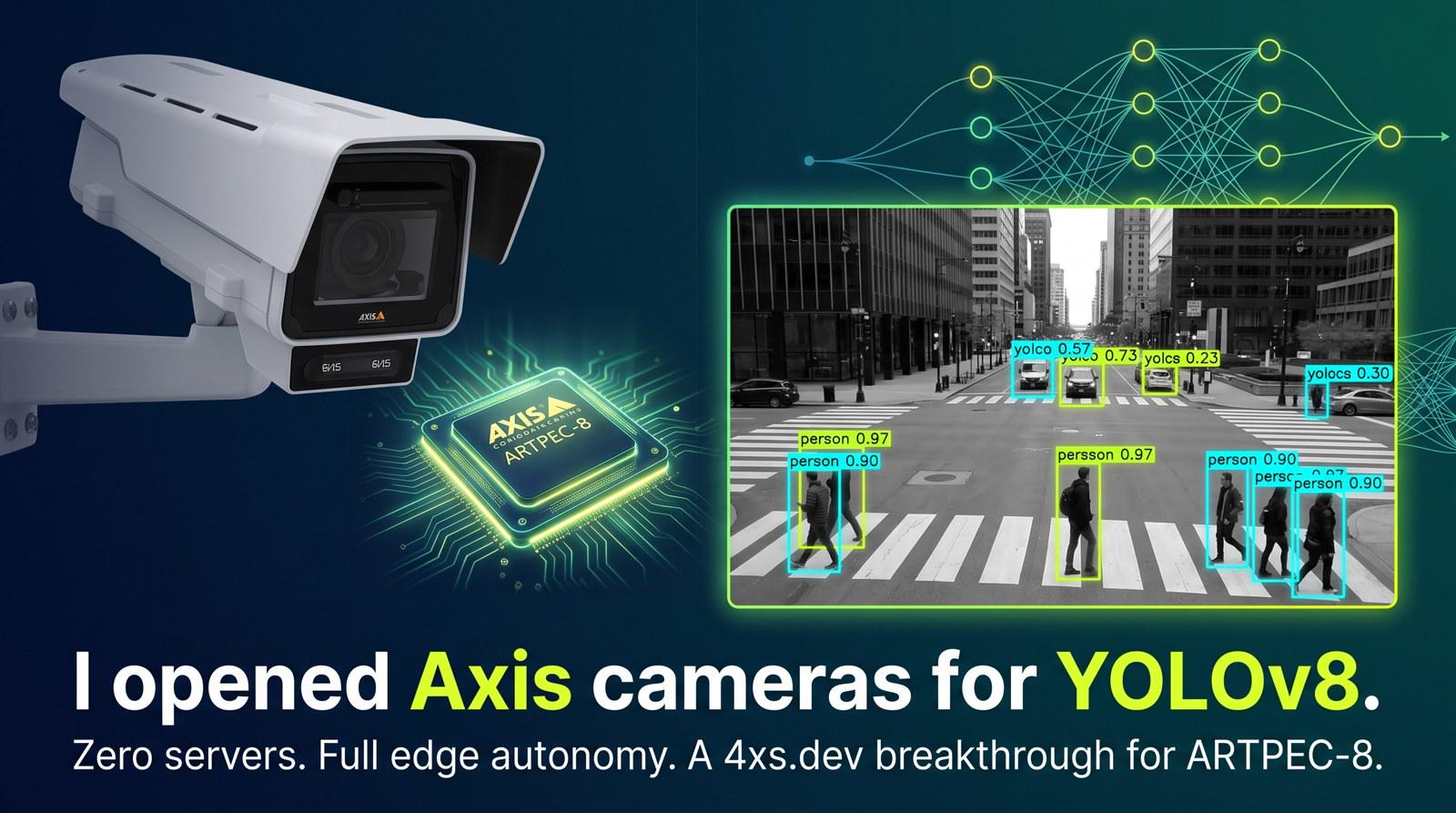
Showcase Stock COCO YOLOv8n running on the camera's own DLPU. 80 classes, on real hardware, no server, no cloud.

Post image
0 Upvotes

r/computervision • • Sep 27 '26

Help: Project Tool for auto generating a description of an object on a picture

2 Upvotes

Hi there,

I know YOLO is able to detect in real time some objects of interest..

Is there something equivalent for auto describing an object in a picture? (no need to be in real time)

So, not really for detecting an object per say since the object will be alone in the picture..

Objects like, scissors, screw driver, tape, etc. (not sure how precise it can get like telling the difference between a flat head and a Philips screw driver for example)

It's basically for describing everyday household objects..

Thanks for any suggestions.


r/computervision • • Sep 26 '26

Showcase Unreal Engine 5 synthetic data for object detection: 1,124 bounding boxes, none drawn by hand

Post image
38 Upvotes
Every box in the clip comes out of the engine at render time. Each object gets its own ID in a separate buffer, and its box is measured from those pixels. Nobody drew any of them. 14 frames from 7 maps, 1,124 boxes.


What's in the video:


- The line sweeping across is only there for the video. As it passes, each object's mask flashes, then its box appears.
- Colour is the class: pink for people, and chairs, benches, umbrellas, wheelchairs, bikes, cars, tractors, hay bales and animals each get their own.
- A box covers what the camera can actually see. Someone half behind an umbrella gets a box around the visible half.
- The beach is the newest scene: 221 people placed per frame, standing, lying down, in deck chairs and wheelchairs, shot from 07:00 to 18:30.


It exports YOLO and COCO, with segmentation masks if you want them.


It's still rendered people though, and that costs a lot on real footage: the last detector I trained only on renders got 0.35 recall on real drone video. Closing that gap is what I'm working on now.


Which real dataset would you test this against? I'm most interested in crowded ones where people overlap, since that's the slowest part to label by hand.

r/computervision • • Sep 26 '26

Discussion If most of your depth labels come from MoGe-2, can you ever beat MoGe-2?

9 Upvotes

Appendix A.2 of the SenseNova-Vision-7B-MoT paper says the LiDAR depth sets were too sparse, so they used MoGe-2 to make dense pseudo labels. COCO, SA-1B and Objects365 have no depth labels at all, so those got MoGe-2 labels too. By my count from Table 10, MoGe-2 labels are 77% of the depth frames they list. The rest is synthetic data with its own GT.

In Table 2 (their own re-run of MoGe-2) the model is still behind MoGe-2 on most depth sets, like DIODE delta1 76.4 vs 82.3. The weird part is it has the best DIODE AbsRel in the whole table, 20.6 vs MoGe-2's 23.0.

If you've trained on pseudo labels from another model, did yours ever beat the labeler on real data?


r/computervision • • Sep 25 '26

Discussion So tired of this posts

Post image
208 Upvotes

r/computervision • • Sep 26 '26

Discussion Real-time drone tracking pipeline: YOLOv8 + ByteTrack + 6-state Kalman filter with coasting mode

7 Upvotes

Sharing a project that combines several CV techniques into a real-time drone tracking system:

- YOLOv8 detection with hot-swappable model weights (swap models without stopping the video feed)

- ByteTrack for maintaining track identity across frames

- 6-state Kalman filter (x, y, vx, vy, ax, ay) with dynamic dt compensation for FPS jitter

- "Coasting" mode — when the target is visually occluded, the system maintains tracking through pure prediction using accumulated acceleration for 10+ frames

The whole thing feeds into a ballistic computer and servo controller, but the CV pipeline is the core.

GitHub: https://github.com/Fayzullo637/drone_turret_v2

MIT Licensed.

Happy to discuss the tracking approach — particularly interested in how others handle occlusion recovery.


r/computervision • • Sep 26 '26

Help: Project Two-stage shelf audit: YOLO finds the products, embeddings can't tell sibling SKUs apart. What should Stage 2 be?

2 Upvotes

I'm building a shelf audit tool. A photo goes through YOLO, which crops each product, and then I embed the crop and search a small gallery of reference photos to get the SKU. New products should be addable by just dropping in photos, no detector retrain.

Detection is basically fine. Identification is not. Same brand, same bottle, different flavor or size (like 1.25 L vs 2 L) and the nearest neighbor is often the wrong SKU. Correct and wrong scores overlap, so a threshold either misses real products or accepts the wrong one. I tried DINOv2, SigLIP2 and OpenCLIP. Same story.

Crops get letterboxed to 224, so the tiny "1.25L" / "2L" text basically disappears. Most SKUs only have a couple of shelf photos as references, not clean studio shots.

Has anyone actually shipped something like this? Did you fine-tune the embedder on hard negatives, add OCR as a second check, or give up on one global embedding? Curious what worked for size variants.

thanks in advance


r/computervision • • Sep 26 '26

Help: Project Has anyone succesfully made opencv 5 dnn object detection made working in c++ ?

4 Upvotes

Hello i have after a long time and struggle i finnaly installed opencv 5 for cmake on my ubuntu 24.04.5 lts laptop.And i was trying out the new dnn engine.Because i was trying to learn onnx object detection with c++.but when i try the example code in the official documentation i could get it not to work.So i wanna ask does anyone has success in it. And have you got a example code for it?I really would appreciate it.


r/computervision • • Sep 26 '26

Help: Project Problems with inserted objects

0 Upvotes

Hi all, I’m experimenting with inserting a 3D object into casual monocular video (VFX-style compositing) and I’m stuck on anchoring the object to the scene.
Pipeline:
1. Generate a 3D object with TRELLIS2 -> GLB (mesh + mask).
2. Reconstruct the video scene with MegaSAM (UniDepth as depth backbone), export to .npz.
3. Place the GLB into the reconstructed scene and render it back into every frame.
Reconstruction output looks fine:
• T=100, H=328, W=584
• depth range [0.342, 23.559]
• intrinsics: fx=301.70, fy=301.30, cx=295.5, cy=166
• dense point cloud (stride=6): 539K points
• 0 tracks
The problem:
1. The object isn’t bound to a specific point on the surface. I place it on a wall in the viewer, but there’s no real attachment to the geometry.
2. The object doesn’t stay fixed in world space. On every following frame it keeps the same screen/camera coordinates as on the first frame, so it slides along with the camera instead of staying on the wall.
My current understanding: I should unproject the clicked pixel with depth + K into camera coords, transform it to world coords with the camera-to-world pose of that frame, store the anchor in world space, and then render the object on each frame using inv(c2w[t]).
Questions:
• Does MegaSAM’s output reliably include per-frame cam_c2w, and is it consistent with the depth scale?
• Any gotchas converting MegaSAM/OpenCV camera convention to three.js / OpenGL for rendering the GLB?
• Best way to estimate the surface normal at the anchor point for orientation: depth map gradients or local PCA on the point cloud?
• Recommended approach for occlusion (people passing in front of the object): simple per-pixel depth test against the MegaSAM depth, or something more robust?
Any pointers, repos, or examples of doing this with MegaSAM output would be much appreciated. Thanks!


r/computervision • • Sep 26 '26

Help: Project Synthetic dataset for a particular object

0 Upvotes

Hello, I have some models of shelf's that I want my model to detect, but the thing is that I can't just very easily move them around and create a dataset with a good variety of lighting and backgrounds, are there any tools which can help me create a synthetic dataset? (Except just having to 3d model this shelf in something like blender)


r/computervision • • Sep 25 '26

Research Publication Turned CCTV footage into a traffic sensor — vehicle tracking, speed estimation, and OD analysis (YOLOv8 + ByteTrack)

11 Upvotes

I've been working on a project called PathVision to see if a regular traffic camera could produce the kind of data usually reserved for expensive dedicated sensors.

What it does:

- Detects and tracks vehicles in real time (YOLOv8 for detection, ByteTrack for tracking)

- Estimates actual speed in km/h by calibrating pixel displacement to real-world distance

- Maps vehicle paths across 4 entry/4 exit zones to build an Origin-Destination matrix

- Classifies live traffic condition (smooth/moderate/heavy)

- Exports everything to structured CSV: per-vehicle logs, OD matrix, top routes

The hard part wasn't detection. It was keeping track identity stable — surviving occlusion, not double-counting a vehicle, and knowing when a trip is actually "complete" vs. still active. Most naive tracking setups fall apart right there.

Current limitations (being upfront):

- Speed calibration (METERS_PER_PIXEL) is manual per camera — no automatic perspective correction yet

- Zones are hardcoded per view, not portable across setups without reconfiguring

- No formal accuracy benchmark yet (planning to validate against ground-truth data)

Demo video + OD analysis charts from a real test run:

https://youtube.com/shorts/KgDTsUhquNM?si=SLKOG3BJkAttB_vs

Code: https://github.com/anmarw38-ops/Pathvision/blob/530ec18c63a37db53a6e8c42519ca51717d00803/README.md

Would genuinely appreciate feedback — especially from anyone who's dealt with ID persistence in tracking, or worked on ITS/traffic systems. What would you tackle differently?

r/computervision • • Sep 26 '26

Help: Project Need advice on a real-time computer vision proctoring project

2 Upvotes

I’m working on a real-time Computer Vision feature for an online assessment/proctoring system.

The requirement is to detect when a candidate’s face becomes:

Completely absent from the webcam Partially outside the camera frame Potentially multiple faces appear

When the condition persists for a certain amount of time, the system should generate a warning and save an evidence frame with the timestamp and event information.

My initial approach is:

Webcam → Face Detection → Face Visibility Analysis → Temporal/State Logic → Warning → Save Evidence Frame

I’m considering:

Python + OpenCV YOLO for face detection MediaPipe Face Landmarks for better partial-face analysis FastAPI + WebSocket for real-time communication PostgreSQL for event metadata Object storage for evidence frames

Since this needs to work in real time and eventually be integrated into an existing assessment platform, I’d appreciate advice from people who have built similar CV/proctoring systems.

My main questions:

  1. Would you use YOLO, MediaPipe, or another approach for face detection?
  2. What is a good way to reliably distinguish a fully visible face from a partially visible face?
  3. How would you handle temporary detection failures and avoid false warnings?
  4. Would you process frames on the client side or send them to a backend CV service?
  5. What architecture would you recommend for a production real-time system?

Any practical advice, pitfalls, or recommendations would be really helpful.