r/computervision • • Oct 01 '26

Discussion Any one here looking for ML or Computer Vision Intern? Would love to talk more, if anyone has opportunity :)

0 Upvotes

Happy to share my resume or GitHub if you're interested :)


r/computervision • • Oct 01 '26

Help: Project Copdar - A no-account vehicle-labeling tool looking for feedback

Thumbnail
reddit.com
1 Upvotes

r/computervision • • Oct 01 '26

Showcase Chessboard recognition from a screenshot using only template matching: no training, no GPU

4 Upvotes

For fixed, clean UI renders (a digital chessboard), I found that a neural network is overkill. The pipeline:

  1. The user drags a square over the board once (calibration); a grid is overlaid to align it exactly
  2. Templates for all 12 piece types are cut from a starting-position screenshot
  3. Each of the 64 squares is matched against the templates with OpenCV, giving an 8x8 matrix and then a FEN
  4. A sanity check rejects obviously wrong results (e.g. templates from a different theme)

The obvious limitation is that templates are tied to one board colour scheme and piece set, so changing theme means re-calibrating. I'd be interested in cheap ways to generalize across themes without going to a CNN.

Code: https://github.com/Maksimuson/Chess-Cheat


r/computervision • • Oct 01 '26

Discussion Sep 2026 AI Security Report: 126 incidents across 38 orgs, 318M+ records stolen — AI-agent exploits were the top attack vector (39 of 126). Live demo Oct 14.

Thumbnail
gallery
0 Upvotes

RuntimeAI's September 2026 AI Security Report covered 126 incidents across 38 named organizations — 22 critical, 102 high severity. 53 of those incidents had AI either as the attack tool or the target. AI-agent exploits were the top attack vector at 39 incidents, ahead of credential theft (27), zero-days (22), phishing (10), and ransomware (10). The largest single exposure was 220M records from unrotated default service-account credentials.

What stood out: every organization in the report was already running a mature security stack. Okta, CrowdStrike, Palo Alto, Microsoft Defender. Still got hit. The gap is that none of those tools sit at the layer where an agent actually executes a tool call.

RuntimeAI operates at that layer. Know Your Agent handles cryptographic agent identity. The Flow Enforcer inspects tool calls in real time. There's also a sub-50ms kill switch that can halt a compromised agent before a second action completes.

Full breakdown (incident-by-incident, CVEs, vendor stacks): https://runtimeai.io/blog/2026-09-monthly-breach-report.html

We're running a live demo on October 14 — ten attack surfaces, live against a real stack: https://www.linkedin.com/events/7510769146222133248?viewAsMember=true


r/computervision • • Oct 01 '26

Showcase Synthetic DPM / needle-peen pattern generator for YOLO training (Windows, Nim)

1 Upvotes

I built a small Windows GUI tool that generates synthetic Direct Part Marking–style patterns (needle / peen dots on steel) for detector training.

It is not a real ECC200 encoder — no serial numbers, just geometric L-frame + fill dots, Good/Bad classes, and mechanical-style defects (squash, tilt, jitter, missing dots, etc.).

Outputs:

  • 600×200 grayscale JPEG
  • YOLO labels: OBB or ABB
  • Optional Boosting mode: appends Stage-2 feature rows to logs/features.csv for a second classifier

Two render modes: pure synthetic (no assets), or your own BG + dot sprite folders.

Binary only (Nim). Non-commercial / research license. Unsigned Nim builds sometimes get heuristic AV flags — details in the README.

Repo / Releases (v1.1.0):
 https://github.com/olesha-ai/DPM-Pattern-Image-Generator

Related inference PoC trained on this synthetic data:
 https://github.com/olesha-ai/yolox-dmc-inference

Feedback welcome.


r/computervision • • Oct 01 '26

Help: Project Made a Deepfake image detection model and got 93 accuracy but still classifying all images as fake.. what to do ?

0 Upvotes

any idea?


r/computervision • • Oct 01 '26

Showcase Measured a PTZ camera's 1.4s motor lag with block matching, then designed the tracker around it

0 Upvotes

The camera says acknowledged: true when you send a pan command. That means "I heard you," not "I moved." So I stopped trusting the ACK and measured the picture instead.Setup: a stock Xiaomi MJSXJ10CM on shipped firmware 4.5.6_0450, pulled over RTSP at 1080p HEVC via go2rtc v1.9.14 with the go2rtc-xiaomi-control patch. PTZ is MISS opcode 0x112 with { "operation": 1..4 }. That's the whole API.The CV part: grab a frame, send one step, grab another, estimate the shift with block matching (same idea as codec motion vectors), compared against a no-move baseline so sensor noise can't look like motion. Results: left dx=-40, right dx=+36, up dy=-20, down dy=+22. Steps aren't symmetric, so one step is not a fixed angle.Then I sampled frame difference every 200ms after a command. Nothing at 313ms, nothing at 823ms, then 43.2 at 1331ms, settled by 1824ms. Roughly 1.4 seconds of dead time. At 12fps a naive detect-and-step loop fires about fifteen more commands before the first one lands. The fix is to blank the controller for 2s after each step, which makes the real control rate 0.5Hz, and set the dead zone (0.18) wider than one step's 8-12% displacement, or it oscillates forever.Detectors: Apple Vision (VNDetectHumanRectanglesRequest, VNTrackObjectRequest) via a ~150-line Swift child process, 10-30ms, zero dependencies. Optional SSD-MobileNetV1 from the ONNX Model Zoo for 80 COCO classes, ~13ms.Thing that bit me: that ONNX graph resizes internally. Feed it a pre-shrunk 300×300 image and it returns zero detections, silently. Native 1280×720 works fine. Also Vision uses a bottom-left origin; get the flip wrong and tilt confidently runs away from the target.Chair test: 3 steps, centring error 0.76 to 0.21, then held


r/computervision • • Oct 01 '26

Help: Project ​Looking for a ready-to-deploy, pre-built AI video analysis model for football matches! ⚽

0 Upvotes

I am actively searching for developers or teams who have already built and tested robust AI vision systems. Instead of starting from scratch, I am ready to invest in a pre-made, high-performing solution.

​Key requirements for the system:

​Ready & Pre-designed: Fully developed and tested models that can be deployed quickly.

​Camera Transition Support: Must handle camera panning, zooming, and transitions smoothly to maintain accurate tracking.

​Uncompromising Accuracy & Data Richness: Precise spatial tracking, event detection, and granular data extraction that unlock deep tactical insights.

​If you have a mature system ready for the pitch, let's talk. Drop a comment or send a direct message. Thanks


r/computervision • • Sep 30 '26

Help: Project Aligning Two RGB Cameras

2 Upvotes

Hi,

I'm working on inspection of civil infrastructure using a unitree go2 edu robot. I need to collect RGB images of concrete foundations using the robot and then train semantic segmentation deep learning models using them. However, the built-in camera of the robot is only 1MP, which is why I thought of getting a mirrorless camera (canon eos r50) to mount on top of the robot to acquire higher quality images. I also need to figure out the pixel to mm scale so I used intel realsense d435i depth camera that already comes with robot.

Now the problem is I have the canon in one position, and depth camera in another position on the robot. How do I align both of their images? Does it have to be done real-time or is it okay to collect all images then align them later in the office?

I really appreciate your thoughts on this as I don't even know where to start. Thanks.


r/computervision • • Sep 29 '26

Discussion LibreYOLO, the MIT computer vision library with +100 model families

Post image
527 Upvotes

Hello! This is the fourth post about LibreYOLO in the computervision subreddit. Every time I posted here you gave overwhelming support to the project, and for that I'm very grateful. A lot has shipped since the last post!

For those who are new to LibreYOLO: it's a computer vision "meta library" with 100+ models under a familiar, easy-to-use API. I created it because there was no generalist computer vision library covering most use cases under a permissive license, and the most popular YOLO library requires a paid license for closed-source commercial use or research.

It's now starting to be adopted by many companies and individuals, but I still think that there is a very big potential to grow. I don't want to bore you with a list of capabilities that the library has, but it has everything that you would expect from a serious, production ready library.

I want to thank the 20+ contributors for their work, and every company and individual who has supported the project. I also want to thank the reddit computer vision community since 99% of the initial traction has come from here.

Let me know what you think about this library and ideas to improve it. We really listen to the feedback.

How can you support the project? The best way is to upvote this post and star the repo: https://github.com/LibreYOLO/libreyoloFor companies and philanthropists, there is now an Open Collective (https://opencollective.com/libreyolo). Over the next months, donations will fund GPU hours to develop and train the LibreYOLO26 and LibreYOLO27 MIT models, and to retrain from scratch the models whose weights have a restrictive license, such as YOLO-NAS.

Library: https://github.com/LibreYOLO/libreyoloWebsite: https://libreyolo.comBenchmarks are on: https://www.visionanalysis.org


r/computervision • • Sep 29 '26

Showcase Classify documents with open-weight VLMs through a TypeSafe-compatible API

42 Upvotes

Ran the full 1,651-page OmniDocBench through the VLM Run gateway for 25 cents ($1 covers 6700+ pages). The API reads the page as pixels (no OCR->LLM hacks) and returns one typed, calibrated decision per page, ~180ms p50 e2e.

Curious what others are finding in terms of TypeSafe-compatible APIs for vision. Let me know what you think!


r/computervision • • Sep 30 '26

Showcase Short piece on the Ethics of Computer Vision

Thumbnail
medium.com
2 Upvotes

I recently read the following piece on the ethics of the ImageNet dataset and data labeling(https://excavating.ai/ ), and deeply enjoyed it. The piece was written back in 2019, so I kind of went on a small tour of a couple updates on the Computer Vision field since then, and wrote this piece focused on the ethics and neutrality of CV. I enjoyed putting this together so I hope someone can enjoy reading it too!


r/computervision • • Sep 29 '26

Commercial I made a game to track squats on iOS

12 Upvotes

It’s prerelease and still in testing but here’s a preview. It getting closer to where I may release but trying to work out where I want to go as game vs fitness.

The idea is simple - your body is tracked and squats are used to make squatty fly. I’ve done a lot to catch the depth of the squat and have tolerances such it is more robust.

Nothing yet to try to measure and assess quality of the squat, I guess that could come later now the core data is there.

It also works if the user is face on, at an angle or side on.

It’s meant to be a serious fitness tool as squats are excellent exercise but making the user forget they are doing them with a game.

You can also have it show your camera directly in which case the frame sits on your body.

Would love to get feedback from the community. It’s still early stages, mostly focussed on the tracking side and now that seems to work fairly well building around it and wondering where it can go next.


r/computervision • • Sep 29 '26

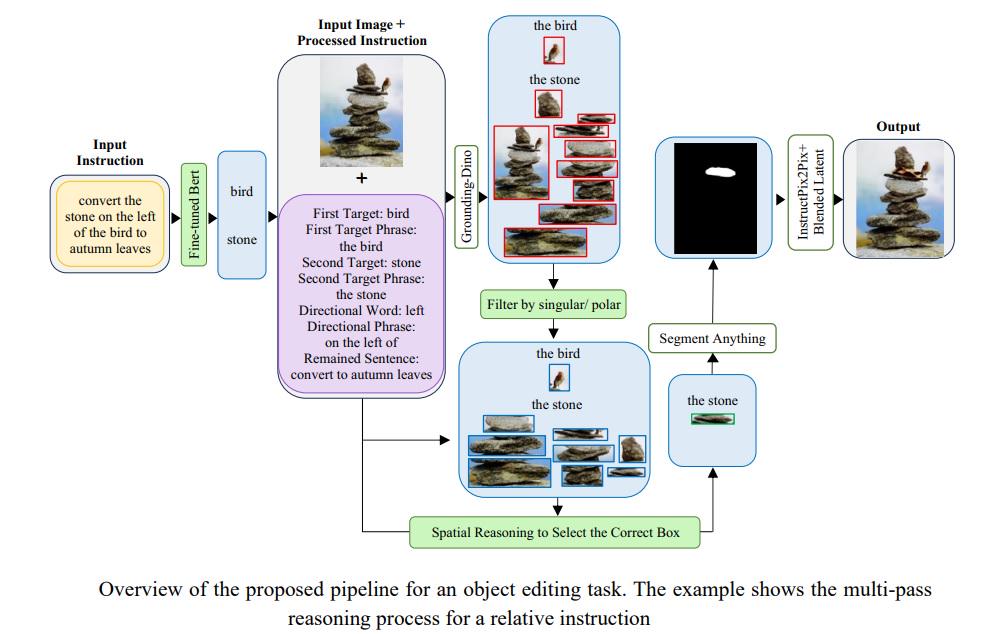
Research Publication [R] GGIP2P: improving target localization and spatial control in instruction-based image editing (grounding + pronoun resolution + size-aware object placement)

Post image
4 Upvotes

I'm one of the authors of this paper, just published in Multimedia Tools and Applications (Springer Nature).

The problem: instruction-based editors (InstructPix2Pix-style) often edit the wrong thing in cluttered scenes, especially when the instruction has pronouns, distractor objects, or spatial relations like "the chair to the left of the table". They also give you no spatial control when the instruction asks for a new object that isn't in the image yet.

What we did: GGIP2P is a modular pipeline that grounds the instruction before editing:

  • Target identification framed as a NER problem, using a BERT model fine-tuned with LoRA
  • Pronoun resolution to disambiguate what "it" or "them" refers to
  • Plurality-aware bounding-box filtering, so singular vs. plural targets select the right detections
  • Spatial reasoning for absolute cues (left/right/top/bottom) and relative ones (next to, above, behind)
  • Guided object generation: a size-prediction model estimates the relative size of an absent object, so it can be placed with a mask at a sensible scale and position

In our qualitative and quantitative evaluations, this improved target fidelity on complex, real-world instructions while keeping the background consistent.

Paper: https://doi.org/10.1007/s11042-026-21941-z
Full-text access to a view-only version: https://rdcu.be/qX5QVymjkGZa

I'd especially like feedback on the limitations of a modular approach like this (error propagation between stages, for example) compared to end-to-end methods. Happy to answer questions.


r/computervision • • Sep 28 '26 Popcorn

Showcase Volleyball match analysis from a moving broadcast camera: RF-DETR + RTMPose + court homography + rules

169 Upvotes

Been working on a volleyball analysis pipeline, this is the current output on a full rally sequence.

The input is just the hall's automatic broadcast camera, so it pans and zooms. No fixed camera, no calibration.

Rough pipeline:

- Detection: RF-DETR Medium at 1280, fine-tuned on of my own labeled frames (ball + person). The ball is tiny (median ~22 px), which is why I stayed at 1280 instead of 640. Test AP50 is 0.92 for the ball, 0.97 for people.

- Camera motion: phase correlation between frames.

- Court: per-frame homography fitted to the white court lines, checked against the floor colour, so everything can be expressed in court metres.

- Ball: my own Kalman tracker with a gravity term, to bridge missed detections and catch bounces and hits.

- Pose: RTMPose on every frame, used for which hand/body part touched the ball and for the first referee's arm signals.

- Players: 6+6 tracks per team, plus referees and bench told apart by position (and shirt colour for the officials).

- Scoreboard: macOS Vision OCR on the broadcast graphic.

- On top of that, a rule layer (FIVB rules) that turns all of this into touches, blocks, rallies and points, and flags it when the scoreboard, the referee and the ball disagree.

It also estimates ball speed per hit (2D, so a lower bound), attack zone and direction, serve position and whistle-to-serve time, landing point in/out, and running distance (experimental).

Hardest parts so far:

- the ball leaving the top of the frame and the tracker jumping to something else

- referee signals: in this hall two staff stand behind the first referee and their boxes are taller than his (his legs are hidden by the stand), so picking "the tallest person on the stand" read the wrong arms

- every new hall = new floor colours, lines, lighting and camera angle

Yes it is all vibe coding with Claude

https://youtu.be/xbSyAW-H-b8


r/computervision • • Sep 29 '26

Showcase Oct 8 - MCP, Agents and Skills Virtual Meetup

Post image
1 Upvotes

Join us on Oct 8 for the monthly MCP, Agents and Skills virtual Meetup!

Register for the Zoom!

Talks will include:

  • Designing Multi‑Agent Systems: Sequential, Parallel, and Beyond with ADK - Roushanak Rahmat at HCLTech
  • Privacy by Deployment: Architecting Agent-Driven Localization Workflows for Regulated Environments - Shruti Joshi
  • MCP Is the Interface; Skills Are the Operating Discipline - Chuck Hernandez at Eliza Solutions Corp
  • Agentic engineering is about good guidance - Dimitri Geelen

r/computervision • • Sep 29 '26

Discussion New to egocentric video data. What quality problems should I watch for?

0 Upvotes

I'm starting a project that uses head-mounted video for robot learning. Before I train anything, I'd like to know what problems experienced people have hit with this kind of data, so I don't learn every lesson the hard way.

What do you wish someone had told you before you started? Anything about capture, synchronization, annotations, or dataset curation helps.


r/computervision • • Sep 29 '26

Commercial Cognex agrees to buy RealSense for $500 million

Thumbnail
pituchim.com
10 Upvotes

cognex plans to combine realsense’s depth sensing with its industrial machine vision business. the deal is expected to close in q4, subject to closing conditions, and realsense’s facial-authentication business is being separated before then. for anyone building around these cameras, the ownership change seems worth following.

disclosure: i run pituchim, which published this summary.


r/computervision • • Sep 28 '26

Showcase RF-DETR INT8 Quantized Model Release

31 Upvotes

We just put up an INT8 version of RF-DETR Base on Hugging Face. Both weights and activations were quantized to INT8 using our quantizer, Kenosis. It's a single ONNX file that runs on ONNX Runtime or OpenVINO.

It scores 53.1 mAP on COCO val2017 against 53.3 for the original FP32 model, so it stays within 0.3 mAP on both runtimes. The file is 42 MB instead of 115 MB. On CPU it runs about 67% faster than FP32 on a single thread in ONNX Runtime, and about 90% faster in OpenVINO with 4 threads.

We scored it on val2017 minus the 200 images we set aside for calibration, and the eval script is in the repo along with a small run script. Apache-2.0.

https://huggingface.co/CoreEpoch/rfdetr-base-int8-onnx


r/computervision • • Sep 29 '26

Discussion How would you optimize a real-time MuseTalk pipeline for cost and concurrency?

0 Upvotes

I’m working on a real-time lip-sync avatar using MuseTalk and currently have a pipeline like:

TTS → audio chunks → MuseTalk → frame blending → H.264 → streaming

A few things I’m trying to figure out:

  • Frame blending is currently happening on CPU. Is there a good way to reduce the overall GPU/CPU cost?
  • What’s the most cost-effective way to run A100s with decent uptime?
  • If multiple users are streaming at the same time, how do you handle concurrency on a single GPU/container?
  • Is batching useful for real-time lip-sync, or does it add too much latency?
  • Would you use multiple workers/processes, a queue, or some kind of GPU scheduler?

My main goal is low latency + good concurrency without the GPU cost getting crazy.

Would love to hear how others have approached this in production.


r/computervision • • Sep 29 '26

Help: Project Suggestion on Text Extraction

Thumbnail reddit.com
1 Upvotes

r/computervision • • Sep 28 '26

Showcase New VLMs vs hard video grounding questions: GPT-6 Astra finds the right object 97% of the time

5 Upvotes

The task: one video plus one question in, boxes on the right object out. You can't answer it from a single frame. You have to watch what happens to know which object the question means.

I ran 300 Perception Test questions through the same pipeline for every model: the VLM picks the object and seeds a box, then SAM 3 tracks it.

ModelRight objectHOTA$ / video hour
GPT-6 Astra97%0.567$105
Claude Opus 5.592%0.572$44
Gemini 3.7 Flash90%0.569$4.86
Gemini 3.8 Flashnot scored0.565$8.73
Qwen 3.8 27B82%0.476$2.43*

*Qwen is self-hosted, so that's our hosting price, not a vendor list price.

  • The new releases win at picking the right object. Astra misses 3 in 100, against 10 for Gemini Flash and 18 for Qwen.
  • Tracking scores (HOTA) are tied for the top three, since SAM 3 does the tracking for all of them.
  • The catch is cost: Astra runs about $105 per video hour, against $4.86 for Gemini Flash.

r/computervision • • Sep 29 '26

Help: Project 寻找教学视频自动审校方案:如何发现口误、板书和公式错误?Looking for an AI-assisted QA solution for educational videos: speech, whiteboard, formula, and subtitle review

0 Upvotes

我们正在做老师讲课视频的审校,目前主要依靠人工逐段观看,效率比较低。

希望寻找一个可以辅助人工审核的方案,对录制好的教学视频自动发现并定位疑似问题,并输出问题发生的时间段、截图或原声证据,以及修改建议。

目前重点需要审核的内容包括:

  • 老师口误、读错数字或数学术语;
  • 漏读、重复读、表达不完整;
  • 咳嗽、杂音、长时间停顿或无效片段;
  • 字幕与老师原声不一致;
  • PPT、电子板书或手写板书中的错别字;
  • 数学公式、符号、上下标、分式、根式或计算错误;
  • 老师遮挡关键文字、板书被遮住;
  • PPT 或字幕文字截断、溢出、显示不完整;
  • 讲解内容与教材、讲义、标准答案不一致。

我们的课程主要是中文教学视频,包含较多初中数学内容。理想结果类似:

时间:13:20–13:25
问题类型:数学术语错误
原话:化简成最简二次根数之后……
板书:最简二次根式
建议:将“二次根数”改为“二次根式”
依据:教材规范术语为“最简二次根式”

目前我们在考虑使用多模态模型、ASR、OCR、公式识别和视频关键帧分析,但希望尽可能先用一个主模型完成第一版。

想请教大家:

  1. 是否有开源项目、论文或产品比较接近这个需求?
  2. 对中文教学视频、数学公式和手写板书,哪些模型或 OCR 方案效果较好?
  3. 有人做过类似的“视频质检 / 教学内容审校”系统吗?
  4. 对于长视频,大家建议按固定时间切片、按画面变化切片,还是结合两种方式?

欢迎大家在评论区分享经验、模型选择、开源项目或踩坑建议。谢谢!

We are building a quality-review workflow for recorded teacher-led educational videos. At the moment, every video is reviewed manually from start to finish, which is slow and difficult to scale.

We are looking for a solution that can assist human reviewers by automatically detecting and locating potential issues in a video, ideally with timestamps, screenshots or audio evidence, and suggested corrections.

The main review targets include:

  • Spoken mistakes, misread numbers, or incorrect mathematical terminology;
  • Missing words, repeated phrases, incomplete explanations;
  • Coughs, noise, long pauses, or other unusable segments;
  • Mismatches between subtitles and the teacher’s speech;
  • Typos in slides, digital whiteboards, or handwritten notes;
  • Incorrect mathematical formulas, symbols, superscripts/subscripts, fractions, radicals, or calculations;
  • The teacher blocking important text or whiteboard content;
  • Truncated, overflowing, or incomplete slide and subtitle text;
  • Explanations that conflict with textbooks, courseware, or answer keys.

Most of our content is in Chinese and includes middle-school mathematics. An ideal output would look like this:

Timestamp: 13:20–13:25
Issue type: Incorrect mathematical terminology
Spoken text: “After simplifying it into the simplest quadratic root number…”
Whiteboard text: “Simplest quadratic radical expression”
Suggested correction: Replace “quadratic root number” with
“quadratic radical expression.”
Evidence: The latter is the standard textbook term.

We are considering multimodal LLMs, ASR, OCR, math formula recognition, and keyframe analysis. For the first version, we would prefer to use one primary multimodal model if possible.

Questions for the community:

  1. Are there any open-source projects, papers, or commercial tools close to this use case?
  2. Which models or OCR tools work well for Chinese educational videos, handwritten whiteboards, and mathematical formulas?
  3. Has anyone built a similar system for educational-video QA or content review?
  4. For long videos, would you recommend fixed-length chunks, scene-change-based chunks, or a hybrid approach?

Any suggestions, project links, architecture ideas, or lessons learned would be greatly appreciated.


r/computervision • • Sep 29 '26

Discussion Man, got burned out searching for internships in linkedin/portals, Hope I can find some opportunity in Reddit, Here's my CV if you have any opportunities, pls feel free to reach out to me, especially searching for internships in ML/CV/DS/AI roles :)

Post image
0 Upvotes

Would be helpful. :)