r/computervision • • Oct 12 '26

Help: Project A little demo of what I’ve been building with drone / 360 footage

16 Upvotes

Hii all, thanks to everyone who signed up after my last post! I made a short demo so you can actually see what I’m building.

You upload raw footage and it turns it into a Gaussian splat, a 3D scene you can move around in. All through your browser.

You can clean it up, place it on a map using GPS, share it, or download the files.

If you want to try this, you can join the beta at ornen.ai (starting with 100 open slots today)

Everyone that signs up gets 10 free credits now, which should allow generating multiple splats at no cost.

Really interested to hear how it works for people here with their own footage. If something breaks or could work better, let me know. I’m building this myself and can make fixes directly based on your feedback. 🙏🙏


r/computervision • • Oct 12 '26

Help: Project Object Detection << Robust Tracking

6 Upvotes

I am seeing lots of demo videos of object detection of people, cars etc. Those are all cool, but I can't see them transfer to an actual useful insight. These days, I am working on a tracking feature for factory environments. My observation is that just doing object detection is far from doing robust, stable object tracking with few ID switches where you can actually get a sense on what is happening in the scene with trajectories. I tried YOLO26, RF-DETR, SAM3 and SAM3.1. SAM3 gave me the best results out of the box, but it was also ~10x more resource intensive. That 10x would require much more GPU compute and capital investment. How do you all approach solving for stable tracking in cases other than football or volleyball games where there's more occlusions and varied background features? Am I missing some established approach to this problem? (Image is representative and AI-generated)


r/computervision • • Oct 12 '26

Discussion Grafana and computer vision

2 Upvotes

Hi! I'm gravitating towards industrial computer vision and is just getting into databases and visualization of the production. I've been playing around with SQLite and Grafana and I feel like it's the perfect match. Live video stream and visualization of yield, type of defects etc in the same GUI. I just want to sync with you guys if I've missed something before I start using it in my projects. Are there better alternatives which are more industry standard?


r/computervision • • Oct 13 '26

Discussion ¿La IA generativa viene a reemplazarnos o a potenciarnos? 🤔

Thumbnail gallery
0 Upvotes

r/computervision • • Oct 12 '26

Discussion For those working in industry: What is your job title/how important are job titles?

2 Upvotes

I currently have a job offer for an embedded software engineer position where I will work on some CV related tasks. Will this job title hurt any future job prospects if I apply to a more traditional CV role down the road, or does this not matter? What job title do you have and/or have you previously had?


r/computervision • • Oct 13 '26

Discussion Anybody building vision agents to monitor 24X7 live stream?

0 Upvotes

Anybody building vision agents to monitor 24X7 live video?


r/computervision • • Oct 12 '26

Discussion How realistic is transitioning from automotive quality engineering into computer vision at 32?

3 Upvotes

I'm 32 and currently working as a quality engineer in the automotive industry. Before this, I spent about 3 years in software QA, so I have some coding experience. My bachelor's is in Electronics Engineering, and I've also worked with Python and basic machine learning.

I don't see myself staying in quality engineering long term. I'm interested in computer vision, particularly autonomous driving and perception systems.

I'm considering building projects involving object detection, low-light image processing, and improving model performance. However, I'm trying to understand what skills actually separate someone who can run pretrained models from someone qualified to develop computer vision systems professionally.

For engineers working in perception or computer vision, what technical fundamentals would you prioritize for someone coming from my background? Would my automotive experience be useful at all, or would I essentially be starting over?

Also, is making this transition at 32 realistic? I'm willing to put in the work, but I'd appreciate hearing from people who have actually made similar career changes.


r/computervision • • Oct 12 '26

Discussion Cool ain't it ? :) Open to feedback, Still working on it....

2 Upvotes

r/computervision • • Oct 12 '26

Discussion [Benchmark] Part 2: i5-6500 ~80 FPS on CPU-only fruit inspection (i5-10300H ~50–70, same conveyor)

1 Upvotes

Follow-up to my AVX2 / i7-2600 post (Part 1). People asked: “we don’t have a 2011 museum PC — we have an office box or a floor laptop. Does it work?”

Same Fruit Inspector pipeline: 3×3 grid, Cat only in centre cell C, YOLOX 640 + ROI 256, LightGBM on CPU. Nim + ONNX Runtime CPU EP only (no OpenVINO, no GPU in these runs).

New rungs:

• i5-6500 (4C/4T, Skylake, Linux, V4L2): ~78–84 FPS, tmin ~8 ms

• i5-10300H (4C/8T, Windows, CPU EP — 1650 Ti in the machine but not used): ~47–72 FPS, more jitter

• Reference from Part 1: i7-2600 ~40 FPS (no AVX2), i5-11400 ~130 FPS

Surprise in my logs: desktop 6500 beat the 10300H laptop on CPU — class/TDP/OS, not just the “i5” badge.

I also sold an RTX 2060 Super: on YOLOX-nano it lost to plain CPU (PCIe overhead). Not telling veryone to drop GPUs — but nano on CPU was honest for this project.

Full write-up (photos, ladder as copy-paste lines):

https://medium.com/@olesha-ai/bypassing-the-avx2-tax-part-2-real-time-computer-vision-on-shop-floor-hardware-2311fd86ae4f

Part 1 (Sandy Bridge, no AVX2):

https://medium.com/@olesha-ai/bypassing-the-avx2-tax-real-time-computer-vision-on-a-fifteen-year-old-cpu-ba6b01868f7f

Demo / clone (v0.10.0, non-commercial):

https://github.com/olesha-ai/fruit-inspector-demo

If you run similar shop-floor CPUs — curious what infer fps you see.

Best regards olesha-ai. 👍


r/computervision • • Oct 12 '26

Help: Project Open-source: one meal photo → calories & macros with calibrated uncertainty ranges, plus "

0 Upvotes

LayaMacro estimates calories, protein, carbs, fat and food weight from a single meal photo. Each number comes with an 80 % range, read from a probability distribution, not a fixed ±%. The same model also answers food questions ("Does this meal contain rice?", "Which of these 5 foods is on the

Architecture: frozen SigLIP 2-large (576 patch tokens) → projector → Laya, an encoder-onlynswer options instead of generating text.

- 48.5 kcal MAE on Nutrition5k (OmniFood8K is better there: 36.8), 63.1 on DFood-TJ hospit

- 0.89 on "contains X?" and 0.86 on "which of 5 foods?" for the 243 foods it was trained on

- ~180 ms per photo on an RTX 4060 Ti

The main lesson: on these datasets, calorie error comes more from what the food is (kcalsize, and on unfamiliar photo types every model I tested falls back on its training portion sizes.

Next: ~1,700 unused weighed Nutrition5k dishes, more food names, and a test of whether depth helps portion size. Pointers to other weighed-meal datasets are very welcome.

Code: https://github.com/Aquos06/LayaMacro

Model: https://huggingface.co/Aquos06/LayaMacro

Full results, including what didn't work, are in the repo.


r/computervision • • Oct 12 '26

Help: Project How do you design a knowledge map or decision framework for document image preprocessing in production OCR systems?

Thumbnail reddit.com
3 Upvotes

r/computervision • • Oct 12 '26

Help: Project How can I teach AI to estimate firefighting fittings from mep drawings?

2 Upvotes

I want to develop an AI tool that can identify components in fire protection drawings and calculate quantities using my own professional knowledge.

I have many rules and exceptions that I apply during manual estimation. Can I teach an existing AI by showing drawing examples, explaining my decisions, and correcting its mistakes?

Would a knowledge base, model training, or a combination of AI and traditional programming be the best solution?

I'm looking for a practical way to build this without creating an AI model from scratch.


r/computervision • • Oct 12 '26

Showcase I ranked wildfire camera feeds under a hard alert budget with classical OpenCV. It matched a CNN-on-every-frame at 1.4 neural-net calls per window instead of 3,645. Here's where it fails.

Thumbnail reddit.com
1 Upvotes

r/computervision • • Oct 12 '26

Showcase I ranked wildfire camera feeds under a hard alert budget with classical OpenCV. It matched a CNN-on-every-frame at 1.4 neural-net calls per window instead of 3,645. Here's where it fails.

1 Upvotes

Wildfire camera networks have far more feeds than anyone can watch. The problem isn't finding smoke on one frame; it's deciding which of dozens of tiles a person should open next, without flooding them with alerts.

So I fixed the budget first: 2 alerts per camera per 81-minute window (a FIgLib sequence). Every system was calibrated to that same budget on a fire-free "confusion set": low cloud, cloud shadow, overcast, cameras hunting exposure. Then I measured minutes from ignition until the right camera was in the top 4 *and* had alerted.

Pipeline (OpenCV 5): phaseCorrelate stabilisation → MOG2 → four plume statistics → cv2.dnn on the top-2 ranked tiles only (1.76% of frames) → each camera z-scored against its own trailing 15 minutes → one threshold solved to spend the budget.

Held-out, read once after freezing the constants: 27/54 detected. A CNN on every frame got 18/54 and frame differencing 20/54, both put through the same per-camera baseline. That per-camera rebasing is what lifted the CNN from 2/54 as deployed to 18/54, which I think is the most transferable finding.

What doesn't work: the lead isn't significant (paired McNemar p = 0.18 / 0.25), half the held-out fire windows are missed (27 of 54), the median is on a knife edge (38.0 min, the 27th detection), it's daylight only, and the statistic I designed it around turned out anti-predictive on its own (AUC 0.44). It's all in the README.

I'd love critique, especially from anyone who has worked with HPWREN/FIgLib or SmokeyNet.


r/computervision • • Oct 12 '26

Showcase Open-sourced my image-dataset prep tool — quality scoring, dedupe, leak-safe splits, Kohya export (pure-Python, MIT)

0 Upvotes

# I ACCIDENTALLY PUSHED THE WRONG FOLDER TO GITHUB, MY APOLOGIES - IT HAS BEEN FIXED WITH THE CORRECT FILES - Oct 12th 2026 -9:04am

I got tired of rewriting the same dataset-prep scripts before every LoRA/Dreambooth run — resize, dedupe, toss the blurry ones, caption, split — so I cleaned mine up and open-sourced it.

It scores each image on classical-CV signals (sharpness, exposure/clipping, contrast, color cast, noise, composition), flags the weak ones, removes exact + near-duplicates, and exports a Kohya-style folder with caption sidecars. Near-duplicates get grouped into the same train/val/test split so they can’t leak across. Captioning supports WD14 and Florence-2.

It’s content-agnostic at the core — each domain is a small plugin that sets its own quality weights and caption vocab (ships with a worked “interiors” example). Pure NumPy/Pillow, no OpenCV, runs from a CLI or as a library. Early 0.1.0, MIT.

Would love feedback on the plugin API and which verticals are worth building next. (Only use it on images you’ve got the rights to.)

https://github.com/snoozey-mf-bnui/pixel-curator


r/computervision • • Oct 12 '26

Showcase I got a SynthID check to return not detected by replacing one texture band

0 Upvotes

JPEG didn't do it. Noise didn't either.

One picture, 1536 × 1024: a girl beside a pond, ducks in the grass. I wanted the SynthID result to change while keeping the scene recognisable. The usual tricks made the image worse. The check kept saying detected.

A more selective approach finally changed the result. I generated a donor with ControlNet Canny, then borrowed one texture band from it. The processed image returned a manual "not detected". The new texture is visible. All the recorded checks come from this scene; I have not measured a success rate across other images.

The tools and both full-size PNGs are in an MIT repo: [synthid-remover](https://github.com/balyakin/synthid-remover).

## The part that failed

Resizing, small geometric changes, blur, noise, JPEG recompression. Combinations of those. Then GAN restoration. Then a simulated print-and-camera trip, halftone and moiré included.

Still detected.

Stable Diffusion 1.5 with ControlNet Tile left SynthID detectable in the versions I checked. Canny was the switch that moved the result. Tile feeds the conditioning channel the source tones. Canny feeds it an edge map. The img2img path still receives the source tile, so the original pixels are not out of the process. They stop arriving as the ControlNet condition.

The donor was usable and, as a picture, too rewritten. The pond stayed put. Grass, reeds and the smaller textures had been repainted.

So I kept less of it.

## One band, not the whole frame

`remaster.py` makes that donor with SD 1.5 and `lllyasviel/control_v11p_sd15_canny`. The run behind the published result used strength 0.9, 30 steps, 640-pixel tiles and overlap 256. The CLI default overlap is 96. Drop the flag and the donor is a different image.

`bandmix.py` builds a band from two Gaussian blurs and replaces it with the donor's band. Finer detail and the broad shading stay with the source, apart from clipping and rounding.

Sigmas on the bundled file: 1.2 and 8 pixels. Blur widths. Not Fourier cutoffs, and not a map of where every SynthID mark lives.

The donor has to match the source size. From the lightweight venv:

```bash

.venv/bin/python bandmix.py original.png donor.png result.png \

--split-sigma 1.2 --correct 8 \

--keep-share 0.12 --match-window 12

```

Twelve percent of the original band stays. The donor band is rescaled so its local energy follows that original band. In the checks I wrote down, keeping 10% or 12% came back not detected. At 15% it was detected again. On this image, that small step mattered.

## The actual pixels

[Original PNG](https://github.com/balyakin/synthid-remover/blob/main/autumn-10x15-yellow-v2.png) and [processed PNG](https://github.com/balyakin/synthid-remover/blob/main/autumn-10x15-yellow-v2.clean.png). Both are 1536 × 1024. At full size the vegetation gives the swap away.

- Mean absolute channel difference, on a 0–255 scale: **16.91**.

- PSNR against the original: **20.68 dB**.

- Manual SynthID check, recorded on **October 9, 2026**: **not detected**.

Not invisible. The scene is still recognisable, and some of its texture is borrowed. PSNR here measures pixel similarity. It is not a watermark score, and one number does not certify the look.

The repo's default donor prompt is generic: a photograph, natural light, sharp focus, fine detail, realistic textures. The bundled success used a prompt for this particular scene, so the generic recipe makes a new candidate. That candidate needs its own check. So does every other input. One image, one donor.

I used [OpenAI Verify](https://openai.com/verify/) and read its SynthID result separately from metadata. "Not detected" means that check did not find the supported watermark. It does not establish that the picture was made without AI. [OpenAI explains how to interpret a missing signal](https://openai.com/research/verify/).

The failed processing tools are in the repo, with tests for image handling. Those tests never call the external detector.

If you have tried a similar band swap across several scenes, I'd like to hear about the misses as much as the hits: where the detector result changed, and where the visual damage made the method hardly worth using. A comparison with settings and a detector result would give us something useful to work with.

r/computervision • • Oct 11 '26

Showcase Camera Chess: from single-frame recognition to live tracking with trained postprocessors

7 Upvotes

Hey everyone! I've been working on Camera Chess: playing Stockfish with a real chessboard and a camera, entirely locally on my Mac. The video above shows my favourite little feature: promoting a pawn, leaving it on the board, and continuing to use it as a queen. 😄 The promotion is manually confirmed in the demo.

I thought the recognition side might be interesting to people here. I'm using Joël Seytre's ChessQ Lite V4, which gives piece probabilities for all 64 squares. The model is useful on individual frames, but getting a live game to stay in sync turned out to be a different problem. One bad reading can become the “previous position” for the next move, and then the mistakes start feeding into each other.

So I kept the vision model frozen and worked on the steps around it:

• Board orientation and automatic perspective correction, with a fallback to the original frame.

• A CRF that scores candidate boards using the visual probabilities, previous position and chess rules.

• Checks across consecutive frames before accepting a move, plus a correction UI when things go wrong.

For training, I replayed chess games and generated noisy piece-probability inputs: confused pieces, missing pieces, swapped squares and uncertain regions. That gave me 20,000 transition seeds and 200,000 synthetic observations. The synthetic data is at the probability level, rather than rendered chessboard images.

I then tried replacing the CRF with small MLP, CNN and attention-based scorers. Those worked reasonably well too; I'm currently using a small two-hidden-layer MLP. In my own games, the whole system now feels much smoother and more reliable, which I'm pretty excited about.

For a separate offline check, the MLP got 128/176 exact boards (72.73%) versus 125/176 (71.02%) for the CRF. These are real photos, but with previous positions constructed from the correct labels, so the correct answer is guaranteed to be among the candidates. It's a limited candidate-scoring test, not a video benchmark, and that small difference doesn't establish that the MLP is better. Full setup and results:

https://github.com/AmethystineAlpaca/camera_chess/blob/main/docs/crf-real-photo-synthetic-previous-evaluation.md

One detail about the video: keeping a pawn after promotion means separating what the camera sees from what the piece means in the game. That substitute-piece path uses visual likelihood, rather than the learned scorers trained without substitutes.

Code, demo and setup:

https://github.com/AmethystineAlpaca/camera_chess

Synthetic-data details:

https://github.com/AmethystineAlpaca/camera_chess/blob/main/docs/crf-data.md

It's currently a source install for Apple Silicon Macs. You move both sides' pieces yourself, and the app speaks Stockfish's reply (the video export is silent).

Curious how others handle this: when your tracker uses its last accepted prediction as the next reference, how do you test recovery after that reference goes wrong?


r/computervision • • Oct 10 '26

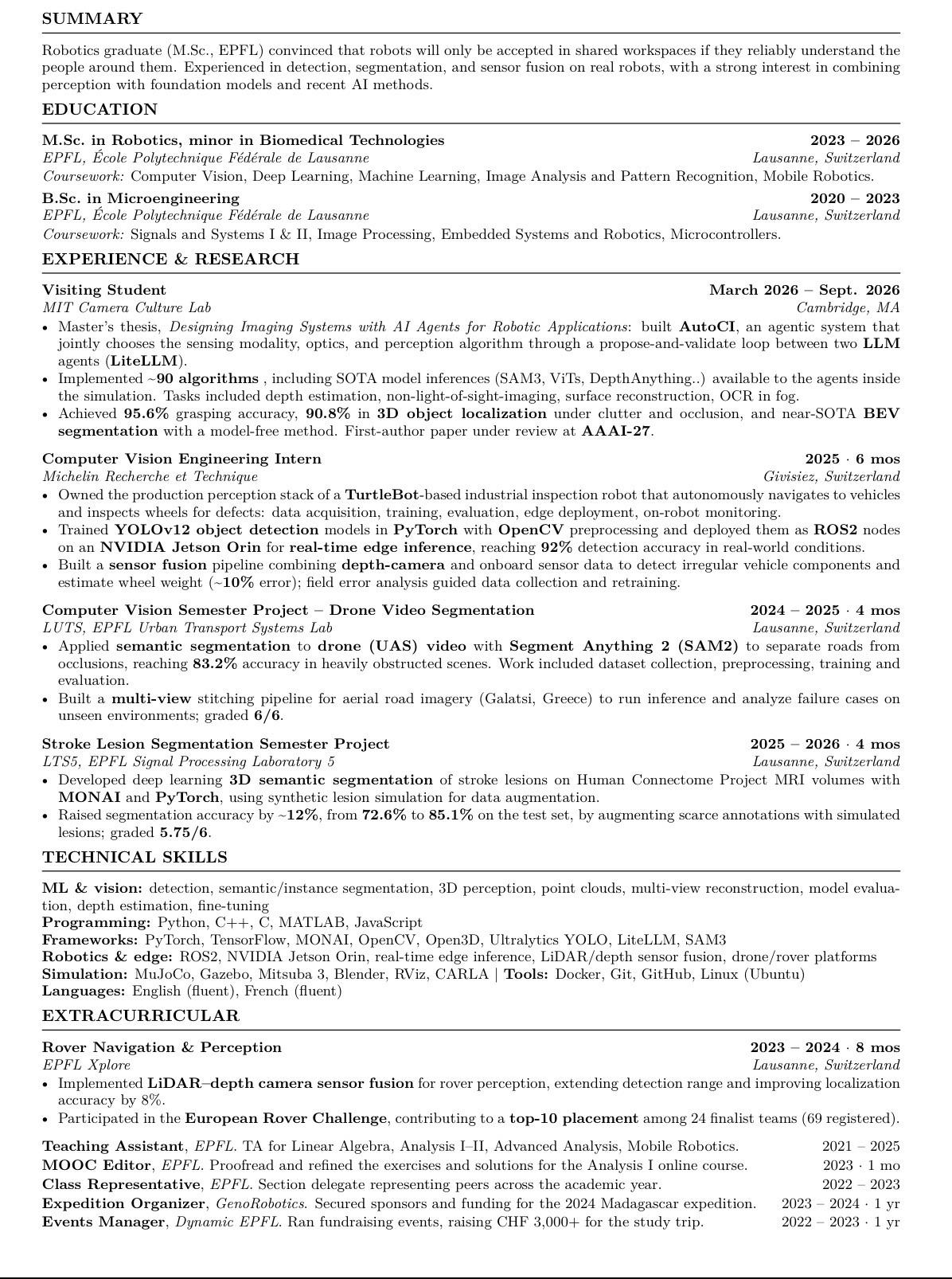
Discussion Applied to ~150 CV jobs. Got only 5 interviews. How can I improve my resume?

Post image
147 Upvotes

Cropped the top of the photo to hide personal informations (GitHub and portfolio are there as clickable links). Targeting Swiss tech companies/startups. I applied to many different job postings and I’d say that it hasn’t been really successful so far since I only got 5 interviews for ~150 jobs. I get rejected sometimes to job postings where I have most of the requirements. I’m tailoring my resume for each job. I’m looking for feedback on the structure of my resume and how should I frame the description of each experience I had. Is it too long? Too much details? Any other red flag?

PS : I know that the metrics to quantify the impact of my project are a bit vague (accuracy instead of IoU, mAP etc..) and I just made a newer version with these new metrics, just didn’t have the file on my phone to upload it. Not sure if this change will make me get a lot more interviews though


r/computervision • • Oct 11 '26

Discussion La Facultad de Ciencias de la Información de la UCM organiza el II Congreso Internacional de IA generativa el 20 y 21 de octubre

Thumbnail
apmadrid.es
1 Upvotes

r/computervision • • Oct 11 '26

Help: Project generating synthetic training data for a kite-mounted cam dancing in the wind

0 Upvotes

heya cv..it I am training a model that will run on a kite, on an extremely limited energy and latency budget. the camera points down toward a well marked target area to provide shadow.

I'd like to be able to simulate varying shutter, light, wind conditions, and camera placement. I don't yet know have vision energy / latency budget but on the other hands the control side needs the cv latency / accuracy curves to solve it. So I'm trying to simulate the full cascade of possible models.

For me, modeling a kite in the wind feels like it should be straightforward to do, but even with ai I wasn't able to find or simulate anything realistic or usable.


r/computervision • • Oct 10 '26

Showcase I built a local OCR model for blood-pressure monitors, it’s not very accurate yet

6 Upvotes

I have been experimenting with replacing Gemini 2.5 flash with a completely local pipeline for reading SYS, DIA, and pulse values from blood-pressure monitor displays.

My motivation is privacy: local inference avoids uploading potentially sensitive info to the cloud.

The current pipeline consists of:

  • A YOLO11n detector for numeric rows and individual digits.
  • A small DigitNet classifier for cropped digits.
  • Geometry-based row assembly and consistency checks.
  • Confidence-based refusal instead of always returning a reading.
  • Multiple preprocessing passes, including lighting normalization and display rectification.
  • ONNX inference locally in a browser worker.

The two ONNX models are approximately 10.9 MB in total.

The detector was initially trained on 239 usable public images and subsequently fine-tuned with eight additional photographs taken by me of my monitor. This small training set is clearly the weakness.

Evaluation

Not to bury the lede: the performance is not great.

I tested the variants on a combined regression benchmark containing:

  • 139 readable monitor photographs.
  • 25 negative images that should not produce a reading.
  • Images from several public sources, with perceptual-overlap checks against the training data.

PASS is when all three values are correct (SYS, DIA, and pulse). FAIL if any is off. Refusals are misses on readable images

PipelineExact tripletsPrecision when acceptedCoverageSafe negativesMedian latency
One full-frame pass28/13992.0%18.0%25/2587 ms
Current staged retries38/13991.2%24.5%25/25253 ms
Staged + display rectification41/13991.7%25.9%25/25262 ms
Staged + normalization + rectification45/13992.1%27.3%25/25767 ms
Google ML Kit, original image1/1394.2%17.3%13/2563 ms
Gemini 2.5 Flash125/13990.6%99.3%25/252.76 s

The latency figures are mostly for fun, as I did not control for the hardware. Gemini’s measurement includes the network request.

Lessons Learned

The largest improvement came from staged retries: From 28 to 38 without reducing negative-case refusal performance.

+Display rectification has the best accuracy/latency trade-off. +Expanded lighting normalization made the pipeline much slower, without a significative jump in quality .

A simple ML Kit implementation performed poorly on the LCD screens, so I did not pursue that approach.

Gemini is dramatically better at generalizing to unfamiliar displays. However, the local pipeline’s advantage is privacy, offline operation, latency, and explicit refusal. I still plan on integrating it in my project, alongside HITL and usage patterns which will mitigate its limitations.

Important limitation

This combined 139-image set has already been used for development and regression analysis. In particular, the normalization-plus-rectification variant was selected after examining its results.

Consequently, its improvement from 38/139 to 45/139 is a post-hoc result, not independent evidence of better generalization. The next step must be a new sealed test set collected before making any further pipeline decisions.

All feedback/ideas for improvement are welcomed

repo (AGPL-3.0): https://github.com/zandaulion/hearth-bp-ocr


r/computervision • • Oct 09 '26

Research Publication I built an end-to-end AI football analytics system using YOLO11 and BoT-SORT

223 Upvotes

Hey everyone!

I've been working on a computer vision project that turns regular football match footage into player tracking, performance statistics, and tactical insights.

It started as my graduation project, but I wanted to go beyond basic object detection and build a complete video analytics pipeline.

Here's what the system does:

- Detects players, goalkeepers, referees, and the ball using a custom-trained YOLO11m model.
- Tracks players using BoT-SORT, with additional logic to handle broken tracks and ID switches.
- Automatically identifies teams based on jersey colors.
- Uses pitch keypoint detection and homography to map player positions onto a tactical minimap.
- Estimates player speed and distance covered.
- Generates heatmaps, possession statistics, tactical insights, and match reports.

**Tech stack :**Python, YOLO11, BoT-SORT, OpenCV, NumPy, and PyTorch.

One of the biggest challenges has been maintaining consistent player identities, especially during occlusions, camera movement, and crowded situations.

I'm continuing to improve tracking reliability and overall robustness.

I'd really appreciate feedback from anyone working in computer vision or sports analytics.

A few questions:
- What approaches would you recommend for reducing ID switches during heavy occlusions?
- How would you improve tracking consistency across changing camera views?
- What would you prioritize before using a system like this in production?

GitHub: https://github.com/Mhmdwael77/ai-football-analytics

Thanks for checking it out! ⚽


r/computervision • • Oct 10 '26

Help: Project Pose-based technique scoring for pole vault: my jitter check rejects real fast motion. How do you separate tracking noise from real movement?

1 Upvotes

Hi! I’m building a tool that analyzes pole vault videos. It runs pose estimation, tracks joints frame by frame, and checks 8 technique “gates” (takeoff leg extended, top arm straight, hips above head, and so on). A video needs at least 4 of the 8 measured to get a score.

The problem is that almost every upload comes back NOT SCORED, with only 0-3 gates measurable.

Setup: MediaPipe pose_landmarker_heavy, YOLOv8n for person detection. 1080p phone video at 30/60 fps, subsampled to 15-30 Hz before pose. Angles computed per frame from world landmarks, no smoothing. Measurement window spans the takeoff, giving 5-13 samples.

Each gate’s confidence is visibility * agreement * plausibility, needing > 0.50. Visibility runs 0.7-0.98 and plausibility is ~1.0, so it’s effectively visibility * agreement. Agreement fits a degree-1 line to the joint angle over the window and scores max(0, 1 - MAD/12°), so it’s exactly zero at 12° median deviation and since the terms multiply, one zero kills the gate.

Here's what the problem looks like across 44 gate instances:

  • Knee and hip angles: agreement 0.00, 0.00, 0.00, 0.00, 0.00, 0.03, 0.17, 0.21, 0.33, 0.41, 0.55
  • Elbow and shoulder angles: 0.87, 0.85, 0.76, 0.75, 0.73, 0.68, 0.61, 0.51, 0.51, 0.47

It fails almost exclusively on the fastest-moving joints. Jitter shouldn’t discriminate by joint, so this looks like the term is acting as a velocity penalty.

Residual signs form runs (-+++++--, ---++--), typically 2-4 sign flips over 6-7 pairs, rather than alternating, which is curvature. But refitting with a quadratic only helps about half the failing cases and makes about a third of them worse (20.96° to 23.52° MAD on one). With 5 points a 3-parameter fit is near-degenerate; leave-one-out on one window gave deg-2 about equal to deg-1 (16.96 vs 16.63).

Implied angular velocity at the largest consecutive jumps: 925-1504 degrees/s. Physically plausible for a knee at takeoff. But at 15-30 Hz that means 40-92 degrees between consecutive samples.

What I’ve tried:

  • Retuned the 12° divisor (to 25°): still no clip reaches 4 gates. The product with visibility keeps it under the bar.
  • Added a floor (minimum 0.35): no clip reaches 4 gates, and it weakened the jitter check: a synthetic large-amplitude jitter case went 0.00 to 0.35.
  • Excluded frames around takeoff from the fit: scored 3/3 deliberately corrupted cases, including a single-frame 75° spike (0.90) and a mid-window left/right keypoint swap (0.82). Rejected.
  • Range-adaptive budget (max of 12° and 0.25 * angular range): survives adversarial cases, improves 5/7 clips, still doesn’t reach the floor, and swaps one unjustified constant for another.
  • Cube-root aggregation: triples measurable gates, but it’s algebraically equivalent to requiring product greater than or equal to 0.125: a threshold change in disguise.
  • Denser sampling around takeoff: fixed 1 of 3 starved clips; the others were visibility-limited.
  • Hand-labeled 35 gate instances blind: in 28 I could clearly see the required joints and the pipeline called them unmeasurable.

I don’t want to just loosen the threshold. The term exists to catch jittery tracking producing fabricated angles, and I’d rather refuse to score than give an athlete feedback built on noise.

Questions:

  1. Am I undersampling the fast transition badly enough that no smoothness test can work at 5-8 samples, and the real fix is a higher sampling rate through the takeoff?
  2. If you only have a handful of samples across a fast movement, is there a way to validate the measurement at all? Something like bone-length consistency, or cross-checking against a second estimator, rather than temporal smoothness?
  3. Has anyone compared MediaPipe against RTMPose or ViTPose specifically on fast limb motion (sprint takeoff, jump plant)? I care about keypoint stability during rapid angular change, not overall accuracy.

My dataset is small right now, 7 clips, mostly from one source, so I know that’s its own limitation. More labeled footage is in progress.


r/computervision • • Oct 10 '26

Help: Theory Python Computer Vision

Thumbnail reddit.com
0 Upvotes

Hello everyone, I’m Mahmoud from Iraq, and I am studying Artificial Intelligence Engineering. I wanted to share my goal of specializing in Computer Vision; I hope you can support me and offer any advice you deem appropriate. Also, if possible, please share study methods or global resources that I could benefit from. Thank you.