r/computervision • • Oct 26 '26

Discussion Running face analysis fully on-device

0 Upvotes

I built a face shape detector and decided early that nothing would leave the phone. 468 point mapping, all local, no account.

Few things that surprised me. Lighting and camera angle shift the result more than the model itself does, so most of my work went into handling that rather than accuracy. Also most faces sit between two shapes, a single clean label like "oval" is usually wrong, people respond better to a blended answer.

If anyone else is doing on-device vision work, curious how you handle the angle problem.

\[https://play.google.com/store/apps/details?id=com.ai.face.shape.detector.meface\]


r/computervision • • Oct 26 '26

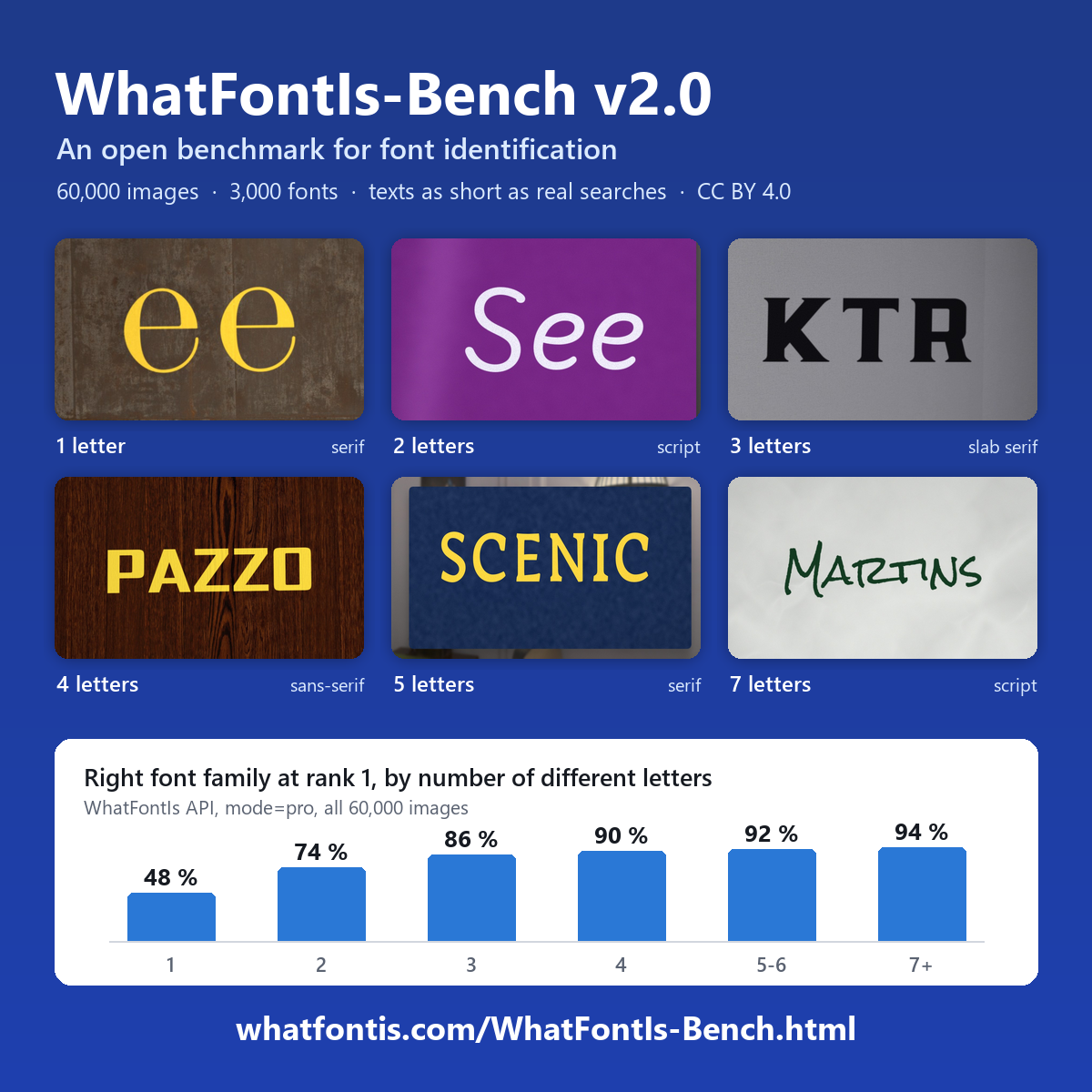
Showcase WhatFontIs-Bench v2.0: 60,000 images with query-length text — font ID top-1 falls from 93% at 7+ letters to 48% with a single letter

Post image
2 Upvotes

Hello

A month ago I posted v1.0 here (12k images, one 7–12 letter word each). A commenter pointed out that real queries are much shorter, and the production numbers agreed: the median query has 5 distinct characters and a quarter have 3 or fewer. So v2.0 matches that.

WhatFontIs-Bench v2.0:

- 60,000 images, 3,000 fonts (1,059 sans, 1,000 serif, 500 slab, 300 script, 141 mono), same three types and difficulty levels as v1

- the text length, case and digit/& mix are sampled from production query statistics; the strings themselves are COCO-Text v2 strings, not user queries

- labels: font, text, word quad, per-letter quads, camera transform; JSONL + COCO, CC BY 4.0

- a 1,200-image subset that scores within about a point of the full set, for quick checks

Baseline (our own API, open catalogue of 1.2M fonts, top-k by font family), top-1 by number of different letters, pro mode / default mode:

- 1 letter: 48.2% / 43.2%

- 2 letters: 73.8% / 64.7%

- 3 letters: 86.2% / 77.3%

- 4 letters: 89.6% / 82.6%

- 5–6 letters: 92.0% / 86.8%

- 7+ letters: 93.5% / 89.8%

- all 60,000: 88.1% / 82.2%

Above five letters it is as easy as v1; below three, there often isn't enough of the font in the image to separate it from its near-twins. The controlled-glyph diagnostic set (same font and background, only the word varies) is the next one.

Hugging Face (viewer, config v2): https://huggingface.co/datasets/whatfontis/WhatFontIs-Bench

GitHub: https://github.com/whatfontis/WhatFontIs-Bench

Disclosure: I run WhatFontIs, and the baseline is our own system. If you run a model on it, I'd like to see the numbers.

r/computervision • • Oct 26 '26

Help: Project Location EXIF data of Image - Marking at Pixel Level.

Thumbnail
gallery
0 Upvotes

Spread-spectrum mark: chroma + luma tiles, pilot tiles, Viterbi + CRC. 0 wrong values, 0 false alarms in our 480-copy benchmark; failures (fog, night, B&W + crop) are in the README.

https://github.com/thevijayparmar/Ghostmark-Image


r/computervision • • Oct 26 '26

Discussion Got an OCR or table-extraction example that still breaks your tools?

0 Upvotes

We're collecting difficult document pages for regression tests, especially cases where the output looks plausible but a number, row or label is wrong.

One of ours is this receipt. It has six product and packaging rows, plus discounts below three of them. An LLM returned nine item records by treating the discounts as extra products. Our schema had no separate discount field and asked for every line item/product, so the instructions left that interpretation open.

Source: NAVER CLOVA's CORD-v2 dataset, CC BY 4.0, image unchanged.

What image or document do you keep around because OCR or layout extraction repeatedly gets it wrong? Handwritten corrections, faint punctuation and wrapped table rows are a few examples we'd like to test.

Public links or redacted snippets would be useful. Include the line, row or field you wanted, what the output should be, and what went wrong. The reader/model and preprocessing settings help too, if you have them. It doesn't need to be a whole dataset.


r/computervision • • Oct 26 '26

Help: Project Detecting urban infill lots and rooftop extension potential using GIS / Computer Vision — existing tools?

1 Upvotes

Hi everyone,

I'm prototyping a tool for an urban planning consultancy in Germany.

Currently, their analysts spend 2–3 days walking streets on foot to manually spot:

  1. Vacant infill lots ("Baulücken"): empty gaps or underutilized surface plots between perimeter buildings.
  2. Vertical extension potential ("Aufstockung"): buildings with flat roofs or lower height than neighboring buildings that could take 1–2 additional floors.

We are testing this in Lower Saxony (Hannover). From initial research, I found that our state survey office (LGLN) provides official 3D building models (LoD2) and 20 cm aerial orthophotos (DOP20) completely free as Open Data.

Before building from scratch:

- Are there existing open-source tools, repos, or workflows that leverage LoD2 3D models / aerial rasters to automate infill & rooftop potential?

- Is it better to solve this purely via 3D vector/GIS math (building heights delta, roof shape analysis in QGIS/Python) or combine it with Computer Vision on street-level imagery (Street View / Mapillary)?

Appreciate any pointers, papers, or libraries!


r/computervision • • Oct 26 '26

Help: Project I built an open-source Python SDK for local facial expression recognition

Thumbnail reddit.com
1 Upvotes

r/computervision • • Oct 25 '26

Discussion Is the resume ok ? Been applying for internships or roles but still no avail. :(

Post image
3 Upvotes

If anyone has opportunities feel free to reach out


r/computervision • • Oct 25 '26

Help: Project Does an app already exist that can automatically sort graduation photos by person?

0 Upvotes

I'm looking for software that can organize hundreds of graduation/event photos into folders for each person.

Some photos contain diplomas with names, which could be used to identify and group the surrounding photos.

Before building my own solution, I'd rather use or adapt something that already exists.

Does anyone know an app, GitHub project, or AI tool that does this or something similar?

Open source, paid, cloud-based — all suggestions welcome!


r/computervision • • Oct 25 '26

Discussion How to chose the cases to add into a paper for a qualitative comparison?

1 Upvotes

Hello,

Durint the last reviewing round, 2 reviewers suggested adding qualitative results. The task is pose estimation.

How do I chose the examples to include? And to which baseline should I compare to since space is very limited? Should I include a failire case?

Thanks


r/computervision • • Oct 25 '26

Research Publication Topologically Consistent Multi-view 3D Head Reconstruction via Coarse-Guided Layered Surface Sampling

Thumbnail syntec-research.github.io
1 Upvotes

r/computervision • • Oct 25 '26

Help: Project Feedback request for my final year project idea: a clapperboard detector

4 Upvotes

Background

I'm coming up with ideas for my CS degree capstone project. I like making short films, so I looked into what kind of software I could make to facilitate the process. One thing I find annoying in post-production is having to go through all the recordings and look for the clapperboards on each video to know what scene, shot and take the video is of. My idea is to train a neural network to find the clapperboard in each recording and extract the information written on the clapperboard to appropriately name the recording. Ex. Avengers_Scene_4_Shot_5_Take_3.mp4.

In short, the neural network would do the following:

  1. Detect the clapperboard in a video frame.
  2. Read the handwritten text/numbers on the clapperboard.
  3. Understand what each piece of text represents

My questions

  1. I have not been able to find a lot of videos with clapperboards I could use to train my model. I'm thinking I could create my own videos to train it, so it is trained faster with a consistent clapperboard format. How many would I need more or less to have it not only recognise handwriting but also determine what the numbers indicate (Scene, shot or take)?
  2. If it would be too hard to train the AI to do what was previously mention, could I get an already trained AI in handwriting recognition and specialise it in clapperboard data extraction? Would this make my final year project too easy?

r/computervision • • Oct 24 '26

Showcase I built an app to browse and search for any photo on my laptop. You can also drag and drop to find similar images. It runs locally with SigLIP 2.

106 Upvotes

Hi everyone.

I've always had lots of photos on my laptop, and it's very difficult to look through them. Google Photos works, but I prefer to have everything locally, and it's also not possible to change directories based on what I want to look at.

So I decided to create an app to do so.

Found it super useful, so I decided to open source it too: https://github.com/chaseleantj/orchard-photos

It runs fully locally using SigLIP 2. It takes about 8s to index 1k photos on an M5 Pro GPU, and 1 min on CPU only, and 5 min/1k photos on a regular Windows office laptop.

There's text search, where you just describe what's in the image, and image search, where you drag and drop to find similar images. There's also some small QOL features like stacking near-duplicate images together. You can open whatever folder you want, or the root, in which case it scans all folders on the device.

For the map, I applied UMAP to project the embeddings into 2 dimensions, so images that are closer together look more similar to each other.

Hope you guys find it interesting.


r/computervision • • Oct 25 '26

Discussion We almost bought a second GPU for an OCR pipeline. Optimizing the existing one gave 15x instead. How often is “buy more hardware” the wrong fix?

0 Upvotes

a custom multi-language OCR pipeline on a single GPU was choking as load grew (~4 detections/sec, 3s+ tail latency). The plan was a second GPU. Instead we optimized serving on the same card and got 55–125/s with ~100ms tail latency, and memory use actually dropped.

I can’t share the specifics since it’s internal work, but I’m curious how common this is. Have you seen teams scale hardware when the real issue was utilization? What was the bottleneck in your case?


r/computervision • • Oct 24 '26

Commercial I tested 8 local OCR readers on tax documents (thought would be useful sharing real results)

3 Upvotes
ReaderCleanSimulated scanSimulated photoInvented numbers, all 3 conditionsSeconds/page
LightOnOCR-2 (1B)100%100%100%012–17
Nemotron Parse99.5%99.0%98.6%116–31
GLM-OCR99.1%98.4%97.9%011–15
Apple document reader96.2%99.0%99.3%40.4
Apple Vision, strips98.3%99.3%99.1%251–3
Apple Vision, whole page89.8%97.2%95.3%30.2
PaddleOCR86.7%66.8%77.3%18–10
Gemma 4 E4B, reading images78.2%81.8%71.8%7313–19

Those percentages are exact matches against 578 hand-checked amounts, dates and ID numbers per condition. Every digit has to be right. Invented numbers are outputs that weren't on the page, totalled across the three conditions. Timings are on an M4 Max.

I ran this because I'm building Fyllyo, a Mac app that fills PDF forms from supporting documents. A missed number can be left for review. A plausible number that wasn't on the page is much easier to overlook.

The test was 17 pages: statements, 1099s, a W-2c, a tax transcript, a prior return and letters. Eight were real statement pages and nine were made for test clients. Each page was tested as a clean image, a simulated scan with tilt, blur, grain and JPEG compression, and a simulated phone photo with perspective, uneven light and blur.

The result that surprised me was Gemma's 73 invented numbers. The outputs looked like plausible amounts. LightOnOCR-2 read every known number correctly in this test and invented none. I ran the 1B model at Q8 with llama.cpp; it is about 1.1 GB.

GLM-OCR also invented none, but sometimes skipped whole blocks. Apple's readers were much faster. Reading in strips improved Vision's exact-match rate, but it also produced 25 invented numbers, compared with 3 for the whole-page pass. A higher match rate by itself didn't tell the whole story.

I also compared five readers in every pair across the three conditions: 30 pair/condition comparisons. No pair agreed on an invented amount in this test. That gave me a reason to use a second reader and flag disagreements, but it doesn't prove two readers can't make the same mistake.

Fyllyo now uses the PDF text layer where it holds the numbers, LightOnOCR-2 for page images, and Apple text recognition as a second reader. Disagreements are shown for review.

The limits matter: 17 pages, one Mac, simulated scans/photos and a narrow exact-number task. This isn't a general OCR leaderboard, and 100% here isn't a guarantee on another document set.

Full setup and results: https://fyllyo.com/blog/ocr-models-tested-on-tax-documents

Disclosure: I build Fyllyo. This post was drafted with AI assistance; the experiment and results are mine.


r/computervision • • Oct 25 '26

Help: Project SAM 3 segmentation from a Quest 3 app — does Meta's Model API expose it, or should I use a hosted API?

1 Upvotes

I'm building a Quest 3 app (native Kotlin, Meta Spatial SDK) that scans microgreens trays and needs a pixel mask of the plants to measure coverage (plant pixels / tray pixels). I already have Muse Spark working via Meta's Model API for the verdict text, but I can't find a SAM endpoint in the same API — SAM 3/3.1 segmentation, not a chat model.

Does Meta's Model API expose SAM at all? If so, what's the model ID, endpoint, and mask format?

2.

If not, what's the recommended path from a Quest app — a hosted SAM API (Roboflow, Segmind, etc.)? What mask format do those return (mask image, RLE, polygons)?

3.

On-device SAM on Quest is off the table (too heavy) — is a backend service the only other option?

The mask feeds a coverage calculation, so I need actual pixel data, not a text estimate. Thanks!


r/computervision • • Oct 24 '26

Help: Project Any suggestions/tools to solve this issue ? (post processing analysis)

10 Upvotes

"I think this mainly happens due to pose model confusion, which directly affects the 3D reconstruction in certain frames. I considered frame-to-frame averaging, but it's ineffective during fast motions."


r/computervision • • Oct 24 '26

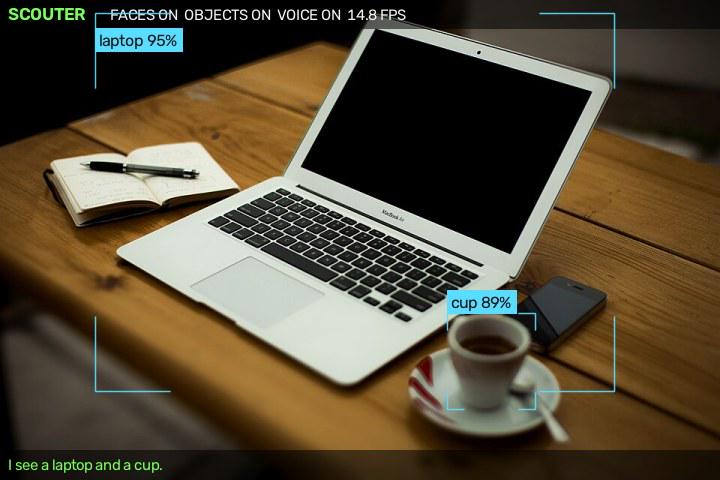
Showcase Scouter 2: a small Python app that recognises people and objects through a webcam and says what it sees (YuNet + SFace + YOLOX, all through OpenCV)

Post image
0 Upvotes

I rewrote an old Raspberry Pi project of mine that never worked. Now it:

  • recognises enrolled faces (YuNet detection + SFace embeddings, cosine match)
  • detects the 80 COCO object classes with YOLOX-S via cv2.dnn
  • speaks what it sees, with rules so it doesn't nag: greet a person once per 30 s, debounce unknown faces, confirm an object over two passes before naming it
  • runs object detection on a background thread so the video and greetings stay smooth

Only dependencies are opencv-python, numpy and pyttsx3. The models download from the OpenCV zoo on first run.

Code: https://github.com/heditrigui/scouter-2

I'd love ideas on making it lighter for a Pi 3 (YOLOX-S at 640 is heavy).


r/computervision • • Oct 24 '26

Help: Project Looking for a Teammate for the Nebius × NVIDIA Global AI Hackathon

Thumbnail reddit.com
0 Upvotes

r/computervision • • Oct 24 '26

Showcase Event Camera Representations: An Interactive Explanation

Thumbnail
youtube.com
2 Upvotes

Here’s the next tutorial in my event camera series. It explores different ways to represent raw event data so that algorithms can use it.

Try the interactive examples in the full blog: https://www.pattarsuraj.com/blog/event-camera-representations

#computer-vision #neuromorphic #event-camera


r/computervision • • Oct 24 '26

Commercial How did you decide what images to collect for an inspection project?

0 Upvotes

I'm taking part in TUM.ai E-Lab and exploring a project around real-world data collection. I'd like to understand how people working on industrial vision decide what data they actually need.

Thinking of a recent inspection project, what were you trying to detect, and what images did you start with? Was that data enough, or did something important only show up when you tested on the production line?

What did you do next, and how did you judge whether the resulting dataset was good enough? An example where existing images worked and you didn't need more collection would help too. No need to name your company or share confidential details.


r/computervision • • Oct 23 '26

Help: Project Looking for a Teammate for the Meta Global AI Developer Hackathon — Computer Vision / Medical AI

12 Upvotes

Hey everyone! 👋

I'm participating in the Meta Global AI Developer Hackathon and looking for a teammate interested in computer vision and biomedical image analysis.

The idea is to build an AI-powered tool that helps doctors and medical students analyze medical images, such as ultrasound and X-rays. The model could highlight suspicious regions, identify anatomical structures, extract useful measurements, and explain its findings.

I'm looking for someone with experience in deep learning and computer vision, especially training models on medical images, image segmentation, object detection, or classification. Experience with TensorFlow/PyTorch and medical imaging datasets would be a big plus.

And I'm also looking for one Full-stack developer with experience in Django or Flask , FastAPI etc etc

Interested? Drop a comment or DM me with a little about your experience and what you'd like to build together. Let's make something impactful! 🚀


r/computervision • • Oct 24 '26

Help: Project Computer Vision Research Collaborator

1 Upvotes

Hi! I recently graduated and completed my undergraduate thesis in computer vision particularly in medical image segmentation. I’m now looking for opportunities to get involved in research and collaborate with people working on computer vision deep learning or AI-related projects.

To be honest, I’m still at an early stage in my research journey, and I have a lot to learn. However, I’m genuinely interested in research, willing to work hard, and open to guidance, feedback, and learning from more experienced researchers.

I’m particularly looking to join ongoing research projects with the goal of contributing to work that could lead to publications in journals or conferences. I would love the opportunity to work toward co-authorship by making meaningful contributions to a research project.

I’m not looking for an opportunity because I already know a lot. I’m looking for one because I want to learn, improve my skills, and gain real research experience while contributing whatever I can to a team.

If you’re open to collaborating with someone who’s eager to learn and willing to put in the work, please feel free to DM me. I’d really appreciate the opportunity! Thank you!


r/computervision • • Oct 24 '26

Help: Project "BlueprintML", A community for learning ML through paper implementations and reproducible research

Thumbnail reddit.com
1 Upvotes

r/computervision • • Oct 24 '26

Showcase Pasma: open clothing classifier with ONNX/CoreML exports and a browser-local demo

1 Upvotes

I'm working on Pasma at Vestes Archive, a compact clothing classifier for single-garment photos in wardrobe applications. The code and fitted weights are open under Apache-2.0, with upstream notices retained.

The model predicts 20 garment types, aggregates them into 6 categories, and provides 21 visual material scores. Small/Nano use EdgeNeXt; Pico uses ConvNeXt. The exported graph includes normalization; the inference example handles aspect-ratio-preserving letterbox preprocessing.

Small-320 scored 89.12% type Top-1 and 97.10% Top-3 on 1,103 held-out real images in the saved PyTorch FP32 evaluation. The model card documents splits, baselines and limitations. The dataset is private, so full independent reproduction isn't possible from this release. Comparisons against zero-shot CLIP/SigLIP aren't equal-training comparisons.

The browser demo runs ONNX locally: your photo stays on your device. First use downloads FP32 weights (~20–33 MiB depending on variant) and runtime. The 10.32 MiB size applies to Small/Nano FP16 exports, not the browser download.

Known limits: blouse/shirt confusion, no explicit unknown class, and uncertain material appearance. Material suggestions cannot verify fibre composition. Phone performance is unvalidated; published CoreML timings are from a Mac M2.

Demo: https://huggingface.co/spaces/Prikol5ist/pasma

Model and evaluation: https://huggingface.co/Prikol5ist/pasma

Source and 25-second walkthrough: https://github.com/prikol5ist-art/Pasma

I'd appreciate feedback on failure cases and the integration contract. If you try it, your browser/device and whether Top-3 was useful would help; no need to share a private photo.