r/computervision • • 19d ago

Showcase Face matching that only proposes and lets classmates confirm: notes from InsightFace on school photos

3 Upvotes

I ran InsightFace over my old school batch's photo archive (I'm an ex-student, doing it unpaid). Cosine scores for confident matches sat between 0.42 and 0.82, median about 0.59, so lots of faces end up in a grey zone.

Instead of auto-labelling those, each one becomes a question the classmates vote on. Clustering the unknown faces first means one answer settles a whole group.

Demo with synthetic faces (press F for the boxes): https://smriti-gallery.pages.dev Code (MIT): https://github.com/codewithpom/smriti

Anything better than a plain threshold for the grey zone? PRs and issues welcome.


r/computervision • • 20d ago

Showcase Weight editing for computer vision tested

Thumbnail
gallery
23 Upvotes

Side project from this week. ResNet-50 learned some shortcuts on ImageNet, and I wanted to see if you can remove them by editing the last layer directly instead of retraining. Claude did the edits from the raw weights, about 5,000 weights changed, no gradients.

Two cases that worked really well:

Seat belt: the model says "seat belt" for basically any photo taken inside a car, because it learned car interiors instead of the belt. After the edit, a selfie in a car with no belt went from 98% "seat belt" to under 1%, and a dog actually wearing a seat belt still gets "seat belt" at 99%.

Snorkel: anything underwater got called "snorkel". After the edit, a swimmer with no snorkel went from 100% to under 1%.

Not free though, some real photos break and a proper retraining method (DFR) still does better overall. Second image has the comparison.

Code: https://github.com/kevinpl07/weight-patching

Write-up: https://kevinpl07.github.io/weight-patching/#vision


r/computervision • • 19d ago

Help: Project Title: First-year engineering student working on an AI-based face recognition project for people with amnesia – Looking for guidance and suggestions from experienced developers

0 Upvotes

​

Hi everyone!

I'm a first-year engineering student currently working on a project focused on assisting individuals with amnesia, and I'd really appreciate some guidance from senior engineers, developers, or anyone experienced in computer vision and AI/ML.

**The problem I'm trying to address**

People experiencing amnesia may sometimes struggle to recognize familiar individuals, including family members and people they interact with regularly. This can make everyday social interactions confusing and affect their independence.

My idea is to develop a laptop-based assistance system that can help them identify familiar people through facial recognition.

**How I'm planning to build it**

I'm currently planning to use the following technologies:

**Python:** Main programming language.

**OpenCV:** For real-time face detection through a webcam.

**Haar Cascade:** For detecting faces in the webcam feed.

**LBPH Face Recognizer:** For training and recognizing familiar faces.

**Webcam:** To capture live images and identify known individuals.

**Text-to-Speech (TTS):** To provide audio feedback by announcing the recognized person's name.

**Proposed workflow**

The system captures live video through the laptop webcam.

OpenCV detects faces in the video feed.

We collect and store multiple images of five family members, with their permission.

An LBPH face recognition model is trained using these images.

When a familiar person appears in front of the camera, the system compares their face with the trained dataset.

If a match is found with sufficient confidence, the person's name is displayed and announced through text-to-speech.

If the face is unfamiliar or recognition is uncertain, the system should avoid making an identification.

**My current progress**

I've successfully:

Installed Python and OpenCV.

Set up the project using Python IDLE.

Loaded the Haar Cascade XML model.

Implemented real-time face detection through my laptop webcam.

I'm currently moving towards the face recognition stage.

**Where I need your advice**

I'd love to hear your thoughts on a few things:

Is Haar Cascade + LBPH a reasonable combination for a beginner-level prototype, or would you recommend a different approach?

How can I improve recognition accuracy under different lighting conditions, angles, and facial expressions?

How should I handle situations where the system incorrectly identifies someone?

Are there better ways to manage the dataset and train the model?

What additional features would make this project more useful in real-world situations?

Are there any important limitations or ethical considerations I should account for when developing something intended to assist people with memory-related conditions?

I'm working with a limited budget and trying to build a functional prototype using primarily software and a laptop webcam, without wearables or expensive hardware.

I understand that this is only an assistive prototype and not a medical solution. Privacy, consent, and avoiding incorrect identifications are important considerations.

Since I'm still learning computer vision and AI/ML, I'd genuinely appreciate suggestions, alternative approaches, resources, or even criticism of the current architecture.

**Thank you! Any guidance from people who have worked on similar projects would be incredibly helpful.**


r/computervision • • 19d ago

Help: Project Region outlining

0 Upvotes

For a downstream object detection problem, i'm trying to outline a a region where the detected objects would be ignored

What is the current best practice for creating such outlines? I have CCTV images of fenced areas, i'd like some kind of polygon or seperating line between what is considered inside (fenced) and outside. fence can be hidden behind things such as structures, cars, overgrown plants etc.

No manual labeling (ok if for training) - cameras get moved around and there are thousands of such cameras

Cameras are sometimes located inside, and sometimes outside of the shed- so a simple fence detector is not sufficient. It really is a sort of image understanding problem, with lots of variance between each camera.

will finetuning a small VLM work for this specific task work?


r/computervision • • 19d ago

Discussion When PGD attacks fail, is your model actually safe? I tested empirical robustness vs. exact SMT proofs (Marabou) on traffic signs

Thumbnail
reddit.com
1 Upvotes

r/computervision • • 20d ago

Showcase I ran a label checker on 6 public YOLO datasets: 15 brain MRI slices with visible tumors have no labels

7 Upvotes

I built a small open-source CLI, labelcheck, that scans YOLO/COCO datasets for label mistakes and writes an HTML report with the bad boxes drawn on thumbnails.

To see whether it finds anything real, I ran it on the ready-made datasets that Ultralytics hosts (coco128, brain-tumor, crack-seg, medical-pills, signature, african-wildlife; about 7k images). Then I checked every finding by hand.

  • brain-tumor: 15 training images have no label file. When I opened them, every one shows the same bright lesion that is boxed on neighbouring slices of the same scan. YOLO reads a missing label file as "nothing here", so these images train the model to treat tumors as background. (Reported upstream: https://github.com/ultralytics/ultralytics/issues/27066)
  • crack-seg: 7 cracks are traced twice, repeated across augmented copies. There is also one image with two obvious cracks and an empty label file.
  • coco128: 2 images have no labels, and 2 label files have no images.
  • The other three: clean.

I found no false alarms on these, but it is still a small test, so I would love to hear where it breaks on your data.

pip install git+https://github.com/therealclvn/labelcheck@v0.1.0

(Not a radiologist. "Visible lesion" means it looks like the labelled slices next to it.)


r/computervision • • 20d ago

Discussion My free, open-source keyframe extractor for COLMAP and Gaussian Splatting just got easier to install

6 Upvotes

I've been working on this open-source tool for extracting motion-adaptive keyframes from video, primarily for photogrammetry and Gaussian Splatting workflows. Thought it might be useful to people here too!


r/computervision • • 20d ago

Help: Project Beginner: How to start Autonomous/Motion Planning projects without hardware?

2 Upvotes

For reference I'm a first-year student interesting in AV and Robotics. For some time, I won't have access to hardware or a strong computer. I can run Python and possibly a very light simulator if needed.

I'm primarily interested in building the intelligence behind AV and Robotics, and I'd love to start teaching myself / making projects related to Motion Planning and Computer Vision in these fields.

Most things I find online are hardware adjacent---are there any projects I can work on that are relevant / impactful and Computer Science specialized?


r/computervision • • 20d ago

Showcase I built an API and Swift SDK for Gaussian Splatting

Thumbnail
splat-3d.com
2 Upvotes

r/computervision • • 20d ago

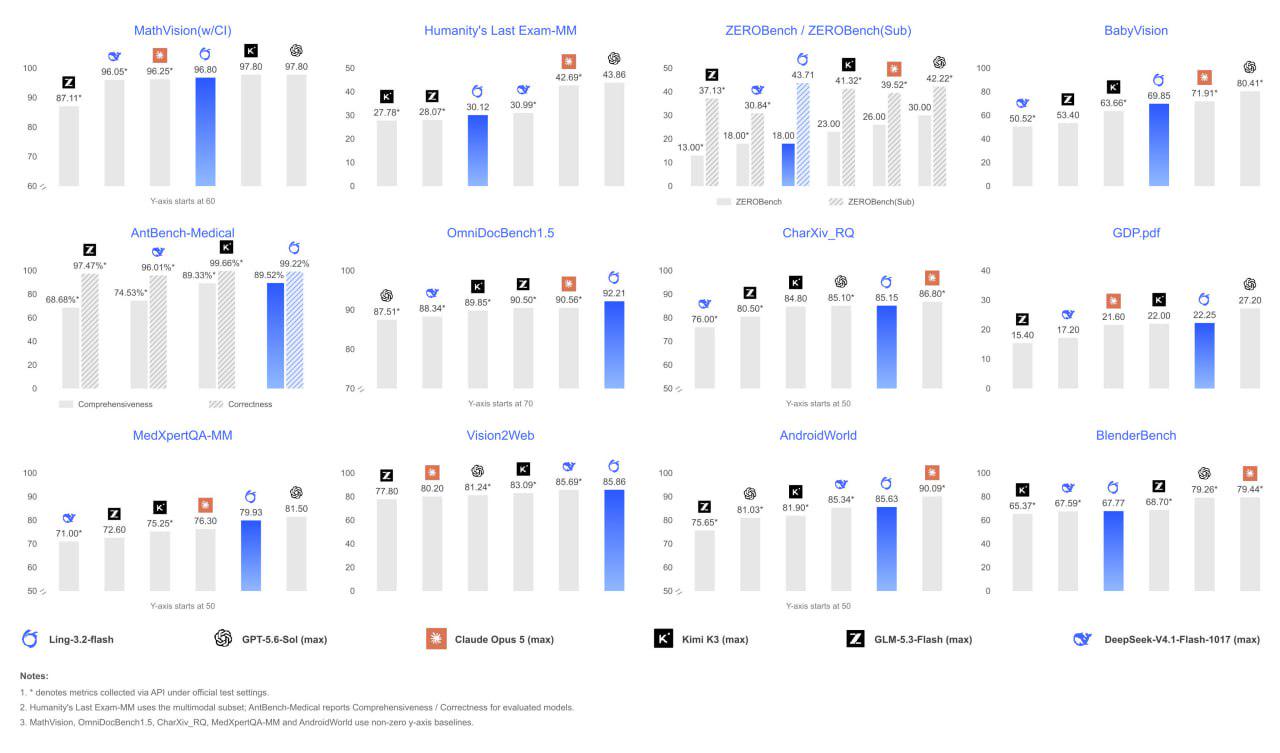
Discussion Ling-3.2-flash reports 92.21 on OmniDocBench 1.5 and 85.15 on CharXiv_RQ

Post image
2 Upvotes

Ant Ling's new multimodal release has two useful document-and-chart results to read together: 92.21 on OmniDocBench 1.5 and 85.15 on CharXiv_RQ.

The comparison goes in different directions across the two tasks. The release chart puts Claude Opus 5 (max) at 90.56 on OmniDocBench 1.5 and 86.80 on CharXiv_RQ. That gives a more specific view of the model's visual capabilities than collapsing everything into one rank.

Ling-3.2-flash is a 560B-total, 25B-active native multimodal MoE. Alongside the evaluations, Ant Ling demonstrates reading research-PDF figures and equations and using that content to implement an algorithm. The model's documented inputs include text, images and video.


r/computervision • • 20d ago

Research Publication Beginner researcher here. Teach me how to find the data, methods & findings in papers

1 Upvotes

Hi everyone!

I'm working on my first research paper as a CS student. I've just chosen a topic that interests me and started working on the title, research plan and problem identification.

My topic is:

Domain : BLOCKCHAIN

Sub-Domain : PQC(POST-QUANTUM CRYPTOGRAPHY)

Co-Domain : IoT devices / Embedded devices

My supervisor asked me to find 20 previous research papers related to my area of interest and prepare a summary of each paper, covering the following aspects:

- Data used

- Methods used

- Key findings

- References

However, as a beginner, I'm struggling to understand how to identify the data used, the methods applied, and the findings in previous research papers.

Could anyone suggest how I should approach this task or guide me on where and how to start? I'd really appreciate any advice, resources, or guidance from those with research experience.

I'm completely new to academic research, so any assistance would be greatly appreciated.

Thanks in advance!


r/computervision • • 21d ago

Showcase Calculating the risk of vehicle hitting jaywalker via an embedded, visionAI implementation.

3 Upvotes

Continuing from previous post of wanting to make an improvement off previous script, where we said one of a more practical implementations will be to analyse the risks of moving vehicle hitting jaywalker.

Adding hit score as below:

The score answers: "How dangerous is this vehicle to this jaywalker right now?" on a 0-99 % scale, for every vehicle-jaywalker pair on screen.

It is a risk index built from rules, not a statistically calibrated probability. There is no crash data behind it, and 80 % does not mean "8 in 10 such situations end in a hit". It is designed so that:

  • it rises smoothly as danger grows and falls as danger passes;
  • an imminent hit always reads high (above 75 %, shown in red);
  • harmless situations stay low.

The range is strictly 0 to 99 %. 100 % is never shown, because the system cannot be certain a hit will happen.

Input to this analysis will be : 1) Distance; 2) Speed; 3) Direction.

The formula

Stopped vehicle (speed 0, or not yet known):

score = 99 x exp(-d / 5 m) x 0.4

A stopped vehicle cannot hit anyone, but a jaywalker right next to one is still in a risky place (it may pull away). So the score is capped at 40 % (RISK_STATIONARY_WEIGHT).

Moving vehicle: the score is the highest of three measures:

1. Proximity      99 x exp(-d / 5 m)
                     x (0.7 + 0.3 x min(1, km/h / 30))      slower = a little lower
                     x (1 - 0.5 x how directly it is driving away)

2. Time to        99 x exp(-TTC / 1.5 s)
   contact        where TTC = d / (speed towards the jaywalker)
                  (only while the vehicle is closing in)

3. Near floor     if d <= 1 m:  80 % at 1 m, rising evenly to 99 % at contact

Not yet a field test, will conduct actual field test on actual road soon for real data.

(A noticeable bug, count of jaywalkers not tally with J ID. will fix in next version).

Suggestions/Comments welcome on what else need to be considered for the formula.

previous posts:

part 1: https://www.reddit.com/r/computervision/comments/1xliui4/a_project_to_identify_jaywalker/

part 2: https://www.reddit.com/r/computervision/comments/1xnhuh9/testing_the_project_jaywalking_on_the_actual/


r/computervision • • 20d ago

Discussion The unglamorous side of scaling perception models: why edge cases still break automated pipelines

Post image
0 Upvotes

r/computervision • • 21d ago

Help: Theory Best Resources to Learn How to Build Datasets for Training

10 Upvotes

Just wondering how people gather the intuition to build their datasets. I have been going based in vibes so far and I don’t know if vibes are enough to make a good robust dataset. I guess I don’t know yet how to even validate whether the data I took for a CNN is even contributing much if I have a diverse dataset with completely different scenes.

For example if I’m trying to guess what city I’m in based on a photo I would take the buildings from the skyline but I’d also take corner stores. This might be too diverse? There’s a huge difference between whwt the suburbs and downtown look like and in some cases there could even be a castle. This might be a poor example but it’s something I tried with not much success.

Was hoping for good resources or tips that will help teach you this.


r/computervision • • 21d ago

Discussion How do you build visibility through open source contributions?

5 Upvotes

I’m an MSc CS student with a background in 3D computer vision, trying to figure out how to build visibility and credibility in the AI/ML community.
I’ve been thinking about contributing to established open source projects rather than building standalone GitHub projects. Honestly, the latter feels like a weaker signal nowadays, especially with AI tools making it easier than ever to build things.
For those working in 3D CV, ML or applied AI, how would you approach this? What are the current challenges for new contributors, and how do you find projects where meaningful contributions can actually get noticed?
Would be interested to hear about your experiences.


r/computervision • • 20d ago

Showcase We built Adaver Convert any image into an editable SVG in milliseconds (Open Beta)

Thumbnail reddit.com
0 Upvotes

r/computervision • • 20d ago

Help: Project Football computer vision

Thumbnail reddit.com
1 Upvotes

Hello, I'm a broke engineering student and I would like to learn about computer vision in football. Do anyone know where can I find lives transmission or video records of football matches with normal or tactical point of view?


r/computervision • • 21d ago

Discussion 99.5% of AOI-flagged images were acceptable, are we making enough use of archived inspection images?

1 Upvotes

I do research and software engineering in the computer/machine vision area and I came across an interesting October 2026 study (linked, below) involving a real mixed-model SMT (Surface Mount Technology) production line.

The researchers evaluated 34,466 archived inspection images that had been flagged by a 3D Automated Optical Inspection (AOI) system for manual re-inspection.

Of those images:

  • 34,291 were considered acceptable after review.
  • Only 175 were recorded as defective.
  • That's approximately a 196:1 ratio of acceptable to defective images.

Importantly, the study used the AOI system's exported 2D color images, not its 3D height data.

The researchers evaluated several CNN classifiers, including ResNet and YOLO classification variants, to determine whether a secondary classification stage could reduce unnecessary manual inspection.

They reported configurations that reduced manual review workload by more than 98%.

However, there was an important tradeoff: the two reported configurations achieved only 78.3% and 89.1% defect recall, meaning some genuine defects would bypass manual review, if I understood it correctly.

An additional finding caught my attention: When the researchers excluded evaluation images from boards also represented in the training data, recall dropped to 73.7% and 87.7%, respectively. This was a post-hoc evaluation restriction, not a retrained board-grouped split, but it highlights the importance of avoiding shared-board exposure during model validation.

I think this raises a broader question about how we use historical machine-vision images.

Rather than retaining them only for troubleshooting individual failures, archived images could also be used to:

  • Reevaluate false rejects.
  • Compare updated classifiers against historical production images.
  • Investigate changes in classification behavior over time.
  • Evaluate false-accept versus false-reject tradeoffs before production deployment.

These seem like particularly useful applications for offline batch classification, especially when a trained model and an archive of production images already exist.

I started my career in mechanical engineering, but for 20 years since then, I have been doing software engineering, and am now looping back so, I'm interested in how others handle this in practice.

The broader question I'm interested in is whether manufacturers are fully exploiting the information already available in their historical machine-vision images.

For those working with industrial vision systems: Have you found measurable quality or operational benefits from analyzing archived inspection images beyond their original OK/NOK decisions?

For example, have you used historical images to reduce false rejects, investigate process drift, evaluate model updates, or identify previously missed defects?

Or is retrospective image analysis something that seems valuable in principle but is difficult to justify or implement in practice?

I'm particularly interested in what has actually worked, what hasn't, and what prevents more extensive use of historical image collections.

Thanks for your time in reading this! The article I referenced is linked below.

-----------------
Paper: Tian & Niu (2026), A Deep Learning Approach for Automated Re-Inspection of False Calls in Mixed-Production Surface Mount Lines Under Extreme Class Imbalance.

https://doi.org/10.3390/app162010068

Disclosure: I develop Dulce Free, a Windows application for running existing compatible ONNX image classifiers against folders of images locally. That's part of my interest in retrospective classification workflows. Dulce was not used in this study.


r/computervision • • 21d ago

Showcase Multi-agent autonomous robotic simulation with distributed context for identifying humans in distress(Opencv , Orbs-SLAM )

10 Upvotes

Quadruped robots search a burning house with no floor plan, joining their maps over a lossy radio with OpenCV 5 visual SLAM, so they can find survivors before firefighters go in.(github included)
Main Link


r/computervision • • 21d ago

Showcase I built a free iOS app using RT-DETR and OSNet for real-time people counting and tracking

9 Upvotes

I built CrowdFlux, a completely free iOS app that uses on-device computer vision to detect, track, and count people in real time.

Uses RT-DETR (transformer-based real-time person detection) and OSNet embeddings for person re-identification to help avoid double counting. Everything runs entirely on-device, with no cloud inference.

You can either start live tracking with your iPhone or iPad camera or import a recorded video.

The idea is to make people counting accessible without expensive CCTV analytics systems. Potential use cases include restaurants, clubs, retail stores, and events where you want to estimate how many people are present, monitor crowd levels, or analyze foot traffic.

The app tracks current visible counts, estimated unique visitors, and peak occupancy in the camera view.

It's 100% free on the App Store:

https://apps.apple.com/app/id6821608555

Would love feedback from anyone working on object tracking, re-identification, or edge AI!

PS - Credit - stock video from https://www.youtube.com/watch?v=9XYcSb-pAU4


r/computervision • • 21d ago

Discussion Frame polling, motion triggers or a streaming VLM: what should decide when a camera assistant speaks?

3 Upvotes

Thinking about a camera assistant that only talks when one specific thing happens, like "tell me when the package on the porch is gone". I can see three ways to decide when it speaks, and none of them is free:

  1. Send a frame to a VLM every few seconds. Easy to build, but cost scales with the polling rate and anything between frames is invisible.
  2. Use motion or a detector as the gate and only ask the VLM on a trigger. Cheap, but the gate has to know in advance what matters, and "the package is gone" isn't a class.
  3. Let a streaming model watch continuously and decide for itself when to say something. No gate to maintain, but you're now trusting the model's own sense of when the event happened.

That last part is what I can't settle. With the first two you can measure the gate. With a streaming model, how do you score "spoke at the right second" on your own footage? Hand-labeled event times and a tolerance window? MOSS-VL-Realtime, an open model that works this way, reports proactive alerting scores on public benchmarks, and I'd want the same kind of number from my own camera before picking an approach.

My guess is a detector gate still wins whenever the event fits a class, and streaming only earns its keep for events you can describe but not label.


r/computervision • • 22d ago

Discussion C++ Sky Tracker 1.1.0, free for students

270 Upvotes

Some time ago I posted here about Sky Tracker, back then it was still in test phase. Now its officially stable version with 2 main profiles, default for sky and correlation for the rest.

https://www.reddit.com/r/computervision/s/N8sVsBnirt

It has free demo apps for Windows, macOS and Linux so you can test it for free on your own videos. Also for students the license is free (for 1 year).

Default profile is based on template matching, correlation is… correlation 😄 But also has tiny ML option for more tough videos.

https://sky-tracker.deneb-systems.com


r/computervision • • 20d ago

Showcase I built an in-browser auto-labeler that exports YOLOv8, YOLO11, and Rotated OBB in 0.3s (Polytate)

0 Upvotes

Hey r/computervision,

Like many here, I’ve spent countless hours manually clicking bounding boxes in CVAT and LabelImg for custom object detection models.

I built **Polytate** (https://polytate.com) to solve this bottleneck with in-browser zero-shot AI vision:

  1. **Instant Zero-Shot Prompting**: Type any class name (`car`, `retail barcode`, `drone`, `face`), and it detects and bounds objects in ~0.38s.
  2. **Rotated YOLO-OBB Support**: Includes circular rotation handles and exports 4-corner normalized polygon coordinates (`x1 y1 x2 y2 x3 y3 x4 y4`) for oriented aerial, satellite, and robotic vision.
  3. **Ultralytics YOLO Ready**: 1-click export of structured ZIP archives (`images/`, `labels/*.txt`, `data.yaml`).
  4. **No Installation / No Docker**: Runs entirely in the web browser.

You can test it directly on the landing page interactive sandbox without signing in: https://polytate.com

Every signup gets 10 free AI credits to test on their own images. Would love to hear your feedback on the latency and rotated bounding box precision!