Hi everyone! I’m one of the authors of “When Does Latent Prediction Error Support Physical Surprise Claims in Video World Models?”, accepted at the World Models in Physical AI Workshop at NeurIPS 2026.
We study a question that comes up when evaluating video world models: if an event produces high prediction error, how much evidence does that give us that the model detected a violation of physics?
We examine frozen representations, latent geometry, and prediction errors using IntPhys2, Physion++, and controlled Kubric experiments. A few findings:
Physically impossible events can receive lower prediction error than possible ones.
Changing a clip’s colors can substantially affect error while preserving its physics.
Repeating a single frame can produce higher error than the original moving clip.
Physical information can be accessible in a model’s representations without its prediction error reliably tracking physical validity.
One particularly interesting test involves a sphere stopping on a solid support or falling through a gap. Switching the support changes which motion is physically possible, but the model’s error does not consistently follow that change.
We propose an evaluation framework for checking when prediction error supports a physical-surprise interpretation. The conclusions are specific to the models and settings we tested; they don’t establish an absence of physical knowledge.
For people working on video representations or world models: how do you separate sensitivity to physical violations from sensitivity to appearance and motion? I’d appreciate feedback on our controls and evaluation setup!
It’s pretty obvious that tuning a small model on actual surroundings yields much more accurate results for day-to-day activity. Even small/tiny models on dated architectures seem to do really well when looking at things they are familiar with.
My question is how does this relate to security when you are looking for events that are anything but day-to-day where you have no idea what people may look like, what the lighting may be at that moment, and where they will be coming from?
Are you better off sticking to a much larger pretrained model from the likes of Ultralytics or Roboflow? These don’t seem to make many mistakes with people. Compute resources are basically limitless with these tasks with modern NPUs and a detection pipeline that makes sense for the possible activity.
Couple of weeks ago I posted here about face shape results flipping between two labels with head angle. The advice was that the detector crop is probably jittering not the landmark plus one euro filter and median instead of mean.
If you have ever had to bundle OpenCV into a Docker container, deploy to an embedded target, or compile across platforms without wrestling with CMake and C++ shared library dependencies, you know how heavy the toolchain friction can be.
To make classic feature extraction lightweight and portable, I built pure-sift: an open-source, 100% pure-Rust library implementing Lowe's SIFT (Scale-Invariant Feature Transform, US6711293B1 patent expired in 2020), 2D Similarity RANSAC, 4-Point DLT Planar Homography, and an automated image stitcher with zero OpenCV or C++ dependencies.
I've been working on a personal robotics project and would be interested to hear what people on this sub think of my approach to the computer vision side of things.
The project is an open-source desktop companion robot. It uses a Raspberry Pi Pico W controls a two-axis servo neck, allowing the physical head to follow people.
The project's moved forward quite a bit: I've mounted a phone on for an animated face with pupils that run their own face tracking, and I have the pico running EMA smoothing, but the above video shows how the robot's CV works best.
The laptop handles all the processing, including the computer vision.
The tracking system has been one of the more interesting parts of the development.
My current approach works roughly as follows:
A fixed webcam observes the space around the robot.
People are identified and tracked using AprilTags that they wear.
The laptop scans for specific AprilTag IDs and uses MediaPipe to detect faces within an ROI around each tag.
I created two LOBFs through calibration, which convert the 2D coordinates of the face closest to the currently focused AprilTag into angles for the robot's servos.
These angles are sent to the Pico over serial.
If an AprilTag disappears, the script continues "coasting", retaining the previous ROI and using the last known AprilTag position.
If the face disappears, the script uses its previous momentum to predict where it should be.
The robot can also talk and listen, with its LLM and speech recognition running locally on the laptop.
One thing I'd eventually like to implement is speaker detection using mouth movement. The idea is that the robot could detect who's speaking and shift its attention towards them.
There's a complication with my current approach, though: because the script only looks for faces within the ROI around the currently focused AprilTag, it can only detect mouth movement from the person it's currently tracking.
I could change the script to look for faces and monitor speaking activity across every person wearing an AprilTag, but I'm not sure how efficient that would be, particularly given that the laptop is already running the LLM and other models.
I'm curious what people here think about the current approach and where I should take it next.
Would you handle the tracking or prediction differently?
Is it worth running face detection across all tagged people to identify who's speaking, or would there be a more efficient approach?
Are there techniques I should be looking at to improve tracking continuity when an AprilTag or face temporarily disappears?
The project is open source, and I'd welcome suggestions, criticism or contributions!
I've been a massive fan of Sir Roger Penrose's work for years, and I've always wondered if twistor theory (CP³) and 2-spinors could be translated out of theoretical physics equations into a practical, differentiable graphics pipeline.
As someone exploring this intersection with heavy AI co-piloting, I wanted to see if we could build a rendering engine that skips 4x4 Euclidean matrices entirely. Surprisingly, the math clicked: the engine uses native complex64 spinor conjugation and eigenspinor incidence residuals to do end-to-end 6-DoF pose recovery and depth shading out of the box.
What's shown in the image above: An end-to-end 6-DoF camera pose recovery test on a 3,500-vertex Stanford Bunny .ply scan. Starting from a heavily misaligned camera guess (Initial Guess), the engine optimizes both 3D position and SU(2) orientation purely from 2D pixel loss, converging to machine-precision zero loss in 150 epochs (Final Recovered vs Ground Truth).
Key Technical Highlights:
SU(2) Spinor Conjugation: Camera rotation is applied via unitary spinor conjugation (X_cam = R_A * X * R_A^†), keeping updates strictly on the manifold without gimbal lock.
Differentiable Depth Relief Shading: Computes signed longitudinal depth along ray spinors (Im(<pi | diff>)) to render smooth 3D studio lighting contours without a traditional Z-buffer.
Hardware Portability: Verified with identical convergence across Intel XPU (SYCL), NVIDIA CUDA, and CPU.
The result shown in Ant Ling's Ling-3.2-flash Grad-CAM demonstration is class-specific: the input image stays fixed while the selected class changes between boxer and tiger cat, changing the displayed activation heatmap.
The recording follows the model from reading the original research PDF through implementing the method and running it on CPU. In the final visualization, the requested class and the highlighted image regions can be inspected together. Switching the class exposes the different heatmaps produced for two labels on that same source image.
We built our owns models & free app because we weren’t happy with what else exists. The good apps are paid but slow, and often using TinEye. The free apps are often faster but accuracy is through the floor as soon as you get some glare.
I’m really pleased with what we’ve built. It can accurately detect dozens of cards from one image, spot many different variants of each card, and is resilient to glare and awkward angles caused by sleeves and binders.
How it works
A small card detector we trained ourselves, on a MobileNetV4-small backbone, finds every card in the photo, even rotated, overlapping or in a pile.
Each card is straightened and turned into a fingerprint by a fine-tuned DINOv3 ViT-S/16. That fingerprint is matched against about 100k reference images of cards in English, Japanese and Chinese.
Reprints often share the same art, so to tell them apart we read the collector number (OCR) and line the card up against our scans using classic computer vision (SIFT) to compare the small details.
First results appear in about 0.3s, and the full double-check finishes a second or so later. As the models improves, the double-check is finding even fewer places to correct.
We trained the models on cloud GPUs using many thousands of real card photos. We labelled those photos by hand at first with custom tooling, and once the models got good enough we only had to double-check their answers.
OPEN SOURCE
We built this for the love of the game, not to monetise people for $7 a week like many similar apps do. So we’re soon also open sourcing all of our models, the scanner index, and the card data :)
pennysleeve.app if you want to give it a try. We’re currently iOS only.
(App is 100% free without any ads, tracking, or subscriptions)
On my Mac, I'm currently vibe-coding a way of reading tablature for stringed instruments (guitar, etc.). Scanned/PDF tablature has staff lines, like conventional musical notation. However, the staff lines often intersect with numbers. This creates challenges for the under-the-hood OCR methods that are built into Apple. I've considered probabilistic as well as adversarial models but this is proving to be tough. The next step up would be a 500MB model which is too cumbersome for this small app. Does anyone out there have any ideas how to get more accurate recognition?
I know my lingo is probably all garbled and ignorant; forgive me, as I mentioned above, I'm an amateur.
Hi everyone What models are best for such a task: Is there a model that can perform region-level or object-level analysis on semantic segmentation outputs, extracting and analyzing specific regions of interest?
Not to segment, the masks and segmentation are done
We measured 602 timm ImageNet classifiers with TensorRT INT8 on five NVIDIA GPUs: L4, RTX 2080 Ti, Jetson AGX Thor, AGX Orin and Orin NX. Each line in the chart is a GPU's Pareto front.
The best model depends on the GPU. Of the 149 models measured on all five GPUs, only 2 are on every front.
PiT-B is the best choice on Thor (83.9% in 1.05 ms), but 2.3-2.8× slower than the front everywhere else.
ConvNeXt-B is on the front everywhere except the L4.
MobileNetV2-1.4 is on the front everywhere except Thor.
INT8 cost: a median of −0.76 top-1 against timm's FP32 numbers, across 609 models.
Method: TensorRT, batch 1, GPU compute only, timm default input size. Accuracy is measured on the full ImageNet val set.
Every model has its own page per GPU, with full numbers: https://embedl.com
I’m developing Holoscape, a Windows wallpaper app that uses webcam head tracking to update the viewpoint in a 3D scene.
Moving sideways reveals different parts of the forest, with nearby trees shifting more than distant ones. This creates the illusion of looking through a window.
What would you measure to evaluate how convincing the effect is, especially tracking latency and stability?
I have thousands of 2D plots saved as images, from where I need to extract x&y values in the most efficient way. Some plot may have multiple lines. Sonnet 5.5 is pretty good at it, but it takes >5 minutes per plot and consumes too much credits.
Does anyone knows a way of doing it more efficiently?
Thanks everyone!
Example: Need to extract F1 x&y . Red '+' were identified by sonnet.
Image 1: standard 3DGS with default-like settings, green cropped, no inverse rendering (I did not record the exact iteration count, so this is not a controlled comparison). It ends up with holes, spiky “urchin” splats and floaters. Images 2–3: my pipeline, built on the open-source 3DGS-MCMC code with added surface constraints and inverse rendering (albedo/roughness), 13.8M splats.
The source is a handheld smartphone video (about 1–1.5 minutes walking around the perimeter, 407 frames used). Only video was used — no LiDAR data, no survey. The code was developed entirely through AI co-development; I do not write code myself.
Measured on the final surface: holes cover about 0.7% of the area and floaters about 0.1%. The outer edge of the capture area is still rough. Mowing-line patterns show up in the height map and match the footage. Local vertical scatter is about 1.5–3.4 cm, relief about 27 cm over a ~38 m span including the fringe (scale is an estimate, ±10% or more).
Not verified yet: absolute accuracy (no comparison with terrestrial laser scans or RTK-GPS), the lighting separation, and other courses (only one green tried).
Feedback from anyone who has laser-scanned turf or benchmarked photogrammetry against ground truth would be very welcome.
Race photographers shoot thousands of photos per event, and runners usually have to scroll through all of them to find themselves. I built Race Photo Finder to fix that: point it at a folder of event photos, and runners can search by their bib number.
How it works
photo → person detection → bib detection + OCR → face embedding → participant match
YOLO26 finds each person, and a fine-tuned YOLO26s finds the bib inside the person crop
PaddleOCR reads the bib number
InsightFace (SCRFD + ArcFace) builds a face template for each runner, only from photos where their bib was read
Photos with a hidden, blurred or turned-away bib get matched to a runner by face, conservatively. Face matches never feed back into the templates, so one bad match can't snowball.
It all runs locally, with an SQLite index and a small web UI for searching. Once an event is processed, the search UI is a lightweight Flask app, so you can deploy it with its index to any Python web host or VPS and share the link with runners.
I have a live streaming app, and I need real-time skin smoothing + light retouching (dark circles, blemishes, eye brightening) in web browsers, on a live camera feed at 720p/30fps
What is the best commercial SDK to use that is battle tested? Or are there open source examples to build this on my own?
What if we could bring modern diffusion research together into one unified, extensible PyTorch framework instead of implementing and maintaining every algorithm in isolation?
That's the idea behind DiffusionEngine, an open-source project I've been building:
The goal is to build a modern DDPM framework that brings together established diffusion algorithms, research-based improvements, advanced sampling methods, and training strategies under a single, consistent pipeline.
The project already includes several diffusion implementations, and I'm actively working on extending the existing DDPM framework with more advanced features.
I'm looking for contributors interested in deep learning, generative models, PyTorch, and diffusion research.
Some areas where contributions are welcome include:
Implementing diffusion algorithms from research papers.
Improving existing DDPM components and training strategies.
Developing and integrating advanced sampling methods.
Exploring improved model architectures and conditioning mechanisms.
Testing, benchmarking, and optimizing existing implementations.
The focus is not just on implementing more algorithms. It's about making them work together seamlessly through a unified, modular, and configurable framework.
If you're interested in contributing, collaborating, or learning through hands-on implementation, I'd be glad to have you involved.
Contributors of all experience levels are welcome, provided they're willing to learn, implement, and test their work.
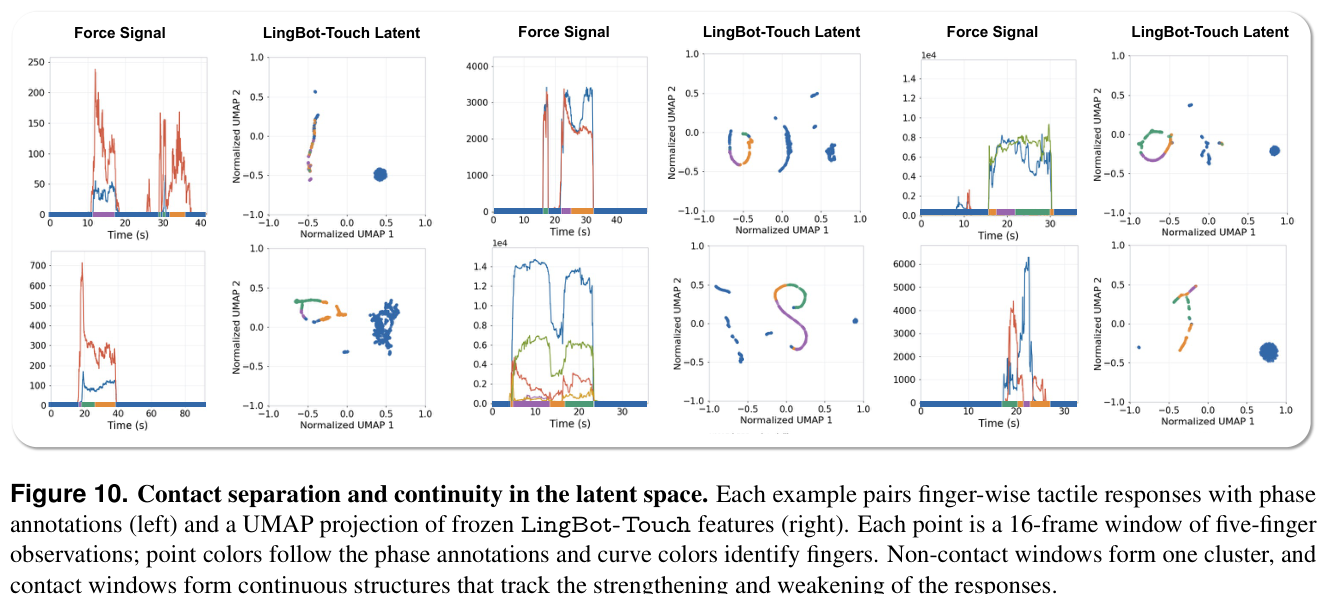
This is Figure 10 of the paper behind Robbyant's LingBot-Touch, released Nov 9. Each dot is a 16-frame window of five-finger touch, features averaged per finger and concatenated (3,840 dims total) before UMAP.
The pattern is clean: windows with no contact collapse into one tight cluster. Once something is being touched, points form smooth curves ordered in time, consecutive windows right next to each other. Different phases of a grasp sit on different stretches of the curve. So the features capture continuous variation during contact, not just a binary contact/no contact signal.
Worth noting for this sub: the Sharpa Wave fingertips are cameras filming a gel skin from the inside (240x240 deformation maps at 30 Hz), pooled into at most 200 virtual taxels so they share one token space with coarse 3x3 and 4x4 glove arrays and magnetic skins.
From touch alone, the frozen features retrieve the matching video clip in the top 5 72.6% of the time on Sharpa Wave and 47.1% on XHand1, whose magnetic sensor was never in pretraining.
Hello! I am a process engineer currently working in a manufacturing plant. I am recently foraying into use of computer vision models for safety applications. My team has developed a Yolo based computer vision software to detect humans. The software is working fine and accuracy is also good. But it requires too much computing power. This is creating an obstacle to scaling up. In a 8MB RAM/i7 processeor we are only able to run inference on 3 camera feeds simultaneously. Since I don't have computing background, I would to request suggest to me some Pre trained models which can inference with lower computing power. Please🙏
Right: Same cup floating above table → declared constraint WARN
To be clear: this is currently a naive 2D geometric constraint checker, not a real-world physics engine. Obviously, a cup in mid-air isn't always a model hallucination—it could be falling, being picked up, or thrown. A single static frame cannot distinguish between a dynamic action and a tracking/detection error. This is exactly why we’re extending it to temporal tracking: motion context lets us distinguish normal movement from true detection errors.
Hi computervision,
I've been building a small, training-free consistency auditing layer for object detection and segmentation outputs. The core idea: high detection confidence doesn't necessarily mean consistency with the scene's spatial constraints.
What works today
I have a reproducible prototype for 2D spatial constraint auditing. It checks user-declared geometric rules (e.g. cup:on:table) using detection boxes. It also includes optional Ultralytics YOLO and SAM2 adapters for detection and segmentation.
The synthetic demo runs with only NumPy and Pillow — no GPU, model weights, or model downloads required.
• It checks declared constraints, not automatically inferred physical rules.
• It's a 2D geometry checker, not a validated 3D physics or causal reasoning system.
• The algebraic features are experimental. Real-model inference and performance gains haven't been validated yet.
Why I'm extending this to object tracking
One problem that interests me: a bad association isn't necessarily just a single-frame error.
When a tracker updates its motion state or appearance embeddings with a wrongly matched detection, that error can bias future associations. In memory-based video segmentation like SAM2, incorrect masks can also affect subsequent propagation.
This becomes particularly difficult with similar-looking targets, occlusions, and detector jitter.
I'm exploring whether an independent temporal consistency auditor could flag suspicious associations before they're committed to persistent tracker state.
The first version would run in shadow mode, flagging suspect transitions without modifying tracker output.
If validated, later versions could explore pre-update gating — deferring uncertain associations, preserving predicted states, or requesting alternative matches.
I haven't implemented or validated the tracking extension yet. It will require integration with trackers like ByteTrack or BoT-SORT, and separate work for SAM2 memory handling.
I also recognize that motion continuity alone cannot resolve every ID switch, especially when nearly identical targets cross with similar trajectories.
Even a post-processing auditor could be useful for flagging suspect tracks for downstream analytics, human review, or offline re-processing — without modifying tracker internals.
Looking for real failure cases & collaborators
I'm particularly interested in developers working on sports tracking, crowded scenes, animal behavior, or industrial object tracking — especially where appearance-based matching becomes unreliable.
If you have a short video showing ID switches, ID reassignment, or track fragmentation, I'd love to collaborate.
Frame-by-frame detection boxes and track IDs would also be useful. Even descriptions of difficult failures could help identify test scenarios.
I'd like to compare this approach against standard motion gating and existing tracking baselines, measuring ID switches, false alarms, identity consistency, and runtime overhead.
A note on the math
The prototype implements standard Cayley–Dickson octonion multiplication and associator calculations, rather than treating eight values as an ordinary linear vector.
Whether these nonassociative features provide useful information beyond conventional geometry and motion features remains an open experimental question.
I'm not claiming an improvement over existing tracking methods yet. That's what I hope to investigate with real-world data.
If you've encountered stubborn tracking failures, or have suggestions about where to insert a pre-update audit without breaking tracker internals, I'd appreciate your feedback.
I'm a Machine Vision Engineer with 1+ year of experience in AOI for high-volume electronics manufacturing. I work with Cognex 2D vision systems, camera calibration, and deep learning models for defect detection, and spent 3 months onsite in South Korea.
Looking for Computer Vision / Vision AI / Machine Vision roles, preferably office-based or hybrid, in Bengaluru, Hyderabad, or elsewhere in India. Open to relocating.
Skills: Cognex VisionPro, Python, OpenCV, Deep Learning, AOI
If your team is hiring or you can refer me, please comment or DM.