r/computervision • u/nextjumpdevs • 4d ago
Showcase Jump rope world record analysis
23
Upvotes
Custom model for jump/rope tracking and counting + 3d pose estimation
r/computervision • u/NvGstPS • 4d ago
Hi cvisioners. I am CV freelancer. I made a wrapper program for faster CV pipeline prototyping, optimization, and launching with GStreamer, and then Claude visualized it. I pushed it this repo.
I thought that this can also useful for this community, especiallly beginners.
I am wondering your opinions too.
Best.
r/computervision • u/tenkei_01 • 4d ago
Recently I’ve been testing VLMs for auto-labeling (you might have seen my Qwen3-VL-2B or Qwen3-VL-2B vs 235B posts here).
So far, I have two main use cases:
I started with datasets that were easy to download and integrate. Now that the project is taking shape, I’m running into some limitations:
| Task | Current dataset | Limitations |
|---|---|---|
| Classification | CIFAR-10 | Tiny 32×32 images; only 10 classes. |
| Detection | COCO128 | Just 128 images from COCO’s training set; potential pretraining overlap. |
| Grounding | RefCOCOg | Limited testing of missing targets or ambiguity. |
| Attributes | OVAD | My adaptation uses 22 categorical groups, making it narrower than the original benchmark. |
| VQA | VQA v2 | Limited coverage of OCR, documents, and unanswerable questions. |
| Captioning | COCO Captions | Short references and overlap metrics can penalize valid descriptions and miss factual errors. |
I’m looking for datasets—or curated subsets—that are:
Basically, I’d love a small, thoughtfully selected evaluation set where the examples cover a useful range of cases. Recommendations for individual tasks are very welcome; it doesn’t need to be one dataset covering everything.
I may end up handpicking the subsets myself, but before doing that let me know if there is any existing datasets or curation efforts worth looking at?
r/computervision • u/PotentialNoise856 • 4d ago
I built LeanScene to index thousands of hours of video locally on a MacBook Pro.
Because it’s so lightweight, LeanScene runs completely client-side in the browser. The demo chains it with MobileCLIP to split long videos into shots and make them searchable by text, a full video indexing pipeline running locally with no server backend.
Standard shot transition detectors like TransNet V2 run 3D convolutions over overlapping windows of frames. That gets expensive fast and TransNet V2's PyTorch port doesn't run on Apple's MPS backend, leaving it at 152 FPS end-to-end on CPU.
Instead of 3D convolutions, LeanScene encodes each 100x100 frame once with a 4-layer 2D CNN alongside two simple pixel descriptors (a 64-bin joint RGB histogram and an 8x8 color thumbnail). A dilated 1D network (63-frame receptive field) then labels each frame as same, cut, or fade using those features and their explicit frame-to-frame differences.
A few numbers:
- Size & compute: 0.39M parameters (1.6 MB), 7.2M MACs/frame (115x fewer than TransNet V2)
- Speed (Apple M1 Pro): 5,171 FPS model-only on GPU (2,522 FPS end-to-end including video decoding and resizing); 1,000–2,091 FPS model-only on CPU
- Accuracy (5-seed mean F1 vs. TransNet V2): 97.4 vs. 96.1 on BBC Planet Earth, 79.1 vs. 77.7 on ClipShots, and 93.7 vs. 92.6 on RAI
Interestingly, scaling the 2D encoder up to 4x wider barely changed accuracy, most of the gains came from mining the model's false alarms on real footage and masking out high-confidence predictions so unannotated transitions weren't penalized as negatives.
Live browser demo:
https://lucasjackson.dev/leanscene/
Code, weights, and evaluation scripts:
https://github.com/lucasjacks0n/LeanScene
Would love to hear how it handles any tricky edits, flashes, or dissolves you throw at the demo.
r/computervision • u/_ullas • 4d ago
I’m a co-founder at GritWorks. We ran a small Docling CPU OCR experiment on 14 synthetic Latin-script pages (291 fields per condition). We blurred copies of the same pages and kept the expected values fixed. Field exact match went from 70.5% to 4.8% for EasyOCR and from 98.6% to 93.1% for RapidOCR. That’s one simulated blur setting, not a ranking of OCR engines or a test of real phone photos.
One thing I’d check before blaming recognition: the confidence filter. On a separate four-page check, lowering EasyOCR’s threshold from 0.5 to 0 cut blur character error rate from 81% to 28%. Small sample, but it’s a reason to inspect what the pipeline drops before comparing engines.
When you test blur, do you hold the confidence threshold fixed, or tune it per engine and compare at the same coverage?
r/computervision • u/mehdi-33 • 5d ago
I'm building a 2-axis gimbal with a visible and a thermal camera for a small fixed-wing drone, as my master's thesis. The clip is the CAD model: on the left the gimbal as it looks, on the right the same unit with the housing made see-through, doing the same moves.
I'm posting here because the mechanics are mostly settled and the vision side is where I'd like input before I freeze the hardware.
What the cameras get from the gimbal:
Two things I already know will matter for the image processing:
Questions for anyone who has worked with visible and thermal pairs, or with cameras on gimbals:
Thx!
- Amine Mehdi M.
r/computervision • u/TwinReplay • 5d ago
Technical stack info I can share about the 3D pipeline (works on regular handheld videos):
Bounding Box & Target Tracking: MediaPipe JS library running in the browser for lightweight 2D pose tracking, used primarily for accurate automated cropping and keeping the subject centered for downstream processing.
3D Mesh Recovery: A specialized 3D reconstruction model optimized for video sequences (operating on the cropped sequence), combined with a custom gravity and Inverse Kinematics (IK) pipeline to lock world orientation and adapt ground contact constraints. I use Meta’s MHR for the body model for an efficient body mesh model.
Temporal Alignment: Fast approximate Dynamic Time Warping (DTW) to handle frame synchronization across movements with different tempos/speeds.
Rendering: Three.js for 3D rendering. Activeframe for fast video scrubbing.
You can try it out for free at twinreplay.com with your own clips or check out the built-in interactive demos.
Would love to hear your thoughts or feedback.
r/computervision • u/iekmuby • 5d ago

Hey everyone,
A year ago, I decided to transition from web development into ML/CV. Instead of doing standard MNIST/COCO tutorials, I picked a real-world problem close to home: I have guinea pigs, and taking them to the vet for fecal exams is a slow, tedious process.
My goal is to build an assistive CV tool for vet lab technicians—something that scans microscope slides and highlights suspicious regions (with an eventual goal of exporting to ONNX for edge cameras).
For v1, I grabbed all the public datasets I could find (Chula, HEMIC, AI4NTD) and built a two-stage cascade (a fast binary detector to find parasite-like objects, followed by a fine-grained species classifier). On paper, the metrics looked great. In reality, the model completely fell apart on unseen data.
Here are the 4 biggest engineering traps I hit and what the numbers actually looked like:
In an early contour-based cascade, I tested the pipeline on 1,003 completely negative (uninfected) HEMIC frames. It hallucinated at least one parasite on 558 of them.
Why? Because the downstream classifier was forced to pick 1 of 11 parasite species—it had no "debris / air bubble / unknown" rejection path. Any false positive from stage 1 automatically became a confident diagnosis.
3. Tiling isn't optional for microscopy
Resizing a high-res microscope frame down to standard model input sizes destroys small eggs (some are barely 30–50px). On the other hand, fixed small crops slice larger eggs (like Ascaris) in half.
When I tried merging Chula and HEMIC to fix generalization, false positives spiked. Looking manually at the labels, many public datasets had incomplete annotations (e.g., 5 eggs on a slide, only 2 labeled), which actively punished the model for finding real objects. Plus, most public datasets focus on human parasites, missing key veterinary species.
What already worked & my pivot for v2 (Data-Centric approach)
Through iterative experiments, I found a few things that actually moved the needle before scrapping the old public datasets:
640x640) for empty negative windows drastically cut down false positives on uninfected slides.clipLimit=2.0, tileGridSize=(8,8)) to normalize local contrast across different microscopes.For v2, I'm building a clean dataset from scratch for 14 veterinary parasite classes (enforcing a ≥80px donor threshold so objects retain detail, while still validating on real 50–80px small targets). Right now, I'm deep in manual annotation—and preparing controlled experiments for mask-based copy-paste synthesis and localized Z-axis defocus blur (applying blur to confirmed hard negatives too, so the model doesn't learn a shortcut like "blurry = egg").
Next up, I'll share the messy reality of scraping microscopy videos for data and testing whether synthetic copy-paste actually improves recall on rare classes.
For those working with medical/microscopy CV: How do you usually handle domain shift across different camera setups, and what's your go-to strategy for hard negative mining on debris and air bubbles?
Note: The attached images are synthetic visual illustrations created to demonstrate the pipeline concepts (false positives on debris, CLAHE contrast normalization, and candidate review UI) without sharing restricted dataset files.
r/computervision • u/Significant_Neat_263 • 4d ago

I made this 3D green from phone video only (no LiDAR, no survey). Same model in all three pics, only the sun position changes.
Sun intensity 1, ambient light 0.25. The sun starts on the opposite side from the camera, then I rotate it: +90° (pic 1), -90° (pic 2), 180° (pic 3).
Pics 2 and 3 look flat to me. Pic 1 shows the slope better, but parts of it blow out. My guess is that a low sun from the side works best, but I'd like to hear what you think.
Where would YOU put the light? Is the ambient too low? Does this look like a real green to you, or does something look off?
Tell me what's wrong with it, I can take it. Just a hobby experiment, not a surveyed map.
r/computervision • u/atmadeep_2104 • 5d ago
Hi all,
I'm currently working on building a product for multiple industries where I want to perform surveillance using thermal cameras. I've got couple of questions regarding this:
r/computervision • u/No_Refrigerator_2987 • 4d ago
Hi everyone! I hope you're all doing well. Can I ask which AI tool you think is best for conducting research and writing the literature review for a thesis? Thank you in advance
r/computervision • u/TopExample1905 • 5d ago

I’ve been trying to get an edge camera to tell me what’s visiting my bird feeder after dark. I ended up with a few camera boards and a DIY IR setup, so I pointed all five at the same indoor scene to see how much detail each one could pull out.
The pair I was most curious about was the MaixCAM 2 and Seeed reCamera Pro. Both use the SmartSens SC850SL, and their frames looked noticeably different. The Pro kept more visible texture and color in this particular scene. You can see it best by flipping between the last two shots in the gallery.


I blacked out the room with curtains and tape. A Testo 540 and a DELIXI DLX-1805 both displayed 0 lux, though I could still see a faint bit of light leaking around the curtains. That’s the lighting condition for these shots. I didn’t measure the light below what the meters displayed.
I used the same tripod position and aimed at the same objects. Each setup used its factory lens, highest image-quality mode, and stock auto exposure. The lenses have different fields of view, so the framing varies a bit. Only the Raspberry Pi + OV5647 rig had an 850 nm IR illuminator running. I put a lights-on phone photo first so you can see what the cameras were looking at.
Here are the samples from this shoot test.


reCamera 2002:

CamThink NE301

OV5647 + IR fill light
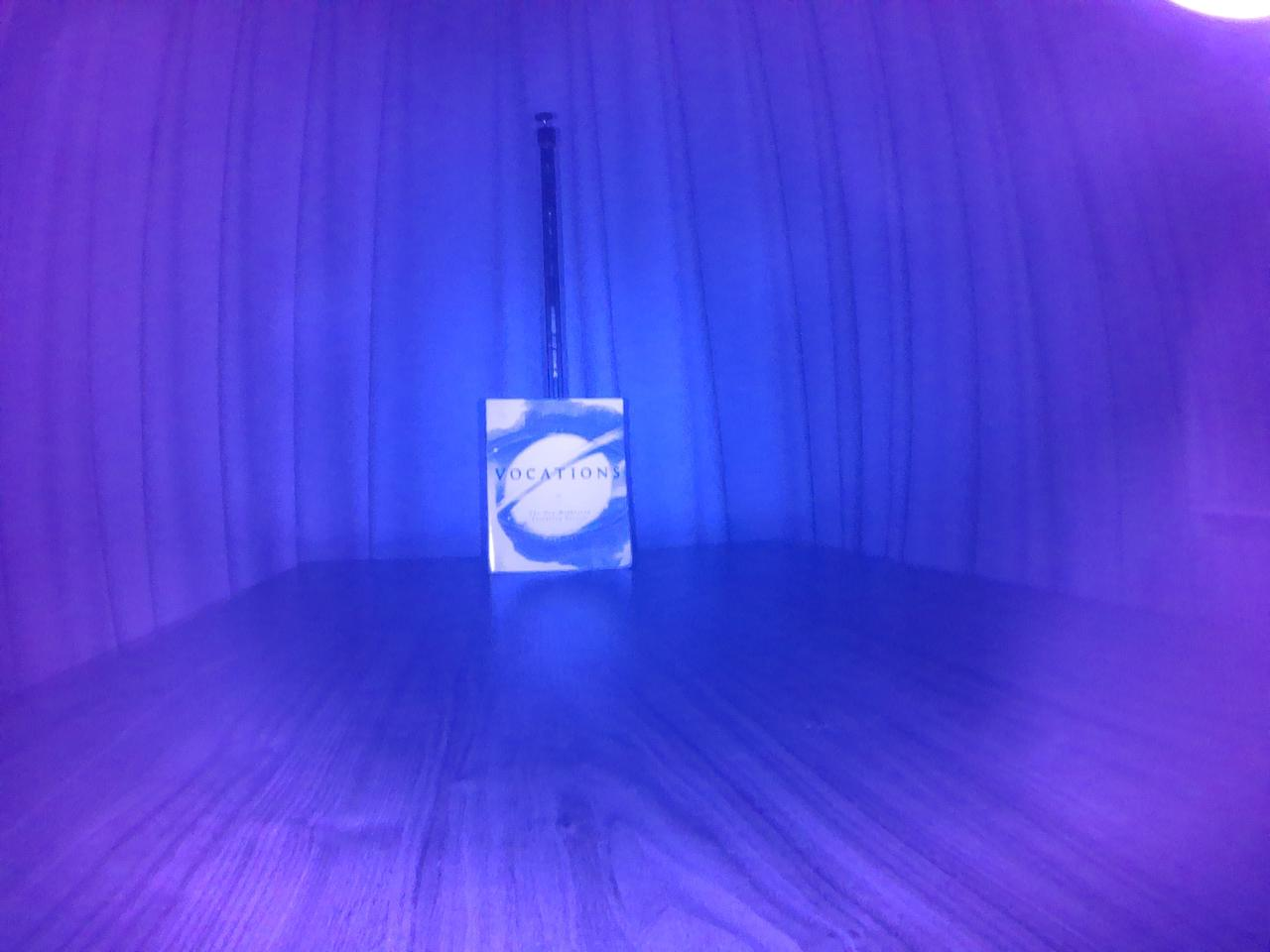
MaixCAM 2

reCamera Pro

I went in expecting the two SC850SL cameras to look fairly similar. With the stock settings, they didn’t. Between the factory lenses, auto exposure, gain, and ISP noise reduction, there are several things that could account for the difference. I didn’t match exposure or swap lenses, so all I can say from these frames is how the two complete setups behaved out of the box.
For the feeder project, the next thing I want to know is whether the extra visible detail actually helps the detector. This run was a still-image comparison. A moving animal adds motion blur, and a cleaner-looking frame doesn’t tell me how often the model will get the species right.
If you’ve tuned an 850 nm setup for a feeder or another close-range camera, what helped most with the hotspot? I’m curious how far people are placing the illuminator from the lens when the subject is close.
r/computervision • u/martincsweiss • 6d ago
I was tech chair for ICCV 2021, and had "root access" to the whole process, so I saw (and scrubbed) its barnacly underbelly.
The ICCV organization tried to combat fraud, plagiarism, and cheating, but it was not a fair fight. There were at that point no effective mechanisms for detecting and punishing authors who tried to gain an unfair advantage.
Academic ML needs better policies. And we need to get this right because society needs better ways to build consensus and seek truth.
I wrote this essay to share some meta-science analysis I did over the last few weeks on academic ML and a few policy ideas.
My hope is to engage in discussion about academic ML policy. I believe that the only way we make progress on this is to sample and refine ideas together. So I ask: what are the policies you'd like to see adopted by academic journals and conferences?
(I'm now a postdoc-entrepreneur at Mila with Hugo Larochelle and Chris Pal, working on meta-science, multi-agent games, and AI for science.)
r/computervision • u/FirstPrinciplesRobot • 5d ago
The core idea of VGGT (Visual Geometry Grounded Transformer; Wang, Chen, Karaev, Vedaldi, Rupprecht, Novotny, CVPR 2025), in text, for people who know the usual structure-from-motion pipeline but haven't read this paper:
The usual pipeline. Find the same features across photos, triangulate, then run bundle adjustment until the cameras and points agree. It is careful, and it is also a chain of steps: matching can fail on blank walls, shiny metal or repeating texture, and the solve can take a while.
The swap. VGGT is one feed-forward transformer that looks at the whole photo stack at once. That is the main difference from DUSt3R and MASt3R, which work on image pairs and then need a separate global-alignment cleanup (about 10 seconds a scene in the VGGT paper's telling). VGGT alternates frame-wise attention (within one photo) and global attention (across all photos) for 24 layers. Each frame carries one extra token that becomes the camera pose and intrinsics; the per-patch outputs become depth and a point map. Nobody wrote a triangulation step or a solver into the feed-forward path. It learned from seventeen collections of real and synthetic scenes where the cameras and geometry were already known.
Numbers, with context. The paper's main camera-pose test is RealEstate10K, held out of training, 10 random frames, AUC@30 (0–100), timed on one H100. A COLMAP+SuperPoint+SuperGlue baseline scores 45.2 in about 15 seconds. MASt3R scores 76.4 in about 9 seconds. Feed-forward VGGT scores 85.3 in about 0.2 seconds, about 45 times faster than MASt3R on that timing. If you then hand VGGT's guess to bundle adjustment as a starting point, the score goes to 93.5 in about 1.8 seconds. So the learned guess beats those baselines on this benchmark, and it is also a better place for the old math to start.
The fine print. "About a second" is for roughly 50 frames on a data-center GPU (about 1.04 seconds on one H100 in Table 9). 200 frames take about 8.75 seconds and 40.63 GB peak GPU memory on that same table — and those two figures are for the feature backbone only; each DPT head adds about 0.03 seconds and 0.2 GB per frame. Images are small, about 518 pixels on the long side (the Table 9 examples are 336×518). The output has shape, not true metric scale: it lives in the first camera's frame at a normalized scale. It does not support fisheye or panoramic cameras, it is worse under extreme rotations, and it fails on substantial non-rigid deformation. It is a fast first draft, not a survey.
For people who already run SfM: is a fast, scale-free first draft actually useful as a starting point for bundle adjustment, or is the missing metric scale the deal-breaker?
Paper: https://arxiv.org/abs/2503.11651 (arXiv:2503.11651, v1, Mar 14, 2025; arXiv non-exclusive distribution license). If you'd rather watch it, there's a 7-minute video version: https://youtu.be/CZngQrcpT4Y. Disclosure: it's our channel's video; narration and visuals made with AI tools; the script was researched and reviewed by the channel.
r/computervision • u/OliviaYii • 5d ago
Give an agent a few black-and-white drawings, access to Python, and an hour. Don’t explain the puzzle’s rules or tell it whether its guesses are correct. How far does it get?
That’s the setup behind Visual Cipher Bench, a new study from our research team at Einsia. It contains 40 original puzzles, and the best configuration tested reaches 26.7% accuracy.
One finding worth discussing: on a 10-task subset, stating the underlying mechanism raises pooled accuracy across three tested models from 12.2% to 51.1%. The hints give neither the answer nor intermediate states.
This points to a gap between discovering a rule from visual evidence and carrying it out once it’s known. I’d be interested in approaches that help agents generate and reject candidate rules using the clues already in an image.
r/computervision • u/tenkei_01 • 5d ago

I thought it would be interesting to see how Fable 5.2 would perform on some of the more traditional vision tasks. Considering its hefty price—an estimated $15.19 / 1,000 samples across the suite—I was expecting a lot:
Verdict: Mixed value
Definitely strong at detection, but there are cheaper alternatives that come close on several other tasks.
See the full results and cost comparison:
https://github.com/Tenkei/vlm-tasks/tree/main/benchmarks
r/computervision • u/SpectralAstraeus • 5d ago
I've been exploring Computer Vision, particularly Visual SLAM, 3D perception and reconstruction, through research oriented projects and open-source contributions (Open CV, Kornia and Apache Iceberg).
I'm looking to connect and collaborate with researchers, PhD students, postdocs or master's students working in these areas. I'd be interested in contributing to experiments, projects or ongoing research where my engineering background could be useful.
Also open to research guidance from people working in this space.
r/computervision • u/re_complex • 6d ago

project Iris is an experimental browser-based tool exploring how gaze-assisted communication can work using everyday consumer technology. The goal is simple but important: Can we make gaze-assisted communication accessible without specialized hardware?
High-end eye-tracking systems improve accuracy with dual-camera setups, higher frame rates, and infrared illumination. But the cost and logistical complexity of getting those devices into the hands of people who need them can create significant barriers to access.
While this project has evolved over the past 18-months, I recently dug up the original Python file that first made me believe in project iris. With only ~500 lines of code, it's pretty cool to look back and see just how far things have come.
I'm sharing an updated version of that file here in hopes that someone (or something**) might find it interesting and want to contribute or expand upon the project!**
A couple of ways to get involved:
Try the browser-based experience: https://www.projectiris.app/geoface
Explore the source code and experiment: https://github.com/racheleasen/iris_vision
This is an open-ended project, and there's plenty left to figure out.
r/computervision • u/kamesh_singh • 6d ago
I'm trying to build a golf ball tracking app similar to Shot Tracer and SmoothSwing. I've experimented with several open-source AI models, but I haven't been able to achieve reliable tracking accuracy.
The ball is tiny and moves very fast, making it difficult to track consistently across video frames.
I'm looking for advice from people experienced in computer vision, object tracking or ML:
I'm not looking for a basic YOLO implementation. I'd like to understand how to build a genuinely reliable tracking pipeline.
Any suggestions or experiences would be appreciated!
r/computervision • u/Savings_Durian3268 • 6d ago
Hi everyone,
I am working on a computer vision project for road damage detection using the RDD2022 dataset and YOLO (currently using YOLO11). I've hit a plateau with my baseline and suspect a few "bugs" in how the dataset is structured for deep learning. I am looking for advice on the highest-ROI optimization steps before I spend more GPU hours.
The Dataset (The "Bug"):
Current Results:
My Proposed Approaches (What should I prioritize?):
Question for the community:
If you had limited GPU hours (Colab/Kaggle), what sequence of experiments would you run to break past the 0.52 mAP50 plateau? Should I focus on the resolution, the model size, or the data processing first?
Thanks in advance for any insights!
r/computervision • u/FishermanResident349 • 5d ago

BlueprintML: https://github.com/AbhinandanMandal/BlueprintML
Discord: https://discord.gg/RR5XhNhH4
r/computervision • u/rgc4444 • 6d ago
Hi everyone,
I’ve been collecting upcoming technical webinars in a public events directory, and a few sessions may be useful to people working on industrial computer vision:
• November 24 — A3 / LMI Technologies: 2D and 3D vision for manufacturing and logistics, including robot guidance and inspection. This session is in Spanish.
• November 25 — Siemens / Procter & Gamble: visual inspection use cases and the progression toward more autonomous production.
• December 3 — COMSOL Day: AI for Modeling and Simulation, with sessions covering synthetic training data, surrogate models, and digital twins.
I’ve organized these alongside other robotics and industrial AI events, with dates, times, short descriptions, and links to the organizers’ pages:
https://www.blackscarab.ai/events/virtual
Disclosure: I run Black Scarab, the site hosting the directory. It’s free to browse and doesn’t require an account.
Which recurring computer vision seminars or practical online workshops would you recommend adding? I’m particularly interested in industrial inspection, anomaly detection, 3D vision, and deployment on real hardware.
r/computervision • u/Oli_Bear • 6d ago
I’m working on my thesis and am genuinely curious how other researchers keep up with new papers. How do you decide which ones to skim and which ones to read in full?
I’ve been using LLMs to work through papers. I can get the main ideas quickly, skip sections that are less relevant to my work, and ask follow-up questions when something doesn’t click. It feels like a one-on-one discussion, and I often come away feeling like I understand the material better.
Still, I wonder what I’m missing by reading fewer papers end to end. How do you balance covering more ground with reading deeply enough to really understand the work?
r/computervision • u/tunisiangurl • 6d ago
Hi /computervision!
I work at Tech To The Rescue. We're a nonprofit that matches tech companies with NGOs on pro bono AI projects, and we’re looking for a company team to take this one on.
IFPRI, the International Food Policy Research Institute, runs picture-based crop insurance for smallholder farmers in India and Kenya. Field photos are reviewed by hand today. IFPRI wants a model that detects crop damage and estimates its extent, built into its Indian partner’s claims workflow. The starting point is more than 70,000 labeled photos from over 9,000 farmers.
Only companies can apply, so if this fits what your team builds, bring it to your CTO or founder.
We announce the match publicly and publish a case study about it once the project is done. Companies apply at Matching Day on 3 December. Link in the comments.