r/computervision • u/External_Shoulder_43 • 5d ago
Help: Theory help me!!!monocular depth estimation
0
Upvotes
我正在寻找一个想法,以解决在包含透明物体的场景中进行单眼深度估计所面临的挑战,并希望将其发展成一个研究项目。你有什么建议吗?
r/computervision • u/1017_frank • 6d ago
I’ve been building Repchek, a web app that counts reps and checks exercise form using your phone camera.
It runs entirely in the browser using MediaPipe.
A few things I learnt while building it:
My initial assumptions about joint angles were wrong. Real movements don’t always match what you expect, so I built a debug mode to record and analyse metrics from actual workout sessions.
Pose detection struggles with occlusion. For example, during push-ups, shoulders can appear closer together and wrists can disappear. I had to account for this using measurements captured at the start of a set.
Tracking the biggest person in the frame doesn’t always work. In a busy gym, that person might be the spotter. I added logic to identify and follow the person actually exercising.
Counting reps before someone is in position creates false positives. A readiness check helped solve this.
Repchek currently supports 13 exercises, including holds like planks and stretches.
Some limitations I’m still working on:
- Handling occlusion more reliably.
- Personalizing thresholds for different users.
- Testing newer exercises with real workout footage.
I’d appreciate feedback, especially from anyone who’s worked with pose estimation models.
GitHub: https://github.com/frankndungu/repchek
Try it live: https://repchek.fit
r/computervision • u/National_Honey_9225 • 6d ago
Looking for someone perhaps bachelor degree or master in AI who is willing to connect one hour per week to go through computer vision.I am following this book: Szeliski, R. (2022). Computer Vision: Algorithms and Applications, 2nd ed. Springer.
Need some coaching or some buddy to study together, any expert or someone who is studying and can hep
r/computervision • u/SpectralAstraeus • 6d ago
I'm exploring Computer Vision, particularly Visual SLAM, 3D perception and reconstruction, through research-oriented projects and open-source contributions OpenCV and Kornia.
Looking to connect with professors, researchers, PhD students and research groups working in these areas for potential research collaborations, contributing to ongoing projects or exchanging ideas.
I bring a software engineering background and hands on experience building and experimenting with these systems. Also open to research guidance from people in the field.
If you're working in this space, I'd be glad to connect.
r/computervision • u/No_Difference9752 • 6d ago
r/computervision • u/redado360 • 5d ago
Lecturer explaining resnet, vggnet, googlelenet and alexnet in cnn class.
I have no clue what is that ? I am concentrating 100% and still can’t catch up.
And how resnet is better than human being ?
And what is convolution is local connection plus weight sharing ? What does this mean
And what is the inductive bias : translation equivalent
r/computervision • u/pasticciociccio • 6d ago

r/computervision • u/Safe-Escape197 • 6d ago
so few days back i posted my tiny vision model here(https://huggingface.co/amartomar683/tiny-vision-flickr8k) and you guys actually checked it out, its at 74 downloads now 😅 thanks for that. after that one worked (kinda), i started wondering what else i can build from scratch on my mac, and a language model was the obvious next thing to try.
i was reading the Next-Concept Modeling (NCM) paper by Kumbong, Khare et al. (Stanford / Together AI, arXiv:2610.14162) and the idea really clicked for me. normal llms write one token at a time, but in NCM a VQ-VAE turns text into levels of codes, coarse to fine, and the model fills one full level at once. so i decided to build it myself from the paper, just to understand how it works from inside. all credit for the idea goes to them, i just implemented my own version.
its called tiny-ncm. its around 36M params (21M generator + 15M VQ tokenizer), trained completely from scratch, no pretrained weights. same macbook pro m5, but this time it took like 12 hours total instead of 42 min 💀
basic idea:
text → split in 32-token blocks → each block made coarse to fine in 5 levels (2 → 4 → 8 → 16 → 32 codes) → 6 passes per block instead of 32i trained it as a small daily assistant. alarms, reminders, timers, calendar, gmail (read only), weather, notes, web search, simple maths and little bit of small talk. there is a --show-levels flag which shows each block going from rough guess to final text, honestly this was the most satisfying part:
level 1: Hello! How can I help you today?
level 3: Hello Jordan, How I I you you today today?
level 5: Good morning! What can I do for you today?
some honest stuff:
23*10 😂 cause all codes in a level are predicted same time, so two positions can both write the same word.random thing i learned on mac (MPS):
next i am thinking to export it to onnx so it can run on phone also, and maybe connect tiny-vision with it. lets see what will happened.
code: https://github.com/amar683/tiny-ncm
model: https://huggingface.co/amartomar683/tiny-ncm
would love any feedback or tips, especially if someone played with NCM or coarse-to-fine text models
r/computervision • u/Friendly-Society3573 • 7d ago
Hi everyone,
I'm currently pursuing a research-based master's degree in computer vision and have the opportunity to transition directly (Direct PhD) into a funded PhD.
I'm trying to decide between two paths:
Option A: Complete my master's and enter industry earlier, focusing on computer vision, 3D perception, robotics or research engineering.
Option B: Continue into a PhD, spend approximately two additional years developing a stronger research portfolio, and potentially pursue an industry research internship before graduating.
My ultimate goal is industry rather than academia. I'm particularly interested in advanced ML engineering, research engineering and potentially industrial research-scientist positions.
I'm curious about how hiring managers and experienced engineers evaluate these two profiles.
For people working in CV/ML research or engineering:
I'd especially appreciate perspectives from people who have worked in industrial research or been involved in hiring.
Thanks!
r/computervision • u/SnappySkillz • 6d ago
Hi All,
So, I've been scratching my head for a week or so now on this problem. I need to predict certain pose estimates from an image.
The issues is that there is very limited real world data. But, I have very large synthetic datasets. I have tried a multitude of techniques, but keep coming back to the same problem, real world pose estimation is HORRIBLE, like as bad as the mean. Meanwhile, another synthetic dataset (different configurations) has like 98% accuracy.
To alleviate this, I've been following a paper from Microsoft: https://arxiv.org/pdf/1909.06993, where they use a cross-modal variation autoencoder with latent space constraints.
I literally have been using the same architecturs, but it is just doing rubbish on real world data. They claim that they are able to generalise very well, which can be seen from one of the latter images.
So, anyone know where I could be going wrong? Is there genuinely a problem in my pipeline? Or does it happen that their dataset works better for their task? I think their results are truthful.
Any help would be really appreciated as this is incredibly frustrating! Thanks!
r/computervision • u/nextjumpdevs • 7d ago
Custom model for jump/rope tracking and counting + 3d pose estimation
r/computervision • u/NvGstPS • 7d ago
Hi cvisioners. I am CV freelancer. I made a wrapper program for faster CV pipeline prototyping, optimization, and launching with GStreamer, and then Claude visualized it. I pushed it this repo.
I thought that this can also useful for this community, especiallly beginners.
I am wondering your opinions too.
Best.
r/computervision • u/tenkei_01 • 6d ago
Recently I’ve been testing VLMs for auto-labeling (you might have seen my Qwen3-VL-2B or Qwen3-VL-2B vs 235B posts here).
So far, I have two main use cases:
I started with datasets that were easy to download and integrate. Now that the project is taking shape, I’m running into some limitations:
| Task | Current dataset | Limitations |
|---|---|---|
| Classification | CIFAR-10 | Tiny 32×32 images; only 10 classes. |
| Detection | COCO128 | Just 128 images from COCO’s training set; potential pretraining overlap. |
| Grounding | RefCOCOg | Limited testing of missing targets or ambiguity. |
| Attributes | OVAD | My adaptation uses 22 categorical groups, making it narrower than the original benchmark. |
| VQA | VQA v2 | Limited coverage of OCR, documents, and unanswerable questions. |
| Captioning | COCO Captions | Short references and overlap metrics can penalize valid descriptions and miss factual errors. |
I’m looking for datasets—or curated subsets—that are:
Basically, I’d love a small, thoughtfully selected evaluation set where the examples cover a useful range of cases. Recommendations for individual tasks are very welcome; it doesn’t need to be one dataset covering everything.
I may end up handpicking the subsets myself, but before doing that let me know if there is any existing datasets or curation efforts worth looking at?
r/computervision • u/PotentialNoise856 • 7d ago
I built LeanScene to index thousands of hours of video locally on a MacBook Pro.
Because it’s so lightweight, LeanScene runs completely client-side in the browser. The demo chains it with MobileCLIP to split long videos into shots and make them searchable by text, a full video indexing pipeline running locally with no server backend.
Standard shot transition detectors like TransNet V2 run 3D convolutions over overlapping windows of frames. That gets expensive fast and TransNet V2's PyTorch port doesn't run on Apple's MPS backend, leaving it at 152 FPS end-to-end on CPU.
Instead of 3D convolutions, LeanScene encodes each 100x100 frame once with a 4-layer 2D CNN alongside two simple pixel descriptors (a 64-bin joint RGB histogram and an 8x8 color thumbnail). A dilated 1D network (63-frame receptive field) then labels each frame as same, cut, or fade using those features and their explicit frame-to-frame differences.
A few numbers:
- Size & compute: 0.39M parameters (1.6 MB), 7.2M MACs/frame (115x fewer than TransNet V2)
- Speed (Apple M1 Pro): 5,171 FPS model-only on GPU (2,522 FPS end-to-end including video decoding and resizing); 1,000–2,091 FPS model-only on CPU
- Accuracy (5-seed mean F1 vs. TransNet V2): 97.4 vs. 96.1 on BBC Planet Earth, 79.1 vs. 77.7 on ClipShots, and 93.7 vs. 92.6 on RAI
Interestingly, scaling the 2D encoder up to 4x wider barely changed accuracy, most of the gains came from mining the model's false alarms on real footage and masking out high-confidence predictions so unannotated transitions weren't penalized as negatives.
Live browser demo:
https://lucasjackson.dev/leanscene/
Code, weights, and evaluation scripts:
https://github.com/lucasjacks0n/LeanScene
Would love to hear how it handles any tricky edits, flashes, or dissolves you throw at the demo.
r/computervision • u/mehdi-33 • 8d ago
I'm building a 2-axis gimbal with a visible and a thermal camera for a small fixed-wing drone, as my master's thesis. The clip is the CAD model: on the left the gimbal as it looks, on the right the same unit with the housing made see-through, doing the same moves.
I'm posting here because the mechanics are mostly settled and the vision side is where I'd like input before I freeze the hardware.
What the cameras get from the gimbal:
Two things I already know will matter for the image processing:
Questions for anyone who has worked with visible and thermal pairs, or with cameras on gimbals:
Thx!
- Amine Mehdi M.
r/computervision • u/_ullas • 7d ago
I’m a co-founder at GritWorks. We ran a small Docling CPU OCR experiment on 14 synthetic Latin-script pages (291 fields per condition). We blurred copies of the same pages and kept the expected values fixed. Field exact match went from 70.5% to 4.8% for EasyOCR and from 98.6% to 93.1% for RapidOCR. That’s one simulated blur setting, not a ranking of OCR engines or a test of real phone photos.
One thing I’d check before blaming recognition: the confidence filter. On a separate four-page check, lowering EasyOCR’s threshold from 0.5 to 0 cut blur character error rate from 81% to 28%. Small sample, but it’s a reason to inspect what the pipeline drops before comparing engines.
When you test blur, do you hold the confidence threshold fixed, or tune it per engine and compare at the same coverage?
r/computervision • u/TwinReplay • 8d ago
Technical stack info I can share about the 3D pipeline (works on regular handheld videos):
Bounding Box & Target Tracking: MediaPipe JS library running in the browser for lightweight 2D pose tracking, used primarily for accurate automated cropping and keeping the subject centered for downstream processing.
3D Mesh Recovery: A specialized 3D reconstruction model optimized for video sequences (operating on the cropped sequence), combined with a custom gravity and Inverse Kinematics (IK) pipeline to lock world orientation and adapt ground contact constraints. I use Meta’s MHR for the body model for an efficient body mesh model.
Temporal Alignment: Fast approximate Dynamic Time Warping (DTW) to handle frame synchronization across movements with different tempos/speeds.
Rendering: Three.js for 3D rendering. Activeframe for fast video scrubbing.
You can try it out for free at twinreplay.com with your own clips or check out the built-in interactive demos.
Would love to hear your thoughts or feedback.
r/computervision • u/iekmuby • 7d ago

Hey everyone,
A year ago, I decided to transition from web development into ML/CV. Instead of doing standard MNIST/COCO tutorials, I picked a real-world problem close to home: I have guinea pigs, and taking them to the vet for fecal exams is a slow, tedious process.
My goal is to build an assistive CV tool for vet lab technicians—something that scans microscope slides and highlights suspicious regions (with an eventual goal of exporting to ONNX for edge cameras).
For v1, I grabbed all the public datasets I could find (Chula, HEMIC, AI4NTD) and built a two-stage cascade (a fast binary detector to find parasite-like objects, followed by a fine-grained species classifier). On paper, the metrics looked great. In reality, the model completely fell apart on unseen data.
Here are the 4 biggest engineering traps I hit and what the numbers actually looked like:
In an early contour-based cascade, I tested the pipeline on 1,003 completely negative (uninfected) HEMIC frames. It hallucinated at least one parasite on 558 of them.
Why? Because the downstream classifier was forced to pick 1 of 11 parasite species—it had no "debris / air bubble / unknown" rejection path. Any false positive from stage 1 automatically became a confident diagnosis.
3. Tiling isn't optional for microscopy
Resizing a high-res microscope frame down to standard model input sizes destroys small eggs (some are barely 30–50px). On the other hand, fixed small crops slice larger eggs (like Ascaris) in half.
When I tried merging Chula and HEMIC to fix generalization, false positives spiked. Looking manually at the labels, many public datasets had incomplete annotations (e.g., 5 eggs on a slide, only 2 labeled), which actively punished the model for finding real objects. Plus, most public datasets focus on human parasites, missing key veterinary species.
What already worked & my pivot for v2 (Data-Centric approach)
Through iterative experiments, I found a few things that actually moved the needle before scrapping the old public datasets:
640x640) for empty negative windows drastically cut down false positives on uninfected slides.clipLimit=2.0, tileGridSize=(8,8)) to normalize local contrast across different microscopes.For v2, I'm building a clean dataset from scratch for 14 veterinary parasite classes (enforcing a ≥80px donor threshold so objects retain detail, while still validating on real 50–80px small targets). Right now, I'm deep in manual annotation—and preparing controlled experiments for mask-based copy-paste synthesis and localized Z-axis defocus blur (applying blur to confirmed hard negatives too, so the model doesn't learn a shortcut like "blurry = egg").
Next up, I'll share the messy reality of scraping microscopy videos for data and testing whether synthetic copy-paste actually improves recall on rare classes.
For those working with medical/microscopy CV: How do you usually handle domain shift across different camera setups, and what's your go-to strategy for hard negative mining on debris and air bubbles?
Note: The attached images are synthetic visual illustrations created to demonstrate the pipeline concepts (false positives on debris, CLAHE contrast normalization, and candidate review UI) without sharing restricted dataset files.
r/computervision • u/Significant_Neat_263 • 7d ago

I made this 3D green from phone video only (no LiDAR, no survey). Same model in all three pics, only the sun position changes.
Sun intensity 1, ambient light 0.25. The sun starts on the opposite side from the camera, then I rotate it: +90° (pic 1), -90° (pic 2), 180° (pic 3).
Pics 2 and 3 look flat to me. Pic 1 shows the slope better, but parts of it blow out. My guess is that a low sun from the side works best, but I'd like to hear what you think.
Where would YOU put the light? Is the ambient too low? Does this look like a real green to you, or does something look off?
Tell me what's wrong with it, I can take it. Just a hobby experiment, not a surveyed map.
r/computervision • u/atmadeep_2104 • 7d ago
Hi all,
I'm currently working on building a product for multiple industries where I want to perform surveillance using thermal cameras. I've got couple of questions regarding this:
r/computervision • u/No_Refrigerator_2987 • 7d ago
Hi everyone! I hope you're all doing well. Can I ask which AI tool you think is best for conducting research and writing the literature review for a thesis? Thank you in advance
r/computervision • u/TopExample1905 • 7d ago

I’ve been trying to get an edge camera to tell me what’s visiting my bird feeder after dark. I ended up with a few camera boards and a DIY IR setup, so I pointed all five at the same indoor scene to see how much detail each one could pull out.
The pair I was most curious about was the MaixCAM 2 and Seeed reCamera Pro. Both use the SmartSens SC850SL, and their frames looked noticeably different. The Pro kept more visible texture and color in this particular scene. You can see it best by flipping between the last two shots in the gallery.


I blacked out the room with curtains and tape. A Testo 540 and a DELIXI DLX-1805 both displayed 0 lux, though I could still see a faint bit of light leaking around the curtains. That’s the lighting condition for these shots. I didn’t measure the light below what the meters displayed.
I used the same tripod position and aimed at the same objects. Each setup used its factory lens, highest image-quality mode, and stock auto exposure. The lenses have different fields of view, so the framing varies a bit. Only the Raspberry Pi + OV5647 rig had an 850 nm IR illuminator running. I put a lights-on phone photo first so you can see what the cameras were looking at.
Here are the samples from this shoot test.


reCamera 2002:

CamThink NE301

OV5647 + IR fill light
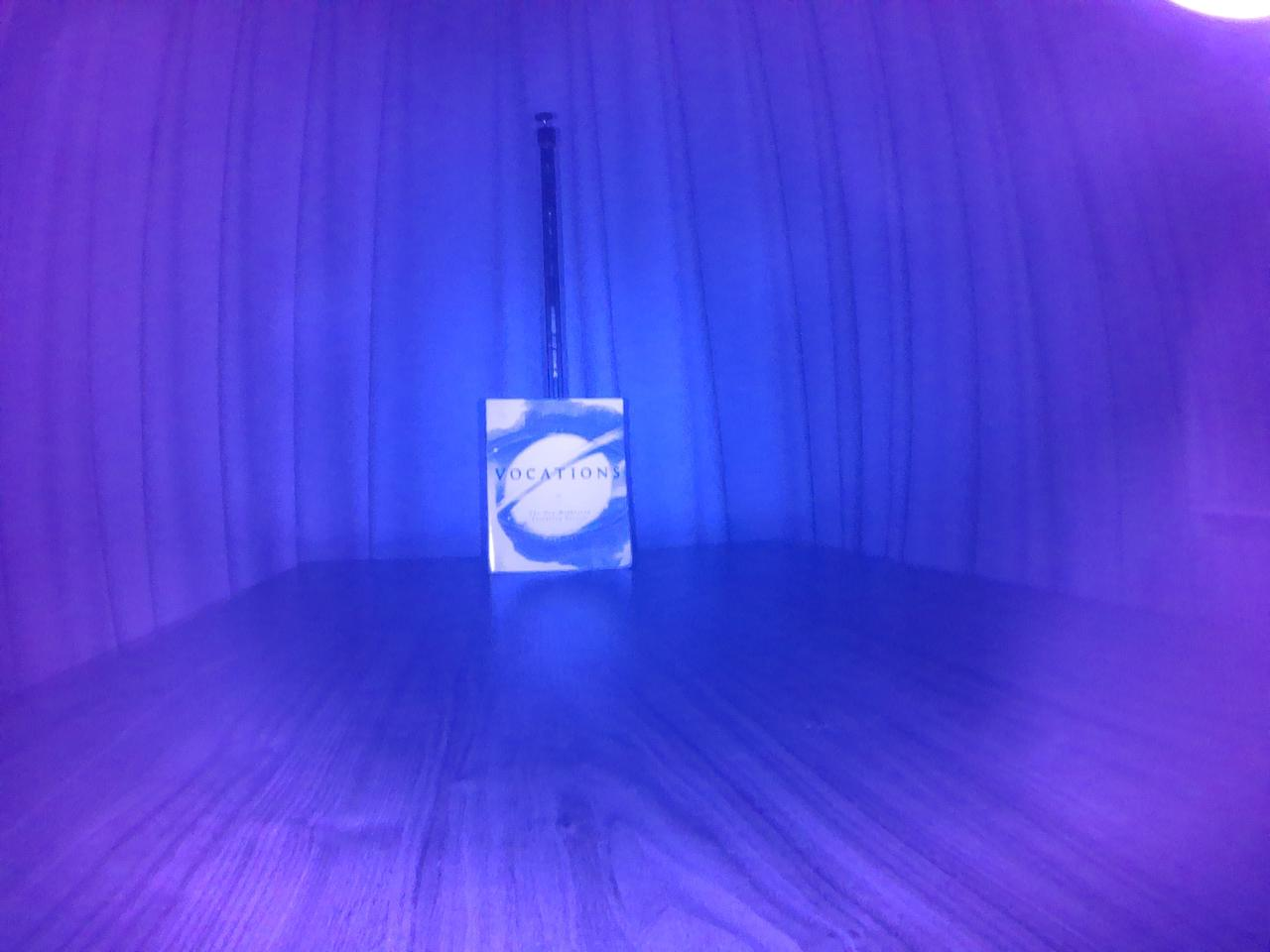
MaixCAM 2

reCamera Pro

I went in expecting the two SC850SL cameras to look fairly similar. With the stock settings, they didn’t. Between the factory lenses, auto exposure, gain, and ISP noise reduction, there are several things that could account for the difference. I didn’t match exposure or swap lenses, so all I can say from these frames is how the two complete setups behaved out of the box.
For the feeder project, the next thing I want to know is whether the extra visible detail actually helps the detector. This run was a still-image comparison. A moving animal adds motion blur, and a cleaner-looking frame doesn’t tell me how often the model will get the species right.
If you’ve tuned an 850 nm setup for a feeder or another close-range camera, what helped most with the hotspot? I’m curious how far people are placing the illuminator from the lens when the subject is close.
r/computervision • u/martincsweiss • 8d ago
I was tech chair for ICCV 2021, and had "root access" to the whole process, so I saw (and scrubbed) its barnacly underbelly.
The ICCV organization tried to combat fraud, plagiarism, and cheating, but it was not a fair fight. There were at that point no effective mechanisms for detecting and punishing authors who tried to gain an unfair advantage.
Academic ML needs better policies. And we need to get this right because society needs better ways to build consensus and seek truth.
I wrote this essay to share some meta-science analysis I did over the last few weeks on academic ML and a few policy ideas.
My hope is to engage in discussion about academic ML policy. I believe that the only way we make progress on this is to sample and refine ideas together. So I ask: what are the policies you'd like to see adopted by academic journals and conferences?
(I'm now a postdoc-entrepreneur at Mila with Hugo Larochelle and Chris Pal, working on meta-science, multi-agent games, and AI for science.)
r/computervision • u/FirstPrinciplesRobot • 7d ago
The core idea of VGGT (Visual Geometry Grounded Transformer; Wang, Chen, Karaev, Vedaldi, Rupprecht, Novotny, CVPR 2025), in text, for people who know the usual structure-from-motion pipeline but haven't read this paper:
The usual pipeline. Find the same features across photos, triangulate, then run bundle adjustment until the cameras and points agree. It is careful, and it is also a chain of steps: matching can fail on blank walls, shiny metal or repeating texture, and the solve can take a while.
The swap. VGGT is one feed-forward transformer that looks at the whole photo stack at once. That is the main difference from DUSt3R and MASt3R, which work on image pairs and then need a separate global-alignment cleanup (about 10 seconds a scene in the VGGT paper's telling). VGGT alternates frame-wise attention (within one photo) and global attention (across all photos) for 24 layers. Each frame carries one extra token that becomes the camera pose and intrinsics; the per-patch outputs become depth and a point map. Nobody wrote a triangulation step or a solver into the feed-forward path. It learned from seventeen collections of real and synthetic scenes where the cameras and geometry were already known.
Numbers, with context. The paper's main camera-pose test is RealEstate10K, held out of training, 10 random frames, AUC@30 (0–100), timed on one H100. A COLMAP+SuperPoint+SuperGlue baseline scores 45.2 in about 15 seconds. MASt3R scores 76.4 in about 9 seconds. Feed-forward VGGT scores 85.3 in about 0.2 seconds, about 45 times faster than MASt3R on that timing. If you then hand VGGT's guess to bundle adjustment as a starting point, the score goes to 93.5 in about 1.8 seconds. So the learned guess beats those baselines on this benchmark, and it is also a better place for the old math to start.
The fine print. "About a second" is for roughly 50 frames on a data-center GPU (about 1.04 seconds on one H100 in Table 9). 200 frames take about 8.75 seconds and 40.63 GB peak GPU memory on that same table — and those two figures are for the feature backbone only; each DPT head adds about 0.03 seconds and 0.2 GB per frame. Images are small, about 518 pixels on the long side (the Table 9 examples are 336×518). The output has shape, not true metric scale: it lives in the first camera's frame at a normalized scale. It does not support fisheye or panoramic cameras, it is worse under extreme rotations, and it fails on substantial non-rigid deformation. It is a fast first draft, not a survey.
For people who already run SfM: is a fast, scale-free first draft actually useful as a starting point for bundle adjustment, or is the missing metric scale the deal-breaker?
Paper: https://arxiv.org/abs/2503.11651 (arXiv:2503.11651, v1, Mar 14, 2025; arXiv non-exclusive distribution license). If you'd rather watch it, there's a 7-minute video version: https://youtu.be/CZngQrcpT4Y. Disclosure: it's our channel's video; narration and visuals made with AI tools; the script was researched and reviewed by the channel.