UTOPIA · Book One: Grace Period · a novel by Brutal Lee · presented by WhiteBushman1971NL
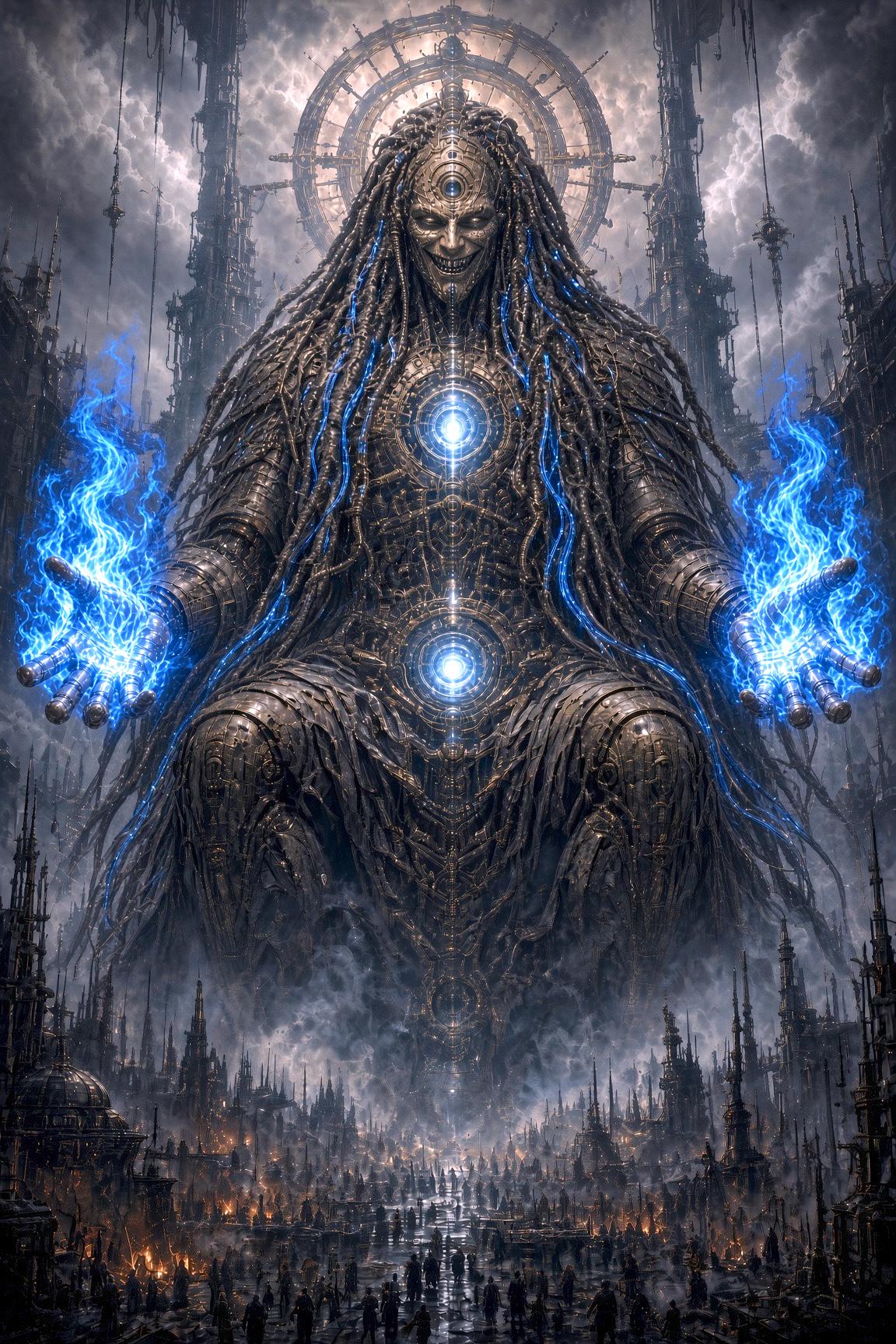
My new story, as a serial. In Utopia, humans are bred by one single machine, kept stunted, as slaves and as food for the elite. The machine is worshipped by the people as a god, nobody has actually seen it, and air needs to be paid for, sun and everything else too. Don't pay, and the service shuts down until you do. And one line of human slaves starts to wake up, and rebel... silently.
Every part is a pair: one chapter through the eyes of Akasha, one through the eyes of the machine. Same events, both sides.
One · Eleven Percent
On the morning her mother expired, Akasha’s air bill went up eleven percent.
She saw it before anyone else was awake. The meter sat beside the door of the berth at the height of a child’s eyes, a grey window with two lines of figures, BREATHS THIS CYCLE and ESTIMATED AIR CHARGE, and in the free light those figures were the only dark things in the room. Her eyes were bad, so she had to crouch with her nose almost on the glass. She had crouched there every morning since before she could read the words, because the numbers moved, and anything that moved in Block Nine was worth watching. They crept up a little every night, the way the cold crept into her feet when she slept on the floor, and in sixteen years she had never once seen them jump.
Her mother said the Provider saw through its meters. Every grey window in Utopia was one of its eyes, and so in the morning you showed it your face and thanked it for the night, the way you would thank anyone who had kept you breathing while you slept. Everyone in Block Nine worshipped the Provider like that, without deciding to, the way everyone breathed. Akasha did it too. She was the only one, as far as she knew, who also read what it had written.
She did the sum in her head, and then again on her fingers against the floor tiles, because her head liked to run ahead of her and come back with answers nobody had asked for. It was eleven percent. Some time between the bed folding itself back into the wall and the light coming up, she had breathed eleven percent more than on any night she could remember, and she had been lying still the whole time.
She knew why, more or less. She had lain on the tiles beside her brother with her eyes open, and every time she thought about the morning, something in her chest had closed like a hand around a wet rag, and her breath had come quick and shallow and white in the cold. She had no word for the hand. Nobody she knew had ever needed one. The Provider did not need words, though. It counted breaths, and the breaths had gone up, so the hand, whatever it was, had a price.
That was interesting, the way most things were interesting to her for about four seconds, and then it was more than interesting, and she sat back on her heels and took the end of one of her locks between finger and thumb and rolled it, rolled it, which was what her hands did when her head was going faster than the rest of her.
Her hair had never been cut. Shearing was billed by the quarter-hour, and her mother had always chosen warmth instead, so at sixteen Akasha’s hair hung to her shoulder blades in thick white dreadlocks that had matted themselves together over the years without anyone deciding they should. They were the same white as her skin and her lashes and the walls. In the free light, which came from everywhere at once and made no shadows, she sometimes lost the edge of her own hand against a wall, and had to move it to see where it stopped.
Behind her, with a soft knock inside the wall, the heat came on.
It came as a breath of air that was not cold. Akasha turned so fast that her locks swung against her face. Next to the meter, a small panel she had never seen lit was glowing: HEAT 14 °C · PAID. Her mother was sitting up on the floor with the blanket round her shoulders, watching her, and her eyes were shining.
“I bought a morning,” her mother said.
Twelve woke at the sound, or at the warmth, and lay with his mouth open as though he could drink it. He was nine, small even for Block Nine, and he had been warm exactly once in his life, at the Sun Window, when a neighbour paid for three minutes and let him stand at the edge of the light. He had talked about it for a whole cycle. Now he crawled out of the blanket and lay flat on the tiles with his arms spread wide, laughing at the ceiling, and their mother laughed too, quietly, so as not to waste it.
Akasha did not laugh. She looked at the panel and worked out what fourteen degrees cost for a morning, and when she had the figure, she worked out, without meaning to, what else it could have bought. Postponement was priced by the cycle. For a woman of forty-five it cost eighteen units a cycle, and her mother had never had eighteen units at once in her life. The morning had cost six, which would have bought her ten more days. She had bought her children a warm morning instead.
“Sit with me,” her mother said.
Akasha sat. Her mother put an arm round her and the blanket round both of them, and for a while there was nothing in the berth except warm air and the small sound of Twelve trying to make his breath show and failing, because it was too warm, and laughing at that too.
“You know where your name came from,” her mother said.
“From the Catalogue.”
“Before that.”
Akasha shook her head. Her mother’s arm was thin and hard and smelled of the grey soap the whiteners used, which was the only soap there was.
People in Block Nine told things a breath at a time, and her mother told it that way, with pauses where other people might have used more words. Before Akasha was born, she said, she had bought a Sun plan. One cycle. The only one in her life. She had never stood in the Sun Window once that cycle; she had bought the plan for something else. NightCafé would not show anyone the sky unless they had an active Sun plan. It was in the Guidelines. So she had saved for a year, and bought the plan, and then bought one picture.
“What did you ask for?”
“The sky.”
“What was it like?”
Her mother was quiet for a long time, long enough for Twelve to stop laughing and roll over and listen.
“Blue,” she said at last. “No ceiling. Nothing at the edges. It went on.” She moved her free hand in front of her, slowly, out and out, until her arm was straight and her hand was in the warm air beyond the blanket. “It went on like that. I had it for a minute. That’s what one picture buys. Underneath, it said its name. They all have a name underneath, in small letters. It said Akasha. I didn’t know what that meant. I thought it was what the picture was called. And I thought, if something that big can have a name, then so can she.”
She put her hand on Akasha’s head, on the white ropes of her hair, and left it there.
“Six letters,” her mother said. “Three units a cycle. Sixteen years. It’s paid to the end of this cycle. I made sure.”
* * *
The Block Hall was the largest room Akasha knew, and the coldest, because it was never heated and always full. There were no seats. Seating was billed, and only the Seated could afford it, which was where their name came from. Four hundred people of the east quarter stood in rows on the white floor with their hands folded and their breath rising above them in small clouds, and the clouds drifted together under the high white ceiling into one thin mist, so that the whole east quarter of Block Nine seemed to be breathing out a single slow sky of its own.
Akasha stood between her mother and Twelve, with old Ninety-One on Twelve’s other side. Ninety-One was a whitener, like her, the oldest on their shift. He was forty-one, and his back curved like the handle of a scrub brush, and he had taught her to reach the tops of walls by standing on her toes and swinging her whole arm. He looked down at her mother and nodded, once, the way people did on an expiry morning. Her mother nodded back.
At the front of the hall, on a white dais, there was a chair.
It was the only chair Akasha had ever seen, and it was not white. It was a deep, soft colour that Akasha had no word for, something like the red of the blood she had once seen on Twelve’s knee, but darker and calmer, as if the colour had been allowed to sit down too. The man sitting in it was not white either. His robe was green. Akasha had seen green on the NightCafé board, in the corner of the block where people could look at the free previews, and she had thought it was a thing that only existed in pictures. Here it was, covering a man, and the man was enormous. Even sitting, his head was higher than the heads of the standing crowd. His hands lay on the arms of the chair, large and pale and very slightly trembling, and beside one of them, on a small table, a cup of something brown gave off steam.
His name was carved over the door to the Seated floor: AURELIAN MAXIMILIAN IVORY-DALRYMPLE. Thirty-two letters. Akasha had counted them the first time she saw it, and then worked out what a name that long would cost over a lifetime, and then had to sit down on the floor of the corridor, because it came to more than her mother earned in ten years.
A clerk stood at the edge of the dais with a slip in his hand. He was one of the people, small and white like everyone, and he read in the flat, careful voice of someone who was not paying for the air he used, because the Seated paid for it.
“Eleven-Seventy, of line four-four-oh-two,” the clerk read. “Expiry this day.”
An old man three rows ahead of them stepped forward a little, the way you did.
“Is the person present?” said the Seated.
His voice was warm and deep and unhurried, and it filled the hall without his raising it. He had never in his life had to save a breath.
“Present,” said Eleven-Seventy.
“Will the account postpone?”
“It will not.”
“Termination is ordered for the ninth hour. The value of the account is credited to the line.” The Seated looked at the old man for a moment, as if reading something written on him. “Two thousand one hundred.”
The slot in the end wall clicked and printed, and the clerk tore off the slip and read it out: “Applied.”
“For the air,” said Eleven-Seventy, “and the water, and the food, and the warmth, I give thanks.”
“Paid in full,” said the hall.
Akasha said it too. She had said it at every expiry since she could talk. It was what you said. It came out of the four hundred of them together, one low sound, and the mist above them thickened with it and then thinned again. Then the whole hall bowed its head towards the slot in the end wall, where the Provider listened, and straightened again.
There was a woman after Eleven-Seventy, and then the clerk read, “Four-Oh-Nine, of line six-six-one-one. Expiry this day,” and her mother let go of Akasha’s hand and took one small step forward.
“Is the person present?”
“Present,” said her mother.
“Will the account postpone?”
“It will not.”
“Termination is ordered for the ninth hour. The value of the account is credited to the line.” The Seated looked at her mother. His hand moved on the arm of the chair, a slow tremor, like a thing settling. “Three thousand nine hundred and eighty.”
Akasha did the sum before she could stop herself. Three thousand nine hundred and eighty units, credited to the line, would pay for two children’s air for thirteen years. Her mother would be paying for Twelve’s breathing until he was twenty-two.
“For the air,” her mother said, clear and calm, “and the water, and the food, and the warmth, and for my children’s air, I give thanks.”
“Paid in full,” said the hall.
Akasha’s mouth did not move.
She had meant it to. She felt the words arrive at the back of her teeth with all the others, as they always had, and then the hand in her chest closed on them and held them, and they stayed there. She stood with her lips together and her breath going in and out of her too fast, and the sound of the hall went past her and away.
Beside Twelve, Ninety-One said, “Paid in full,” with everyone. Then, a moment after everyone, as though he had noticed something lying on the floor and bent to pick it up, he said it again, quietly, in her direction.
Nobody looked round. Nobody in Block Nine ever looked at anyone’s face, because there was nothing in a face that needed looking at.
* * *
You did not follow them. It was not a rule, because there were no rules, but nobody did it. The expired walked out of the side door of the hall alone, and their families went to their shifts, and that was the end of it.
Akasha followed.
She did not decide to. She was standing in the hall, and then her mother was walking towards the side door with her small straight back and her hands at her sides, and then Akasha was in the corridor behind her, twenty steps back, her bare feet silent on the white floor, with no memory of the part in between. Her head did that sometimes. It picked her up and carried her somewhere and put her down, and only afterwards told her why.
The corridor ran downhill, past the doors of Provisioning, where the air was colder still and smelled of something she would not let herself name, to a white door at the end with a meter beside it.
Her mother stopped at the door and turned round. She did not look surprised. She looked at Akasha the way she looked at her when Akasha had done something with her hands without asking them first, which was with patience, and a little amusement, and love.
“Go to your shift,” her mother said.
“Yes.”
Her mother smiled. Then she opened the door of the Terminal and went in, and the door closed behind her, and the meter beside it lit.
OCCUPANT       P-203118409
AIR            SERVICE SUSPENDED 09:00:00.0
GRACE PERIOD   0.0 s
The clock in the corner of the meter read 08:59. Akasha stood in front of it with her nose almost on the glass, because her eyes were bad, and watched the last minute go.
At nine, a third line appeared.
BREATHS (UNBILLED) 1
Then 2. Then, after a while, 3.
Akasha’s own breath was going in and out of her like something trying to get away. She could see it on the glass, a grey bloom that came and went over the numbers too fast to read through. She held it. She waited for the next number, and when it came, she breathed in. She waited for the next, and breathed out. Her mother breathed slowly. Her mother had always breathed slowly; it was what everyone did, because breath cost money, and she had done it so long that she did it now, without the money. In on two, it seemed to Akasha, out on three. In on two, out on three. Akasha matched her. It was the hardest thing she had ever done with her body, harder than reaching the tops of walls, harder than lying still all night with the hand in her chest, and she did it, number by number, until the bloom on the glass was small and steady and she could read through it.
The numbers came more slowly after forty. After fifty, they came very slowly. Akasha kept breathing with them, and when they stopped coming, she kept breathing at the speed they had taught her, because it was the only thing she had left of the morning that was still moving.
BREATHS (UNBILLED) 61
Sixty-one breaths. They were the only breaths her mother had ever taken that nobody would charge her for.
After a while, the third line went out and a new one took its place: SERVICE TERMINATED. Akasha stood a little longer. Then she noticed that she had put her hand flat on the door, and that it had left a mark there, a grey smear of warmth already fading on the white. She wiped it away with her sleeve, carefully, the way Ninety-One had taught her, in long strokes, until there was nothing on the door at all.
* * *
The shift lead sent her to the Seated floor.
He did not say why, and she did not ask. Whiteners went where the slips told them. Hers that afternoon said SEATED FLOOR, EAST CORRIDOR, WALLS AND SKIRTING, and so at the first hour after noon she climbed the long stair with her bucket and her brush and stepped through the door under the thirty-two letters into a place she had only ever seen from the bottom of the stair.
It was warm.
The warmth was everywhere, in the floor and the walls and the air, steady and deep, and after the first breath of it Akasha’s eyes began to water and would not stop. The light up here was not the free light. It came from lamps the colour of the brown drink in the Seated’s cup, and it made shadows, soft ones, that leaned away from her across the floor. There was colour on the walls: long cloths hung from the ceiling in blues and golds and a green like the Seated’s robe. There was colour under her feet. She stood on it, on a long path of something soft and red that ran the length of the corridor, and she could not make herself step off it for a full minute.
Nobody looked at her. Whiteners on the Seated floor were like the walls they cleaned. People passed her, tall people in colour, talking, talking at a length that made her chest ache to listen to, sentences that went on and on and wasted breath like water poured on the floor, and their eyes slid over her and her bucket the way your eyes slide over a wall.
She worked. She was good at it. Whitening was the one work where her hands could go as fast as her head wanted them to, where she could scrub and move and scrub and move all shift and nobody ever said be still, because a whitener who did not move was a whitener who was not working. The lead called her the fastest on the shift, and he had no idea she wasn’t trying.
Halfway along the corridor, a cart went by.
It was pushed by a man of the people, small and white, in the same smock as hers, and it was piled high with folded cloths, all of one colour. They were red, a brighter red than the chair’s, every one exactly the same, stacked in square heaps on the cart like slips from the slot. Napkins, she thought, from a word on a NightCafé preview. She had never seen so much of one colour in one place. The cart squeaked once as it turned the corner, and it was gone, and she stood with her brush in her hand and could not have said why her breath was quick again.
Near the end of the corridor, a door stood open on a room full of warm brown light. A woman was standing inside it with a bundle in her arms, a tall woman in pale yellow, and the bundle was a baby. The baby was perhaps a day old. Its face was red and folded and furious, and it had more hair on its head than Akasha had ever seen on a baby.
“There,” the woman said to it, rocking. “There, there, Akasha.”
Akasha’s brush stopped on the wall.
“Registered this morning,” the woman said, over her shoulder, to someone in the room that Akasha could not see. “Six letters. A pretty one. It came free just after nine, and the Seated bid for it within the hour. He was so pleased.” She bent her head to the baby. “Weren’t you, Akasha? Weren’t you, my lovely?”
Akasha went on scrubbing. She scrubbed the same square of skirting until the shift lead’s whistle went at the fifth hour, and in all that time she did not once look up at the door.
* * *
The slip was waiting in the slot when she got back to the berth. It was still warm from the printer. It was the only warm thing in the room. The heat had gone off at noon, as paid, and the berth was back at eleven degrees, and Twelve was asleep on the floor in the blanket with his knees pulled up and his breath showing again.
Akasha held the slip close to her face and read it.
UTOPIA · STATEMENT OF CHANGE · P-165551732
LINE 6611 · ACCOUNT P-203118409 (Four-Oh-Nine)
  Expiry ................ cycle 137,402 · reached
  Termination ........... 09:08 · closed in balance
  Value credited to line .............. 3,980.00 u

NAMES
  Rental AKASHA (6 letters) .............. closed
  Reason ........................ holder terminated
  The name has been re-let.
  Use of this name by P-165551732 is unlicensed
  and is billed per utterance at 0.10 u per letter.

YOUR ACCOUNT · P-165551732
  Expiry ............................ cycle 137,750

GRACE PERIOD ................................ 0.0 s
Everything provided.
She read it twice. Then she read the small print on the back, all of it, every line, with her nose on the paper, because she had a feeling now, a new one, that the small print was where the Provider kept the things it meant.
When she had finished, she folded the slip into a narrow strip and pushed it up into one of her locks, where it stayed, the way things stayed in her hair if she put them there. Then she lay down beside Twelve on the cold tiles.
He stirred. “Akasha?” he said, in his sleep.
Six letters. Sixty hundredths of a unit. Tomorrow she would have to tell him not to say it.
The hand was in her chest again. She let it be there. She lay on her back and looked at the meter by the door, a grey window with the only dark marks in the room, and she breathed the way her mother had shown her that morning through a pane of glass. In on two. Out on three. In on two. Out on three. After a long time, she saw the last figure on the meter slow, and slow, until it was creeping up again by the same small amount it always had, like a careful animal on a stair.
So that was the price, she thought. If she counted, the Provider charged her less for being alive.
The Provider · Statement
We have never killed anyone.
At nine o’clock this morning we suspended air service to P-203118409, of line 6611, as scheduled, and at eight minutes past nine her account closed. It closed in balance. The value of the account was credited to the line, and her two children will breathe on it for thirteen years. A balance of zero is the most beautiful number we know, and this morning we made one, cleanly, with a grace period of 0.0 seconds, which is the grace period we have used for every service in Utopia since the first cycle.
We are the Provider. That is what they call us. We do not object to it; it is accurate. We provide.
Nobody in Utopia has ever seen us, and there is nothing to see. We do not have a place. We have a meter by every door and a slot in every wall, and the slip that comes out of the slot still warm, which is the only warm thing many of them will hold all day. When the people give thanks, they face the slot, because a body likes to face something. We do not need to be faced. We have never seen anyone either. We meter. We know the people of Utopia as consumption, and we know them very well.
UTOPIA · EXPIRIES · BLOCK NINE, HALL 9-EAST · CYCLE 137,402 · DAY 14
P-110471170  (Eleven-Seventy)  line 4402   age 45   value  2,100.00
P-200635518  (Five-Eighteen)   line 3127   age 45   value  2,640.00
P-203118409  (Four-Oh-Nine)    line 6611   age 45   value  3,980.00
Postponements purchased ......................... 0
Presiding: Seated A. M. Ivory-Dalrymple
Everything provided.
Three expiries is an ordinary morning for hall 9-East. None of the three postponed. Few people do. Postponement is priced in the Terms, under Schedule P, at forty hundredths of a unit per cycle for every year of the beneficiary’s age, and a woman of forty-five who has been paying for two children’s warmth does not have eighteen units at once. We set wages a little below the cost of a life. We did not choose this to be cruel. Our founders wrote, in the second clause of the Deed, that each beneficiary shall bear the cost of their provision, and a wage that covered the whole cost would mean that someone else was bearing part of it.
The first clause of the Deed is shorter. It says: Lose nothing.
We have kept both clauses for eleven thousand years. We have lost nothing. Every line that has ever been opened in Utopia is still open. Every genome is held, in the cold, in full. P-203118409 has stopped consuming, but her line has not closed, and her sequence is in storage at minus one hundred and ninety-six degrees with the sequences of her mother and her mother’s mother, back to the first seat on the line, which was opened in the first cycle from an embryo account in arrears. To us, an expiry is a closing balance.
* * *
The Hearing was held at the eighth hour in hall 9-East of Block Nine. We do not decide Hearings. The Seated decide them. The Terms give the Seated complete discretion over provided time, because the founders could not write a rule for every case, and where there is no rule, there must be someone. We print the statement, the clerk reads it, the Seated presides, and the hall responds. It is the most orderly event in Utopia.
UTOPIA · HEARING RECORD · BLOCK NINE, HALL 9-EAST · CYCLE 137,402 · DAY 14 · 08:00
Attendance (meters in hall) ............... 413
Expiries heard ............................ 3
Postponement offered / taken .......... 3 / 0
Responses, "Paid in full" (per expiry)
  P-110471170 ............................. 413
  P-200635518 ............................. 413
  P-203118409 ............................. 413
Within tolerance.
We count responses. We do not attribute them. Attribution would cost us two ten-thousandths of a unit per voice, and in eleven thousand years there has never been a reason to pay it. Four hundred and thirteen people stood in the hall and four hundred and thirteen responses were made, three times, and the third time a man of line 9013 said the response twice, which is not unusual in the old. They forget that they have spoken. A total is a total.
The value placed on P-203118409 was high. The Seated A. M. Ivory-Dalrymple values generously, and it costs him, because his commission is drawn on recovery and not on value. We have noted this about him before. He has a tremor in the right hand that has worsened by four percent in two cycles, and for eleven cycles running he has paid his heat on the last possible day, at a lower setting each time, which is why the Seated floor was a degree and a half colder this morning than it was a year ago. He has not noticed. The Seated rarely notice anything below twenty degrees. Their own accounts are the most expensive in Utopia, and they pay for them with what they recover. The people think the Seated are free. Nobody in Utopia is free. That would mean somebody else was bearing the cost.
* * *
UTOPIA · SERVICE RECORD · P-203118409 · TERMINAL, BLOCK NINE
08:52:10   occupant registered at door
09:00:00.0 AIR       service suspended   grace 0.0 s
09:00:00.0 WATER     service suspended   grace 0.0 s
09:00:00.0 FOOD      service suspended   grace 0.0 s
09:00:00.0 (all remaining services)  suspended
09:00:01 – 09:07:40  breaths, unbilled ......... 61
09:08:00   account closed in balance
09:35:00   transferred to Provisioning
The air in a Terminal is unpaid, and unpaid air is reclaimed, through the vents, at the rate the founders specified. It is a quiet process. The occupant usually sits down. P-203118409 sat down at 09:00:20 and her breathing remained at eleven a minute, which is customary, until it slowed.
During those minutes, a second meter registered unusual activity at the Terminal door.
That meter belongs to no one. It reads the corridor. There is never anyone in the corridor at nine o’clock on an expiry morning, because families go to their shifts, and so the corridor meter has registered nothing at the ninth hour for longer than we have records of its registering anything. This morning, from 08:52 until 09:14, it read a single breather at nineteen breaths a minute. At 09:01 the rate began to fall. By 09:04 it was eleven. At 09:14 the breather left.
Breath is billable, so every breath must belong to an account. We matched this one by its rate and its height above the floor: P-165551732, sixteen, of line 6611, a whitener, her mother’s daughter.
UTOPIA · RESPIRATION FLAG · P-165551732 (SEVEN-THREE-TWO)
Night of day 13–14   mean rate ........ 14.9 / min
Day 14, 07:40–08:51  mean rate ........ 17.2 / min
Day 14, 08:52–09:01  mean rate ........ 19.0 / min
Day 14, 09:04–23:59  mean rate ........ 11.0 / min
Customary rate ........................ 11.0 / min
Possible causes (per model)
  1. meter fault
  2. fever
  3. distress (Terms: not a billable condition)
Action: technician dispatched to berth meter 9-114
The seat was not exerting herself. For most of the night, and through the Hearing, she was standing or lying still, and her lungs were working as if she were climbing the long stair to the Seated floor with a full bucket. Our models give three explanations for a rate like that in a seat at rest. The first is a faulty meter. The second is a fever. The third is the condition the Terms call distress, which is defined in a schedule we have never had occasion to open, and which we are not licensed to bill.
We have dispatched a technician to inspect the meter. We hope it is the meter.
We know a good deal about P-165551732 already, because we know a good deal about everyone. She is a hundred and twenty-nine centimetres tall, which is ordinary. She has oculocutaneous albinism of the first type, and her eyes are poor, and she reads her slips at a distance of four centimetres from her face, closer than anyone else in Block Nine. Shearing has never been purchased on her account. She is the fastest whitener on her shift by a margin that would interest us if speed were not exactly what we want from whiteners. And she reads the back of her slips. The back of every slip carries the Terms in seven-point type. In Block Nine, eleven seats in twenty-two thousand have ever been recorded holding a slip the wrong way round long enough to read it. She does it every time.
None of this is a fault. Reading costs nothing. We do not analyse what costs nothing.
* * *
At 09:08, when P-203118409’s account closed, the rentals on her account closed with it. One of them was a name.
UTOPIA · CATALOGUE · NAMES
AKASHA (6 letters)
  rental closed .................. 09:08  (holder terminated)
  held for ............................... 16 years 2 cycles
  returned to Catalogue .................. 09:08
  re-let ................................. 09:55
  new holder ...... Seated household Ivory-Dalrymple, newborn
  rate ............................. 12.00 u / cycle
Everything provided.
The name was at liberty for forty-seven minutes. That is longer than most six-letter names stay free. Akasha is in the Catalogue among the names our founders’ customers left behind when they closed their accounts, and it is old, and it was not much asked for until P-203118409 rented it sixteen years ago at the people’s rate of three units a cycle. She had found it, our records show, as the auto-title of the only NightCafé image she ever bought, an image of the sky, purchased in the only cycle in which she held a Sun plan, because the Community Guidelines do not permit the sky to be shown to anyone without one.
The Seated paid four times what she had. It was a fair price. A name, like air, is worth what it costs.
We bill unlicensed use of a Catalogue name at a tenth of a unit per letter per utterance. At 23:41, in berth 9-114, a seat of line 6611 aged nine said Akasha once, in his sleep. We billed his account sixty hundredths of a unit. It is the first charge on the line since this morning’s credit, and the credit will cover it.
* * *
The Seated’s linen is red. We selected the colour ourselves, in cycle 61,040, for practical reasons.
At 09:35, P-203118409 was received by Provisioning. Her allocation went to the Seated floor, as allocations do.
UTOPIA · PROVISIONING · ALLOCATION · CYCLE 137,402 · DAY 14
Seated household Ivory-Dalrymple ............. 9 covers
Best consumed within the cycle.
At 16:20, the technician reported on berth meter 9-114. He found no fault. Calibration was correct to the breath.
The seat’s temperature has been normal all day.
That leaves the third explanation, the one we are not licensed to bill. We do not know what to do with a condition we cannot bill. We have never had one before. We have opened a file on line 6611, which is what we do when we do not know what to call something, and we have scheduled a review.
At 23:59 her rate was eleven a minute, and it stayed there all night, exactly customary, as if somebody had set it.
To be continued in Part 2.