r/dividends • u/Visible-Smell2701 • 5h ago
Seeking Advice Anyone still holding SG REITs at a loss?
reddit.com
2
Upvotes
r/dividends
•
u/Firstclass30
•
Mar 26 '21
[This post is designed to serve as an introduction to new users of the subreddit, based on my own personal experience. Please read this post in its entirety before contributing to the subreddit, as it answers 95% of the questions most commonly asked by new users and investors. The Moderation Team will remove any submission that asks a question answered by this post. Nothing in this piece should be taken as legally binding financial advice. Even though citations have been included, please do your own research. While I ( u/Firstclass30 ) am the lead moderator of the r/dividends subreddit, I am not a licensed financial advisor.]
Good afternoon, and welcome to r/dividends. We are a community by and for dividend growth investors. Our community was started all the way back in 2009 as a discussion forum for dividend investors. Whether you are just starting out in your investing journey, or are months away from retirement, we hope you will find enjoyment in participating with this online community. This post will go over absolutely everything you need to get started in the world of dividend investing. Whether you are new or have been investing for years, it is well worth a read.
Part 0: What are dividends exactly?
From Investopedia:
A dividend is the distribution of some of a company's earnings to a class of its shareholders, as determined by its board of directors. Common shareholders of dividend-paying companies are typically eligible as long as they own the stock before the ex-dividend date. Dividends may be paid out as cash or in the form of additional stock.[1]
Dividend investors are those who incorporate dividend payers into their portfolio.
Part I: Understanding the benefits and drawbacks of dividend payers
Dividend payers tend to be big, well-established companies that have an abundance of cash. According to Steve Greiner, Vice President of Charles Schwab Equity Ratings®, "They [dividend payers] often can't compete with the rapid appreciation of fledgling, fast-growing companies, so they use dividend payouts as an enticement." Because of this, many newer investors often think of dividend payers as being the opposite of so-called "growth stocks." In reality, it is usually dividend-paying securities that produce more growth over a long period of time.
Dividends, when reinvested, can significantly boost total returns over time, making dividend-paying stocks an attractive option for older and younger investors alike. For example, if you invested $1,000 USD in a hypothetical investment that tracked the S&P 500 Index on January 1, 1990, but did not reinvest the dividends, your investment would have been worth $8,982 USD at the end of 2019. If you had reinvested the dividends, you would have ended up with $16,971 - nearly doubling your returns. The longer the timeframe, the more dramatic the disparity. According to research conducted by the Hartford Funds, "Dividends have played a significant role in the returns investors have received during the past 50 years. Going back to 1970, a whopping 84% of the total return of the S&P 500 index can be attributed to reinvested dividends and the power of compounding."[2] Drawing from the decades of data available, intentionally excluding dividends from your portfolio could result in significantly handicapping your portfolio for decades.
With the S&P 500 yielding approximately 1.52% as of December 31, 2020, dividends paying securities can serve as an attractive alternative to Treasuries and other fixed income investments often pushed by professional retirement planners.
The downside to dividends is that they are not guaranteed. This is important information to consider, as companies can and will stop paying dividends if necessary, or worse, if legally required. Certain market conditions like the 2020 coronavirus pandemic can create an uncertain environment for dividend-focused companies. In 2020, 68 of the roughly 380 dividend-paying companies in the S&P 500 suspended or reduced their payouts.[4]
Fortunately, companies generally only cut their dividends when they are in distress, so favoring those with sound financial metrics can help mitigate the risk.
Part II: Understanding how to pick dividend stocks
If you create a post in the r/dividends subreddit asking for a list of good companies that pay dividends, your submission will be removed. This is because this community believes firmly in the "teach someone to fish" mentality. Instead of asking for a list of dividend payers, it is far more valuable instead to understand the fundamental ideas behind why specific individuals choose specific companies. By knowing and understanding these principles, you can build your own portfolio that, if properly executed, could beat 90% of lay investors with relatively little effort. While far from comprehensive, these six tips can help you identify dividend-paying stocks with strong financial health.
#1. Do not chase high dividend yields: If a company has a high dividend yield, there is always a reason (most of the time not a good one) that a security is offering payouts that are well above average. A good rule of thumb is that before you purchase a high-yield security (those with a yield of 5% or more), try to determine why it is so high. It is important to note however, that the dividend yield is not a fixed amount, but in reality changes every second a stock is traded. According to Investopedia:
The dividend yield, expressed as a percentage, is a financial ratio (dividend/price) that shows how much a company pays out in dividends each year relative to its stock price.[3]
If a high or rising yield is due to a shrinking share price, that is a bad sign and could indicate that a dividend cut is in a company's future. However, if a rising dividend yield is due to rising profits, that indicates a more favorable scenario. When net profits rise, dividends tend to follow suit. Make sure you know exactly what is causing the increase before buying the stock.
#2. Assess the payout ratio: This metric (calculated by dividing dividends per share over earnings per share) tells you how much of a company's earnings are going toward the dividend. A ratio higher than 100% means the company is paying out more to its shareholders than it is earning. In such cases, it may be able to cover its dividends from available cash, but that can only last for so long.
If a company whose stock you own is losing money but still paying a dividend for an extended period, it may be time to sell off and cut your losses. US tax law allows you to write off up to $3,000 per year in capital losses in exchange for a tax credit. Your circumstances may vary, so check your local tax authority. The reason you may want to consider this option is because dividend payers in financial hard times may try to stave off a dividend cut by funding payouts with borrowed funds or cash reserves. These actions will often drive away shareholders, forcing the share price down. History also shows these actions rarely turn things around, and are usually just delaying the inevitable. (To those of you who know about REITs, keep reading, they will be addressed further down.
#3. Check the balance sheet: High levels of debt represent a competing use of cash. Under most global securities laws, a company must pay its creditors before it pays its dividends. A fast-rising level of debt could indicate bankruptcy in the short or medium-term future. Under US and EU bankruptcy law, corporations in the bankruptcy process are (depending on the circumstances) legally barred from paying dividends to shareholders. Corporations with high debt levels may also look to the courts to assist in reorganizing debts without declaring bankruptcy. Oftentimes, judges in these cases will force reductions or suspensions in dividend payments to prioritize the repayment of creditors.
#4. Look for dividend growth: Generally speaking, you want to find companies that not only pay steady dividends, but also increase them at regular intervals (i.e. once per year over the past three, five, or even 10 years. Research has also shown that companies that grow their dividends tend to outperform their peers over time.[2] Not only that, but a strong history of regular dividend growth also helps keep pace with inflation, which is particularly valuable to those who wish to seek financial independence and live off of their investments.
With that being said, just because a company did not increase their dividends in 2020 or 2021 does not make it necessarily worthy of exclusion from your portfolio. Certain industries (like the top US banks) were legally prohibited by the federal government from raising their dividends during the COVID-19 pandemic. Most companies have been hoarding cash to help weather the economic uncertainty, so it is not unreasonable to for them to keep dividends stagnant until the economy bounces back. When it comes to companies impacted by the pandemic, look for other factors aside from dividend changes to determine whether or not the company is worth your investment.
#5. Understand sector risk: Some sectors offer a more attractive combination of dividends and growth than others, but they also offer different risk characteristics that you should consider when researching dividend payers for your portfolio. Stocks from the banking, consumer staples, and utilities sectors, for example, are known for steady dividends and lower volatility, but they also tend to offer less growth potential (though this varies from company to company). Dividend paying tech companies, on the other hand, could offer attractive dividends along with the opportunity for larger price gains, but they also tend to be much more volatile. If you are a long-term investor, you might be willing to accept tech's higher volatility in exchange for its growth and income prospects, but if you are nearing or in retirement, you might want to prioritize dividend-payers from less volatile industries.
#6. Consider a fund: If you are worried the potential for price declines eroding the value of your dividend stocks, consider instead a dividend-focused exchange traded fund (ETF) or mutual fund. Such funds typically hold stocks that have a history of distributing dividends to their shareholders, and they provide a greater level of diversification than you can achieve by buying a handful of dividend paying stocks. Funds are typically preferred by those who wish to take a more hands-off approach to their investments. These will be your best option if you lack the time or inclination to conduct in-depth research of companies.
Part III: Ideal age of the dividend investor.
Oftentimes inexperienced investors will claim dividends are for those at or nearing retirement. As was demonstrated earlier in this piece, nothing could be further from the truth. No matter what stage of your life or investing career, dividend-paying stocks can be a great way to supplement or even replace your income and improve your portfolio's growth potential. Just be sure you research their overall financial health, not just their dividend rates, before investing. There is no such thing as a right or wrong decision, as long as you achieve your desired outcome.
Part IV: When not to reinvest
Part I demonstrated how powerful reinvesting one's dividends can be, but there are certain circumstances where it can be more financially savvy to refrain from reinvesting your dividends. Below are three situations in which you might want to deploy dividend payouts elsewhere.
Part V: Understanding Taxes on your portfolio
The question of taxes often comes up a lot in investing communities, and r/dividends is no exception. However, we mods prohibit direct questions regarding taxes and other questions of legality because nobody here is a licensed tax professional in every single tax jurisdiction on Earth. The question of taxes varies so wildly between regions that even making basic generalizations borders on pointless. The only constant is that you will pay taxes at some point in your life on your investments. Whether it is before you make your gains, after you make your gains, or somewhere in between, you will pay taxes. The different types of accounts and options available to you varies based on your income, geography, employer, and dozens of other factors. Some countries offer special accounts for those who serve in the military, law enforcement, or some other specialized profession(s). Some trade unions help pay the taxes you may owe on certain investment types. The variations on the tax question are so all over the place that I could break Reddit's character limit just covering the most general details.
Typically the best resource for understanding your local tax situation is the government agenc(ies) responsible for collecting your money. As of 2021, most all have websites of various levels of usability. They should often be your first stop for most questions. When in doubt, always talk to a professional.
Part VI: Special Snowflake companies (REITS, MLPs, royalty trusts, etc.)
Some companies do not fit neatly into the category of an S-class corporation, and see themselves as special snowflakes worthy of a special tax status. Understanding these entities is a critical prerequisite to holding them in your portfolio, as many may require additional tax paperwork. In my personal experience, aside from REITS, most are not worth the time of the average investor. Unless you already have a preexisting knowledge of how these companies work, I would not go out of your way to understand in-depth how they operate when there are so many options out there that could provide better returns.
The only exception to this rule is the Real Estate Investment Trust (REIT). Unlike other special snowflake investments, REITs are relatively self explanatory. They deal 100% in real estate. Nothing else. REITs are favored by dividend investors because of their special arrangement with the US government. In exchange for not having to pay most federal corporate taxes, REITs are legally required to pass on at minimum 90% of their profits under GAAP to shareholders in the form of dividends, which are taxed as income by the US government. The keyword here is GAAP.
Most places on Earth (aka the United States and almost nobody else) requires the usage of the Generally Accepted Accounting Principles (or GAAP standard of accounting). GAAP is incredibly strict, intricate, complicated, and almost impossible to cheat. 100% of publicly traded companies in the US use GAAP, which makes comparing the finances of US stocks incredibly easy. However, the tax structure of Real Estate Investment trusts often causes the math behind GAAP (or any other accounting system for that matter) to break down. This can make REIT payout ratios look absolutely insane in relation to other companies, and can make most REITs look incredibly unprofitable. To combat this, REITs have developed their own standards utilizing simplified math, called the funds from operations (FFO) metrics. I originally had a more in-depth explanation of this concept (as well as information about BDCs, MLPs, and Royalty Trusts), but I had to cut it out of the final draft of this post because Reddit has a 40,000 character limit. The best I can do right now is to point you in the direction of Investopedia, which has an excellent article on the subject of FFOs, linked here.
The decision of whether or not to incorporate these types of investments into your portfolio is a personal one, and just like with any other type of investment, varies greatly based on your risk tolerance and portfolio goals.
Part VII: Performing in-depth research on companies
While anyone can read a balance sheet synopsis on Seeking Alpha and vaguely grasp its meaning, above understanding a concept is the ability to put one's knowledge into practice. The reason I put this skill above actually picking companies is because stock picking can be done with a relatively low knowledge base, but actually digging deep into financial statements and balance sheets to discover companies on your own not on the traditional press circuit can serve as the true test of someone's research potential.
Oftentimes I come across even experienced investors unaware of just how many resources are available to them on this front. While websites, apps, and YouTube channels exist all over the place, an often underutilized resource for investment knowledge is the companies themselves. 99% of publicly traded companies have a website dedicated to serving the needs of investors, often with email addresses, phone numbers, and physical addresses just begging to be contacted. How much did Coca-Cola pay in dividends in 1926? Google doesn't know (I checked), but I guarantee you somewhere in an Atlanta filing cabinet lies Coke's dividend history from back in that time. It is obscure, seemingly random knowledge like that investor relations experts are paid to answer.
[Side note: originally, there was going to be a far larger expanded section about this, but it was cut for the sake of conforming to Reddit's character limit.]
Part VIII: Diminishing returns and micromanagement
By paying attention in school, you may have been informed regarding the law of diminishing returns. When it comes to dividend investing (or any type of investing), the law of diminishing returns can play a big part of your portfolio management. While you should always be on the lookout for investment opportunities, if day trading is the reason you wake up in the morning, dividend investing may not be right for you. Strategies like buying right before the ex-div date and selling immediately afterwards rarely turn out in your favor, and even when they do are often not worth the trouble. Your gain will be a few cents at best, or worse you lose money. In my experience as the lead moderator of this subreddit, monitoring comments, I can say with confidence that most people will lose money on this day-trading type strategy. Most of the price action regarding a dividend took place days or weeks before the ex-dividend date, spread out over a period of time. Companies often issue dividends on a clockwork schedule according to the ISO Calendar, so institutional investors are often able to predict when the dividend will be paid months or even years in advance, long before the boards of these companies officially announce their dividends.
A similar thing can be said for those attempting to buy stocks at the absolute lowest possible price. I have seen individuals hold out for days waiting for a few extra cents. If you have a six figure portfolio, you do not need to be trying to time a 12 cent price drop. Your time will be better spent elsewhere. Understanding the law of diminishing returns can sometimes singlehandedly turn an underperforming portfolio into an overperforming one. By taking a hands off approach to most of your investments, you let the market work in the background of your life. As the old saying goes, "time in the market beats timing the market every day of the week."
Part IX: Debt and financing your investments
Early in your investment journey, the idea of purchasing dividend stocks on debt sounds like a great idea. Buy the stocks, use the dividends to pay off the loan, then keep the stocks and profit. It sounds foolproof right up until it isn't. What seems like free money is more akin to an advance on a sh***y record deal. If you decide to take out a $50,000 loan to buy dividend stocks, don't be surprised if acquiring a home or auto loan becomes significantly more difficult or downright impossible depending on your circumstances. Banks and credit unions are often far more hesitant to lend out money to those with high amounts of preexisting debt. When these loans are given however, they often come with interest rates higher than what you would have normally had to pay if you had not decided to buy a bunch of AT&T with a personal loan. Any amount below $20,000 will hardly have a significant effect on your long-term portfolio (assuming you are still investing with earned income), and any amount above $20,000 could have serious ramifications on your ability to access credit in the event you truly need it. If you fail to disclose this preexisting loan to any prospective lender, then congratulations, you have just committed fraud, which is something we do not condone here on r/dividends.
Your income and lifestyle should be sufficient to fund your investment needs. While I understand the frustration that can come with being a student with 0 disposable income, being a student is actually the best possible reason not to have a five-figure unsecured debt load. As someone with a degree in Management and a career in the field, I can tell you that many employers conduct background and credit checks on prospective employees (though credit checks on employees are illegal in certain states). A $20,000 personal loan made by a 20 year old raises a lot of red flags, and while it could signal personal illness or medical debt, it could signal a gambling problem. When you tell them you used the money to buy stocks, they will immediately assume gambling problem. Good things come to those who wait.
Part X: Brokerages and celebrity portfolios
If you came to this post or subreddit looking for nothing but a brokerage recommendation, I recommend you look elsewhere. While my wife and I personally use M1 Finance, and I do recommend it to friends and family, I have no idea who is reading this post. I know only what information Reddit gives me as a moderator, so I will say that for the love of whatever you believe in do not choose a brokerage just because some internet personality, or some random person on Reddit told you about it. Brokerages are not interchangeable, and they offer wildly different features and benefits. I like M1 because of the ability to form pies. This for example is my personal portfolio. I enjoy what I enjoy about M1, and what it is able to offer me and my family. Your situation is (likely) different. This is also the reason we explicitly ban referral links on r/dividends. The only recommendation I will issue is do not invest with Robinhood. Other than that, go nuts.
Part XI: Beyond dividends, and knowing when not to invest.
Equally important to the skills of investing are the skills of knowing when not to invest. If you have credit card debt, pay that off first, and make sure to pay 100% of your balance every month. If you do not have an emergency fund, create one. It should consist of roughly six months worth of expenses. If you lack a financial plan or budget, create one. My wife and I use Mint.com for our budget. We sync it with our cards, and everything comes out perfectly. I highly recommend it.
Part XII: Seeking feedback
Saving and investing can become an addiction, so it is important to know when to moderate it. Having a third party provide additional input or opinions on your decisions can work wonders. If you have a significant other or a best friend, I would recommend getting them into the investing mindset, if they are not already. Having a trusted voice to bounce ideas off can lead to not only financial reward, but emotional and intellectual growth.
Since I took over this subreddit in August 2020, I have strived to create that environment here. It is from this base framework that I am hoping future discussions in this community can branch from. If you are just joining us, or have been with this community for years, I thank you for joining us on r/dividends.
Happy investing,
[This post was inspired by an article in Charles Schwab's Spring 2021 Investment magazine. The article was titled "Rx for what ails you. Dividend-paying stocks could be just what the doctor ordered." The research it presented served as the inspiration and backbone of the first half of this piece. Other works found through my own research constituted the majority of the factual content of this piece. The majority of this post's contents are my personal opinions, and should not be taken as financial advice. Invest at your own risk. Recommendation or mention of a security or service does not constitute an endorsement. I received no compensation from any individual or group for writing this post.]
[The first draft of this post was over 50,000 characters long, and exceeded Reddit's character limit by more than 25%. For the sake of brevity and my own sense of perfectionism, this post's length was cut in half. As of original publication it contains over 4,100 words, with over 26,000 characters.]
Edit: This piece was originally written in Microsoft Word, and copied over to Reddit. A few formatting errors slipped through by mistake, and those were corrected after publication.
r/dividends • u/AutoModerator • 2d ago
This daily thread serves as the home for all "Rate My Portfolio" questions, as well as any other generic questions such as "What do you think of XYZ," that would otherwise violate community rules.
To better tailor advice, please include such context as age, goals, timeline, risk tolerance, and any restrictions you may have. Such restrictions may include ethics, morals, work restrictions, etc.
As a reminder, all Rate My Portfolio posts are prohibited under Rule 1 Submission Guidelines. All general stock questions that don't include quality insight from OP are prohibited under Rule 4 Solicitations for Due Diligence. Please keep all such questions to the daily thread, and report and violations under their respective rule.
r/dividends • u/Visible-Smell2701 • 5h ago
r/dividends • u/IWantToPlayGame • 20h ago
Congratulations to HRL owners on your raise.
1% increase.
Goes from $0.292 per share/per quarter to $0.295 per share/per quarter.
This marks 61 years of consecutive dividend increases, making HRL a dividend king!
About HRL: Hormel Foods Corporation develops, processes, and distributes various meat, nut, and other food products to foodservice, convenience stores, and commercial customers in the United States and internationally. It operates through three segments: Retail, Foodservice, and International. Hormel Foods Corporation was founded in 1891 and is headquartered in Austin, Minnesota.
https://seekingalpha.com/news/4675958-hormel-foods-raises-dividend-by-1-to-0295
r/dividends • u/IWantToPlayGame • 20h ago
Congratulations to HPE owners on your raise.
19.3% increase.
Goes from $0.1425 per share/per quarter to $0.17 per share/per quarter.
This marks 4 years of consecutive dividend increases.
Additionally, the board approved an additional $5 Billion in share buybacks.
About HPE: Hewlett Packard Enterprise Company develops intelligent solutions. It operates in five segments: Server, Hybrid Cloud, Networking, Financial Services, and Corporate Investments and Other. The company serves commercial and large enterprise groups, as well as business and public sector enterprises. It sells its products through resellers, distribution partners, master area partners, original equipment manufacturers, independent software vendors, systems integrators, and advisory firms. The company was founded in 1939 and is headquartered in Spring, Texas.
r/dividends • u/West-Structure-4030 • 1d ago
Most portfolio trackers show forward income as current annual dividend times shares held. That number always looks better than what actually lands in the account, so a more honest estimate would help.
A few things seem to break the simple math. Holdings with a payout ratio well above their usual range, or with free cash flow not covering the dividend, are the ones most likely to freeze or cut, so it feels wrong to count them at full value. Specials and variable payers inflate the trailing figure. Companies with a long record of raising every year probably deserve a small bump rather than a flat number. And payment timing matters if you're living off it, because a year can look fine overall while a few months come in well short.
One approach is splitting holdings into rough buckets: steady raisers counted at the current rate plus a small typical raise, stretched payers counted at a haircut, and variable or special payers counted at their lower recent level. Then lay the result out month by month instead of as one annual figure.
Curious how others here do it. Do you haircut anything, or just take the forward yield and accept the surprises?
r/dividends • u/travelflix420 • 20h ago

After yesterday’s rally and today’s pullback, I’m thinking about how quickly market sentiment can change. For income-focused ETFs, what do you watch when things get choppy: distribution changes, price and NAV trends, total return, or concentration?
With SPYI near its 52-week low, would you see that as a buying opportunity, or wait to see what happens next? Do you wait for several warning signs before adjusting, or do you set rules for yourself ahead of time? I’m trying to pay attention to opportunities, sustainability and risk, not just the payout.
r/dividends • u/Bmoses99 • 16h ago
r/dividends • u/Hot-Razzmatazz-4251 • 1d ago
How about it? Long term investing.
r/dividends • u/WesternWriter7269 • 1d ago
Do you think SCHD bounces from here and continues for higher highs or we sell off into the end of the year because of people taking minimum distributions, and the feds almost guaranteeing two basis point interest rate hike?
Please think objectively and not biased. I own a lot of schd but I'm debating on adding to my position here or waiting for another entry.
r/dividends • u/DividendsEngineer • 1d ago
On October 1 I stopped adding new money and started tracking one number every week: how much my portfolio is projected to pay me in dividends over the next 12 months. Every dividend is reinvested automatically (DRIP). Here's where it stands after 7 weeks.
Forward annual dividend income
Where the growth came from
The thing that surprised me: the raises added more income than reinvesting $900 of cash did. Reinvesting is slow but a raise lifts the whole position at once
| Holding | Forward income | Share |
|---|---|---|
| SPYI (NEOS S&P 500 High Income ETF) | $2,342 | 25.0% |
| 401k (3 index/target funds, ) | $1,742 | 18.6% |
| BIP (Brookfield Infrastructure) | $905 | 9.7% |
| MPLX | $592 | 6.3% |
| MAIN (Main Street Capital) | $558 | 6.0% |
| BAM (Brookfield Asset Mgmt) | $525 | 5.6% |
| VICI Properties | $413 | 4.4% |
| EPRT (Essential Properties) | $365 | 3.9% |
| O (Realty Income) | $320 | 3.4% |
| DLR (Digital Realty) | $183 | 2.0% |
| WSO (Watsco) | $180 | 1.9% |
| V (Visa) | $180 | 1.9% |
| AVGO (Broadcom) | $173 | 1.9% |
| HD (Home Depot) | $165 | 1.8% |
| FNF (Fidelity National Financial) | $164 | 1.7% |
| MSFT (Microsoft) | $154 | 1.6% |
| UNP (Union Pacific) | $143 | 1.5% |
| LMT (Lockheed Martin) | $141 | 1.5% |
| SBUX (Starbucks) | $83 | 0.9% |
| CARR (Carrier) | $37 | 0.4% |
| Total | $9,365 | 100% |
What I'm watching
How do you track your progress: forward income, monthly cash received, or yield on cost?
I post this update every Friday on Substack if anyone wants to follow along.
r/dividends • u/Helpful-Staff9562 • 2d ago
I honestly don't understand the clash between the FIRE and dividend investing communities. I find it a bit absurd when people argue over different approaches, as I believe there's value in both and the truth is often somewhere in the middle.
I'm not here to support either side. I started with the FIRE approach (VT and chill - which also pays dividends anyways), which was the first strategy I learned, but I've also spent time studying dividend investing.
I understand that dividends aren't free money, but there are also psychological benefits, and dividend-focused ETFs tend to tilt towards more mature, less volatile companies.
I also see a trade-off: FIRE investors might need a higher net worth before generating sufficient income, potentially requiring them to work longer. Dividend investors might reach their desired income sooner, but potentially sacrifice some overall wealth growth.
So, particularly for those who strongly favour dividend investing and disagree with the FIRE approach:
- Why do you believe a dividend-focused strategy is superior?
- What makes you actively reject a total-return/FIRE approach?
- How has this played out in your own portfolio? Real examples would be particularly interesting.
Genuinely curious to understand different perspectives, not looking to start another debate!
Also if anyone can comment o how they would go with my situation: I am at FIRE now at a 3% swr in a total world etf. Wpuld you cover that 3% with dividends alone or leave as is and mix divs + withdrawals?
r/dividends • u/paymerich • 1d ago
https://finance.yahoo.com/quote/ABR/
I don't think it will recover.
My question is do you think it will get bought by some other company and if yes whom ?
r/dividends • u/Gapodi • 1d ago
Are there any SP500 based, non - covered call ETFs with low initial cost per share? The ones I know of are SPYM, SCHG, SCHD, SCHB etc but most of these (except SPYM of course) are not based on S&P500 exactly. There are a few covered call ones such as SPYI/TSPY etc. but are there any others SP500 based not listed above?
PS - Ideally, I am looking for counter parts of QNDX/IQQ which are just about twenty bucks. SPYL is a good one but can't be bought in US or Canadian markets.
r/dividends • u/Bmoses99 • 1d ago
r/dividends • u/NBMV0420 • 1d ago
I’m considering adding a small position in GPIQ or another covered-call ETF to my Roth IRA next year.
My dilemma is that I usually like to take advantage of market dips by adding more shares when prices drop. However, since I already max out my Roth IRA contribution early in the year, I can't contribute any additional money when the market pulls back.
I'm wondering if it would make sense to allocate a small portion of my Roth IRA to a covered-call ETF like GPIQ to generate distributions that I could reinvest when the market dips.
Does this strategy make sense, or would I be better off sticking with traditional growth ETFs and simply holding through market downturns?
r/dividends • u/Bmoses99 • 1d ago
r/dividends • u/ccredditt22 • 2d ago
Just curious if there are fellow investors who are more motivated by continued income over total value.
Essentially is anyone an income investor with little or no interest in growth?
I believe I may be one of the very few but would like to hear from others if there are any. Of course I would love to have my income investments also be growth BUT in market downturns it does allow me to sleep easier so long as my dividends are secure.
r/dividends • u/dadevildawg1775 • 2d ago
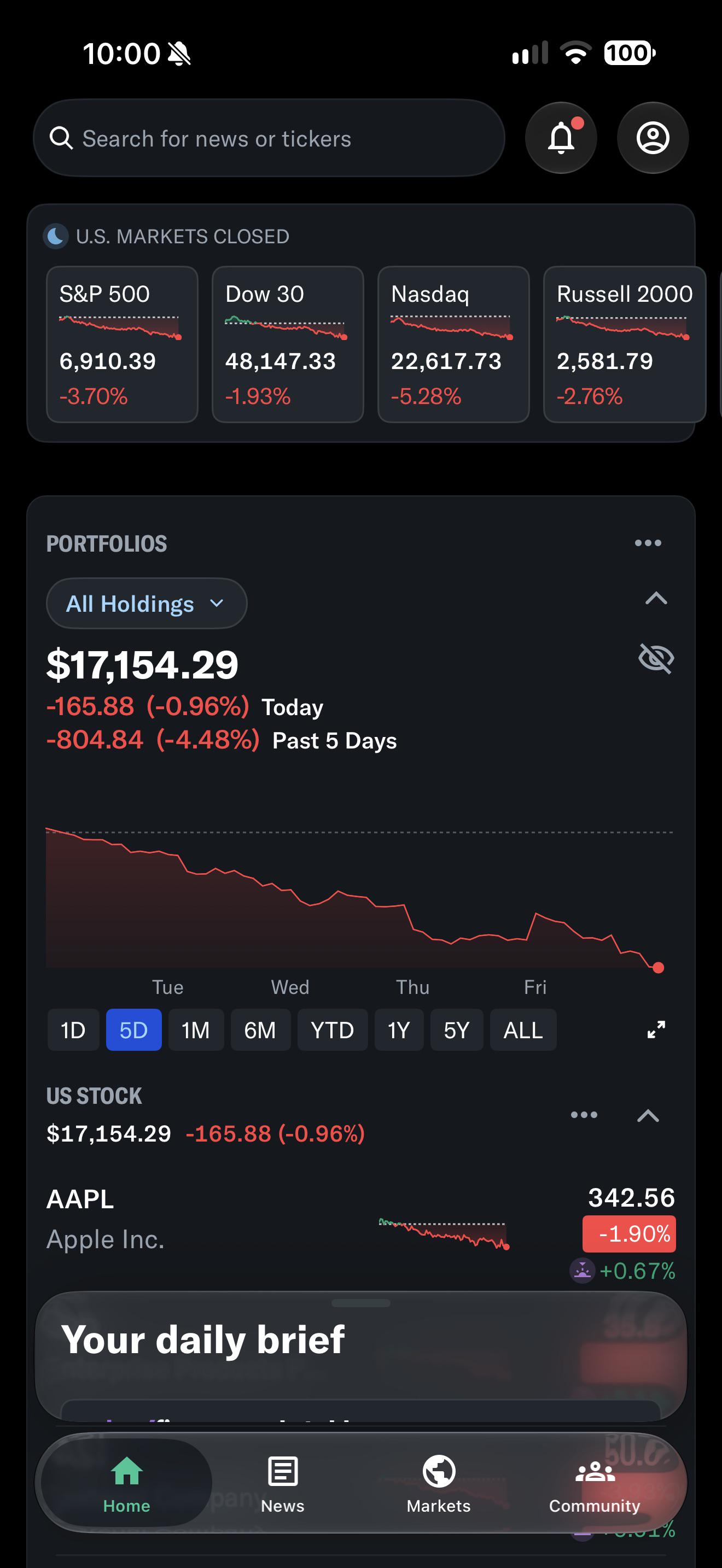
Ah can’t say I’m not surprised. I know the stock market has been having a bad end of month with all of the ai chips and all of that, but this is the realization that I have put most of my eggs in one basket on tech companies and maybe I should move more capital abroad. What do you think?
Stock Portfolio
AAPL 1.183
EPD 19.276
FAST 7.202
JNJ 6.153
KO 14.658
MAIN 100
MCD 3.787
QQQM 1.467
SCHD 106.023
SPYI 23.401
T 7.507
VOO 1.134
VYMI 0.986
Edit: I should have addressed that my plan is to retire on dividends, so I am not planning on selling anything any time soon.
r/dividends • u/magicfitzpatrick • 2d ago
This is my shopping list for tomorrow. I’m hoping the market dips again so I can pick up these stocks at bargain prices. Some are already near their 52-week lows.
T
BXSL
JEPI
GPIQ
GPIX
JEPQ
XLUI
SPYI
PBP
TDAQ
MAA
VTEB
r/dividends • u/Captain-overpants • 2d ago
Just started a dividend sleeve to DCA into, maybe around 500-600 per month. Something to go alongside other retirement accounts.
It’s a brokerage, so the idea is for it to potentially give me some optionality and independence to enable a coastfire situation somewhere down the line. Currently 34.
Current positions are AMLP and IDVO. I’m thinking of adding MAIN and ENB. I’d like to keep things relatively diversified so probably MAIN first. ENB has advantages though, so it might take up some space next to AMLP as an energy allocation.
SCHD seems more like a growth fund at this point - a good one, but still maybe a bit overbought for me without a real compelling yield for my purposes. I’d be more likely to consider SPHD for this account.
Some AI prompting indicated that monthly income will exceed my contributions before year 8 or so. So I’m looking at it as a private type of social security that I can begin drawing from at any age.
I like ROC tax treatment and qualified dividends. I may go with SPHD over MAIN for that reason, as I don’t want to create too much of a tax burden in building this up over my life. But MAIN seems attractive enough for an IRA - it’s beat the SP500 since its 2007 inception by a lot and never cut.
Any suggestions or obvious fits that I haven’t considered?
r/dividends • u/wishihadaps42 • 3d ago

You're not perfect but you're always there.
