r/GrandTactician • • 9h ago

Missing Officer Portraits

Thumbnail
steamcommunity.com
1 Upvotes

Copied from the Steam Mod Forum because it seems dead and I'm not getting any response from the AOM modders over there.

I've just started a new Union Campaign and noticed that some of the officers are missing portraits.

I'm not sure if this is a bug or just a modding glitch as I think I'm using the Additional Officers Mod to add more commanders. So, I thought I'd ask here first to see if anyone else has had the issues and for advice on how to resolve it.

Is it possible to add portraits to your game during play?

I have done some research into this problem and discovered that the Officers with missing portraits are recorded as 'default' in their portrait id. Whereas those with portraits have a portrait file name such as 'acgodwin' in their portrait id.

What's even more interesting though is that having found the list of portraits in the 'Avatar' folder I've discovered that most, if not all, the officers who are missing portraits because their portrait id is recorded as 'Default' actually have portraits stored in the avatar folder.

So, it appears that the problem is simply that their portrait id's have not been recorded in the Commanders.txt file.

The problem now is that I have no idea where to find their portrait id's to add them to the file.

Any thoughts on how to resolve this glitch?


r/GrandTactician • • 22h ago

William Frobisher: The First Battle of Richmond and an Unwanted Recruit

8 Upvotes

Returning to Richmond after Buford’s victory at Petersburg, I was surprised to see Shipton awaiting me at the entrance with a worried look on his face.

“Has something happened, Shipton?” I asked as I dismounted.

“Yes, sir. A rather…peculiar development, if you will.”

He led me inside to what had been Jefferson Davis’s office, and I saw that the Confederate President’s chair was occupied.

By the Union President.

Abraham Lincoln had been looking out the window at Richmond, but now he turned the chair, in what I expect was calculated to be dramatic, to regard me with that broad grin of his.

“Hello, Mr. Frobisher.”  He said simply.

“Mr. President.” I said. “I…well, sir…what in the name of…what exactly are you doing here, sir?”

“I wanted to see Richmond.”

“But sir, how did you manage to get here?”

Lincoln rested his hands on the table, looking as at home as he likely did at his own White House.

“Came through on an Ironclad. You boys did a fine job of clearing the James. Please, have a seat, General. You too, General Pip…that’s what they call you these days, don’t they?”

“Yes, that is, well…” Shipton stammered. “I suppose just Pip will do.”

I suppressed a smile. Shipton disliked being called Pip.

We took the seats in front of the desk, and I was privately glad that I never took this office as my own. It would have been even more awkward than it was.

“I suppose you can imagine the consternation it caused when I had your commission papers written up, Pip.” Lincoln continued. “Never mind that you ‘ain’t even the youngest General in the Union Army.”

“Yes, sir. General Pennypacker and I correspond from time to time.”

Lincoln nodded his approval. “Well, your name suits you better, I think, born as it is out of Great Expectations.”

Shipton’ forehead wrinkled. He was trying to work out if the statement was meant to be a joke, but Lincoln’s calm chuckle helped ease the situation.

“I…will admit a fondness for Dickens, sir. Although I tend to prefer Austen.”

“Never read Austen.” Lincoln said. “Where would you recommend I start?”

‘Sense and Sensibility, sir.”

“I like the title.”

Lincoln paused for a moment, looking from Shipton to myself and back again.

“An Englishman and a Canadian are responsible for capturing the Confederate capital. That’s one for the history books. Tell me, you two. How close do you think we are to ending the war?”

I exchanged looks with Shipton. We had discussed this very matter on a few occasions. He gave me a shrug as if to indicate “Why not tell him?”.

“Sir, the lines are static everywhere but here.” I began. “The Department of Pennsylvania and the Army of Northeastern Virginia are trading objectives with the Confederate Armies on a daily basis. Their units are all mixed together and there’s no real coordination. This, uh, this is not General Sherman’s fault, sir.”

“Whose fault is it, do you expect?”

“I hesitate to answer, sir, in deference to the uh….”

Lincoln smiled. “You are a polite people, aren’t you? Say it out straight, son. You won’t offend anyone worth worrying about.”

Still I hesitated, but Shipton, who had become restless, said it before I could.

“McDowell’s, sir. And….”

“McClellan.” Lincoln finished. “Sherman and I come to the same conclusion last month. Time to clean out the hen house, don’t you think?”

“I think it would be best, sir. Yes.”

Just then Fischer rushed in.

“Message from General Smith, sir.”

I read it quickly.

“Forgive me Mr. President, but it seems General Pi…General Shipton and I are required in the field.”

“Go to it, son.” Lincoln said.

Shipton and I rose.

“Major Fischer, will you please see that our guest is made comfortable?”

Fischer nodded. “I will do that sir.”


 ***


“How goes it, Smith?”

General Smith had his field glasses to his eyes. He was standing on the parapet looking over the lip of the entrenchments we had dug on this side of Richmond.

“I’m a bit embarrassed to have put you to the trouble of coming out here, Bish.” He said. “I thought the attack would be much larger than what’s in front of me.”

He handed me his glasses and I had a look.

“Hmm…Looks like only three brigades at most. Must be a probe, I would say.”

Smith nodded. “Nothing we can’t handle, sir.”

“I’m sure you’re right. But if you don’t mind, I’ll stay here until we’re certain. I telegraphed down to Petersburg to alert Buford in case we need him. Your battlefield, General.”

I stepped back along one of the connecting trenches so I could be out of the way. Presently the firing from the parapets began, cannon fire and rifles going off at regular intervals.

“How do you stand the noise?”

I turned to see the lanky frame of Abraham Lincoln standing behind me. Fischer emerged from behind his long shadow, accompanied by a group of soldiers he had rounded up to act as a bodyguard.

Shipton cursed under his breath.

“I’m sorry General, but he insisted!” Fischer declared over the din.
“You should have stopped him!” Shipton retorted.

“All due respect, General, but you try stopping Abraham Lincoln from doing what he wants and see how easy it is!”

We heard the rebel yell emanating from the field, and presently a small group of confederates somehow managed to get through the fire and into the trenches. Most were quickly swarmed and disarmed by our troopers, but Shipton, who could never stay out of a fight, engaged one of them in a vicious hand to hand struggle, exchanging punches and grappling like wildcats.

Lincoln reached into the fray and pulled the rebel soldier out like a mewling kitten. He put the grey clad soldier into a vicious looking headlock.

“Easy son. Give it up. You done good, but it’s over now.”

The President’s steely grip was apparently quite painful.

“All right! You got me, Yank!” the soldier cried, “Now let me…go.”

Lincoln had released his grip and the soldier realized who had captured him.

“Dangit. If I know’ed it was you, you sonofa…”

He stopped when he heard the click of Shipton’s Colt revolver.

“Choose your next words carefully.”

“Well son, don’t mean to trample on your right to free speech, but maybe it’s best you mind your manners for now.” Lincoln said calmly, like a schoolteacher imparting a lesson to a truant student.

“Yeah…Yes sir. All due respect, sir.” He saluted smartly. “See you in hell, Mr. President.”

Lincoln returned the salute. “I wouldn’t bet against it.”

A group of our troopers took charge of him and escorted him away.

Shipton was dusting himself off. “I had him, sir.” He said with just a slight air of irritability.

“You did, son, you did. I hope you’ll forgive this old man for wantin’ to see if I could still wrestle. Seems I can.”

The rebel charge was the last gasp of the attack. Lincoln, Shipton and I began walking back to where our horses were being held.

“Well sir,” I said. “This makes you the first sitting President to see action under fire.”

Lincoln nodded. “Another story for them to spin about me when I’m gone. Tell me, son, what are your plans after the war?”

“I’ll probably go home, sir. Take over the family business or find a nice quiet corner to live out my days in peace.”

“How about you, young fella?”

Shipton’s face colored. “I…I haven’t given it much thought, sir…”

Lincoln favored him with a smile. “I know that blush, son.”

“General Shipton is corresponding with my youngest sister, sir.” I informed him, much to Shipton’s chagrin.

“Is he now? Is she the uh, headstrong sort?”

Shipton grumbled a response. “That she is, sir.”

Lincoln nodded. “Well, a headstrong woman can be a handful, but they do keep us honest. You should find one yourself, Bish.”

Shipton’s face brightened as he took the opportunity to return the embarrassment. “General Shipton has caught the eye of a Duchess, sir.”

Lincoln let out a warm burst of laughter. “Look at the two of you, sniping like a pair of old ladies. You should stick together after the war. Make a good team.”

Later that evening, Lincoln and I sat by the telegraph office, awaiting further news on Grant and Sheridan’s foray into southern Virginia. The President had wrapped himself in a shawl, looking in my eyes like more of a grandfather than a father. The war had aged him, and probably all of us to some extent. I wondered how I might look to my friends and family that I had not seen since last December.

“I’ve probably said it before, Bish, but I’m impressed with how you’ve managed to keep harmony amongst your fellas. Germans, Dutch, Canadians, Negros…it gives me hope.”

“We’ve even a few Asians in our division, sir. Two Chinese signed up in New York under American names, and there’s a very interesting Japanese fellow in the 2nd Canadian.”

“Is that so?”

I nodded. “Yes sir, Captain Abe his name, but he goes by Able. He has some very techniques in hand-to-hand combat. He's also a fine swordsman. He has two Japanese swords that he wears into battle that can take a fellow's head clean off, from what I hear. Shipton trains with him from time to time.”

Lincoln smiled in amusement. "Sounds like a useful fellow to have. Hope we never have to fight his countrymen."

He took a sip from his coffee before continuing.

"You know, Mr. Frobisher, when I was working the circuit courts back in Kentucky, there was a bear problem in one of the townships. Terrible situation, quite a few people killed. Now according to the tracks they found, the locals figured there were two bears. You can tell by the size of the prints.”

Here he held up his own large hands by example.

“Anyways, three gentlemen volunteered to track the critters. One fella was from Kansas, another was a Frenchman, spent a lot of time trapping beaver and the like, before they became scarce. The last volunteer was an Eastern European, a Czech I believe he was. Well, they went out, and nobody heard back from them for weeks. The rest of the men in the town, feeling a bit ashamed of themselves I guess, went out to try and find ‘em. They hunted the female and put her down, and when they cut her open, they found a locket belonging to the fella from Kansas, and the false teeth belonging to the Frenchman. The mayor of the town, being a rather inappropriate sort, declared in a pompous voice…”

Lincoln held back a chuckle at this point.

“Well, gentlemen, I guess the Czech is in the male.”

I laughed and groaned at the same time. “Sir! Forgive me but two puns in the same joke is unbecoming of a man of your station.”

The president nodded. “I should have gone for three.”

“At least, sir.”

Lincoln slapped my knee. “Anyways, son, your division gives me hope. It shows what folks can do when they put their minds to it.”

“Sadly, sir,” I told him, “It’s a bond forged in blood and death.”

“Much like this country. But even so, I hope it’s a bond that will last.”

We escorted the President back to the ironclad the next morning.

“Well, gentlemen, I suppose I’ve seen enough.”

He took off his hat and pulled a folded piece of paper from inside. “This is for you, General Frobisher. Have a gander at it when you get back to your office. I expect you’ll find the contents interesting.”

We exchanged salutes and Shipton and I watched him go.

“I honestly don’t know what to make of him, sir.” Shipton remarked. ‘He seems kindly enough, and yet…”

I was reading the paper Lincoln had slipped me.

“And yet, never underestimate that man’s cunning, Shipton.”

I handed him the paper.

“What is it sir?”

“Another headache. He's taking Grant from us, promoting him to Major General, and putting him in charge of the armies in the west."

"He's dismissing McClellan?" Shipton said with a gleeful smile. "Permission to cheer, sir?"

"Denied. We should avoid celebrating another person's misfortune."

"Permission to cheer Grant's promotion, then?"

"Granted."

"Huzzah!"

[I decided to mash one truthful account and one fictional one. Lincoln was present at the defense of Washington during Jubal Early's raid. And he wrestled Ghengis Khan in Star Trek. :) Also, the youngest Union General at about age 20, was in fact, General Pennypacker.]


r/GrandTactician • • 1d ago

The Most Fun Campaign To Date

Post image
38 Upvotes

My most recent Union Campaign.... let me tell you it was a blast


r/GrandTactician • • 1d ago

Union Spring 61 Settings/House Rules

6 Upvotes

I am wondering what settings or “house rules” folks use for their union playthroughs for a better campaign. I always run “very hard” difficulty when playing as the Union to give the CSA the most man power & economic help it can have. I don’t adjust aggressiveness as I’ve found it just causes the AI to battering ram my field armies with no logic.

I have been progressing through a CSA playthrough into 1863 as I’m making a push to win & finish that campaign I am starting to look into a Union play through to be the most challenging given the drastic man power advantage I will have. Any tips, rules, advice or even mods I should consider for a better play through?


r/GrandTactician • • 12h ago

My Second Union Campaign – Very Easy & Calm

Thumbnail
youtu.be
0 Upvotes

I started a new campaign last night.

This is my second Union 1861 Campaign, and this time I've opted for 'Very Easy' difficulty with 'Calm Aggression' to see how it affects AI performance and the overall length of the war.

I hadn’t realised with my first two campaigns that the game lacks a true 'Normal' difficulty. According to the developers, any setting above 'Very Easy' gives the AI bonuses to manpower and wealth to make it more challenging. So, when I chose 'Mediocre' difficulty initially, I wasn’t selecting a level playing field, I was actually giving the AI an advantage, with higher difficulties providing even greater bonuses.

The AI doesn’t plan strategically, it merely reacts to circumstances. So, I assume that supplying it with extra manpower and wealth results in more invasions and aggression, which can lead to more defeats and an early end to the campaign.

Interestingly, in my CSA campaign, the AI became more cautious, clever, and devious when low on men and resources. So, I’m curious to see if playing on 'Very Easy' will actually make the game more engaging, rather than just a straightforward 'Wakka Mole' experience.


r/GrandTactician • • 4d ago

Favorite Union Officers?

18 Upvotes

Other than the better known ones, which Union Officers do you like in your playthroughs? I kind of like Alex Pennington Jr. as a cavalry commander


r/GrandTactician • • 5d ago

Regular's act, yay or nay for a CSA playthrough?

16 Upvotes

Hey yall, throughout past threads I've seen the general consensus to not take the regular's act, citing that you really ought to rush manpower on CSA playthroughs. But you literally can't get any more militia acts prior to Apr 20th, leaving you really to choose between regulars or subsidies.

So... wouldn't it actually make more sense to get the regular's act, seeing as it get's done quicker than the others and contributes to manpower? Let me know your thoughts fellow metagamers


r/GrandTactician • • 6d ago

My GTCW Mod's and Setting Changes.

Post image
44 Upvotes

I've been discussing how to improve the way GTCW plays with debtmars on the Steam Forum and he asked me to list all the setiing changes and Mods I use to improve my own game So, I listed all the changes I've made and how he could go about making them himself.

I just thought that I'd share them on here for consideration by other players who perhaps don't visit the steam forums.

How to Search Config Files.

CTRL+F will allow you to search for a word or phrase.

It's useful when searching the Config files for settings you want to edit. I also find it useful when looking for information on potential solutions in the MOD and Discussion folders of the steam forum as it lists the posts that mention the word you are interested in..

How to find the info you need to change the settings?

Some help for some of the mods I use in my own game Although the best place to look is in the Mod Forum on Steam.

Lowering the Minimum Camera Height:

Edit the Battlefieldprefs.txt setting

Battlefield Minimum Camera Height

20

I reduced the setting to 2.

Applying Crono900's modified weapon settings so that howitzers now fire like howitzers.

You need to go to the Mod Folder and read Crono900's notes.

https://steamcommunity.com/app/654890/discussions/3/4630358389444161790/

I downloaded his version of the Weapons.txt file in full. But the file itself is helpfully divided into labelled sections for each weapon. So, one could be more selective if one wished.

Changing the retreat conditions so that smaller armies can still fight things like rear-guard actions without being forced to retreat.

I got fed up with small armies automatically retreating without allowing me to make the decision. So I changed the Campaignprefs.txt from 0.3 to 0.01. Now I get to decide whether to fight or not regardless of the size of the army.

Minimum strength relation between two opponents to start a battle (otherwise unit with low strength is retreating)

0.3

Undoing, unwanted officer promotions to demote officers who were auto-promoted without my permission.

This is a slightly different sort of change as it is directly interfering with something that has happened during play. To do this you need to edit your saved game file.

I shall provide a link to a discussion on how to do this below.

https://steamcommunity.com/app/654890/discussions/0/570427687922830807/

But the best approach I've found is to:

  1. Make a special save, so you know that the save file you are editing is the latest version. Note: On my first attempt I managed to waste a lot of time editing the wrong save and wondering why nothing had happened.
  2. Find the Officer you want to demote in the Commanders.txt file of your saved game. The best way is to CTRL+F and look for the officers name.
  3. Copy or edit the data for that officer. I found the best way was to copy across the data of that officer from a saved file taken before he was promoted. But I am trying to create a list that deciphers what all the data values mean so that one can be more selective if you wish..

The Map Mod

Improves the look of the terrain.

https://steamcommunity.com/app/654890/discussions/3/4361248897890592605/

Accurate Unit Frontages

I changed the unit frontages to something that looked more plausible and more or less matched what I thought they would be historically.

https://steamcommunity.com/app/654890/discussions/0/568165241142325788/

Note: This is not merely a cosmetic change; it also impacts the firepower distribution of a battle line. For example, a full brigade of 3,000 men in line can deliver the firepower of 3,000 rifles along their front, limited only by the range of their weapons. However, if that firepower is spread across a 1,000-yard frontage, it is far less effective than if it is concentrated within a narrower 500-yard frontage. Similarly, if 3,000 men are compressed into a 500-yard frontage, twice as many rifles can be deployed compared with a 1,000-yard frontage, significantly altering the dynamics of the battlefield. Basically the firepower delivered per yard of frontage in the default game is far too high.

Improved Battlefield AI.

I adopted 74 changes to the Battleprefs.txt settings suggested by the BAM Mod that improve the way the AI behaves in battle. These were mainly intended to make the AI behaviour less predictable and to make it more responsive to changes in the tactical situation. I can't list them all here, but basically I ran a Difference Checker between the BAM version of the Battleprefs.txt and mine and copied over anything that looked like a good idea.

https://steamcommunity.com/sharedfiles/filedetails/?id=3834593192

The main change is that there are now more battlefield VPs on most battlefields so its harder to predict which ones the AI will use, and the AI now reacts far more rapidly to changes in events and tends to co-ordinate its attacks better. But obviously thats the result of the changes I chose to adopt. So as the player you get to choose.


r/GrandTactician • • 7d ago

William Frobisher, Richmond, Petersburg, and the Quiet General

Post image
15 Upvotes

[Plan for 1st Cavalry Corps lines of advance towards Richmond, Aug 1-15th, 1863]

“Gentlemen, here’s what we’re going to do.”

I began to point out locations on the map that had been spread over the dining room table, using the twig that had become something of a regular instrument at headquarters.

“General Smith will advance on Fredericksburg from his current position. General Grant will push east within supporting distance. Your joint purpose will be to keep the Army of Shenandoah away from Richmond. If they move north to try and hold Fredericksburg, you can force an engagement. McDowell has orders to come down and support you. Sherman will be riding with him, so there won’t be any, er, hesitation on his part.”

I pointed further south.

‘Phil, your objective will be Hannover Junction. Once it’s secure, leave a covering force. and head south towards Richmond. John, you’ll head directly towards Richmond and hopefully you two will meet up with each other within a few days.

Sheridan grinned. “A race, then, John?”

Buford shrugged, noncommittally. “I never was much of a betting man, Phil.”

“Gentleman’s wager then?”

“That’s fine.”

I gave Sheridan a stern look. “Just remember, Phil, Hannover first. And if you do get to Richmond before John, you and your troops will be polite.”

Sheridan looked crestfallen.

I indicated the map again.

“General Smith and General Grant, I would like you both to set up outposts here, and here. If we’re successful, then we will have secured a supply line as well as the capital itself.”

“Think the Rebs will surrender once we take Richmond?” Buford asked.

“Probably not, but it will have a powerful impact on their morale and their industrial capacity. It might not be the end of the war, but it will cut it shorter, especially if we can hold it. If we can’t, well, you’re welcome to do your worst, Phil.”

“That I will, sir. That I will.”


As it turned out there was no combat at all during this phase of the campaign. The Army of the Shenandoah fell back and was besieged at Fort Aquila, while Sheridan’s advance on Hannover took place without incident. I gave Grant permission to advance as far east as Bowling Green and he encountered no resistance there either. All of this left Buford a clear path to Richmond, which he took on the 12th of August.


“Well, now what do we do?”

Shipton’s remark occurred as we rode down the main avenue of Richmond, doing our best to be peaceable in the face of many a disapproving glare among the citizens.

“It’s the Reb capital, son.” Elliot growled. “I expect they’re gonna want it back.”

As we approached the Confederate White House, which would become our own Headquarters while we remained in the town, there were more cheerful faces, largely among the Negro population that we had freed. Buford was already forced to turn away many male Negroes who had shown up looking to enlist, not because we didn’t want them, but because we could not properly train them until we had finished securing the supply lines back north.

Buford himself was waiting for us at the entrance. He tipped his hat as my party dismounted and I returned the salute.

“It seems that you’ve won the gentleman’s wager.” I told him. “Although I’m sure Sheridan won’t begrudge you the honor.”

“Wouldn’t have gotten here so quick if it hadn’t been for the rest of you.” Buford replied. “Anyway, the place is yours, sir.”           

I entered to have a look at what was once the seat of power for the Confederacy. Jefferson Davis, it seemed, had left in rather a hurry, as there were still notes and paperwork strewn about his desk.

“Have the staff go through all the records and catalogue it all.” I said. “Let me know if there’s any interesting intelligence we can use.”

I looked at Davis’s seat and had a mind to sit in it, but I restrained myself for some reason.

“Well, gentlemen, now that we have the place, we have to hold it.”

"We're going to need Petersburg to do that." Shipton said.

"John," I asked, "Once Smith gets here to cover Richmond, can you take Petersburg."

Buford, with his usual tacit demeanor, nodded. "I reckon I can."

******

[South of Petersburg, August 25.]

Buford looked out over the fields, appraising the situation with his old soldier’s eyes.

“Devin, do you know what’s going to happen here in the morning?”

“Sir?”

“Ewell will be here in the morning. And he’ll do what he does best. He’ll wait.”

“Won’t he try to push past us? Get at Richmond?”

“He knows we need Petersburg too. It’s the only way to press further south. And soon every damn Reb in Virginia will know he’s here, and they’ll flock to his banner, screaming to take back the Capital. Frobisher will be here in the afternoon. He’ll have to leave a garrison in Richmond, so he won’t have all of Smith’s Division. If Ewell gets reinforced, he’ll have to wait until Grant or Sheridan can come back up the Peninsula. And by then Ewell will be entrenched and ready for a siege. A long one, too. All through the winter.”

Buford took off his dusty cavalry hat and scratched his head, as if there was something within that plagued him.

“Devin, I’ve led a soldier’s life, and I’ve never seen something as clear as I see this. It’s like I can see the long, endless lines of trenches. Men dug in like rats…that wide killing ground between their lines and ours. Those damn coffee mill guns tearing up Rebs like sawdust. Odd, set quality to it. Like it’s already happened and there’s nothing you can do about it.”

He cast his eyes down with his hat clutched to his chest, as if he were watching the passing of a funeral.

“As if it were already history.”

Devin could never understand Buford when he got into one of these moods, but he did know that the General’s predictions, if they could be called that, were usually accurate.

“What do you want us to do here, sir?”

Buford let out a sigh.

“We ain’t gonna wait for Frobisher to bring the army up. We gotta keep Ewell busy until he gets here. If Ewell shows up, we’re going to hit him fast, get him to deploy before he can dig in. If we can keep him busy for a few hours, we’ve got a chance to end this fight before it gets out of hand.  We do that, maybe we can write our own history.”

****

Frobisher and Smith rode up with their staffs, looking over the remains of the battlefield. There were surprisingly few corpses lying on the field, and those injured were already being collected by the stretcher bearers for movement back into Petersburg.

“Late for the party again.” Smith remarked.

“Don’t be concerned, General.” Frobisher told him. “You’ve done plenty during this campaign.”

“Thank you, sir, but my boys would still like to contribute more. Then again, I expect this won’t be the first attempt to take the city.”

“Probably not. You’ll have a chance to pitch in, I’m sure of it.”

They rode along until they came upon General Buford, sitting atop a rail fence, whittling away at a branch with his bowie knife.

“How goes the day, John?” Smith asked.

“Fine.” Buford replied. “Wrapped up a couple hours ago. Sorry you missed it. Didn’t think I ought to wait.”

Frobisher nodded. “Can you give me a brief report.?”

Buford shrugged. “Had my sharpshooters in the trees over yonder. When Ewell came up, we hit him with 1st Cav. Stalled him out, couldn’t get himself organized before we hit his rear with 2nd Cav. After that it was just a roundup.”

“What were your losses?” Smith asked.

“Two hundred or so, maybe less than a hundred dead.”

“And Ewell?”

“Still haven’t finished counting the prisoners yet. Maybe three or four thousand all told.”

Frobisher and the others exchanged impressed looks.

“Yes, well, Smith, if you wouldn’t mind taking charge of General Buford’s prisoners so his boys can have a rest. Deploy vedettes to look for enemy stragglers if you would, as well.”

“It would be my honor.” Smith said, sweeping his hat off in salute to Buford.

Smith went to see to his division, while Frobisher’s staff began to disperse.

Command Sergeant Elliot trotted up to Buford and the two locked eyes. From Frobisher’s vantage point, they looked like nearly identical brothers, one clean-shaven and grey haired, the other with a prominent moustache.

“Now that’s a good day, General Buford.”

Buford nodded. “I reckon so.”


r/GrandTactician • • 9d ago

How often are you using melee in battles?

19 Upvotes

I'm fairly new to the game and so far I've never used or seen the ai commit to a bayonet charge with infantry. I've attempted a few cavalry charges into flanks or low morale units and my cavalry always seems to lose so I've given up and started using them as mobile infantry, just wondering if anyone has successfully used melee for infantry or cavalry?


r/GrandTactician • • 10d ago

William Frobisher: Chain of Command

22 Upvotes

 [Just a short one today]

To: William T. Sherman, Commanding General. US Armies

From: Willam B. Frobisher, Commanding General 1st. Cavalry Corps

Scouts indicate that routes to Richmond are open. (STOP) Believe I can occupy same if permission is granted to leave my assigned operational area. STOP Respectfully request your permission to proceed. Please advise at your earliest convenience.

Yr. Ob’t S’rvt

MG William B Frobisher


“What in the name of God’s heaven is wrong with that man?”

The Major tilted his head in curiosity as Sherman, dressed in his uniform shirt and pants finished reading the telegram that had been sent to him.

“He’s asking my damned permission to take Richmond. Richmond!”

“Well, you did tell him to operate west of the Manassas line, sir.”

“I know that, Major! But here he is with the key to the whole damn war in his hands, and he takes the time to telegraph me in the middle of the night to ask my bloody permission? I’d be halfway to the damn city by now!”

“Yes sir. However, the Canadians are known to be a polite people. Perhaps he thought it might have been rude not to inform you.”

“Rude? Rude! I’ll give you rude. Send the following message: To William B Frobisher, etcetera, from William T. Sherman, etcetera. If way is open do not hesitate. STOP Advance on Richmond immediately. STOP. Use any and all means at your disposal to achieve same. STOP Crush I repeat crush any damned sesesh Reb armies that get in your way! STOP! Make Richmond howl! STOP Do not, repeat, do not under any circumstances contact me again until that damned city is in your damned Canuck hands. STOP.

Sherman grabbed a cigar from his nightstand and lit itl.

“Read that back to me, Major.”

The Major did so.

Puffing thoughtfully, Sherman scratched his uncombed hair.

“What do you think? Too many words?’

“Perhaps sir.”

Sherman took another puff and exhaled. “Well, you know what I want to say, Major. Just edit it as you see fit and send it, before he sends me another polite request to, I don’t know, ship Jeff Davis to Washington for trial or some such nonsense.”


To: William B. Frobisher, Commanding General, 1st Cavalry Corps

From William T. Sherman, Commanding General, US Armies

Proceed.

Y’r Obd’nt S’rvant

W. T. Sherman.


r/GrandTactician • • 11d ago

William Frobisher: Whiskey and Oranges

Post image
16 Upvotes

Orange Court House, Morning of August 8

"Having Grant and Sheridan on the battlefield considerably eased my worry." -MG. William Frobisher

Grant sat on his horse and scanned the prospective battlefield with his sharp blue eyes. The Canadian had picked a good spot. There was a good mix of high ground, cover, and even a stream and a railway cut ahead of the position. The fact that Frobisher had an eye for the ground was promising, even though by now Grant had been impressed with his conduct. At Culpepper he had mostly left him alone, even though Grant had taken command of his old division, with his old regiment as its elite unit.

He heard the sound of approaching hoofbeats, saw Phillip Sheridan riding up with his staff. For some reason, the stout Sheridan always looked taller in the saddle.

“How goes, Sam?”

“Passing well.” Grant said.

“The old soldier’s jest, from you? You must be in a pleasant mood.”

Grant shrugged. “Better than most days. Look where the Canadian’s dropped us.

Sheridan raised his binoculars and scanned the field from one end to the other.

“Lovely ground.”

“I thought so too. Didn’t see you at Culpepper, Phillip.

“Yes, we missed the ball, I’m afraid.”

Grant nodded. “Burn anything interesting lately?”

This actually evoked genuine laughter from Sheridan.

“Two in one day? This must be a fine day for you, Sam.”

“I hope it is.”

“Have you heard anything from Buford?”

Grant nodded as he pulled a cigar from his coat.

“He’s heading for Charlottesville. The boy’s with him, I think.”

“Shipton? He was with you at Culpepper, wasn’t he?”

Grant lit his cigar and took a puff.

“That he was.”

“How’d he do?”

“He did good. Led a charge while my back was turned.”

“Rascal.”

“I’d have done the same if I’d been there.”

Sheridan nodded thoughtfully. “I’m glad to hear he’s not a problem.”

“He’s a good executive officer. Stays out of the way most of the time, pitches in when we need it. Good rider too. Better than you, even.”

Sheridan chuckled.

Grant looked to the road beyond him. “Here comes the boss. Let’s go see what he wants us to do.”

The two men rode up to meet Frobisher and his small staff.

“Gentlemen.” Frobisher said with a polite nod. At his request they had eliminated the need for salutes in the field. “Is the ground suitable to you?”

“Yes sir.” Grant said.

“Excellent ground, sir.” Sheridan added.

“Very well. General Buford reports that Ewell’s army is about a day’s march from here, supported by half a dozen brigades from other outfits. I expect he knows were here,”

“You sure he won’t try to get around us? Get between us and Winchester?” Sheridan asked.

“That’s why Buford is out there, Phil. He’s watching the roads on our flanks, and if Ewell heads either way, we can turn to meet him. But I think he’ll be here.”

“Where do you want us posted, sir?” Grant asked.

Frobisher looked over the field.

“Well, I’d prefer to fight defensively at the start. Make use of the cover if we can. If I were you, gentlemen, I’d place your divisions on the edge of those woods there. It will give you three possible lines of resistance.

Sheridan was looking through his binoculars again.

“I see. The railway cut, the stream, and the woods.”

“Exactly. I’ll leave it to you to decide who takes the left and who takes the right.”

“I’ll take the right, if that’s fine with you, Sam. It gives me more room to maneuver, and I might be able to make use of those trees there.”

“Fine by me.”

Frobisher continued. “I recommend stacking your cavalry on the flanks, keeping both your infantry brigades in the center, with the artillery flanking them. Nothing fancy.

“Sheridan’s flank will be in the air.” Grant observed.  “You don’t think Ewell will try to hit us there?”

“Well, he’s come right at me every time I’ve faced him.” Frobisher said. “But I would suggest you stack your cavalry brigades in column, one behind the other. Have the rear brigade deployed to watch the flanks just in case. If he decides to form up on that flank, we can pivot and make use of that ridge there.”

Grant nodded.

“Sir, do we have any plans for an attack?”

“If we get the chance, Phil. If Ewell hits the left, we’ll hold for a while, see if he has any surprises. The same if he hits the right. In either event, the unengaged division will attack in echelon. If he comes up the middle, we’ll try for a classic double envelopment. Other than that, we’ll just have to improvise, gentlemen.”

The two men nodded in agreement.

“Any other questions or concerns?”

“No sir.” Grant said.

“Not at this time, sir.” Sheridan replied.

“Very well. Place your divisions, gentlemen.”
The next morning Sheridan and Grant rode the lines together, checking the final preparations.

“My scouts say Ewell’s on his way.” Sheridan told him.

“Reckon he’ll be here directly, Phil.”

Grant pointed towards the sky behind him.

“The ballon’s gone up.”

“What do you think of the Canadian’s plan, Sam?”

“It’s textbook.” Grant said. “But let’s see what happens if Ewell decides to throw that book away.

‘Old Baldy? I doubt he’s ever been that creative.”

“I suppose your right. Good luck Phil.”

“You too Sam.”

They shook hands and parted company.

As Frobisher predicted, the first attack, infantry supported by artillery, came in right at the center. The Confederates were out in the open and outmatched in firepower by the fast-firing Spencer rifles possessed by the Union.

Grant stood by his infantry, watching the skirmishers keeping the rebels at bay. His men were making good use of the stream as cover. Around him, he could sense the rest of his division, coiled like a spring, waiting for the order to attack. Grant would have liked to let them go, but he hadn’t heard from Frobisher, and the weak nature of the rebel advance was troubling.

He lifted his telescope and scanned what he could see beyond the battlefield. There was no sign of reinforcement.

“That can’t be all he’s got.”

Just then Frobisher rode up.

“Grant! Get ready to advance your infantry to the creek! But keep a regiment in reserve!”

Grant studied the concerned expression on the Canadian’s face*. He doesn’t know where the rest of their army is*, he thought.

He ordered his first two regiments in position. Frobisher rode to the center of the line, looking towards Sheridan’s division on the right and back towards him. When he deemed all of the units were in line, he lifted his wide brimmed hat into the air.

“Infantry! Advance!”

It wasn’t exactly the approved wording, but Grant ordered his bugler to sound the advance. The four lines of infantry, two from each division, advanced in perfect step towards the creek. Frobisher rode out from under the trees to watch them for a moment, then he fell back towards the woods, close enough to where Grant was standing that the latter could hear him cussing up a storm.

“God damn son-of-a-bitch! Where are you hiding, Baldy? What’s keeping you?”

He rode off towards the balloon tether.

Less than ten minutes later, Grant saw the Canadian riding back. His head was down as if dejected.

“He’s not coming, Grant. Damned lily-livered coward. That’s about half of his army out there.”

“Where’s the rest of him, do you think, sir?”

“Heading west, I would guess. The balloon observers saw dust that way.”

“Shame.” Grant said.

“Damn right it is.” Frobisher let out a disappointed sigh.

“Well, start moving your cavalry out on the flanks. I’ve sent word to Sheridan to do the same. You shouldn’t have to use it all, so you might as well keep a good reserve.”

He scanned the battlefield once more.

“Who knows? Maybe old Baldy will grow a backbone in the next two hours. Carry on, Grant.”

“Yes sir.”

The battle ended abruptly, with the cavalry executing the double envelopment that Frobisher had envisioned. Grant found Sheridan watching his troops as they marched the large catch of prisoners to the improvised stockade.

‘Well met, soldier!” Sheridan called, doffing his hat in salute. “How goes the day?”

“Passing well.” Grant replied.

“As near a perfect victory as one could ask for.” Sheridan said.

“Not if you talked to Bish.”

Sheridan’s face looked puzzled.

“Why’s that?”
“Reckon he’s disappointed he didn’t beat Ewell once and for all. He was cussing up a storm about it, last I saw him.”

Sheridan ran a finger through his moustache. “I was told Canadians were a polite folk.”

“They are until you get ‘em on a battlefield, Phil. I reckon that’s why they whupped us twice as I recollect.”


The two divisions spent a couple of days resting and resupplying the troops while Frobisher, Grant and Sheridan studied the maps to determine their next move. Grant and Sheridan spent the last night together, sitting by the fire and catching up.

“Heard anything about Longstreet?” Sheridan asked.

“He’s out east, squaring off against McDowell.” Grant said as he stared into the fire. “Hope he makes it all right.”

“Odd, isn’t it? Having to go up against our old friends like this?

“Odd isn’t the word for it. More like damn tragic.”

“Well I…”

“General Grant! General Sheridan!”

The two men looked up to see the red uniform of Shipton as he rode up and dismounted with alacrity.

“Where’s Will..I mean where’s General Frobisher?”

Grant pointed over his shoulder. “Over by those trees, Pip.”

“You jumped out of that saddle like your pants were on fire, m’boy.” Sheridan remarked. “What’s got you all excited?”

Shipton wiped the dust from his young face as he tried to catch his breath.

“Buford! We ran into Ewell this morning. Got whipped!”

“Buford got whipped?”

‘No, Ewell got whipped!”

Shipton paused to control his breathing. “Apologies, sirs. Been riding hard all day.

“Take your time, son.” Grant said and handed him a small flask.

Shipton took a hard swallow of the whiskey.

“Thank you, sir. Where was I?”

“Buford.” Sheridan said helpfully.

“Yes. Buford. General Buford caught Ewell at Charlottesville. He whupped him good, too.”

“I thought Ewell was heading towards Staunton.” Grant said.

“He is now, but he won’t have much of an army left if he gets there. But that’s not the important point.”

“Well get to it, son.”

“We scouted east as far as we could go, ran into some Federal scouts out from Fredericksburg. They told us the Army of the Shenandoah is moving north again.

“Well not to fret, Pip. McDowell’s between them and Washington.”

Shipton let out a deep growl of exasperation, went to his saddle bags and pulled out a map of Virginia and handed it to Grant, who inspected it.

“Look, sir.  Don’t you see it?”

“I see Virginia and a bunch of nice drawings, son. Can’t figure out what they’re supposed to mean. They some kind of symbols you’ve worked up?”

“They are sir! Look here. That’s Ewell. That’s Longstreet. That’s McDowell, and that’s us”

Grant’s eyes widened in realization.

“Well, I’ll be damned.”

Sheridan got to his feet. “God damn you both! Will someone please tell me what the hell is going on?”

Shipton was beaming like a boy on Christmas morning.

“Sir! General Buford just opened the back door to Richmond!”


r/GrandTactician • • 13d ago

On the fence about buying

10 Upvotes

I've been looking at the game for a couple days now and I'm on the fence about buying it. I'm mainly interested in the whiskey and lemons dlc to have my own regiment for a cog in the machine type gameplay. I don't have much interest in commanding a larger formation, just looking to make a regiment my own and upgrade/level up/whatever term the game uses them from fresh recruits to a crack unit throughout the war.

How much can you specialize a regiment? Can I make my regiment specialized to accurate long range skirmishers, a hyper aggressive unit that favors charges, or a stubborn defensive unit? And will the AI commander take that into consideration when they order my regiment or is it just infantry do infantry things? Similarity, does the unit you select at the beginning change how the AI uses you or just what you start with?

Are regiments one solid brick of dudes like total war style? Or can I split off detachments?

I've heard the AI commanders are bad. Is it where the commanders are bad on both sides so it balances out? And if the commander gives a bad order how much would I be punished in game for ignoring it?

Can your character die? How about other staff?


r/GrandTactician • • 13d ago

How do you export from the modding tool?

3 Upvotes

Maybe I am a retard but I seem to be unable to export using the modding tool and when I click it nothing happens


r/GrandTactician • • 13d ago

20x and 50x speed

7 Upvotes

I used to play a lot a couple years ago and I remember hearing playing above 5x speed sorta breaks the AI and makes them ack whacky. Is that still the case? Should I avoid those speeds or will I be alright?


r/GrandTactician • • 13d ago

William Frobisher: Cry Havoc

Post image
6 Upvotes

Strategic map of the Western Virginia Theater. Location of the 1st Cavalry Corps circled in Blue. May 4th, 1863.

"I took no joy in destroying a young man's idealism."

-Gen. Ulysses S. Grant.

"Shipton never revealed much about his past, unless there was good reason for it."

-Major John Fischer, 1st Cavalry Corps

Goodrich and Lucas took their demotions reasonably well, all things considered. I gave them both brigade commands that were still commensurate with their ranks, and on that basis they elected to stay with the Corps, at least for the time being. Surprisingly, it was Shipton who objected to the most about the proposed changes.

“No, sir.”

“I’m sorry?”

Shipton folded his arms. “No, sir. I won’t accept a Division command. I’m not qualified.”

“Permission to speak freely, sir?” Elliot asked.

Shipton rolled his eyes. “Why stop now, sergeant?”

“Commanding a regiment is a waste of your time. You got a gift. I’ve seen it. If you want this thing to end quick, you gotta step up and pitch in will all you got.”

“Perhaps if you voiced your concerns, we might better understand your situation, Shipton.” I said, leaning forward.

Shipton hesitated for a long moment before he finally spoke.

“When I first enlisted, I just wanted to fight. I just wanted to be a common soldier. I became a sergeant because I cared for the men, and I accepted a commission because you needed me at headquarters.”

“I still need you.”

“Please let me finish, sir. When you sent me to take over the First, I did it because they were in danger. And I’ve stayed there.”

Elliot broke in. “Pennington can take over for you. He’s ready.”

“Or we can move McQuade over.” I suggested. “He’s the best we’ve got.”

Shipton closed his dark eyes for a long moment, as if trying to rein in his temper. I picked up that he desperately wanted to say something but feared the consequences.

“Forget rank for now, Ship…Maynard.” I glanced at Elliot, who nodded his tacit approval. “Just, speak to us as men.”

Shipton exhaled. “Why is it that men, once they receive a certain level of authority, assume they can move those beneath them like pieces on a chessboard? Is that what we become? My father was the same way!”

I felt like I was beginning to see the issue. Shipton had, after all, been sent away as a child to become a midshipman, and for someone at that age, it may have felt like abandonment. And it never occurred to me that a life at sea was not what he had wanted for himself. Of course, there was duty to his family and his country, but something must also be said for the desire for freedom, the desire to choose one’s own destiny, and to be accepted for that. In a way, that freedom was one of the principles our army was fighting for.

“I am not trying to be your father, Maynard.” I spoke in a gentle voice. “I am, however, your friend, and I admit that my affection for you runs deep. You are…invaluable to me. As far as this position goes, Mr. Elliot is right, you do have a gift. I do not know if having a talent for warfare is difficult for you to accept. We all know what that responsibility entails, and what it requires us to do. I think that accepting more responsibility on your part, however uncomfortable, would be best for the army as a whole. But I must weigh that against what’s best for you. Please, tell me what you think is best.”

“Sir…William, if I may…” he said hesitantly.

“You may on this occasion.” I said with a warm smile.

“I can only say that it would not be in my best interest to command a division.”

“Very well.” I said. “I will say no more on the subject. However, I still think we need to place you where you can do the most good. Would you be amiable to returning to Headquarters in a senior staff position?”

“I would accept that.”

“Then it’s settled. We’ll work out the details later. Plumley, do you have anything to add?”

Plumley Elliot looked from myself to Shipton and back again.

“I ‘ain’t got the foggiest notion of what you two are on about, but I’m satisfied. If you’re happy, and the boy’s happy, and this army gets better leadership, well that’s just fine by me. Just don’t be throwing away your shot, son.”

Shipton favored him with a smile. “I am not throwing away my shot, I am waiting for the right one, Plumley. But you have my deepest thanks for respecting my wishes, and for your high regard for me as a soldier. It means a great deal to me.”

Elliot waved a hand dismissively. “Naw, I call it as I see it, Maynard. ‘Fore we go back to bein’ soldiers, though…I ‘aint your father neither, but I’d be damn proud of you if I was.”

As if to shift us back to our army roles, he placed his battered black hat onto his head.

“But if you call me Plumley again, I’ll gut you like a bison.”

 *****

Some days later I pulled my senior commanders together to brief them on how I intended to conduct the army. Posted to the wall of the army’s temporary headquarters in Alexandria was a map of our assigned theater of operations, as well as our current intelligence on the Confederate forces in the area. There was Grant, sitting with his legs crossed and a half-chewed cigar in his mouth. Buford looked relaxed and attentive, Sheridan was leaning forward in his chair, eager to get the thing underway, and our new Commanding General of Engineers, General Smith. Each of them had brought their primary staff officers as well as a designated second in command. My own staff was present, including Shipton in his new role.

“Gentlemen, until now we have largely been on the defensive. But with Washington secure for the moment, I believe we now have an opportunity to be more aggressive. It’s time we began our own campaign.”

Sheridan began nodding his head.  There was something about the man that was reminiscent of a hound straining at the leash.

“What would be the objective of this campaign?” Grant asked, his eyes never leaving the map. I could almost see ideas emerging in the cigar smoke.

“To pick a fight.” I told him.

A predatory grin emerged on Sheridan’s face.

“If you please, Shipton.”

Shipton took a twig he had found and used it to point out locations on the map.

“General Sherman has designated our area of operations as everything to the northwest of the Manassas railway line, down to Charlottesville, across roughly to Staunton, and back up the valley to Harper’s Ferry.”

“So our objective will be the Shenandoah?” Smith asked.

“Not exactly.” Shipton explained. “Until now we’ve been thinking in terms of gaining territory and securing objectives. The Shenandoah Valley. Richmond. Norfolk. But given the size of our operational area, these objectives are almost impossible to hold. If we invade the Shenandoah, it exposes Washington. If we try to push towards Richmond, it exposes the Shenandoah. Even if we take Richmond, it will still leave all these Confederate armies in the field, and if we turn our backs on any of these locations, they can simply re-occupy them.”

Shipton nodded to me and I took up the improvised pointer.

“What I propose, gentlemen, is that we make these armies our objective. We have advantages in firepower, mobility, and tactics. Therefore, we will go after these armies one at a time, fight them, and continue fighting them until they are too weak to accomplish any meaningful offensive. We can do this by threatening these critical locations, but they are not the primary goal. If in the process of reducing these armies we can capture vital locations, all well and good, but we don’t try to hold them.”

“Are we just giving them back?” Sheridan asked.

“Yes, but in such a state that they will be of no use to the enemy.” Shipton said. “We ship back any supplies that can be moved, we emancipate the Negros and evacuate them as necessary, and we burn everything else to the ground.”

Sheridan nodded in comprehension. “Scorched earth.”

Smith looked aghast. “But what about the civilian populations? Won’t they starve?”

“Not entirely.” I told him. “Your goal with the engineers will be to establish forts and supply depots at selected locations. Not just for our armies, but for the civilians as well. Lincoln has agreed to transfer stores for that purpose.”

“And if the rebs come back, try to take the forts?”

“Then we will know where they are, and we go after them.”

Smith was not convinced. He shuffled in his chair anxiously. “But what if you can’t get there in time?”

“Then the garrison destroys the stores and withdraws.” Shipton said.

“And the population starves again.” Smith finished. “Gentlemen, you are proposing we make war upon the civilian population of the south.”

Grant regarded him with his piercing blue eyes. “They brought this on themselves.”

“But how can we say we’re a country, when we’ve conquered the population by force and starvation? How do we become one people again?”

“That’s up to Lincoln.” Sheridan said.

Smith shook his head. “This is unconscionable, gentlemen."

The room was silent.

“Have you ever starved, General Smith?”

We all turned to look at Shipton.

“I beg your pardon?” Smith asked.

“Have you ever missed a meal, gone hungry, or watched your family go hungry?”

“Well, no, but….”

“I have.” Grant said.

“As have I.” Sheridan added.

Shipton nodded to them. “Then you gentlemen understand that when your family is hungry, you will do everything in your power to put food in their mouths. And for the southerners, if that means giving up this so-called peculiar institution of theirs and staying in the Union, trust me, General Smith, they will do it.”

Grant spoke plainly. “It’s the only way to end this war, as I see it.”

He turned to look at Buford. “You ain’t sayin’ much, John.”

Buford took a long puff from his pipe.

“’Ain’t got much to say. When you got a nasty job to do, the quicker it gets done, the better. And the quicker we end this fight, the quicker our boys get to go home. Theirs, too. Let's get it done, gentlemen."

[Author note: I never really thought I'd have to get into these difficult questions, but the game really makes you think about how and why this war was fought. And I didn't know that Grant and Sheridan, who advocated the destruction of the south's industry and agriculture, had also both been poor and understood what lack of food would do to the population, and therefore why scorched earth would work.]


r/GrandTactician • • 14d ago

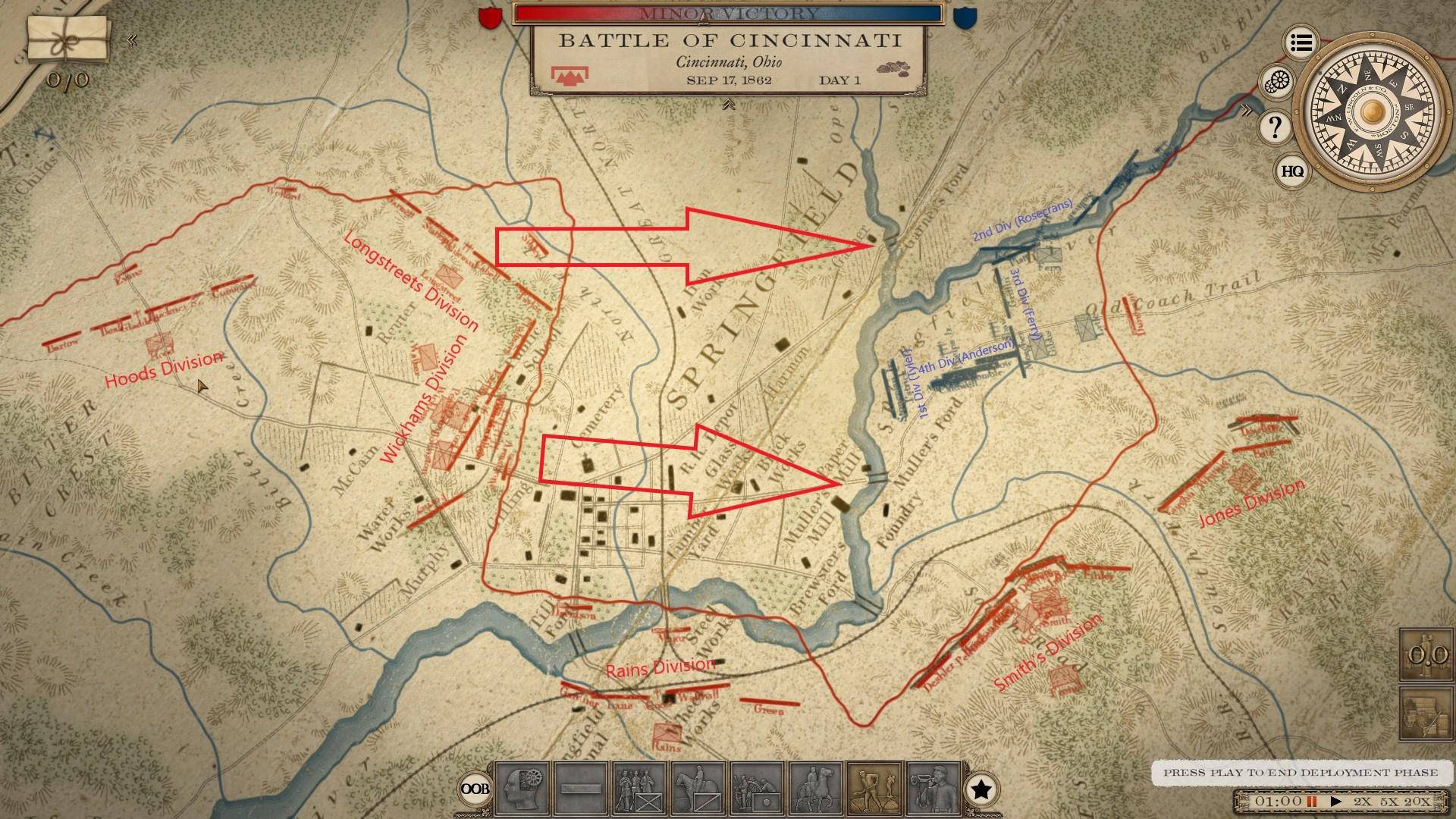
The Battle of Cincinnati - The Union manage to raise a decent army.

Post image
10 Upvotes

1862 Sept 17-19: The Battle of Cincinnati,

The first two days of the battle witnessed a series of probes and skirmishes between the Army of Mississippi and the Army of Tennessee resulting in a steady trickle of casualties on both sides. Frost's Army of Tennessee sought to protect the main trade routes and supply roads south of the Springfield River.

  • Stone Rook (3 VP)
  • Humbert's Hill (3 VP)
  • South Road (5 VP)

Frost's overall strategy was to deny the enemy the river crossings and keep them away from the industrial areas to the south of the city. However, unknown to Frost, Major General William H. Lytle had called up a pontoon train and was in the process of bridging the river east of Muller's Ford. Which would enable his army to outflank Frosts defences on the river. Fortunatelyfor Frost. the Confederate cavalry accidentally discovered the bridges and the bridgehead in the small hours of September 17th.

1862 Sept 17 (Day 1) 1 am (Night): Initial Deployment and Tactical Plan 

The Tactical Plan agreed between Lt. General Frost and General Johnston was to be the tried and trusted 'Hammer & Anvil' approach.

'The Anvil'

Frost's Army of Tennessee would form the 'Anvil' that blocked the enemy advance south of the river.

However, the revelation during the night of the 17th that Lytle had pontoon bridges over the Springfield River east of Muller's Ford caused Frost to order some last minute changes to his deployment.

  • Jones and Kirby-Smiths Divisions had to be moved to the right to contain the Union Bridgehead.
  • Jones Division now took up position on the extreme right defending the wooded hill known as Raymer's Rise.
  • Kirby Smith's Division were strung out across South Road with orders to prevent the enemy advancing beyond the South Fork Creek.

Both divisions spent the night fortifying their positions as heavily as time and resources would allow. Well aware that according to intelligence the enemy had a significant advantage in artillery.

Frost was well aware that his right flank was spread thin and reinforced it as best he could with the guns he had available.

He also warned Major General Gabriel Rains that his division would be required to move to defend the South Road should the enemy manage to turn the armies right flank or drive in Jone's Division. But that he was to wait until the Army of Kentucky had confirmed that the town of Springfield opposite his position was devoid of enemies before abandoning his defence of Till's Ford and the Railway bridge.

'The Hammer'

Johnston's Army of Kentucky would be the 'Hammer' that descended on the enemies flank and rear and beat them bloody.

  • Wickham's Division had orders to clear the town of Springfield and secure the northern bank of the river at Muller's Ford and Brewster's Ford. Once this was achieved Rains Brigade would be released to march east and reinforce Jone's Division along the South Road.
  • Longstreet's Division would advance to the left of Wickham's Division to secure Garner's Ford and then move against the enemy pontoon bridges to cut the enemy line of retreat and threaten their rear.
  • Hood's Division would cut the enemy line of supply to the north along the Bitter Creek Road and then march east to provide support and reinforcement for Longstreet and Wickham's Divisions.
  • Sam French and the Reserve Artillery would provide close support for Wickham's Division

It was recognised that there was no way of predicting how the enemy would react to the arrival of the Army of Kentucky and that they may change their own plans to counter the Army of Kentucky's attack. But it would not be the first time that the roles had to be reversed and the hammer become the anvil and vice versa. So, flexibility would be vital.

Assessment of Risks

During the night the troops on the right of the Army of Tennessee had worked hard to fortify their defences.

On the extreme right Jones's Division had constructed Raymer's Redoubt with a reinforced parapet defended by Fry's Regular Alabama Brigade and the five guns of Dowling's Texan 12 pounder battery.

The was connected with the South Fork Creek by a breastwork known as 'The Fence' defended by Whiting's Mississippi Brigade and Vaugh's Tennessee Brigade. Both well trained brigades but only armed with captured Springfield muskets.

Bates Tennessee Brigade was held in reserve to deal with any breach in the defences. It too was well trained but poorly armed.

Beyond the South Fork Creek Kirby Smith's Division was spread thin.

  • It's right was anchored on the South Fork creek with a reinforced redoubt called 'South Fork Redoubt' defended by Moore's poorly trained and armed Missouri Brigade and fifteen artillery pieces with a good field of fire over the creek to their front.
  • Finlay's crack Florida Regular Brigade was covering their right flank overlooking the creek and one of the few brigades armed with Springfield Rifles.
  • Beyond that Kirby Smith's men had constructed a long breastwork to block the South Road. leading to Brewster's Ford called 'Brewster's Fence'. It was defended by two well trained Alabama Brigades commanded by Deshler and Breckinridge, and eight artillery pieces.

The position was as strong as it could be given the troops available and the time to prepare it. However, a strong determined assault might easily breach it by overwhelming one position. the other concern was that the enemy may decide to simply march around it by following the Old Coach Trail past Mrs. Pearman's Farm and then cutting west to Raymer's Farm and the South Road. This was why Frost was keen to move Rains Division east as soon as possible.

I was also concerned about the weapons available to the troops in both the army of Tennessee and the Army of Kentucky, neither of which had been receiving much love from the CSA Ordnance Department. the vast majority of good rifles had gone to the Army of Northern Virginia and the Army of the Shenandoah. Of the 24 brigades available only 2 were armed with Mississippi Rifles and 3 with captured Springfield Rifles, The remaining 19 brigades were armed with captured Springfield Muskets with poor accuracy and only 200 yard range.


r/GrandTactician • • 14d ago

William Frobisher: Generals are Not Gods

Post image
19 Upvotes

Artist's Conception of the Battle for the Bull Run Bridges, May 8, 1863. Union forces marked in blue, Confederate forces and key strong points marked in red.

"At our first meeting, General Frobisher and I talked at length about our experiences during the war, and he graciously told me that had I been assigned more men, my attacks against him at Bull Run would have been completely successful.

-Lt. General Dabney H. Maurey, CSA

"In retrospect, I was simply not suited for higher command, and had I been truthful with myself, I never would have accepted it."

-Brig. General Daniel Lucas, Union Army.          

In the first few months of its existence, the Cavalry Corps benefited from the experience of two excellent Division commanders, experienced gentlemen who had fought in the Mexican War. William Harney had command of the 1st Division, with scouting as it's primary function,, and Phillip Kearny had command of the 2nd Division, which was initially tasked with engaging and holding an opposing force in place while the Capital Division, now under Major General Quimby, maneuvered for advantage. In addition, there was a division of mobile combat engineers under the command of Brigadier Andrew Humphreys. The steady leadership of these men had played a critical role in the victory at 3rd Manassas. It was Harney who had determined that the path around our left flank was clear, and Kearny and Humphreys who had kept the relatively green 2nd Division and the Engineers in line during the initial attacks.

Haney’s wisdom was invaluable to me during the action near Alexandria two weeks later. He led his division well ahead of the Corps, discovered that the Confederates had not yet crossed Rock Creek, and then held the bridge until the rest of our forces arrived to complete the victory. Kearny, for his part, infused his division with a fierce determination to fight that made them charge into battle with the courage of veteran troopers.

But both men were getting on in years, and Haney came to me shortly after Alexandria and let me know that he wanted an administrative position instead of a division command, and I obliged him by finding a position on Sherman’s staff. Kearny, for his part, was still full of fight, but he found the extensive administration duties of a division commander distasteful, so he graciously stepped aside and accepted command of a new brigade instead.

At the time their departures did not seem to be a hardship, as I had two veteran commanders, Goodrich and Lucas, whom I planned to elevate when given the opportunity. Both men had served me well as regiment and brigade commanders, so it seemed logical that they should advance along with me. In this I was probably motivated by our long histories as comrades in arms. I was well aware of their difference in personalities: Goodrich was close to his men and saw their well-being as his primary responsibility, while Lucas was something of a martinet. He was a fine trainer and was competent in the field, but there was no love between he and his men. He told me quite frankly that he preferred it if his men did not like him. Hatred, he said, was a powerful motivator.

The first sign of trouble appeared during a deployment exercise where I observed Goodrich losing track of his brigades. His staff officers were clustered around him, making every effort to help him sort out the problem.

“Sir, Colonel Cake’s brigade is posted here, near the crossroads.” I heard one of them say.

Goodrich, looking flustered, asked “Who told him to move there?”

“You did, sir.”

“But I wanted the Sharpshooters there, with Cake on the left.”

“You ordered Wild to the left, sir.”

“Oh, yes. I recall now. Thank you.”

And so it went. Goodrich appeared as if he were taking on more than he could handle, and when he lost control, he deferred to his aides. As for Lucas, while he excelled at training his men, he was displaying the markings of a man who was enjoying the exercise of his power too much. He was arbitrary in his punishments, and he played favorites with some of his officers. Elliot let me know that the noncoms in his brigades were on the verge of mutiny. They did not trust him to do anything but attack, which he did even when such an action was not warranted.

“He had them abandon a perfectly good position and charged right into an ambush that Buford had set up.” Elliot said. “If that happened in the field he would have lost his lead regiments.”

I attempted to instruct both men on their duties, but there was never enough time to train them properly, as the events of the war simply would not allow us that luxury. Matters came to a head during the Battle of Bull Run Bridges, which taught me a great deal about the business of being a Corps commander, and how quickly a situation can slip from control.

We were transiting the dreaded Manassas battlefield where recent reports had suggested another probe by Confederate forces. Our scouts located the enemy positioned on the same heights. I ordered Goodrich to take his scouting division and secure the bridge that crossed on the north side of Bull Run, and once that was complete, Lucas was to take his division across. I would follow up with the Capital Division and deploy along whichever flank seemed the most vulnerable, with the Combat Engineers acting as a reserve.

In this I committed the first of my errors that day, for there were in fact two bridges on the north side of the Run; one near … farm and the other near Sudley Church. Goodrich was not sure which one I had meant, and he halted the march to look at his map and try to figure out which of the crossings he was supposed to secure. It was at that moment that the rebel army made its attack.

Herein lay my second error, for I unwisely assumed that our opponents would simply occupy the heights as they had previously done. Ironically, I had decided on a different course of action so as not to be caught executing the same plan a second or third time, but I failed to realize that the opposing generals might be as unpredictable as I was.

Rather than await an assault, the general in command of the Confederate armies, one Dabney H. Maury, elected to attack across all of the crossing points along Bull Run. Three of them were meant to be demonstrations, but one of them, the one across the bridge at the farm, was the main thrust, and it had come down on Goodrich just after he had halted his advance.

My next mistake was where I had positioned myself in the line of march. I was behind the Capital Division and just ahead of the Engineers, which meant that I was further away from the vanguard and thus not able to react to the situation as quickly as I should have. This was further complicated when the Capital Division was attacked by one of the distraction forces. Quimby immediately deployed his division to respond, but doing so meant that our most experienced brigades were unable to lend support to Goodrich. Lastly, my Engineers found themselves attacked by yet another force, which also kept them occupied.

Leaving Quimby to direct the two rear divisions, I rode forward to get a better understanding of what Goodrich and Lucas were facing. When I reached the farm, I found chaos. Goodrich had deployed some of his brigades to contain the attack, just as we had done at Alexandria, but not all of his forces were committed. The units involved in the fight had no cohesion; they were regiments from different brigades, which made it harder for their commanders to coordinate their units. Complicating the matter further, Lucas  had deployed some of his units into the mix, and as a result there was confusion not only at brigade level but at the level of divisions. As I scanned the battlefield, I found I could not locate the entirety of Lucas’ forces. Even worse, I could see that there was a hodge podge of regiments, some from Lucas, others from Goodrich, that were standing in disjointed lines, waiting for orders that were not forthcoming.

I rode to where the 5th Pennsylvania Cavalry was sitting and spoke with their colonel.

“Where is the rest of your brigade, Colonel McQuade

“Up by Sudley church I expect.” He told me in a rather relaxed fashion. “Lucas saw the fight here and halted some of us, but I suppose word didn’t get out fast enough, and the rest of them just kept on going. I heard musket fire up thataway shortly afterwards.”

“Where is General Lucas?”

“He went to have a word with General Goodrich. Didn’t seem to pleased about it, either.”

I realized I had to get control of the situation quickly.

“Mr. Fischer, ride forward to Sudley Church and report the situation to me as soon as possible. Carey, locate General Lucas and General Goodrich and have them report to me here immediately.”

Without much thought, I began riding across the battlefield, issuing orders to different regiments as I happened upon them. I had batteries move to the flanks of the line to pour fire down on the Confederates as the exited the bridge and reinforced the line using only Goodrich’s troops initially, thinking that if the situation warranted, I would send Lucas to deal with the fight at Sudley.

At length my two missing division commanders appeared.

“Reporting as ordered, sir!” Lucas said with an immaculate salute. Goodrich said nothing.

“Gentlemen, the fight is on us, and I have been directing the troops in your absence. Will you please explain yourselves?”

Lucas looked at me stone faced, but Goodrich replied, “Sir, General Lucas and I have been discussing the best course of action. It appears that…”

A blast of canon fire came down near us.

“It appears," I said sternly, "that the enemy has attacked us across four different crossings. We need to reorganize and get the men into the fight.”

Fischer rode up at that moment and reported that the fight at Sudley Church was getting hotter.

“General Lucas, your units are gathered by that stand of trees. Take them and reinforce your men at Sudley Church.”

“Sir, some of my men are holding the crossing here.” Lucas explained.

“I know that. General Goodrich, your sharpshooters are not engaged yet, am I correct?”

“I…I believe so, sir.”

“Bring them up to the bridge to take over General Lucas’ people. Once your men have withdrawn, Lucas, take them to Sudley and stay there until the issue is decided! Is that clear, gentlemen?”

“Yes sir!” they said in unison.

With my two lead divisions disentangled, I looked to see how we could turn the field to our advantage. As I watched the momentum of the battle begin to shift, I recalled that there was a bend in the river that ran from this crossing to the one where my other two divisions were engaged. If the Capital could accomplish a crossing at their location, they could move up and flank the Confederates now attacking across the river.

“Sergeant Elliot, ride back to General Quimby and tell him that if he can push his troops across the bridge, he is to send as many brigades as he can to attack the rebel formation at our location.”

Elliot was looking at the battle with his glasses. “I don’t think that will be necessary, sir. Look over yonder.”

I looked to where he indicated and saw the flags of Quimby’s regiments, those of Grant, Sheridan, and lastly Shipton. Together, they slammed into the flank of the rebel attack, pushing them back. Apparently, Goodrich had seen them as well, for his men pushed the grey troops in front of him back across the river. The rebel lines broke and retreated, albeit in good order.

In the aftermath of the fight, I went to each of the division headquarters to hear their reports. General Humphreys had led his men effectively when they were pressed into battle, but he told me his units had been understrength, and his artillery pieces were too short ranged to be effective across the river. I had, unfortunately, neglected his needs. When I saw Quimby I thanked him for his quick action, but he demurred.

“The credit belongs to my colonels, sir.” He told me. “Buford offered to hold the rebs back while Grant, Sheridan and Shipton got across. It was all their idea. I only agreed to it.”

Goodrich gave me his account of the battle as follows:

“When we reached the Red Hill farm bridge, I hesitated, trying to determine whether this was the correct crossing. It was only a few moments before the rebs came storming across and attacked. I began to deploy my forces when the leading elements of Lucas’ division arrived. Some of them joined the fight, but others kept on going towards Sudley Church. I have no idea why. When Lucas approached, I tried to ask him what his orders were, but he began haranguing me regarding my position. We were still arguing about it when Major Carey found us.”

Lucas’s account went as follows:

“When I heard the sound of gunfire I diverted my division towards the battle. Upon arrival, I saw that Goodrich’s forces were in disarray. As senior officer I went to locate him to take command of the field. But he began to question me about his orders and insisted he retain command of his division. We were discussing the matter when Carey arrived.”

I knew I had made my own mistakes during the battle, but I also knew that something had to be done regarding this conflict between my commanders. As I have oft said, there was no training for this level of command, so I had nobody to rely upon except for myself and the advice of my companions. The situation was compounded by the fact that General Humphreys, whom I had selected for his engineering expertise, asked to be relieved of his command as well. The last straw, General Quimby, had also received a promotion to Major General, and was being eyed for command of the Artillery for the Army of the Potomac. I had to admit it was the ideal position for him. Unfortunately, this left me in the awkward position of having to replace all four of my division commanders.

***

“You think Sherman will cashier me for this?” I asked Elliot. We had taken to drinking on selected evenings.

“Naw, sir.” The old soldier told me. “You just gotta come up with some names.”

“Names of four individuals with the instincts to organize two brigades of cavalry, one brigade of sharpshooters, and three batteries of horse artillery, march them along unfamiliar roads, in a timely fashion, arrive at an unknown location, read the terrain correctly and deploy eight to ten thousand soldiers to kill their fellow men.”

Here I paused for a sip of whisky. “For a good cause.”

“’zackly.”

“I don’t think any of our brigade commanders can do the job.”

“Lemme ask you a question, sir. If rank had nothing to do with it, who would you pick to lead a division?”

“You.”

[redacted]

I chuckled. “What have you got against my horse?”

“Back to the question, sir. Who else would you pick?”

“Well,” I began, “If you don’t want the job, I may as well have your twin. Buford.”

“Good choice. Who else?”

“Among the colonels? Well, that’s easy. Grant and Sheridan.”

“Done. You just need one more.”

“I can’t think of anyone else.”

Elliot took a long swig from his flask. I had no idea what he actually drank, and I wasn’t sure I wanted to know.

“I’d spell it out for you sir, but I can’t.”

I nodded. “I understand. This is something I need to figure out for myself.”

“Naw, sir, I just ain't good at spelling. But you know the answer.”

I nodded again. “Shipton. But what will Sherman say? Or the brigade leaders?”

“Sheeeet, sir. We got governors handing out commissions like they were sugar plums. ‘Aint nobody'll say nothing, at least nobody with brains in his head. And any soldier worth a damn would know you’re making the right choices. They just want good leaders.”

I downed the last of the whisky in my glass. “I expect the press will just love the fact I’m handing a general’s commission to a boy who’s barely started shaving.”

Elliot looked me in the eyes for a moment as if to say something, but thought better of it and just drank.


r/GrandTactician • • 16d ago

Any mods to make the AI less bad?

9 Upvotes

The AI has never been good. It will suicide against a heavily entrenched position if it has the numerical advantage, but something that is particularly infuriating is that it doesn’t even seem to attempt to fight back against if it is outnumbered and on the defensive. It will just wait for you to come and you can easily surround bits and pieces with no real response outside of the local units. It’s so bad that it makes the game kind of pointless.


r/GrandTactician • • 16d ago

William Frobisher: War Means Killing

Post image
11 Upvotes

The Capital Division deploying at Manassas. From Left: Capital Riders, Capital Sharpshooters (Colored Infantry), 1st Canadian Mounted, 2nd US Mounted.

“In selecting Manassas as the battlefield, with all of its advantages in defensive terrain, I failed to account for the intimate knowledge of the location that was possessed by General Frobisher and his officers.”

Lt. General Aldey H. Gladden, Confederate Army of the Peninsula.

“There is so much Canadian blood soaked into the ground here as to qualify it for citizenship.”

Col. Maynard Shipton, 1**st Canadian Mounted Infantry

“The first day we were facing the east, the second day we were facing the south, and the last day we were facing the west. The Canadians spun us around like a debutante.”

-          Col. William J. Clarke, Confederate Army of the Peninsula

“I hate this place.” Carey said beside me, his thin face twisted into a scow. “By God, I hate this place.”

Elliot spat on the ground. “You ‘aint alone, brother.”

We were surveying the all-too-familiar grounds around Manassas, looking at the Confederates’ positions on the high ground.

“As much as I agree, gentlemen,” Father Hogan remarked, “Seeing them inhabiting our former positions feels like coming home and finding squatters on our property.”

“It kind of does seem like that, preacher.” Morgan said. “What’s the plan, General?”

He waited for a long moment.

“General Frobisher sir? What are your orders?”

I had not heard him because I was watching the First Canadian regiment riding in the distance with Shipton at the head of the column. I knew both he and the regiment were capable, but I was still worried about them.

“I’m sorry, Mr. Morgan.” I told him. “Send to all the Division commanders and have them meet me here.”

It is a little-understood fact that the higher the rank one achieves, the further away one feels from the fighting. I began to feel this distance slightly at the brigade level, and more profoundly when I commanded a division, but the business of a corps commander was by far the most difficult transition. While I was never far away from the violence, I had to become somewhat prescient in my ability to comprehend the miles of battlefield for which I was responsible. Despite the best maps and scouts available, one cannot see everything or be everywhere, and at times it felt as if I were engaging in some peculiar form of mysticism in the way I made decisions.

In the third battle of Manassas I was aided by my familiarity with the ground, having ridden and fought over it on many occasions, it was easy to visualize. I understood that the ground to the east was barred by water and hills topped by woods, and how the ground to the south was mainly open fields with stone fences and lanes. But the ground to the west was the most open. There were hills that could conceal the approach of an army, and between those heights and the familiar location of Henry Hill and the other high grounds, there was open territory that made moving troops and sighting cannons for bombardment much easier.

My strategy on this occasion, with General Gladden’s Army of the Peninsula occupying the heights, was to initially give a repeat of my attack from the south during the battle of the previous November, with General Cadwallader’s divisions attacking from the east. This I would accomplish with two of my divisions, the 2nd and 4th, respectively, while my 3rd division would maneuver and attack from the west once the enemy was pinned down. Lastly, my old Capital Division would ride completely around Gladden’s army and attack from the north, sealing off the escape.

All of this seems simple enough to explain, but the experience of it was much more complex. I had to position myself so I could see as much of the field as possible, and when that was not practicable, I needed to rely on my division commanders to provide me with the necessary information. Even then, there were moments where I had to ride up to the line and try to encourage my men and direct their efforts when I felt it became necessary. There is no training for this type of work, and upon later reflection, I began to see why so many of my previous commanding officers appeared to lose control of a battle. Trying to think clearly, to visualize the parts of the field one cannot see amidst the chaos, and to still be within easy reach of shellfire and bullets…in all due honesty, I have no idea how I was able to accomplish it.

There were moments when an air of detachment came over me, and I was nearly overwhelmed by the magnitude of what was transpiring. This battle was my first as commander of the 1st Cavalry Corps, or “The Army of the St. Lawrence” as it colloquially became known, due to the preponderance of soldiers from both sides of that mighty waterway. But in those brief moments of reflection, the immense scale of the thing crystalized in my mind. That there were over 70 000 human beings on that field in the process of mutual slaughter, and that I was one of the prime instigators of that, a single man on a field conducting a bloody symphony…the awesome realization was dreadfully, horrifyingly sublime, and Elliot’s words about the responsibility of the king that led them to it struck to my very marrow, and I felt an enormous pity and sorrow for Mr. Lincoln, who bore the fates of not only my 30 000 men but hundreds of thousands more.

The crisis point in the battle came on the second day, when I received a written order from General Cadwalader stating that his army was withdrawing from the field and that I was to follow. But looking around me, I saw that the rebels were giving way, some in good order and others not, towards the east, towards Washington. Cadwalader’s withdrawal had left it as their only avenue of escape, as my divisions were pressing them from the remaining three directions.

“Read this, if you will, Mr. Carey.”

Carey read the hastily scribbled note.

“Is he serious?”

He passed the note to Elliot who scanned it briefly.

“Seems a bit vague to me, sir. Think you should send a note asking for confirmation.”

“The order is clear, gentlemen.” I said sternly. “But as the rebels are retiring in the general direction of Washington itself, and that is our home, we have but one remaining course of action. The 1st Cavalry Corps will retreat in the direction of the enemy.”


The retreat of the Confederate Army of the Peninsula degenerated into a rout soon after I sent out orders for a general advance. They crowded over the bridges and tried to escape across the farmlands but given that fully two thirds of my army was composed of cavalry, a great many of them did not get very far. As I followed my troopers, I could see their formations breaking up to chase down their foes. I realized to my horror and shame that my men were cutting down a great many fleeing men, even some of those who raised their hands to surrender.

“Morgan! Elliot! Fisher! Everyone! Get down there and tell our officers to restrain their men for the love of God!”

My staff officers scattered across the field. I sat on my horse and continued to watch the terrible spectacle. It seemed that it was taking far too long for my orders to be obeyed.

“Dear God, we’re doing murder.”

I turned to see Shipton had ridden up beside me, his face aghast. But then another voice cut through the air.

“War is murder, son.”

We turned to look at Grant, sitting on his dark brown horse, his deep blue eyes staring at the field unflinchingly. For a moment, Shipton looked as if he wanted to strike him off his horse, but we both saw Grant’s expression was not that of a cold-blooded monster. It was the face of a man who knew intimately that the purpose for which he had been created was intrinsically monstrous.

Shipton’s eyes were filling with tears as he turned and rode away.


r/GrandTactician • • 16d ago

The Last Death Throes of a Desperate Union AI.

Post image
40 Upvotes

It is September 1862 and I suspect that my current CSA campaign is nearing its end. Washington has fallen, Philadelphia is occupied, Missouri, Kentucky, Maryland, Delaware and the trade routes to the west are all in Southern hands. The campaign summary acknowledges Confederate Domination of North America.

However, I have edited the Campaign Victory conditions to try and make it last longer by reducing the victory threshold from 25 National Morale to 10. So, for the moment at least I am forcing the AI to keep fighting by denying it the option to surrender.

Unfortunately, it doesn't give the AI any other advantages to help it win the war. It merely forces it to keep fighting despite it's situation. However, it has been interesting to witness how the AI reacts to being dominated and unable to put up a decent defence.

In terms of military strength the AI is currently fielding just over 80,000 men, whilst the CSA has over twice that strength with 187,000 men in the field, This is largely down to the appallingly high losses suffered by the Union in the campaign to date. The Union has lost 304,000 men in 86 military defeats and only won 12 battles in the entire campaign. By comparison the CSA has lost 84,000 men.

The consequence seems to be that the AI is having trouble recruiting troops. No doubt its state support has been badly affected by such huge losses and that is discouraging volunteers to come forward to serve. I've noticed that Union Armies are becoming more and more diverse with not only coloured brigades appearing in its OOB but also brigades recruited from 'Scalawags' (Southern Union Sympathisers) e.g. Missouri Brigades, Kentucky Brigades, Arkansas Brigades and brigades from the Indian Territories.

It is also having trouble fielding decent sized armies and brigades and seems to be compensating for the lack of numbers by increasing the ratio of guns to men. This is quite interesting as it's basically what Napoleon did towards the end of the French Empire. As he gradually drained the last manpower from France, he compensated by filling his armies with soldiers from conquered territories and increasing the number of guns in his OOB.

However, despite it's best efforts I'm seeing AI brigades with as few as 500 men in them and the only full sized brigades of 3,000 tend to be coloured, or 'Scalawags'. The impression being that the AI is scouring the bottom of the barrel for manpower.

Strategically, it has lost a lot of territory. Which is also impacting on its available manpower and resources. Which is making it challenging for the AI to recruit and equip armies.

In the East, Philadelphia (the current Union captial) has just been occupied by Lt. General Henry McCulloch and his 31,000 strong Army of the Shenandoah. The AI is desperately throwing its last reserves of manpower at this army in an attempt to delay Philadelphia's capture. I'm hoping when it does it will force Lincoln to sue for peace. But in the meantime I have had to fight a series of small insignificant Union armies of under 10,000 men that whilst sometimes still tactically challenging ultimately just waste yet more Union manpower.

Also by pushing north into Maryland, Delaware and Pennsylvania the South is capturing Union ports and shipyarda effectively starving the AI of trade and denying the Union Navy of locations where it can repair its fleet.

In the West, Major General Porterfield is in the final stages of capturing all the Union held forts in the Inidian Territories, thus securing total control over the Santa Fe and Origon Trail for the south and cutting the Union off from all trade with the west and the Pacific Coast.

The only serious threat at the moment is along the Ohio River where a Union Army of 28,000 men is currently threatening the Confederate manufacturing centre at Cinncinatti Ohio. I thought the AI was planning to try and attack Frost's, Army of Tennessee which is guarding the city. But at the moment it just seems to be trying to disrupt the production of the Cinncinnatti factory. Nevertheless I have reacted by ordering the Army of Kentucky to march to Cincinnatii and drive the enemy Army of the Mississippi away from the river.

There is an element of 'How the mighty hath fallen.' about what I think must be the final stages of my campaign. The AI is clearly struggling to defend itself but has squandered far too many troops in the early months of the war and the scales are clearly now balanced against it.

But it also proves that even if one edits the campaign victory conditions to try and extend the length of your campaign it doesn't mean that the AI can cope with the cost of a long war. One could just allow the AI to cheat, by increasing the difficulty level to artificially increase the AI manpower, resources, and wealth but that rather defeats the point of a strategy game.


r/GrandTactician • • 17d ago

Whats your guys thought on Grand Tactician Civil War

Post image
38 Upvotes

r/GrandTactician • • 16d ago

The Prussian, Johann von Stuhm

12 Upvotes

After following the series of Docent’s William Frobisher, I’ve decided to make my own unique character for this lovely game. This first entry will mainly be about his backstory and his arrival in the United States. Anyways, here comes the beginning of the first log of the potential upcoming legend, Johann von Stuhm

The Past 1820-1861

Johann von Stuhm was born in 1820 in the West Prussian town of you guessed it, Stuhm. He was the coming heir to the surrounding estates and the town itself, his father was quite the Militarist, as he served in the Napoleonic Wars against the Corsican himself. But by the time he had Johann, he was entering his late 40s, but of course he wouldn’t go down without fighting in the First Schleswig War (1848-1851), with his son who was a junior officer using his noble status, Johann gained much of his experience from his battles in the First Schleswig War, but his Father did not have as much of a good time as Johann did, he was in his Mid 60s and had caught a vicious cold during his campaign, leading to declining health and eventual death in the later stages of war, thus Johann had become “Freiherr” (or Baron) Johann.

After the war, Johann tried to settle in Stuhm and live out his life helping the town grow and boom, but his Prussian urge to fight had led him on a ship to New York in 1860, as the south began seceding from the Union, Von Stuhm gathered many Germans that had settled in New York City to form the 12th New York Volunteer Infantry in 1861, and thus joined the 1st Division of the Army of Northeastern Virginia under the esteemed Irvin McDowell. His Men knew of his service during his Prussian Days and can’t wait for their very own first sighting of the “Elephant” as Johann leads them to Glory.


r/GrandTactician • • 16d ago

Adding generals to later campaigns

3 Upvotes

I was wondering if there was any way to add generals who historically died or resigned to later campaigns. Such as making Stonewall Jackson or McClellan available in the 1863 campaign. I swear i did this in the past but I cannot remember how.


r/GrandTactician • • 18d ago

William Frobisher: An Unexpected Guest, and a New Command

6 Upvotes

[I didn't get much of a chance to choose commanders when I got to division level, but I corrected that oversight here.]

Frobisher was the type of leader who believed in second chances, but he was also able to recognize those men who would not fail him.

- William Tecumseh Sherman

We spent the 12 and 13th of November seeing the dead and wounded from both sides, securing our prisoners, and collecting all of the guns and cannon left on the battlefield. It was Nov. 16th when we finally returned to Washington and found the city had turned out to greet us. The whole affair was an impromptu parade, with citizens from every walk of life lining the streets to cheer us. Our Negro infantry, unused to positive attention, snapped to attention and walked proudly, enjoying the proffered handshakes and backslaps. When we reached our customary bivouac, we found that the garrison soldiers had cleaned the ground up for us, and their cooks had all contributed to creating a veritable feast out of the usual standard rations. It was incredible what motivated men could do with hardtack and salted meats. For the next few months not a single soldier in the Capital Division had to buy a drink for themselves, and clubs that were originally off limits now welcomed everyone, including our Negro infantrymen, with open arms.

By mid-December we were well into Winter Quarters, with some soldiers going home for the holidays, some new replacements joining their regiments, and a reduced schedule of training and drilling. My staff and I were going through the usual mountains of paperwork, when a rising tide of cheers began to sound throughout the camp. We ran outside to see them crowding around an open carriage, where a tall, rather homely looking gentleman was graciously shaking proffered hands, his bearded face contorted upwards in a wide grin.

“Well burn my biscuits.” Morgan exclaimed. “If it ain’t Father Abraham hitself.”

Indeed, it was the man himself, Abraham Lincoln, come to visit the soldiers that had saved the capital. We started towards the crowd, but the press was so tight that it seemed there was no way we were going to get near the President.

“Bugler, sound assembly.” I ordered.

My bugler snapped out of his reverent stare, brought the brass horn to his lips and sounded the call. To their credit, the men dispersed and placed themselves into proper formation, buttoning their coats and trying to make themselves presentable before Sergeant Elliot called them to attention.

Lincoln stepped down from his carriage with Shipton’s help and walked down the front lines with his hands behind his back, nodding his approval. At length he turned and addressed me.

“I hope you’ll forgive my dropping by unannounced, General.” He said, smiling again. His voice was surprisingly high-pitched and a bit shrill.

My staff and I saluted in unison. “It’s an honor, Mr. President.

Lincoln returned the salute in a rather casual fashion.

“I must admit that I am gratified to see your men getting along so well. I was told by many that…mixing cavalry and infantry would be asking for a heap of trouble.”

He was looking over our Negro and white regiments as we began walking towards my tent.

“Shedding blood together on a battlefield has a way of…changing perspectives, sir.” I explained.

Lincoln responded with a quotation: “He that sheds his blood with me shall be my brother….”

He paused, as if contemplating the words, but Morgan finished the rest for him.

“Be he ne’er so vile this day shall gentle his condition.”

Lincoln nodded at the sergeant.

“And gentlemen in England now a-bed will think themselves accursed they were not here.” This, surprisingly, from Elliot.

It was Shipton who finished the speech. “And hold their man hoods cheap whilst any lives that fought with us upon St. Crispin’s Day.”

Lincoln affected an English accent. “Is that the king’s own tongue I hear, my boy?”

“It is sir.” Shipton answered.

“I must say it’s a pleasure to be among such learned folks. Especially those fond of the Bard.”

Elliot shook his head. “That speech is a whole lotta horseshit if you ask me, sir. ‘cept maybe the part about being brothers.”

“Is there another quote you prefer, sergeant?” Lincoln asked, tilting his head.

“If these men do not die well, it will go hard for the king that led them to it.”


Moments later the President and I sat in my tent alone to share a private matter he told me he wished to discuss.

“Your staff is quite the colorful bunch, General.”

“We manage to make it work, sir.”

“I recon they’re much more harmonious than my cabinet, most days. You know, speaking of harmony, I recall hearing a story about James Madison, how he asked his generals what most opportune time for an invasion of Canada would be. They told him the decision would be simplified by the weather.”

I nodded. “Canada has but two seasons, sir. Winter and July.”

Lincoln laughed as if he were hearing the joke for the first time.

“I suspect that’s true, General. But it’s my hope that once this war is done, we can find a way to be more amicable neighbors than we have been in the past. I suppose right now it’s like living next to a married couple who can’t stop squabbling at all hours of the day and night.”

“It does keep the dogs barking, sir.”

He smiled at me again. “I spoke with General Sherman regarding your conduct during the Potomac campaign. He said you were the prime instigator of the whole thing. Says only a crazy Canuck like you could have thought up that move around Ewell’s flank.”

I shrugged. “It seemed rather straightforward to me, sir. Given the situation.”

“No West Point graduate would have dared to try that maneuver. But you did. Tell me, Mr. Frobisher, seeing as how the capital with one division, if I can get you an independent corps, can you save the Union?”

It was, of course, an impossible question.

“Sir, it would take more than just one corps to win this war. I can only promise you my best. Whether we win the war…I’m afraid it still lies in God’s hands. And yours, sir.”

Lincoln nodded. “I’d like to hear your ideas, about what you could do with an independent Cavalry Corps. What you’d do with it, how you’d outfit it, how you’d manage it if such a thing fell into your hands.”

I remained silent.

“Do you need some time to think about it?” he asked.

“Well no sir…the question is…. how much time do you have to hear my ideas?”


“This…. this is a mess.” Shipton said. “How are we supposed to field a cavalry corps in four months?”

“Three.” Morgan corrected.

“Three. But to do this we’re going to need supply trains, depots, and commanders we can trust to act independently.”

“And then we need a strategy on how we intend to use it.” Carey added.

“We got one good division.” Elliot said. “That’s a start.”

“How many divisions do we need?”

I looked at the map. “To cover the ground I’d like to cover? Three would be ideal.”

“Three divisions. Who should we put in command?” Morgan asked. “Goodrich? Lucas?”

“They ain’t ready.”

“I would tend to agree with you, Mr. Elliot.” I said. “Do you know anyone else that would be suitable.?”

“I know a couple of fellas from the regular army. Devin and Gamble. They might suit.”

I nodded. “We’re also going to need some new brigade and regiment commanders.”

Carey spoke up. “There’s a fellow in one of the Maine regiments that seems competent. A professor of all things, but he’s already been in a few engagements. Joshua Chamberlain. Has no problem with black soldiers either. He’d be a good fit.”

“I’ve heard of another regular Army officer.” Morgan added. “Indian fighter from out west. John Buford.”

Elliot winced slightly.

“Is there a problem with him?” I asked.

“Naw, sir. He’s a soldier, that’s for sure, but he irritates me. Kinda reminds me of me too much, if you take my meaning. Like lookin’ into a goddamn mirror.”

“There’s one other fellow. He’s currently in the infantry but he’s looking to switch to the cavalry. Phillip Sheridan.”

“What do you know about him, Shipton?”

“Aggressive, fearless, a decent rider. I’d say he’d be a good fit.”

We were discussing possible placements for these new commanders when General Sherman appeared.

“May I have a word, Mr. Frobisher?”

We stepped outside the tent to converse privately.

“I have a favor to ask of you.”

I smiled. “I hope it doesn’t involve holding thirty thousand angry rebs again, sir?”

“Nothing that drastic. There’s a good friend of mine, just come off of the injury list. He’s looking for a command. Now I will admit he doesn’t have the cleanest reputation in the regular army, but you won’t find a more determined officer. Set him to a task and he will complete it no matter how long it takes. He’s a good man.”

“What’s his fault?”

“He drinks…. but only when he’s idle. If he’s busy you won’t have a problem with him. He’s also a fine horseman. Back in Mexico he went alone to get ammunition for his men and rode his steed sideways to escape the bullets. Damndest piece of horsemanship anyone ever saw.”

“Is he cavalry?”

“Afraid not. There weren’t any billets for cavalry when he graduated from West Point, and when this war broke out, he signed on with the Illinois Volunteers. But I will vouch for him. He’ll make a fine cavalry commander.”

“What’s this gentlemen’s name?”

“Grant. Ulysses Sam Grant.”

“Well, if he has your recommendation, I can give him one of our new regiments.”

“I do appreciate this, Bish. I promise you won’t regret it.”