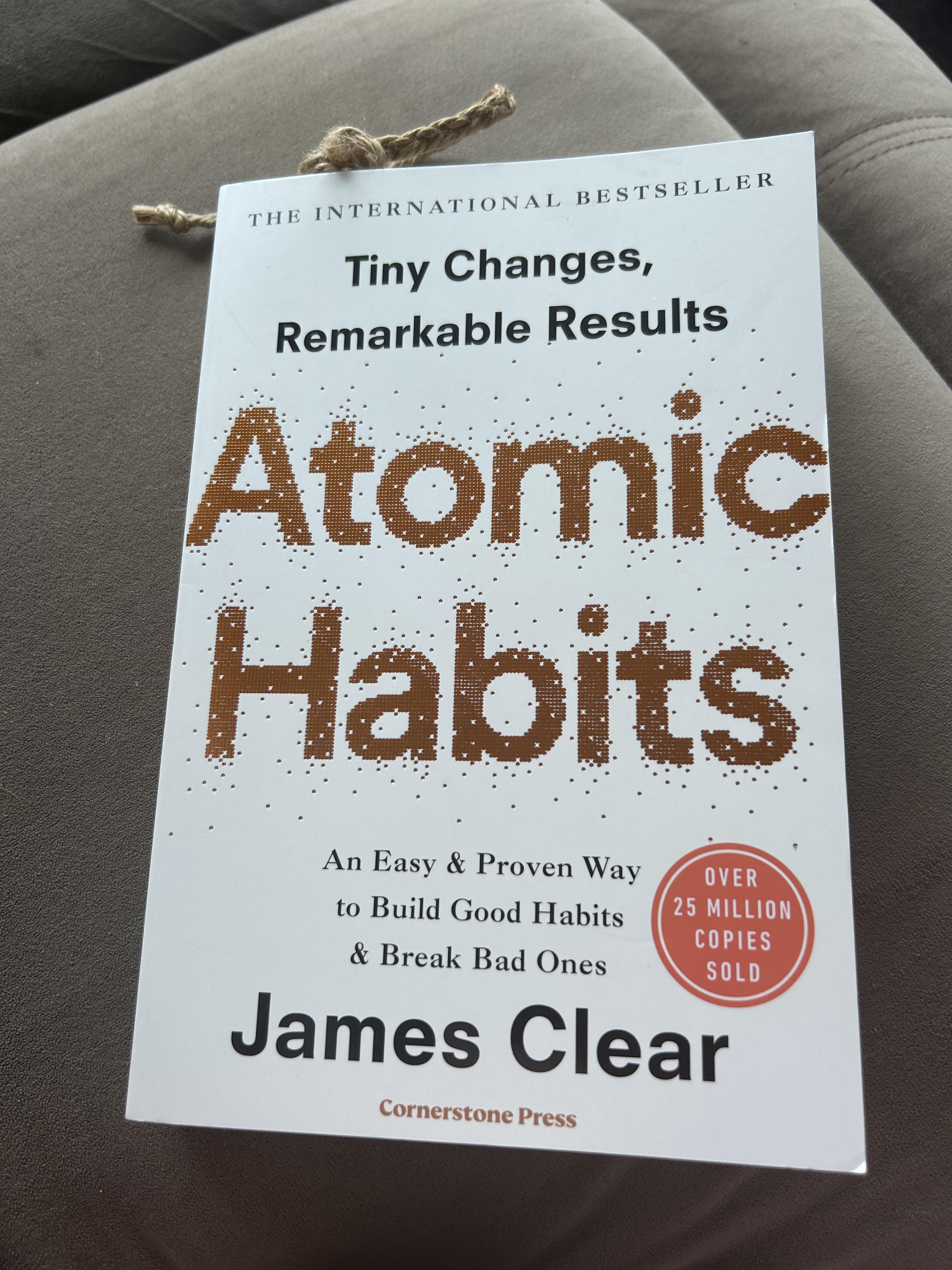
📖 ATOMIC HABITS — Complete Premium Summary
By James Clear | Prepared for Logic Leaf App
⚠️ COPYRIGHT DISCLAIMER
This content is an original, independently written educational summary and interpretation created exclusively for the Logic Leaf App. It is NOT affiliated with, endorsed by, or connected to James Clear, Penguin Random House, or any publisher of the original book "Atomic Habits." All concepts discussed are presented in our own original words for educational and informational purposes only. The original book title and author name are referenced solely for identification under the Fair Use / Fair Dealing doctrine for criticism, commentary, and educational summary. No original text from the book has been reproduced. For the complete experience, readers are strongly encouraged to purchase the original book. Logic Leaf holds the copyright to this specific written summary and its unique structure, formatting, and expression. © 2026 Logic Leaf. All Rights Reserved.
🏗️ PART ZERO: THE FOUNDATION — WHY TINY CHANGES CREATE GIANT RESULTS
The 1% Rule That Changes Everything
Most people believe that massive success demands massive action. This is a dangerous illusion. The truth is far quieter and far more powerful: tiny improvements, repeated consistently, compound into extraordinary results.
Think of it mathematically. If you improve by just 1% every single day for one year, you don't end up 365% better. You end up 37.78 times better (1.01^365 = 37.78). Conversely, if you decline by 1% daily, you degrade down to nearly zero (0.99^365 = 0.03).
This is the core philosophy: Habits are the compound interest of self-improvement.
Just as money multiplies through compound interest, the effects of your habits multiply as you repeat them. On any single day, the difference between a good choice and a bad one seems negligible. You won't see a visible transformation after one gym session, one healthy meal, or one page of reading. But over months and years, the gap between those who compound good habits and those who compound bad ones becomes enormous and irreversible.
The Plateau of Latent Potential
Here's where most people quit — and it's the most important concept to understand.
When you start a new habit, you expect linear progress. You think Day 10 should feel 10x better than Day 1. But reality doesn't work that way. Results are delayed. In the early stages, your efforts seem to produce no visible outcome. You're putting in work but seeing nothing. This is called the Valley of Disappointment.
Imagine an ice cube sitting in a room at 25°F. You slowly heat the room. 26°F... 27°F... 28°F... 29°F... 30°F... 31°F. Nothing happens. The ice cube looks exactly the same. Then at 32°F, it begins to melt. All the energy you put in from 25 to 31 wasn't wasted — it was stored. The breakthrough moment is not a sudden event; it's the result of all the previous actions finally reaching a critical threshold.
Key Insight: Your results are a lagging measure of your habits. Your net worth is a lagging measure of your financial habits. Your weight is a lagging measure of your eating habits. Your knowledge is a lagging measure of your learning habits. You get what you repeat.
Forget Goals. Focus on Systems.
This is one of the most counterintuitive ideas in the entire book.
Society tells us to set big, ambitious goals. But the author argues that goals are not the problem — the system is. Here's why:
Goals Systems
About the result you want to achieve About the processes that lead to those results
Winners and losers have the same goals Goals are temporary; systems are long-term
Achieving a goal is a momentary change Systems create lasting change
Goals restrict your happiness Systems allow continuous satisfaction
Example: Every Olympian wants to win gold. Every candidate wants the job. The goal is the same for everyone. What separates the winners? Their system of daily training, nutrition, recovery, and mindset.
The real formula: You do not rise to the level of your goals. You fall to the level of your systems.
🧠 PART ONE: THE IDENTITY SHIFT — THE DEEPEST LAYER OF HABIT CHANGE
Three Layers of Behavior Change
Imagine an onion with three layers:
Outer Layer — Outcomes: What you get (losing weight, writing a book, winning a championship)
Middle Layer — Processes: What you do (your workout routine, your writing schedule, your practice method)
Inner Core — Identity: What you believe (your worldview, your self-image, your beliefs about yourself)
Most people try to change from the outside in. They say, "I want to lose 20 kg" (outcome) and then try to force a process. This rarely lasts.
True behavior change is identity change.
The most powerful way to change a habit is not to focus on what you want to achieve, but on who you want to become.
The Critical Difference in Language:
❌ "I'm trying to quit smoking." → This person still identifies as a smoker who is attempting something difficult.
✅ "I'm not a smoker." → This person has shifted their identity. Smoking is no longer part of who they are.
How Identity Change Actually Works:
Your identity emerges from your habits. Every action you take is a vote for the type of person you wish to become. No single instance will transform your beliefs, but as the votes build up, so does the evidence of your new identity.
Every time you write a page → you are a writer
Every time you practice guitar → you are a musician
Every time you choose a salad → you are a healthy eater
Every time you skip a workout → you are voting for the identity of someone who doesn't prioritize fitness
The Two-Step Process to Identity Change:
Decide the type of person you want to be.
Prove it to yourself with small wins.
Key Insight: The ultimate form of intrinsic motivation is when a habit becomes part of your identity. It's one thing to say "I want this." It's something entirely different to say "I am this."
⚙️ PART TWO: THE SCIENCE OF HOW HABITS WORK
The Habit Loop — The 4-Step Neurological Pattern
Every habit follows a continuous feedback loop of four stages:
1. 🔔 CUE (The Trigger)
A piece of information that predicts a reward. Your brain is constantly scanning the environment for hints about where rewards are located. The cue triggers the brain to initiate a behavior.
2. 🌟 CRAVING (The Motivation)
The motivational force behind every habit. You don't crave the habit itself; you crave the change in state it delivers. You don't crave smoking a cigarette; you crave the feeling of relief. You don't crave brushing your teeth; you crave the feeling of a clean mouth.
3. ⚡ RESPONSE (The Action)
The actual habit you perform. This can be a thought or an action. Whether a response occurs depends on how motivated you are and how much friction is associated with the behavior.
4. 🏆 REWARD (The Satisfaction)
The end goal of every habit. The reward satisfies your craving and teaches your brain which actions are worth remembering in the future.
These four steps form a neurological feedback loop:
Cue → Craving → Response → Reward → Cue → Craving → Response → Reward...
This loop runs continuously, mostly below your conscious awareness.
The Four Laws of Behavior Change
From this habit loop, the author derives four practical laws that serve as the framework for building good habits and breaking bad ones:
Law Building Good Habits Breaking Bad Habits
1st Law (Cue) Make it Obvious Make it Invisible
2nd Law (Craving) Make it Attractive Make it Unattractive
3rd Law (Response) Make it Easy Make it Difficult
4th Law (Reward) Make it Satisfying Make it Unsatisfying
The rest of the book is a deep dive into each of these laws.
📌 PART THREE: THE 1ST LAW — MAKE IT OBVIOUS
The Habit Scorecard: Awareness Before Change
Before you can change your habits, you must become aware of them. Most of your habits are so automatic that you don't even notice them.
Exercise: Write down every single action you take from the moment you wake up. Brush teeth, check phone, make coffee, scroll social media, etc. Then mark each habit as:
(+) Positive
(-) Negative
(=) Neutral
This is your Habit Scorecard. The goal is not to judge yourself but to observe yourself. You cannot change what you do not notice.
Key Technique — "Pointing and Calling":
Say your actions out loud to raise awareness. "I am about to eat this cookie. I don't need it. It will not help my health." This simple act of verbalizing brings unconscious habits into conscious awareness and dramatically reduces mindless behavior.
Implementation Intentions: The Most Powerful Planning Tool
Most people think they lack motivation when what they really lack is clarity.
The formula is simple but devastatingly effective:
"I will [BEHAVIOR] at [TIME] in [LOCATION]."
Examples:
"I will meditate for 5 minutes at 7:00 AM in my bedroom."
"I will study for 30 minutes at 6:00 PM at my desk."
"I will exercise for 20 minutes at 5:30 PM at the local gym."
Research shows that people who write a specific implementation intention are 2-3x more likely to follow through compared to those who simply say "I'll exercise more."
Habit Stacking: Linking New Habits to Existing Ones
This is an advanced version of implementation intentions created by BJ Fogg at Stanford.
The formula:
"After I [CURRENT HABIT], I will [NEW HABIT]."
Examples:
"After I pour my morning coffee, I will meditate for one minute."
"After I take off my work shoes, I will immediately change into workout clothes."
"After I sit down for dinner, I will say one thing I'm grateful for."
"After I brush my teeth at night, I will read two pages of a book."
Why it works: Your existing habits are already deeply wired into your brain. By anchoring a new behavior to an existing one, you piggyback on the neural pathways already established. You're not building from scratch; you're extending an existing chain.
Pro Tip: Be extremely specific. "After I close my laptop for lunch" is better than "After lunch." The more precise the cue, the more reliable the habit.
Environment Design: The Invisible Hand That Shapes Behavior
This is perhaps the most underrated concept in the entire book.
Motivation is overrated. Environment is everything.
Your environment is the invisible hand that shapes human behavior. You are more likely to eat junk food if it's on the kitchen counter. You are more likely to practice guitar if it's on a stand in the middle of your living room rather than hidden in a closet.
Powerful Environment Design Strategies:
Make cues visible for good habits:
Want to drink more water? Place water bottles in every room.
Want to read more? Put a book on your pillow every morning.
Want to take vitamins? Place them next to your coffee maker.
Make cues invisible for bad habits:
Want to stop eating junk food? Don't buy it. If it's not in the house, you can't eat it.
Want to reduce phone usage? Put your phone in another room while working.
Want to stop watching too much TV? Unplug it after each use and remove the batteries from the remote.
Key Insight: People with the best self-control are not the ones with the most willpower. They are the ones who structure their environment so they rarely need to use willpower at all. They spend less time in tempting situations.
One space, one use: Assign each area of your home or office a single primary purpose. Your desk is for work only. Your bed is for sleep only. Your couch is for reading only. When contexts are mixed, habits become confused and harder to maintain.
The Secret to Self-Control
Research reveals a stunning truth: "Disciplined" people are not better at resisting temptation. They simply encounter less temptation because they design their environments wisely.
Self-control is a short-term strategy, not a long-term one. You may be able to resist temptation once or twice, but it's unrealistic to think you can overpower it every single time. Instead of summoning willpower, remove the cue entirely.
Inversion of the 1st Law for breaking bad habits: Make it invisible.
Reduce exposure to the cue. Remove the trigger from your environment.
Unfollow social media accounts that trigger comparison.
Delete apps that waste your time.
Avoid the aisle in the grocery store that contains your trigger foods.
🧲 PART FOUR: THE 2ND LAW — MAKE IT ATTRACTIVE
The Dopamine-Driven Feedback Loop
Habits are a dopamine-driven feedback loop. Dopamine is not just about pleasure; it's about anticipation of pleasure.
Neuroscience reveals that dopamine spikes not when you receive the reward, but when you anticipate it. The craving is what drives action, not the satisfaction.
This means: To make a habit stick, you need to make it feel attractive and desirable before you even perform it. The more attractive an opportunity is, the more likely it is to become habit-forming.
Temptation Bundling: Pairing Want with Need
This strategy was developed by Katy Milkman at the University of Pennsylvania. The concept is brilliantly simple:
Link an action you WANT to do with an action you NEED to do.
The Formula:
After I [CURRENT HABIT], I will [HABIT I NEED].
After I [HABIT I NEED], I will [HABIT I WANT].
Real-World Example:
A student loved watching Netflix but needed to exercise. He connected his stationary bike to his laptop so that Netflix would only play while he was cycling. If he stopped pedaling, the show paused. He bundled his temptation (Netflix) with his needed habit (exercise).
More Examples:
Only listen to your favorite podcast while doing household chores.
Only eat at your favorite restaurant after completing your monthly review.
Only check social media after completing 25 minutes of focused work.
The Role of Social Influence: Family, Friends, and Tribe
Humans are herd animals. We are deeply influenced by the people around us. The author identifies three groups whose habits we tend to imitate:
1. The Close (Family & Friends)
We absorb the habits of those nearest to us. If your five closest friends are fit, you're likely to be fit. If they smoke, you're more likely to smoke. Proximity is powerful.
2. The Many (The Crowd / Social Norms)
When uncertain, we look to the group for guidance. If everyone in the office works late, you'll feel pressure to work late. If everyone in your community reads, you'll feel drawn to read. We conform to the norms of the group to fit in.
3. The Powerful (Those with Status & Prestige)
We are drawn to behaviors that earn us respect, approval, and status. We imitate successful people because we want the same rewards they enjoy.
Strategic Application:
Join a culture where your desired behavior is the normal behavior. If you want to get fit, surround yourself with fit people. If you want to read more, join a book club. When a habit is normal in your social group, it becomes dramatically more attractive.
The most powerful thing you can do: Join a group where (1) your desired behavior is the norm, and (2) you already have something in common with the group. This creates both belonging and motivation.
Reprogramming Your Brain: Changing What You Find Attractive
You can make hard habits more attractive by reframing your mindset.
Instead of focusing on what you have to give up, focus on what you get to gain.
Old Reframe New Reframe
"I have to wake up early for work." "I get to wake up early and build my career."
"I have to exercise." "I get to build a strong, healthy body."
"I have to save money." "I get to buy my future freedom."
"I have to study." "I get to become the smartest person in the room."
Key Insight: A slight shift in language transforms a burden into an opportunity. The word "have" implies obligation. The word "get" implies privilege.
Create a motivation ritual: Do something you enjoy immediately before a difficult habit. Over time, your brain will start to associate the difficult habit with the pleasurable ritual, making it more attractive.
🚀 PART FIVE: THE 3RD LAW — MAKE IT EASY
Motion vs. Action: The Most Dangerous Trap
This is a critical distinction that most people miss entirely:
Motion = Planning, strategizing, researching, learning. It feels like progress but produces no result.
Action = The behavior that delivers an outcome.
Examples:
Motion Action
Researching 20 diet plans Eating a healthy meal
Searching for the best workout program Doing 20 push-ups
Outlining 10 book ideas Writing one page
Reading about meditation Sitting and meditating for 2 minutes
Motion is not bad. It becomes a problem when it's used as a form of procrastination disguised as productivity. You feel like you're making progress, but you're actually avoiding the real work.
The Rule: You don't need more planning. You need more repetition. The amount of time you spend in motion should be minimized. Standardize before you optimize.
The Law of Least Effort
Human behavior naturally follows the Law of Least Effort. When deciding between two similar options, people will naturally gravitate toward the one that requires the least amount of work.
This is not laziness. It's biology. Your brain is designed to conserve energy. Every action requires a certain amount of energy, and the more energy required, the less likely it is to occur.
Practical Application: Reduce Friction for Good Habits
The key to building a habit is to reduce the friction associated with it.
Want to exercise in the morning? Lay out your workout clothes the night before. Fill your water bottle. Set your alarm next to your running shoes.
Want to eat healthier? Pre-chop vegetables on Sunday. Keep fruits on the counter. Remove junk food from the house.
Want to read more? Keep a book on your pillow, your desk, and your couch. Remove the friction of having to "find" a book.
Increase Friction for Bad Habits
The key to breaking a bad habit is to increase the friction associated with it.
Want to stop watching TV? Unplug it after every use. Take the batteries out of the remote. Put the remote in a drawer in another room.
Want to stop scrolling your phone? Delete social media apps. Log out every time. Put your phone in a timed lockbox.
Want to stop eating junk food? Don't keep it in the house. If you have to drive to the store to get it, the friction is usually enough to stop you.
Key Insight: The difference between a good day and a bad day is often a few small choices made at moments of high friction. Design your world so the right choice is the easiest choice.
The Two-Minute Rule: The Gateway to Every Habit
This is one of the most practical and immediately applicable tools in the entire book.
"When you start a new habit, it should take less than two minutes to do."
The Logic:
A new habit should not feel like a challenge. The actions that follow can be challenging, but the first two minutes should be easy. You want to create a "gateway habit" that naturally leads you down a more productive path.
Examples of Scaling Down:
Goal Two-Minute Version
"Read 30 books a year" "Read one page"
"Do 30 minutes of yoga" "Take out my yoga mat"
"Study for class" "Open my notes"
"Run 5 km" "Tie my running shoes"
"Write a book" "Write one sentence"
Why this works: You are mastering the art of showing up. A habit must be established before it can be improved. You can't optimize a habit that doesn't exist. Standardize before you optimize.
The deeper truth: The point is not to do one thing; the point is to master the habit of showing up. Once you've shown up, it's much easier to continue. The first two minutes are the gateway to the next two hours.
Ritualize the beginning: The most effective way to build a habit is to ritualize the start. If you always do the same warm-up routine before exercising, the warm-up becomes the cue that triggers the entire workout.
Commitment Devices: Locking In Future Behavior
A commitment device is a choice you make in the present that locks in better behavior in the future.
Examples:
Victor Hugo locked all his clothes in a chest and gave the key to his assistant with instructions not to return them until his manuscript was finished. With no clothes to wear outside, he was forced to stay in and write. The result? The Hunchback of Notre-Dame.
Using a website blocker that locks you out of social media during work hours.
Setting up automatic transfers to your savings account so the money is moved before you can spend it.
Asking a friend to hold you accountable and imposing a financial penalty if you don't follow through.
The ultimate strategy: Make good habits inevitable and bad habits impossible. Use technology, environment design, and commitment devices to automate your good behavior and create barriers to your bad behavior.
🎉 PART SIX: THE 4TH LAW — MAKE IT SATISFYING
The Cardinal Rule of Behavior Change
"What is immediately rewarded is repeated. What is immediately punished is avoided."
This is the most fundamental law of human behavior. Your brain is wired to prioritize immediate rewards over delayed rewards. This is an evolutionary survival mechanism — in the wild, immediate rewards (food, safety, shelter) mattered more than long-term planning.
The Problem: Most good habits have delayed rewards (exercise → health in years; saving → wealth in decades; studying → career in years). Most bad habits have immediate rewards (junk food → instant pleasure; social media → instant dopamine; procrastination → instant relief).
The Solution: You need to add immediate pleasure to the habits that pay off in the long run and immediate pain to the habits that cost you in the long run.
Immediate Reinforcement Strategies
1. Use a Habit Tracker
One of the most satisfying feelings is the feeling of making progress. A habit tracker provides immediate visual evidence that you are moving forward.
Mark an X on a calendar every day you complete your habit.
Use a habit tracking app (like Logic Leaf! 😉).
Move a paper clip from one jar to another after each completed task.
The Seinfeld Strategy: Comedian Jerry Seinfeld was asked how he became such a great comedian. He said he wrote jokes every single day and marked a big red X on a wall calendar for each day he wrote. After a few days, he had a chain. His only job was: "Don't break the chain."
2. The "Never Miss Twice" Rule
Perfection is not the goal. Consistency is the goal.
Life will happen. You will miss a day. That's fine. The critical rule is: Never miss twice.
Missed a workout? Don't miss the next one.
Ate a bad meal? Make the next meal healthy.
Skipped a day of reading? Read extra the next day.
Missing once is an accident. Missing twice is the start of a new (bad) habit. The first mistake is never the one that ruins you. It's the spiral of repeated mistakes that follows.
3. Immediate Rewards for Long-Term Habits
Create a reward system that gives you an immediate hit of satisfaction after completing a habit that has delayed returns.
After every workout, transfer ₹100 to your "vacation fund."
After every week of healthy eating, treat yourself to a movie.
After every month of consistent saving, buy yourself something small you've been wanting.
Important: The reward must reinforce your identity, not contradict it. Don't reward a month of healthy eating with a junk food binge. Reward it with a massage, new workout gear, or a hiking trip.
The Inversion: Making Bad Habits Unsatisfying
Accountability Partners
Knowing that someone else is watching is a powerful motivator. We care deeply about what others think of us.
Find an accountability partner and check in daily.
Share your goals publicly (social media, family, friends).
Create a habit contract with real consequences.
The Habit Contract
Create a formal, written agreement that specifies:
The habit you will perform.
The specific consequences if you fail.
An accountability partner who will enforce the consequences.
Example: "I will exercise 4 times per week. If I miss a session, I will pay my accountability partner ₹500. If I miss two sessions in a row, I will post an embarrassing photo on social media."
The pain of the consequence must be greater than the pain of the habit. When the cost of your bad habit becomes immediate and painful, you'll naturally avoid it.
🏆 PART SEVEN: ADVANCED TACTICS — FROM GOOD TO GREAT
The Truth About Talent: Genes and Habit Selection
Do genes determine your habits? Not directly. But they do determine your areas of opportunity.
Genes don't determine your destiny; they determine your areas of greatest potential. Your genes make certain habits easier and others harder. You are more likely to maintain habits that align with your natural abilities.
The Strategy: Choose the Right Game
Play a game that favors your strengths. If you're tall, basketball is a better fit than gymnastics. If you're analytical, data science may be a better fit than sales.
If you can't find a game that favors you, create one. Combine your unique skills in a way that creates a new niche where you have an unfair advantage.
Explore/Exploit Trade-off: In the beginning, explore widely. Try many things. Once you find something that clicks, exploit it — go deep and double down.
Key Insight: The secret to maximizing your odds of success is to choose the right field of competition. Work hard on the things that come easy to you.
The Goldilocks Rule: How to Stay Motivated
The human brain loves challenges, but only if they are within an optimal zone of difficulty.
"Humans experience peak motivation when working on tasks that are right on the edge of their current abilities. Not too hard. Not too easy. Just right."
This is the Goldilocks Rule.
If a task is too easy → you get bored.
If a task is too hard → you get frustrated and quit.
If a task is just manageable (roughly 4% beyond your current ability) → you enter a state of flow and peak motivation.
Application:
As your habits become automatic, gradually increase the difficulty to stay in the Goldilocks Zone.
If you've been running 2 km easily, increase to 2.5 km.
If you've been reading 10 pages easily, increase to 15.
Boredom is the greatest threat to success, not failure. The people who succeed are the ones who can fall in love with boredom and keep showing up even when the work is no longer exciting.
The Downside of Good Habits: The Mastery Trap
Habits create automaticity, which is powerful. But there's a hidden danger: once a habit becomes automatic, you stop paying attention to little errors.
The Mastery Formula:
Habits + Deliberate Practice = Mastery
Habits are necessary but not sufficient for mastery.
Once you've built a habit, you must layer deliberate practice on top of it to continue improving.
Establish a system for reflection and review. Periodically examine your habits and ask: "Am I still improving, or am I just going through the motions?"
Annual Review Questions:
What went well this year?
What didn't go well?
What did I learn?
Integrity Report Questions:
What are the core values that drive my life and work?
How am I living and working with integrity right now?
How can I set a higher standard in the future?
Key Insight: The greatest threat to success is not failure but stagnation. Keep your habits flexible. Don't let your identity become so rigid that you can't adapt. "I am an athlete" is better than "I am a marathon runner" because if you get injured, you can still be an athlete in a different way.
📋 COMPLETE QUICK-REFERENCE CHEAT SHEET
The Four Laws at a Glance:
CREATE A GOOD HABIT BREAK A BAD HABIT
1st Law (Cue) Make it Obvious → Use implementation intentions, habit stacking, environment design Make it Invisible → Remove cues, reduce exposure
2nd Law (Craving) Make it Attractive → Temptation bundling, join the right culture, reframe mindset Make it Unattractive → Reframe the associations, highlight the costs
3rd Law (Response) Make it Easy → Reduce friction, 2-minute rule, commitment devices Make it Difficult → Increase friction, use commitment devices against yourself
4th Law (Reward) Make it Satisfying → Habit tracking, immediate rewards, never miss twice Make it Unsatisfying → Accountability partner, habit contract, immediate consequences
🎯 TOP 10 MOST POWERFUL TAKEAWAYS
1% better every day = 37x better in a year. Small habits compound.
Forget goals. Build systems. You fall to the level of your systems.
Change your identity, not just your behavior. Every action is a vote for who you want to become.
Design your environment. The people with the best self-control spend the least time in tempting situations.
Use implementation intentions. "I will [BEHAVIOR] at [TIME] in [LOCATION]."
Stack your habits. "After [CURRENT HABIT], I will [NEW HABIT]."
Use the 2-Minute Rule. Make the start of every habit absurdly easy.
Never miss twice. One mistake is an accident; two is the start of a new habit.
Make it satisfying. What is immediately rewarded gets repeated.
Fall in love with boredom. The greatest threat to success is not failure but stagnation.
💎 FINAL PHILOSOPHY
"Success is not a goal to reach or a finish line to cross. It is a system to improve, an endless process to refine. The holy grail of habit change is not a single 1% improvement, but a thousand of them. It's a bunch of atomic habits stacking up, each one a fundamental unit of the overall system."
Your habits shape your identity, and your identity shapes your habits. The cycle is continuous. The question is not whether you will change — you are always changing. The question is whether you will change intentionally or accidentally.
Start small. Stay consistent. Trust the compound effect. Become the person you want to be — one atomic habit at a time.
📱 This premium summary was crafted with ❤️ for the Logic Leaf App.
For the complete, immersive experience, we highly recommend purchasing the original book "Atomic Habits" by James Clear.
© 2026 Logic Leaf. All Rights Reserved.
This is an original educational interpretation. Not affiliated with the original author or publisher.
"Hey everyone! I'm a solo indie app developer. I built a small app called LogicLeaf to turn bestsellers into 15-minute visual summaries and 2-host studio podcasts. It's completely free to start with 5 full audiobooks. I'd love your honest feedback!
https://play.google.com/store/apps/details?id=com.raja.logicleaf"