r/Hemochromatosis • u/user140714 • 20h ago
Looking for advice – HFE C282Y homozygous, high transferrin saturation, low-normal ferritin and chronic GI symptoms. Female , 20 years old.
Just looking for some advice about a few issues I’ve been having for the last few years.
It started 4 years ago, in 2023, when I was going into my last year of high school. I began experiencing urgent bowel movements, nausea, stomach pain, reflux and cycles of constipation. This initially happened just a few times a week, then every few days, until it eventually became an everyday occurrence.
At this stage, it was only present in the mornings and was almost always better by lunchtime. I was still managing to go into school, but it was becoming increasingly difficult. Eventually, I had to stop going altogether. With it being my final year of high school and GCSEs coming up, we desperately tried to find a diagnosis.
I saw a doctor and proceeded to have almost every gut-related test imaginable, either back in 2023 or since then, although I don’t remember the exact timeline of everything.
I had an upper endoscopy in 2023, which came back clear other than “mild inflammation of the duodenum”, which for some reason was never followed up. I also had another upper endoscopy and a colonoscopy at the start of this year, both of which came back clear.
I’ve also had a gastroparesis test, tests for inflammatory markers associated with UC and IBD, parasite tests, H. pylori testing, food allergy testing, coeliac testing (which is done yearly due to me also having had type 1 diabetes for 12 years), general blood tests and stool tests. Everything has come back clear.
Alongside all of these investigations, I’ve also tried pretty much every elimination diet imaginable to identify potential food triggers. I’ve tried low-FODMAP, cut out dairy, garlic and onion, increased my fibre, reduced my fibre, cut out fatty foods and went completely gluten-free for two years. My coeliac tests were always carried out before I went gluten-free.
The only food I’ve really identified as a potential trigger is onion, although even that is inconsistent. Sometimes it causes symptoms, and other times it doesn’t.
This has had a massive impact on my life and has done for the past four years. I’m now at the point where I can’t comfortably or reliably leave the house before late afternoon, usually around 2–3 pm. Even then, I can’t reliably make plans for the evening because I never know how I’m going to feel. I’ve also had to stop working because of how much this affects me.
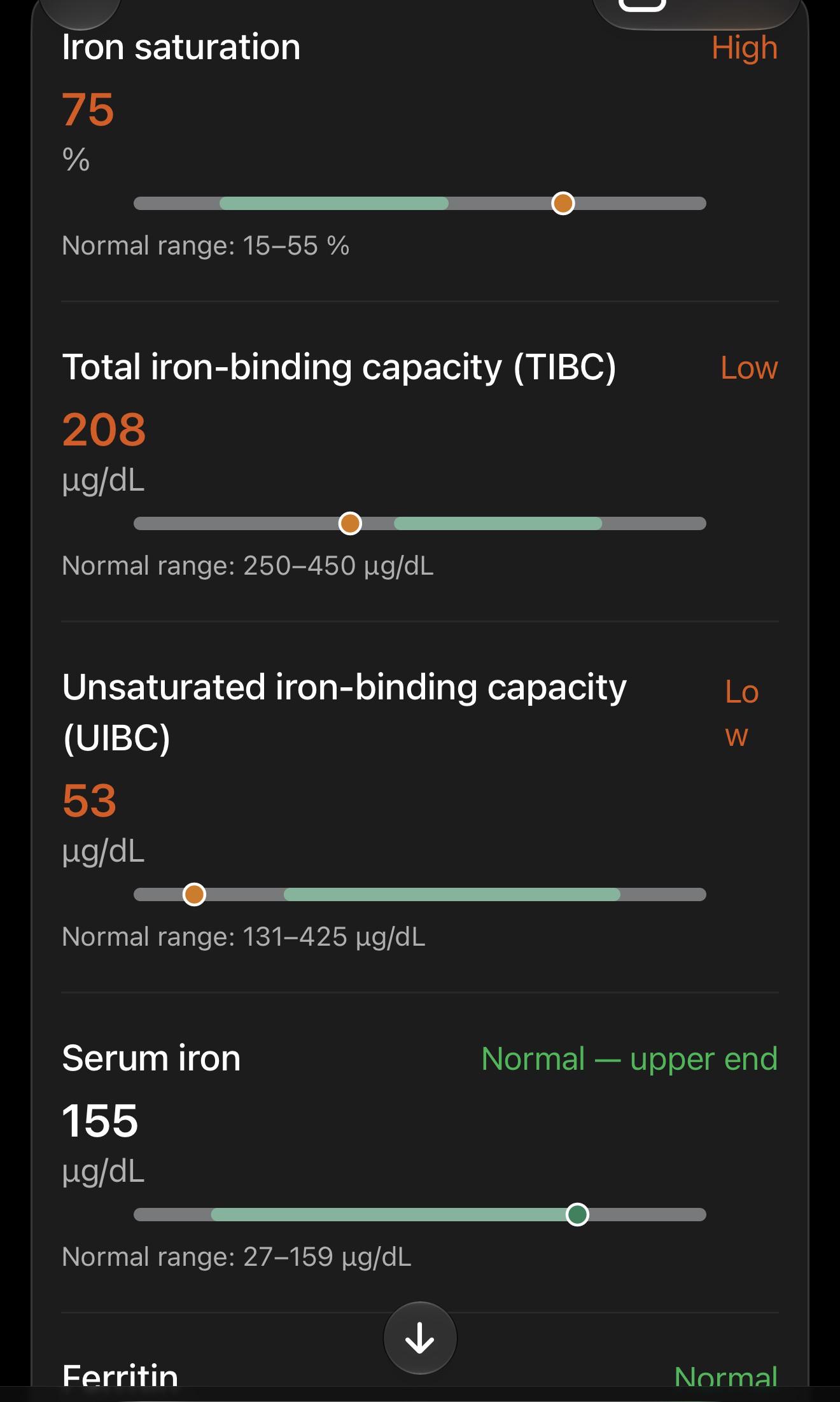
However, during some general blood tests I had in October 2025, they found that my transferrin saturation was high.
My transferrin saturation was high at 75%, ferritin was 33, and serum TIBC was 41.2. My MCV was also 100.2 and MCH was 33.2.
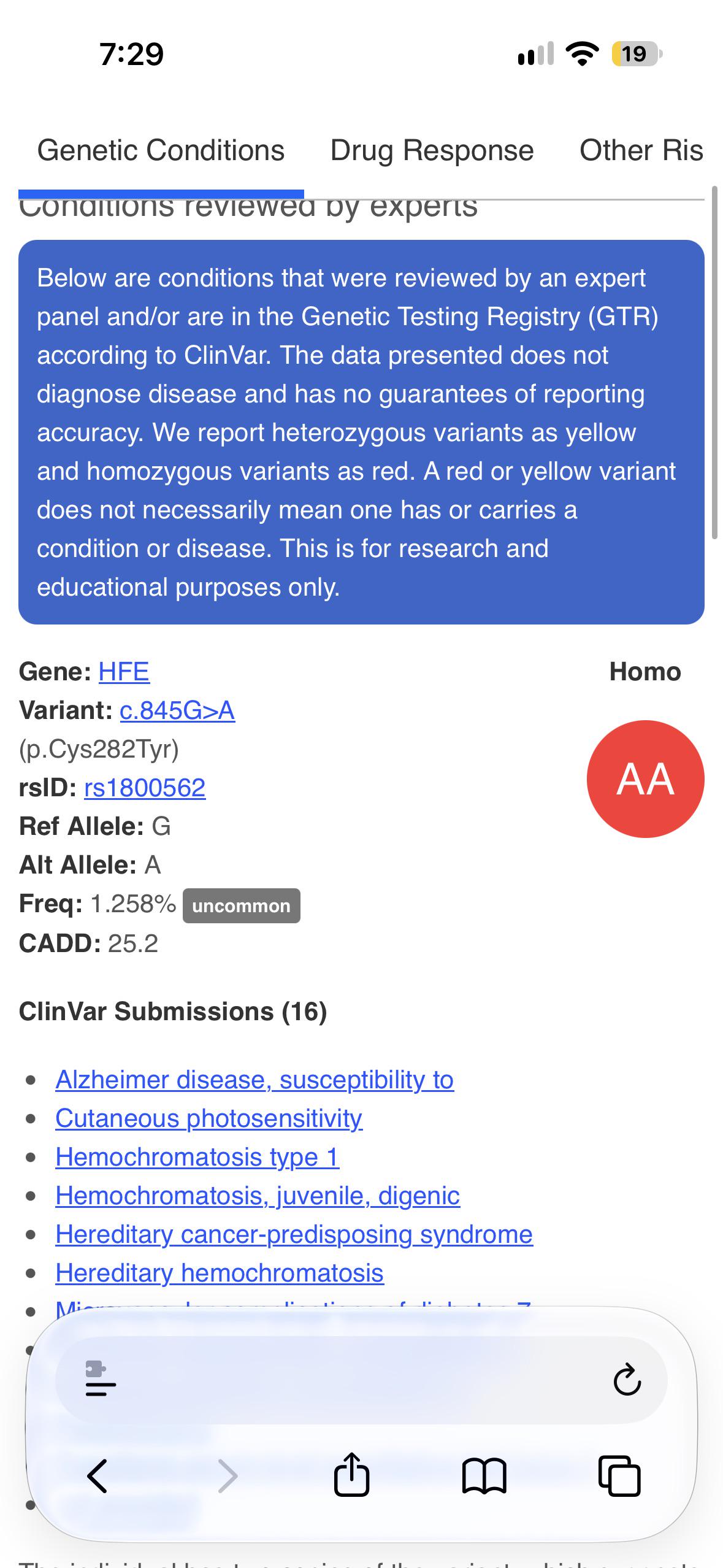
Because of these results, they tested me for haemochromatosis, which came back as homozygous for HFE C282Y. However, I was told that it wasn’t ‘active’ at the moment. I assume this was because of my relatively low ferritin? They said they would monitor my levels yearly. I haven’t had any further iron studies since, and I’m now going to ask for repeat blood tests, as it’s been 15 months.
Over the past 18 months, I’ve also developed a huge amount of fatigue. I feel very unmotivated, weak and drained. I’m also always cold, particularly as winter comes around, even when everyone around me seems to be a normal temperature.
More recently, I’ve experienced periods where even exercising (such as walking the dog) feels very difficult, despite it not being particularly strenuous.
A few months ago, in particular, I had around 4–6 weeks where I was experiencing especially severe fatigue. Walking felt really difficult, my body felt incredibly heavy, I could feel my heart pounding, and I was also experiencing hot flushes when exercising, but sometimes even while at rest.
For some reason, this has improved somewhat since, and I only experience those particular symptoms every now and again. However, the extreme fatigue is still very much present, as are the ongoing stomach issues.
Because a lot of my symptoms seem to overlap with those experienced by people with low ferritin, I initially wondered whether this could be a major contributor, given that my ferritin is only 33. However, I was aware that treating this could be complicated by my high transferrin saturation and HFE genetics.
After a lot of research and countless rabbit holes, I’m now starting to wonder whether it’s actually the high transferrin saturation that could be contributing to many of my symptoms, perhaps indirectly.
There is another part of this that I think is worth mentioning.
I recently saw a gastroenterologist who, after I explained that I suspected SIBO based on my symptoms, thought this was a reasonable possibility. He explained that testing for SIBO has a very long waiting list, so instead prescribed me a two-week course of rifaximin to see whether it made a difference.
After completing the first two-week course, I genuinely felt like it was a miracle. I wasn’t completely symptom-free, but compared with my usual baseline, my stomach symptoms were almost non-existent. I honestly thought I’d stumbled across a cure.
Since then, I’ve completed a further four courses, following a cycle of two weeks on and two weeks off. Unfortunately, each subsequent course has been progressively less effective.
I also think I noticed a significant improvement in my fatigue during those two weeks. Whether this was a placebo effect, or simply because I wasn’t having to deal with the constant stomach symptoms and the physical toll they take on me, I’m not sure. But I did feel noticeably better overall.
I then came across some research discussing how bacteria can utilise iron for growth and how iron availability can influence bacterial activity, particularly in the gut. This led me down another rabbit hole.
I started wondering whether I could have SIBO, and whether the first two weeks of rifaximin had significantly reduced the bacterial overgrowth, explaining why I felt so much better initially. However, I then wondered whether the unusually high transferrin saturation, and potentially increased iron availability, could be creating an environment in which the bacteria were able to multiply again relatively quickly.
I began questioning whether this could explain why each subsequent course seemed progressively less effective. Could the bacteria have been regrowing between courses, potentially influenced by iron availability? And could repeated exposure to rifaximin have contributed to antibiotic resistance, explaining why I now feel that the courses are making very little difference?
I appreciate that this is largely speculation on my part, and I don’t know whether the connection between iron levels, bacterial overgrowth and antibiotic resistance actually works this way.
Another speculation I’ve had relates to the fact that my symptoms are significantly worse in the mornings and tend to improve as the day goes on.
I’d read that transferrin saturation and serum iron can fluctuate throughout the day, with levels sometimes being higher in the morning due to normal biological rhythms. I wondered whether this could potentially have some connection to why my stomach symptoms and fatigue are so much worse in the mornings.
I also came across a suggestion online that, particularly in hereditary haemochromatosis, the body can absorb iron from food more aggressively due to increased intestinal iron absorption. Someone suggested that this could potentially contribute to bloating, abdominal discomfort and irritation after eating. I wondered whether this could explain why my symptoms are often particularly bad after meals.
I also wondered whether these two things could potentially be connected. If my transferrin saturation is naturally higher in the mornings, could eating breakfast, particularly if it contains dietary iron, potentially increase iron availability further in someone with hereditary haemochromatosis? I wondered whether this could contribute to my symptoms being particularly severe after breakfast, when my iron saturation may already be at its daily peak.
Again, I appreciate this is speculation, and I don’t know whether there is any actual physiological connection here.
One other thing worth mentioning is that I’ve always had a relatively low-iron diet, even before discovering the genetic results. I don’t eat red meat due to personal preference, and I also don’t eat dark leafy greens, nuts or seeds. So my dietary iron intake has generally been quite low.
I’m also aware that iron, particularly in the context of iron supplements, can slow bowel motility and contribute to constipation. Although I don’t take iron supplements, I wondered whether there could potentially be some connection here too.
I experience quite unusual cycles of constipation. I’m not necessarily completely blocked up, but I often have difficulty passing stools normally, with periods where I feel like I’m not fully emptying my bowels. I wondered whether iron metabolism or increased iron availability could potentially have any influence on gut motility.
My final speculation might be a bit of a stretch, or it could potentially be an important clue.
When trying to identify dietary triggers, I actually went completely gluten-free for around two years because I suspected gluten might be contributing to my symptoms.
Initially, I noticed a significant improvement in my stomach symptoms. However, after around 10 months, this seemed to wear off. Eventually, I went back to eating gluten normally because I no longer felt that avoiding it was making any difference.
Looking back, though, I’ve started questioning whether it was actually the reduction in dietary iron, rather than the removal of gluten itself, that made the initial difference.
As mentioned, I naturally have a relatively low-iron diet. I don’t eat red meat, leafy greens, nuts or seeds. When I was eating gluten normally, some of my main dietary sources of iron were probably fortified products such as bread, cereals and other wheat-based foods.
When I first went gluten-free, I was also following a fairly strict low-FODMAP diet. I wasn’t really eating packaged gluten-free breads, cereals or other fortified products. My diet consisted largely of simple foods such as rice, chicken, potatoes and fruit.
Therefore, I wondered whether switching to this diet had actually resulted in a substantial reduction in my dietary iron intake, particularly from fortified foods.
As I became more accustomed to eating gluten-free and gradually stopped following the low-FODMAP diet, I started introducing more packaged gluten-free products, including breads, cereals and crackers, some of which may also have been iron-fortified.
I started wondering whether this could explain why I initially felt so much better, only for the improvement to gradually disappear. Perhaps it wasn’t gluten that had been causing the improvement at all, but the reduction in iron-fortified foods and my overall dietary iron intake.
Honestly, I’m just looking for answers at this point. I don’t know whether I’ve somehow pieced together a number of clues and stumbled across something that could genuinely explain a lot of my symptoms, even if only indirectly, for example through a possible connection with SIBO.
I suppose I’m looking for either some validation that there could be something in what I’m thinking, or a reality check if I’m connecting things that aren’t actually related. I’d really appreciate hearing from anyone who has experience with similar blood results, symptoms or circumstances.
My main questions are:
Has anyone experienced significant symptoms with very high transferrin saturation but relatively low or normal ferritin?
Can high transferrin saturation potentially contribute to symptoms even without significantly elevated ferritin?
Has anyone experienced gastrointestinal symptoms that they believe are associated with their haemochromatosis?
Has anyone had SIBO alongside hereditary haemochromatosis, and noticed any connection between the two?
Has anyone noticed improvements in their symptoms after reducing dietary iron, particularly iron-fortified foods?
I’m sorry for the long post, and appreciate hearing from anyone who has experienced something similar, or anyone who has a better understanding of the relationship between transferrin saturation, iron availability and gut health.
I appreciate that some of my theories might be completely wrong, but after four years of struggling with these symptoms and having so many investigations come back clear, I’m trying to explore every possible avenue.
Thanks in advance.