r/IndianwildlifeHub • u/Exoticladakv • 18h ago
🐅 Big Cats Once in a life time photography Ladakh India March 2026 .

34
Upvotes
r/IndianwildlifeHub • u/Alternative_Chair517 • Aug 24 '25
This is the community for everything wild in India — from Bengal tigers and Asiatic lions to elephants, rhinos, wolves, dholes, snow leopards, hornbills, gharials, and beyond.
India is one of the most biodiverse countries on Earth, home to big cats, giants, rare birds, ancient reptiles, and habitats ranging from deserts to mangroves to the Himalayas.
Here you can:
Share your wildlife photos, videos, and field experiences
Learn fun facts and discover new species
Discuss conservation, habitats, and eco-travel
Ask the community to help ID birds, reptiles, or mammals you’ve spotted
But before you dive in — here’s what makes India’s wildlife truly extraordinary:
Did you know?
This is the diversity we celebrate. Whether you’re a traveler, a photographer, or just curious about India’s wild heritage — you’re in the right place.
📸 Share. 🌍 Learn. 🐾 Protect. Welcome to the wild heart of India.
r/IndianwildlifeHub • u/Exoticladakv • 18h ago
r/IndianwildlifeHub • u/grumpydogfather • 1d ago
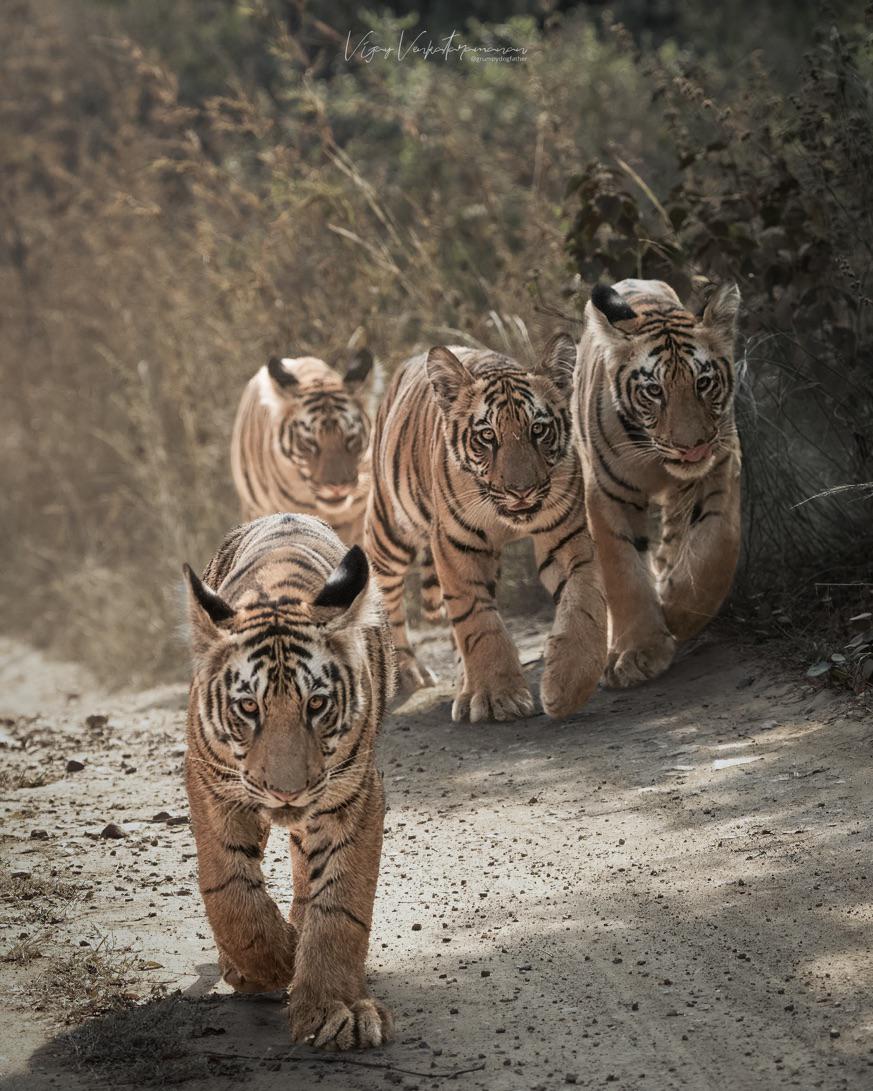
I’m placing my bets on the one leading this little procession. There’s something about the way this cub carries itself that makes me think we’ll be hearing a lot more about it.
These are F2’s four cubs, and they have some pretty big pugmarks to fill. Their mother, daughter of Fairy and believed to be fathered by Surya, has already successfully raised a litter of five cubs to adulthood. I had the opportunity to witness the final chapter of that journey when I saw her disperse the last of them.
Gothangaon has proved to be an important breeding ground for tigers. Its mix of dry deciduous forests, undulating terrain, water bodies and a healthy prey base makes it a wonderful habitat for raising cubs. F2 is a fine example of just how productive this landscape can be.
Four cubs, four personalities, and a whole forest waiting to be explored. For now, they’re growing up under the watchful eye of a rather accomplished mother.
Let’s see if my prediction about the little leader comes true!
Date Photographed: Nov 17, 2026
Gear: Sony A7III with 200-600mm f5.6-6.3 GOSS
EXIF: ISO 400 | 200mm | -1ev | f8 | 1/1000s
r/IndianwildlifeHub • u/mv0828 • 2d ago
r/IndianwildlifeHub • u/grumpydogfather • 2d ago

We were barely 45 minutes into the jungle on this morning when news came in that F2 and her cubs had been spotted outside the Gothangaon gate, crossing the main road. And here I was looking for them inside the reserve. By the time I managed to run out there, most of the family had crossed. One little cub was still waiting, hesitant to make the crossing. This is the moment it finally decided to take the plunge.
I’m happy to see all four cubs looking healthy and doing well. But this photograph also leaves me with a rather uncomfortable feeling.
It’s a reminder of just how dangerously close our worlds are getting. A tigress confidently taking her cubs across a busy public road. People standing remarkably close to photograph them. Both sides seemingly becoming increasingly accustomed to the other’s presence.
Fear, or perhaps more appropriately, a healthy respect and distance between humans and tigers, is essential for the safety of both. When that disappears, the consequences can be tragic.
India has made remarkable progress in bringing its tiger populations back. But protecting tigers isn’t just about increasing their numbers. It is equally about protecting and expanding the forests they need to survive. As habitats shrink and become fragmented, encounters like this will only become more frequent.
It’s wonderful to see these little ones growing up. I just hope we don’t wait for a tragedy to realise that sharing a landscape requires responsibility from both sides.
r/IndianwildlifeHub • u/grumpydogfather • 5d ago

One of my favourite tigresses, F2, from the Gothangaon range of Umred-Karhandla. Spotted yesterday morning with her latest litter of four cubs.
A moment frozen in time. A deer, seemingly aware of the eyes watching it. F2, completely focused on her potential prey. And one of her cubs in the background, watching Mom at work.
For a young tiger, the lessons in hunting begin early. Cubs learn by observing their mother, following her on hunts, imitating her movements and eventually practising their own stalking and pouncing skills. Their mother will continue to guide them through this process until they’re ready to fend for themselves, usually around 18–24 months of age.
Imagine spending nearly two years learning the art of being a tiger!
This photograph means a lot to me because it captures a small part of that learning journey.
Umred-Karhandla is one of my favourite wildlife destinations. I find the Gothangaon landscape particularly beautiful, with its undulating terrain, dense forest, grasslands and numerous water bodies. The sanctuary is also an important wildlife corridor, connecting the Tadoba landscape through forests along the Wainganga river. It’s home to more than 160 recorded bird species and a remarkable diversity of mammals.
r/IndianwildlifeHub • u/grumpydogfather • 5d ago
Boldwaali. And yes, that’s her actually trotting towards our jeep.
This would’ve made most people a bit nervous. I was elated. In my head, I seem to have briefly misunderstood that this was an oversized kitten coming over for a cuddle. I’m probably a little delusional that way!
As it turned out, she had her eyes on something else in the thicket, barely gave us a second glance and carried on with her business.
This is Tadoba-Andhari Tiger Reserve in Maharashtra, a landscape of teak forests, bamboo thickets, grasslands and water bodies. The original Tadoba National Park was established in 1955, making it Maharashtra’s oldest national park.
In the second pic: A little grooming session for Boldwaali. At first glance, this looks like an ordinary moment of a tigress cleaning herself. Look a little closer, though, and there’s a puncture wound on her body.
Could it be a souvenir from a recent altercation with her sister Shywaali? Perhaps an encounter with a sloth bear? We can only speculate.
Tadoba is home to much more than tigers. Sloth bears, leopards, dholes, gaur and an incredible variety of birds share this landscape. Every encounter is a reminder that a tiger reserve is an entire ecosystem, not just a place to see tigers.
The third pic: No tiger series is complete without the mandatory yawn!
Boldwaali, in all her sleepy glory.
Tadoba gets its name from Taru, a revered local tribal figure whose shrine stands near Tadoba Lake. The Andhari part of the reserve’s name comes from the Andhari River that flows through these forests. Two names, two pieces of local history, and one remarkable wilderness.
r/IndianwildlifeHub • u/mv0828 • 6d ago
r/IndianwildlifeHub • u/grumpydogfather • 6d ago
r/IndianwildlifeHub • u/mv0828 • 8d ago

r/IndianwildlifeHub • u/AdWarm2498 • 9d ago

r/IndianwildlifeHub • u/AdWarm2498 • 10d ago
r/IndianwildlifeHub • u/Exoticladakv • 12d ago
r/IndianwildlifeHub • u/SectorImportant8806 • 13d ago

TL;DR: North Gujarat has lost most of its wildlife, and with it the traditional knowledge of living beside it. My idea is to restore village grasslands (charagah) with native grass and link them along the Saraswati to the Balaram Ambaji and Jessore sanctuaries, bringing back animals like blackbuck. Farmers come first, with a shared village fence backed by thor hedges and a trained response team. Benefits include water, fodder, fewer rodents, tourism and a village that learns to act together. Just an idea, and I'd like your feedback.
I grew up in North Gujarat when foxes came near our house and a rat snake coming into the home was normal. I saw porcupines, wild boar and Indian hare. Most of that is gone. We cleared land for farms and removed the animals. A cobra shows up and it's killed, because that's the only way we know to deal with a dangerous animal.
How the West is different now
The West once did the same (they killed their wildlife too). Today, though, people there are aware of the animals around them and know how to protect themselves without killing them. They are aware about how to save themselves from certain animals. They have bear-sprays, they know how to protect themselves from mountain lions etc . Why can't we do the same?
What I see here
Shrinking forest patches, groundwater at 600-700 ft (and nothing at 1000 ft in some places), and the Saraswati of North Gujarat dry all year. Land clearing and heavy pumping do much of this damage, but barren land holds less water.
We're also losing the traditional knowledge our elders had about local plants and animals, such as which snakes are harmless, which plants are useful, and how to live beside wildlife. ( I myself was just recently become aware about many snakes and plants )
The idea
Almost every village has a charagah: a grass and acacia patch that's degraded and cut off from the others. What if we:
Those sanctuaries already hold wildlife. Balaram Ambaji has sloth bear, leopard, nilgai, hyena and wolf. Jessore has jungle cat, caracal, Indian wolf and striped hyena. A biological corridor joining the Aravalli sanctuaries has already been proposed. This idea extends that into the plains, so animals aren't stuck in the hills and our villages aren't empty of wildlife. ( I'm not talking about all animals, but animals that can survive in grasslands)
Which animals
- Blackbuck as the flagship. As far as I know, it was once part of our ecosystem, and open charagah suits it. ( Flagship species is important - i don't think I need to mention why )
- Chinkara and other small grassland species
- Foxes, hares, owls and snakes returning as the grass recovers
- Predators like wolf, hyena and caracal moving down from the hills along the corridor
Farmers first
Nilgai and boar already damage crops, so:
- A village cooperative builds and maintains one shared fence around the farmland, backed by two rows of thor ( and other things that can help )
- A trained local group handles animals that enter the village
- Fast compensation, shared across the village so one farmer doesn't carry it alone
Benefits
I once heard a line: we didn't protect the tiger alone through tiger reserves, we protected the whole ecosystem. The same can happen here. Protecting the blackbuck's grassland also protects the water, soil, pollinators, birds and everything else that lives there.
Monetary
- Tourism and homestays
- Wildlife trails
- Carbon credits
- Selling minor forest produce
Non-monetary
- Better groundwater recharge and a rising water table
- Protection of traditional knowledge
- More awareness among villagers
- Greenery and cooler villages
- Protection of wildlife
- Pollination for crops
- Fewer rodents, since owls, foxes and snakes keep them down
- Limited fodder for dairy animals
- Weekend picnics and nature walks for families
- A village committee that learns to decide together, which can then take on other village problems ( in my opinion when we achieve something collectively, we are going to try replicating it in other things ,like water conservation, reduced plastic etc )
What I'd like to hear
- have you noticed animals disappearing?
- Farmers: what would make this acceptable to you? ( I'm not from farming background, but I don't think it would work if farmers aren't getting benefitted, so i believe farmer first is the way to go )
- Does thor stop nilgai or blackbuck?
- Do you remember blackbuck or other wildlife in your area? (Especially people from Gujarat and Rajasthan)
- Has a project like this worked anywhere in India?
This is just an idea, not a finished plan.
r/IndianwildlifeHub • u/ashudumpsinfo • 14d ago

Do Visit Ashudumps.info
r/IndianwildlifeHub • u/mv0828 • 14d ago

r/IndianwildlifeHub • u/Exoticladakv • 14d ago
r/IndianwildlifeHub • u/SectorImportant8806 • 17d ago

When we think of the ultimate wildlife safari, the Maasai Mara immediately comes to mind. What makes it so iconic?
Now, look at the Banni Grasslands in Kutch, Gujarat. It is literally the largest grassland ecosystem in Asia, offering that exact same vast, horizon-to-horizon field of view. Yet, most of India’s wildlife tourism is strictly forest-centric (dense jungles like Corbett, Ranthambore, or Kanha where visibility is limited).
Imagine if we developed Banni into a premier open-grassland safari destination. We might not have the exact African Big 4, but we have our own majestic native species that thrive in open plains:
* Indian Wild Ass (Ghudkhar): Incredible, fast-moving herds already native to the region.
* Blackbuck & Chinkara: Classic Indian grassland antelopes that can be introduced in large numbers.
* Cheetah: Banni has already been identified as a viable habitat with a breeding center underway. Watching a cheetah sprint across open Kutch plains would be unmatched.
* Asiatic Lion: With Gir reaching capacity, introducing a pride or two into a managed Banni grassland ecosystem could be a game-changer.
Tourism in Kutch is already booming thanks to the Rann Utsav and Dholavira. The infrastructure, roads, and hospitality networks exist. If we restore the grasslands (removing invasive Gando Baval / Prosopis juliflora) and build a sustainable wildlife circuit, Banni could exponentially expand Kutch's tourism beyond just a 3-month winter festival.
What do you guys think? Is an African-style open grassland safari feasible in Banni, or are there ecological roadblocks we aren't considering?
r/IndianwildlifeHub • u/Exoticladakv • 18d ago

r/IndianwildlifeHub • u/Exoticladakv • 20d ago
r/IndianwildlifeHub • u/Exoticladakv • 22d ago
r/IndianwildlifeHub • u/SeaworthinessSea7809 • 24d ago
r/IndianwildlifeHub • u/mv0828 • 26d ago

r/IndianwildlifeHub • u/Straight-Explorer844 • 27d ago

Kanha National Park
Madhya Pradesh India
May 2014