r/InnerCircleTraders • • Aug 06 '25 Bravo Heartwarming

Trading Resources Best ICT Learning Path (Without Wasting Time)

414 Upvotes

Best ICT Learning Path (Without Wasting Time)

Note to mods: All links below directly take you to Michael's channel "except 4 & 5". So I guess I am good with rule 4, right?

Anyways; after going through ICT content and a lot of community feedback, this is the cleanest and most effective learning path to master ICT concepts without wasting hundreds of hours on repetition.


1. Market Maker Primer (MMP 2022)

Why?
Foundation of the ICT approach. Covers:

  • Market structure basics
  • Liquidity concepts
  • Session timings (Kill Zones)
  • How smart money moves the market
    Short, simple, and straight to the point.

2. ICT 2016 Core Content – Selected Lessons Only

Do not watch all 100+ lessons — too much repetition. Focus on these key playlists:


3. 2022 Mentorship - No Rant

Why?
Modern, organized, builds directly on MMP and the 2016 core concepts.
Shows practical examples on recent charts so you can see exactly how to apply the theory.


4. Silver Bullet Model (2022)

Why?
Simple intraday model for NY session trading.

  • Works best after 10:00 AM New York time
  • Uses Fair Value Gaps + Liquidity + Displacement for high-probability setups.

5. ICT Short Term Trading Model (2022)

Why?
Clean short-term model focused on liquidity grabs and Fair Value Gaps.
Great for traders who prefer fast, clear setups.


Recommended Order:

  1. Market Maker Primer
  2. 2016 Core Content (Months 1–4)
  3. 2022 Mentorship
  4. Silver Bullet Model
  5. Short Term Trading Model

Extra Tips:

  • Do not binge-watch everything. Watch a lesson, then backtest it before moving on.
  • Skip older ICT content unless you specifically want deep dives.
  • Focus on high-quality setups, not every possible trade.
  • Grab your pencil and write down what ICT says. Draw the patterns, mark setups, and build your own cheat sheet — it will stick in your mind far better than just watching.

Edit: changed the 2022 full mentorship to the No Rant version as one of the comments reminded me, so that's 50 hours to 3 hours shortcut


r/InnerCircleTraders • • Aug 19 '25

The Largest ICT Content Archive

76 Upvotes

We now have access to one of the largest collections of ICT material ever shared here on this sub, over 1K+ files. This collection has lectures, notes, study guides and research material all in one place.

Link to the archive: https://tinyurl.com/3k4vbrym

Credit: Tristen Gelrud

This will be one of the main reference points for our community moving forward.

[NOTE] The archive is hosted externally and may go down as more people request access. So save what you find useful.


r/InnerCircleTraders • • 9h ago

Futures Trading The ICT 2024 Mentorship is the best mentorship that you can study and learn from ICT.

29 Upvotes

Hey, you, whoever will read this in the future.

The ICT 2024 Mentorship is the best mentorship that you can study and learn from. It made me profitable and gave me the ability to read the chart way better than I used to (WAY BETTER), and gave me the ability to actually start to make money using prop firms. So if you need a sign or a push or some divine sign to tell you to start studying the ICT 2024 mentorship, let it be this.

You will find people in here telling you that studying ICT 2024 or ICT itself will be a waste of time, but do not listen to them; they are just ignorant and petty people (please don't be like them; investigate for yourself).

Before I go further into debt, make sure that you come into this Business of Day Trading using ICT concepts with the mindset that no matter how hard your journey will be, you will never give up. You will succeed no matter how hard it gets, and you will not learn a different strategy because you don't understand anything about ICT. Lastly, talk to God; ask God for help when you are struggling with day trading; He will surely help you.

Have a strong reason why you want Day Trading to work; don't just do it for the money. Do it for your family, your future self or for your loved ones. I promise you this will help you stick to this business when times get tough.

My personal opinion: requirements before you start studying the ICT 2024 Mentorship:

If you want to learn and study the ICT 2024 mentorship, please come with a nice ICT background. Meaning you should have already been studying the ICT 2022 Mentorship and some more of his regular content before heading into the ICT 2024 Mentorship, because if you are a fresh, brand-spanking-new to day trading or to ICT itself and want to start with the ICT 2024 Mentorship, you will not get anything that he says during the lectures; you will be lost, talking from personal experience.
So make sure you have already studied the ICT 2022 Mentorship first. And learned the basics of ICT.

Watching other ICT traders, other than ICT, made me so much better.

Watching and studying other profitable ICT traders' YouTube Videos and trade execution, and seeing how they apply the ICT knowledge on the charts, made me a better trader. I give my flowers to Chermane Trades and Frank369. These are the only ICT Profitable students that I know that I would recommend to you.
What I do to this day is watch a trade execution video while having the same chart where they executed the trade, and ask myself and figure out why they did what they did, why enter there, why stop loss there, why long, why short? Why take profit there? What's the reason why you did what you did? Once I did that, my trading got so much better. Don't watch for the sake of watching; watch for the sake of studying.

Advice Tip: Before you get into a prop firm.

Once you start seeing some nice results after you have gone through the mentorship I laid out for you, you don't just jump into a prop firm just because you start seeing some progress and you feel confident in yourself. **Never Do That**, you MUST always test yourself with data. You want to create a free demo account with TradingView and apply the same rules of the prop firm you would like to purchase to your own demo account. If you are able to pass your demo account at least 3 times without blowing the account, then, in my opinion, you are ready to buy your first prop firm account.

This is my first-ever payout on my first-ever funded account with Lucid Trading 50k Flex Account ... to show you proof using ICT concepts.

I blew 3 prop firm accounts before getting funded and getting my first-ever payout.

Two were won from a giveaway, and one was purchased by me. But I made all my money back and much, much more lol.

I trade with 1 MINI and with 2 if I am really confident in a trade. (Probably because I saw the same setup happen so many times.)


r/InnerCircleTraders • • 4h ago

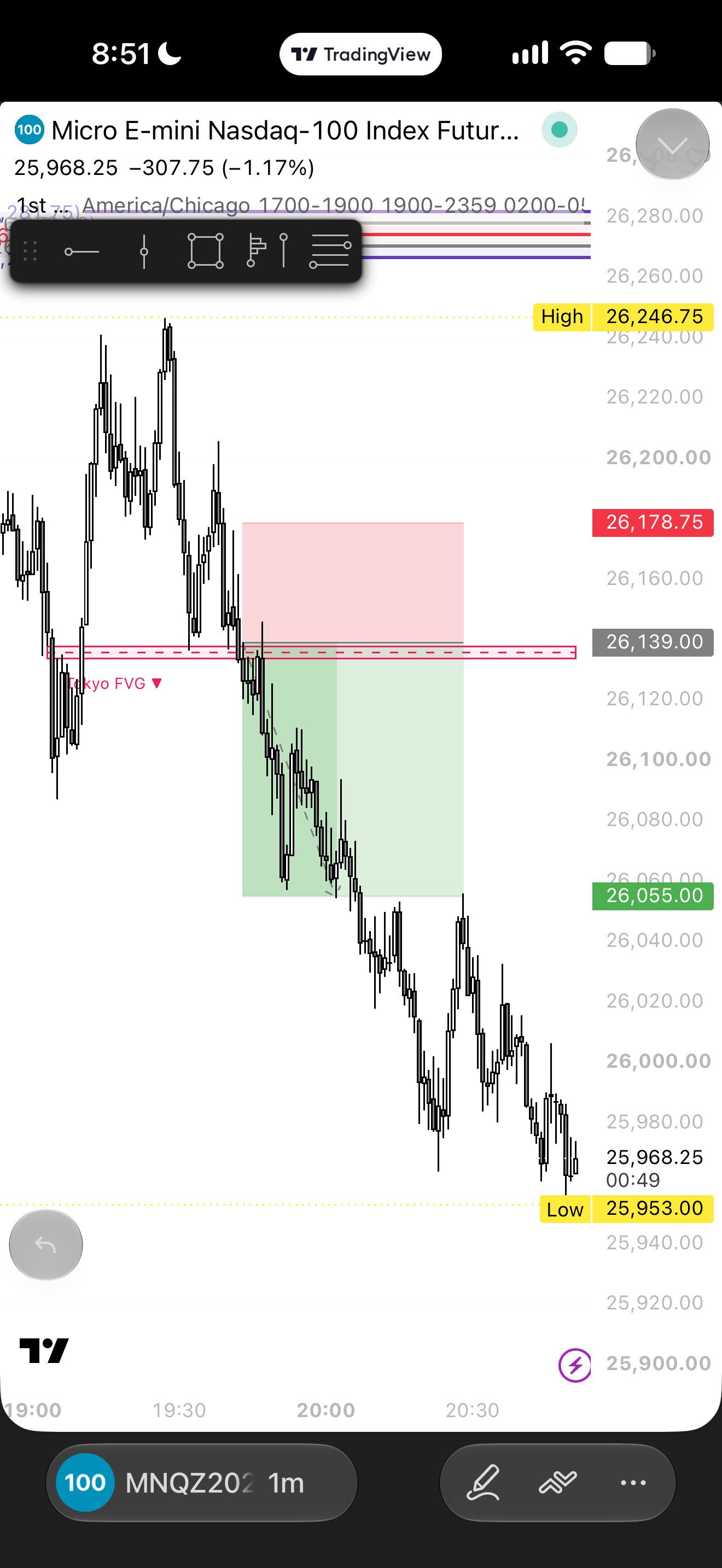
Futures Trading Take what the market gives and protect it: +221 pts on MNQ Tokyo (partials +133.75, runner +87.25)

Post image
3 Upvotes

Setup: Tuesday closed weak near its low. Sydney took the buyside above the NDOG and sold off, so the bias was short. Tokyo took the Sydney low, and the rally that followed couldn't get back into the NDOG.

Trade 1: Short 5 at 26,142 on the retest of the Tokyo first FVG, after price broke through it as support. The stop went at 26,177.

I took the 4 partials at 26,108.75 for +133.75 pts.

I trailed the runner only after each liquidity pool was taken, moving the stop to 26,127, then 26,095, then 26,054.75. It got wicked out at 26,055 for +87.25 pts. +221 pts total (+$436 net).

Lessons: Price ran another 100 points after my runner was stopped, but that's okay. Take what the market gives and protect it.


r/InnerCircleTraders • • 24m ago

Question Golden pocket vs. OTE

1 Upvotes

Do you use only OTE for continuation trades or you also use Golden pocket fibs?

I feel lately a lot of moves happened from Golden pocket region and I am thinking of adding those fibs to the chart also.

Do you use both or just OTE?


r/InnerCircleTraders • • 1h ago

Question Can I use ICT in Indian markets

1 Upvotes

As an Indian citizen, I am unable to trade in U.S. markets, so I am asking whether I can apply ICT in Indian markets using the 2022 mentorship or another year’s program.


r/InnerCircleTraders • • 12h ago

Question Advice on detecting choppy market conditions

4 Upvotes

Do you have any rules for anticipating clean price action? Yesterday we had a massive move due to Nvidia. Today absolutely useless conditions, pure chop. Are there any good rules for this? Thanks!


r/InnerCircleTraders • • 9h ago

Trading Strategies How Trading Everything in One Account Holds Your Returns Back (Numerical Examples)

1 Upvotes

If you trade multiple markets or different entry types inside one account, a drawdown on one setup can reduce the gains on your others if less percentage risk is taken, or wipe out gains if the financial commitment for each position remains constant. These amounts add up over time as a hidden cost, artificially lowering your profitability potential.

Separating each individual setup into its own isolated account protects your upside and lets your strongest edges compound without getting dragged down.

I made this post primarily for those who trade Indices, Metals, Energies, Currencies and have access to regulated high leverage/low intraday margins.
Similar principles are also applicable to those margin trading equities or interacting with options.

Because we as private traders have access to much higher leverage in comparison to institutions, can run multiple isolated accounts and are not bound by the usual fiduciary rules and so on, I definitely see Sharpe as a constraint that not every directional trader should lock in if higher returns are desired as the incentive is not a requirement. Withdrawals also need to be planned too, a lot of traders forget that withdrawals are a part of each strategy.

Why one should consider splitting accounts from the start.
A persistent shift in market conditions can be difficult to define in real time (without hindsight) and it can derail a strategy's effectiveness for months or longer. A highly desired high Sharpe ratio strategy's accumulated smooth P&L can be undone or have erratic swings before coherent withdrawal opportunities are possible. Intentionally separating and isolating risks with withdrawal plans can reduce the financial impact of such disruptions across multiple setups, lift net P&L or both.

Higher Sharpe ratios make sense when a trader is optimising for smooth, linear-looking returns to attract or retain investors, because Sharpe punishes both upside variance and downside variance, but this naturally punishes higher RRR strategies which I prefer to run. If forced, such thresholds can force our hands to throttle the upside that pays us for better stats.

These risk percentages might look high at first glance, by the end of the examples it will click.
A base isolation example: 1:4 RRR two consecutive profitable outcomes.
$100,000 Account (0.8% Risk) - Entire Capital at Risk While Trading with Margin.
After Trade 1: $103,200.00 (+3.20%)
After Trade 2: $106,502.40 (+6.50%)

$10,000 Account (8% Risk Per Trade) - A 1/10 Partition of Capital at Risk. After Trade 1: $13,200.00 (+32.00%)
After Trade 2: $17,424.00 (+74.24%)
$7424.00 gain vs $6502.40 is a 14.2% increase in gains from isolation of risk

100 trades with a 1:2 RRR and 50% winrate results before transaction costs.
0.8% risk on $100,000 over 100 trades = $48,009 in gains (median)
8% risk on $10,000 over 100 trades = $248,399 in gains (median)

Local jumps in percentages do not need to be as extreme to benefit, a 10x % upscaling in exchange for a global 90% reduction to capital at risk was used to make comparisons clear.
For example, the capital could be reduced by 66.66% (2/3) and the person could trade with 3-5x the percentage risk depending on the strategy's risk profile.

The demonstrated differences in compounding are real when inserted into a risk container intentionally.

Across 100 trades on this strategy’s stats at 8% risk, there is around a 25% chance of a local drawdown reaching 50% or more (-5% of total capital), while the remaining trader’s operating capital (90%) remains untouched. $800 risk executed on $10,000 is materially only 0.8% of the $100,000 total capital at the start while the rest of the capital is separated to isolate drawdowns.

A bad run is exposed only to the active partition (10%) while the remaining $90,000 reserve remains in banks or in multiple different trading accounts executing different trading strategies.

This can create a curve where winning runs grow capital faster than losing runs shrink it, known in quantitative finance as convexity.

Only one position is held open at any given time, and an active trade does not cancel out a subsequent setup. The strategy is explicitly designed to reduce position-based path dependence. If positions were allowed to overlap (such as entering a short setup while a long position is active), the strategy would lack proper isolation. Because each setup functions as an independent strategy, overlapping trades would interfere with compounding and free margin.

Separating accounts can also stop one setup from dragging down another.
For example, a loss of approx 10% and a gain of 10% results in a loss of -1.0% net, if separated the loss can produce a more positive outcome and this scales with leverage.

For accessibility I calculated these examples under a basic trade sequencing model which can be replicated by anyone in a standard calculator, outputs vary but the potential benefits remain.
Predefined profit thresholds such as skimming at a set gain level or taking a share of realised gains depend on the strategy. Once withdrawals happen mid run, the sequence of trades can affect the amount taken home.

Over higher samples the beneficial discrepancy can grow, especially if strategies are uncorrelated. I showed this as a short example going over concepts I implement, the magnitude of improvement is not universal, and will vary depending on the strategies involved and their respective dependencies.

Many traders who get into testing attempt to inherit institutional risk rules without questioning why those rules specifically exist for institutions.
Traders have the flexibility to operate like a fleet of speedboats, while many institutions are forced to haul a ship. If you are not answering to outside investors, ask yourself whether your current sizing and account structure are built to protect a smooth equity curve or to harvest asymmetric payouts before market conditions inevitably change.
Research, do the calculations for your strategies and adjust accordingly.

There's no such thing as the goose that lays the golden egg forever - Jim Simons

Do not blindly accept what I have shared with you today.
I want you and others to learn this, so I generated a prompt to inspect this properly.
Paste this in a chatbot; it will calculate and break it down for you, with an open line for questioning.

Prompt:
Compare three 100-trade Monte Carlo models (50% win rate, 1:2 RRR, 10,000+ paths) starting with $100,000 total capital:

  1. Unpartitioned: $100,000 single account risking 0.8% of current balance per trade ($800 initial risk).
  2. Extreme Partition (90% reduction): $10,000 active account risking 8% of current balance per trade ($800 initial risk), with $90,000 held in an untouched reserve.
  3. Moderate Partition (66.66% / 2/3 reduction): $33,333 active account risking 3x to 5x the baseline percentage risk (2.4% to 4% per trade), with $66,667 held in an untouched reserve.

Compute median ending profit, probability of hitting a >=50% peak-to-trough drawdown on the active account, and maximum total capital loss across all three setups. Rely on clean python plots for visuals and explain mathematically why bounding downside to an intentional risk container while compounding geometrically inside the sleeve demonstrates positive convexity rather than a symmetric linear trade-off while explaining what convexity actually is in an accessible way.


r/InnerCircleTraders • • 6h ago

Market Insights When Thousands Trade Your Setup, You Lose Money

0 Upvotes
An example of a YouTube "Strategy" from a so-called educator

People still do not understand how an educator sharing their "unicorn model", "po3", "fvg" setup can inherently degrade it as soon as hundreds to thousands start executing it in live markets and how this makes creating your own, less predictable strategies much better for retaining edges and low transaction costs.
In this post I make the truth more accessible.

Crowds (many traders executing orders with similar intent at the same time) degrade execution quality at the very least and at the worst erode an edge (advantage) significantly reducing the incentive to share when you have something robust and legitimate. Especially if it isn't overfitted and is accessible to retail traders.

Accessible strategies that are consistent and shared amongst retail traders without privacy agreements can be mimicked by buy-side algos, hedged by sell-side algos or costs worsen on execution (if the model is ultra sensitive).

The common misconception:
"This does not matter as retail traders make up a tiny fraction of the total daily volume"

The context that people are missing:
Algorithms can provide liquidity in excess to predictable non-toxic orderflow (uninformed / classified as materially non advantageous trades on the tick level) from common trading strategies or buy side algorithms buying or selling before the traders as a form of arbitrage. This is how edges disappear.

The retail volume does not need to be high for there to be an incentive or impact, if the volume is predictable at specific places and times then it becomes useful to institutions, this is why market crowding works against you as a retail trader.

Retail traders don't need to move the market for saturation to matter.
They only need to become sufficiently correlated in where and how they place orders that they create a locally concentrated liquidity area. That can affect short-term price behaviour even if retail represents a tiny fraction of total volume.

People often confuse this for "stop hunts" or "price manipulation"
It is not the case that institutional algorithms will take excessive amounts of directional risk to move the price many ticks to cause a strategy to execute (otherwise they'd be vulnerable to competitors), but rather that they can adjust how they act in advance in a way that is advantageous to them and react to the predictable crowd at your expense. [1 at the end]

Retail traders make up a small fraction of volume, but locally (at very specific prices at specific coordinated times) retail traders can create meaningful but fleeting blocks of liquidity which influences market dynamics briefly, but over enough ticks to influence the overall outcome of trades because of intraday noise (from changes in Market Maker quoting behaviour in response and from other participants that reposition in response) due to the sequential nature of price discovery (prices forming over time). This is what loses you money.

It's supply and demand. If gold is discovered, then it gets harder to make money mining gold because everyone's competing with you. - Jim Simons

The solution is to create your own strategies, define them mechanically, test, trade and keep them to yourself. Anyone sharing their exact strategy without privacy agreements swindling you for social media ad revenue ($$$) or fees.

The irony is that most educators' strategies never had reproducible evidence showing they worked in the first place, and even if they did, sharing them publicly would destroy the "edge" after costs, reinforcing this reality.

The best strategy is learning how markets really work by reading actual books and structuring your own.

People know that they must study to succeed in any serious field but they think trading is the exception. You yourself after reading will know if you are one of the serious people or are ready to make the honourable secondary choice: walking away.

Context (read carefully this is important):
Overfitted - a strategy that has been optimised heavily to fit around market data to a point that will often not repeat in real markets.

Buy-side algo - a directional automated trading system taking directional positions to close positions out later with the intent of making profit on the difference between entries and exits, these are typically based on markov models, maths, statistics or data streams rather than standard indicator algorithms we see online.

Sell-side algo - these are built to slice up massive client orders to minimise market impact while executing large order sizes. MM sell side algos in sell side firms also function as non-directional automated trading systems which constantly places and withdraws limit orders to provide liquidity to participants who execute market orders at often rapid speeds, while they do try to keep directional risk as close to zero as possible they still do inherit it and often rebalance within microseconds to milliseconds.

[1] Quote pinging is a mechanism where a liquidity providing sell-side algo (MM) will submit small orders to test if liquidity is present and replenishing at specific quotes over microseconds to milliseconds. Not to be confused with taking large long or short positions to move prices several ticks, this is too risky and would result in losses for other institutions who influence their own regulators, fines and license suspensions.

Both types of algos are defined here because these two types of bots can contribute to the degradation of public edges as an indirect consequence of their design, rather than something that is directly targeted.

Edit (Q&A):

When thousands trade your setup, if it's enough to move the market, you make money, not lose it right?

If well-informed people (e.g., institutions) buy after you do by chance in a way that looks toxic to market makers they will withdraw their orders making the price accelerate in your favour yes, but that is not the situation I am discussing in the post, they are completely different events.

When everybody buys at the same time, it drives the price up (called volume), and isn't that what you want?That is not what happens all of the time because the price moves on how much volume is executed relative to how much is available.

People can buy significantly more than people sell by volume ($); the price can still go down because not enough bids (buy limit volume) were provided to the sellers. This is how price works, and this is the truth that breaks support and resistance’s favourite story of “everyone will buy here so the price will go up”.

On ES futures retail traders account for approximately 10% to 15% of total volume, ratios vary by the instrument and market.
But generally speaking if a large amount of retail volume is easily anticipated and usable, it can impact the position, all of this is explained in the post.

Price discovery is an ongoing process, what happens now influences what happens later including indirectly influencing events that materially alter a position's chance of success which many traders overlook.

How does this work if retail traders do not actually trade the same setup, in the same way, even if they claim that they do?

Answer:
Variation in the setup, e.g., how hundreds to thousands trade the same, e.g., “support”, “resistance” live with leverage, is still participation, and participation itself is what contributes to the problem.

Even if one trader gets in a tick or two early and another gets in slightly late, their orders still sit in the same general price band and time window. Delays or differences when the intent is the exact same does not magically erase correlated positioning.


r/InnerCircleTraders • • 23h ago

Technical Analysis 2026-11-24 NQ London Premarket H4 POIs

4 Upvotes

NQ H4 is currently trading within a BE OTE, above a BE Breaker.

I'm watching two possible scenarios, with the BE OB above as the first bullish target and the BU OB below as the first bearish target, while accounting for a potential drop of at least 50% from premium levels within the current retracement range.

Although both the daily and H4 suggest bearish momentum, I maintain no directional bias, allowing randomness to work in my favor and reacting only once price shows its hand.


r/InnerCircleTraders • • 1d ago

Trading Strategies LONDON KILL ZONE

Post image
3 Upvotes

Does that sellside probe the run for that Buyside?.Or are we completing our run on the monthly liquidity?.That next sellside is so significant.a wash on it and we will see it deliver that buyside for London manipulation to deliver the remaining liquidity below later.Else we will see a run against that sellside and monthly liquidity highlighted on our weekly overview we did on Sunday given the first set has already been Tagged.Note that our dealing range equilibrium is not Tagged hence that buyside is a strong D.O.L


r/InnerCircleTraders • • 1d ago

Futures Trading A good trade can still lose. A loss is part of the data: −185 pts on MNQ Tokyo

Thumbnail
gallery
3 Upvotes

Lessons: A loss doesn't mean the trade or the discipline was wrong. It's just part of the data. The stop should sit at an invalidation zone, and when price breaks it, cut the loss early. My first stop at the NDOG quarter would have cost about $600.

Setup: Monday ran about 1,500 pts, and Sydney swept its sellside and delivered back into the NDOG, so the bias was long. Tokyo took the Sydney high right away and left a bullish 1-min FVG.

Trade 1: Long 5 at 26,948, the FVG CE, aiming for the Tokyo high at 27,037. The stop went at 26,910, just under the displacement candle. Price chopped up about 30 pts, then broke the candle's low and stopped me out. Partials −151.75 pts, runner −33.25 pts, −185 pts total (−$376 net).


r/InnerCircleTraders • • 1d ago

Trading Tools Using AI i made a ICT Trading App that trades for me

Post image
9 Upvotes

So one of my stress points has been waiting and finding proper entries. I'd sometimes miss fvgs or sometimes I would see them after the fact. So I ended up using claude to make this free ICT app that finds and uses ifvgs and fvgs for me aswell as orderblocks so far its been doing well.


r/InnerCircleTraders • • 1d ago

Question Which is better, trading in the London or New York session?

Post image
5 Upvotes

r/InnerCircleTraders • • 1d ago

Technical Analysis Confirmation with GEX walls!!

Post image
4 Upvotes

Beautiful, isn't it? - I have just combined gamma walls with my entry levels directly on TradingView, and they are respecting them quite well.


r/InnerCircleTraders • • 2d ago

Technical Analysis Unpopular opinion: CISD or CISD + iFVG is a much more reliable entry model than trading an iFVG on its own

10 Upvotes

Assuming you're trading both with the exact same HTF context, draw on liquidity and POI, I think CISD-based entries offer a much better level of confirmation.

Here's why.

An iFVG on its own tells you that price has traded through an imbalance and that the imbalance may now act as support or resistance. But that alone doesn't necessarily tell you that order flow has actually shifted.

You can get plenty of iFVGs during normal price delivery, minor retracements or simply as part of a larger continuation move. Just because an imbalance gets inverted doesn't automatically mean the opposing side has taken control.

CISD adds another layer of information.

You're looking for evidence that price has shifted its delivery by breaking the opening price of the candles responsible for the previous move. In other words, you're not just reacting to an inverted imbalance. You're looking for a change in how price is being delivered.

And when you combine CISD with an iFVG, you get an additional layer of confluence:

- HTF context gives you the directional narrative.

- Draw on liquidity gives you a reason for price to move.

- Your POI gives you a location to look for a reaction.

- CISD gives you evidence of a potential shift in delivery.

- iFVG gives you a more refined entry opportunity.

The important distinction is that you're waiting for price to demonstrate some form of repricing rather than blindly entering every iFVG that forms at a POI.

Does this mean CISD + iFVG will never fail? Obviously not. No entry model eliminates losing trades.

But in my experience, if the HTF context is identical, I'd much rather wait for a clear CISD or CISD + iFVG than take an iFVG entry on its own.

The goal isn't to get into every move as early as possible. It's to participate when the market gives you a better reason to believe your idea is playing out.

Curious to hear other people's thoughts, especially from traders who have tested both models over a meaningful sample size.


r/InnerCircleTraders • • 1d ago

Technical Analysis Accounta Accountability

1 Upvotes

¿alguien de ustedes practica ict en el kilzone de new york yo para que hagamos equipo y me pueda ir corrigiendo y yo ayudándolo para crecer juntos?


r/InnerCircleTraders • • 1d ago

Question Can anyone explain “engineered” liquidity?

2 Upvotes

I understand the concept behind engineered liquidity that in order for price to move, price needs to either take out sell stops to go higher or buy stops to go lower. That’s great, but there’s so many lows and highs, how do you determine which lows/highs carry a higher probability to for a move?


r/InnerCircleTraders • • 1d ago

Other Let's Learn ICT Together, Serious ones

3 Upvotes

I’m looking to build a dedicated community of serious and committed individuals who want to learn ICT (Inner Circle Trader) from the absolute basics to mastery.

The goal is to systematically cover every ICT concept, model, and strategy through structured learning, practical chart analysis, backtesting, and consistent practice.

This will be a collaborative learning environment where we grow together, share knowledge, challenge each other, and develop into disciplined, skilled traders.

I don't have anything paid to offer, the only reason is that I'm tired of mixed up retail and other concepts, so ended up deciding to make a dedicated ICT learning community,

Where we can learn all of the ICT concepts one by one, discuss them together, backtesting and forward testing with daily and weekly tasks driven community.

Comment below or DM to be the part of it.


r/InnerCircleTraders • • 2d ago

Market Insights He Explains It Well

87 Upvotes

1 minute running time, free from any lecturing.

Edit: I am not the person speaking in the video.

Addressing a common misconception:
This does not matter as retail traders make up a tiny fraction of the total daily volume

The context that people are missing:
Algorithms can provide liquidity in excess to predictable non-toxic orderflow from common trading strategies or buy side algorithms buying or selling before the traders to as a form of arbitrage. This is how edges disappear, I am being precise.

The retail volume does not need to be high for there to be an incentive or impact, if it's predictable at specific places then it becomes useful to institutions which is why market crowding works against you as a retail trader.

Retail traders don't need to move the market for saturation to matter. They only need to become sufficiently correlated in where and how they place orders that they create a locally concentrated liquidity area. That can affect short-term price behaviour even if retail represents a tiny fraction of total volume.

They make up a small fraction of volume, but locally they can create meaningful but fleeting blocks of liquidity which influences market dynamics briefly, but over enough ticks to influence the outcome of trades because of intraday noise (from changes in Market Maker quoting behaviour in response and from other participants that reposition in response).


r/InnerCircleTraders • • 1d ago

Trading Strategies LONDON KILL ZONE

Post image
4 Upvotes

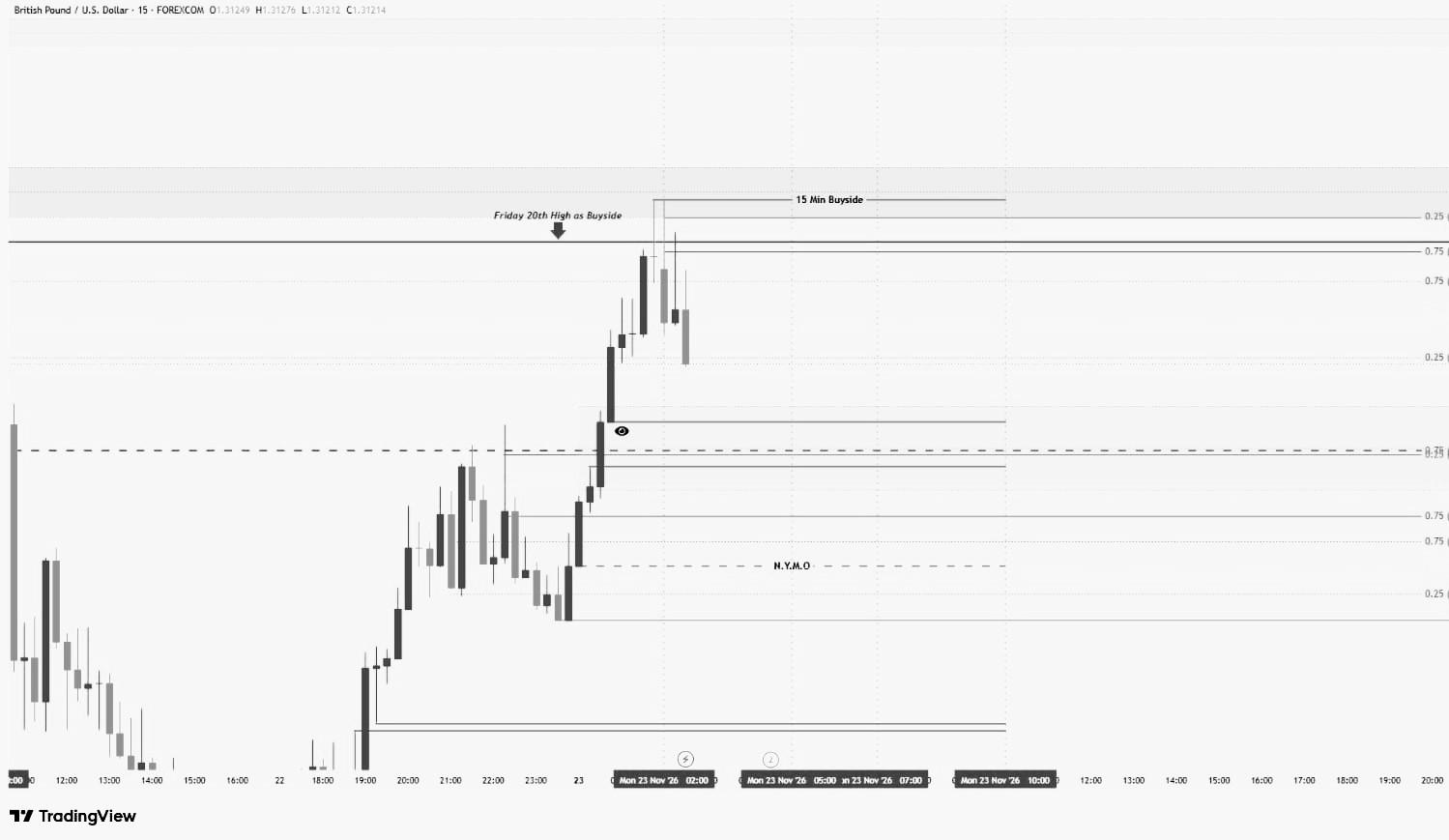
We hit the buyside and 1D array.Could that +FVG engineer a run to that higher -FVG sitting at around 1.31414 on the least?..with extended runs to the weekly discounts?


r/InnerCircleTraders • • 2d ago

Forex Trading 6 years into trading, unemployed, financially struggling and honestly, I don’t know how much longer I can keep going.

45 Upvotes

I don’t even know how to put everything into words, but I feel like I need to get this off my chest somewhere.
I’ve been trading since 2020. I graduated with a degree in Commerce and later completed my MBA. All these years, I’ve been desperately trying to make trading work because I genuinely believed it could change my life.
About a year ago, I finally received my first real payout. I still remember that feeling. For the first time, I thought all those years of struggle, sleepless nights and sacrifices were finally paying off. I thought I’d finally figured it out.
But that was my only payout. I eventually blew the account.
I’m unemployed, and I’ve been arranging and saving whatever little money I could to purchase funded accounts, hoping that one day things would finally work out. But I still haven’t found a consistent edge. Every time I think I’m getting somewhere, something goes wrong.
My family is middle class, and I always felt that I had to be the one to make things better for them. But look at me now. I have degrees, years of trading experience, and absolutely nothing substantial to show for it financially.
The hardest part is watching my friends and college batchmates move forward with their lives. They’re earning, enjoying themselves, building careers and having experiences. Meanwhile, I’ve spent countless nights sitting in front of charts, trying to figure out what I’m doing wrong.
I barely have a social life anymore. There have been nights when I’ve just sat alone and cried, wondering whether all these years have been a complete waste.
Some people might say six years isn’t enough and that I’m giving up too early. But they haven’t seen what those six years have done to me mentally.
I’m exhausted. I’m disappointed in myself, and lately, I’ve been struggling to see a future beyond this situation.
I’m not posting this to seek sympathy or pretend I’m some misunderstood trader. I genuinely don’t know what to do anymore.
Has anyone here gone through something similar? Has anyone had to walk away from trading, rebuild their life and start over?
I don’t even know whether I should continue trading or completely let go of this dream.
I could really use some honest advice, and perhaps just someone who understands what this feels like.


r/InnerCircleTraders • • 2d ago

Futures Trading Pay yourself on the counter-bias scalp: +83.75 pts partials, +12 pts runner, +95.75 pts total on MNQ Tokyo

Thumbnail
gallery
1 Upvotes

Setup: After Friday's 1,600-point selloff, Sydney gapped up, tagged the midpoint of the new week opening gap and trended up all session, so the bias was bullish. At the Tokyo open the first candle was bearish and price didn't want to take the Sydney highs right away, so I read a quick run to the local sellside first.

Trade 1: Short 5 at 25,833 (4 partials, 1 runner), a counter-bias scalp aimed at the local sellside around 25,802. Stop was at 25,876, on an order block under the Sydney highs. Price ran about 40 pts my way but didn't push hard, so I moved my stops into profit and paid myself.

The partials stopped out at 25,812 for +83.75 pts and the runner at 25,821 for +12 pts.

Two minutes later Tokyo wicked to 25,910 and took the Sydney buyside, right through where my original stop sat.

Lessons: On a counter-bias trade, keep the target close and pay yourself fast.


r/InnerCircleTraders • • 2d ago

Question Help with swing points

Post image
8 Upvotes

Hi guys I'd like to know if this is a swing point or not since it doesn't have a swing high