Story by Mohamed Ahmed and Sharif Abdel Kouddous
KHAN YOUNIS, Gaza Strip—Nofal Al-Akhras filled another empty flour sack with sand, tied off the top, and heaved it onto the other bags lining the outside of his tent in the Bir 19 area of the southern Gaza Strip. A displacement camp in a desolate sandy expanse west of Khan Younis, Bir 19 lies close to the yellow line where occupying Israeli troops are stationed. Al-Akhras stacked the sandbags three high, at about waist level, among drying laundry hung on a sagging clothesline, forming a makeshift barrier—a desperate attempt to protect himself and his family from Israeli gunfire.
“Every day, around the clock, we are caught off guard by stray, deadly bullets fired indiscriminately,” he told Drop Site News. “We have lost many loved ones who were martyred by stray bullets striking displacement tents for no reason whatsoever. We had no choice but to collect empty flour sacks, as you can see, and fill them with sand to build protective barriers to shield our children, our families, and our loved ones from the stray bullets.”
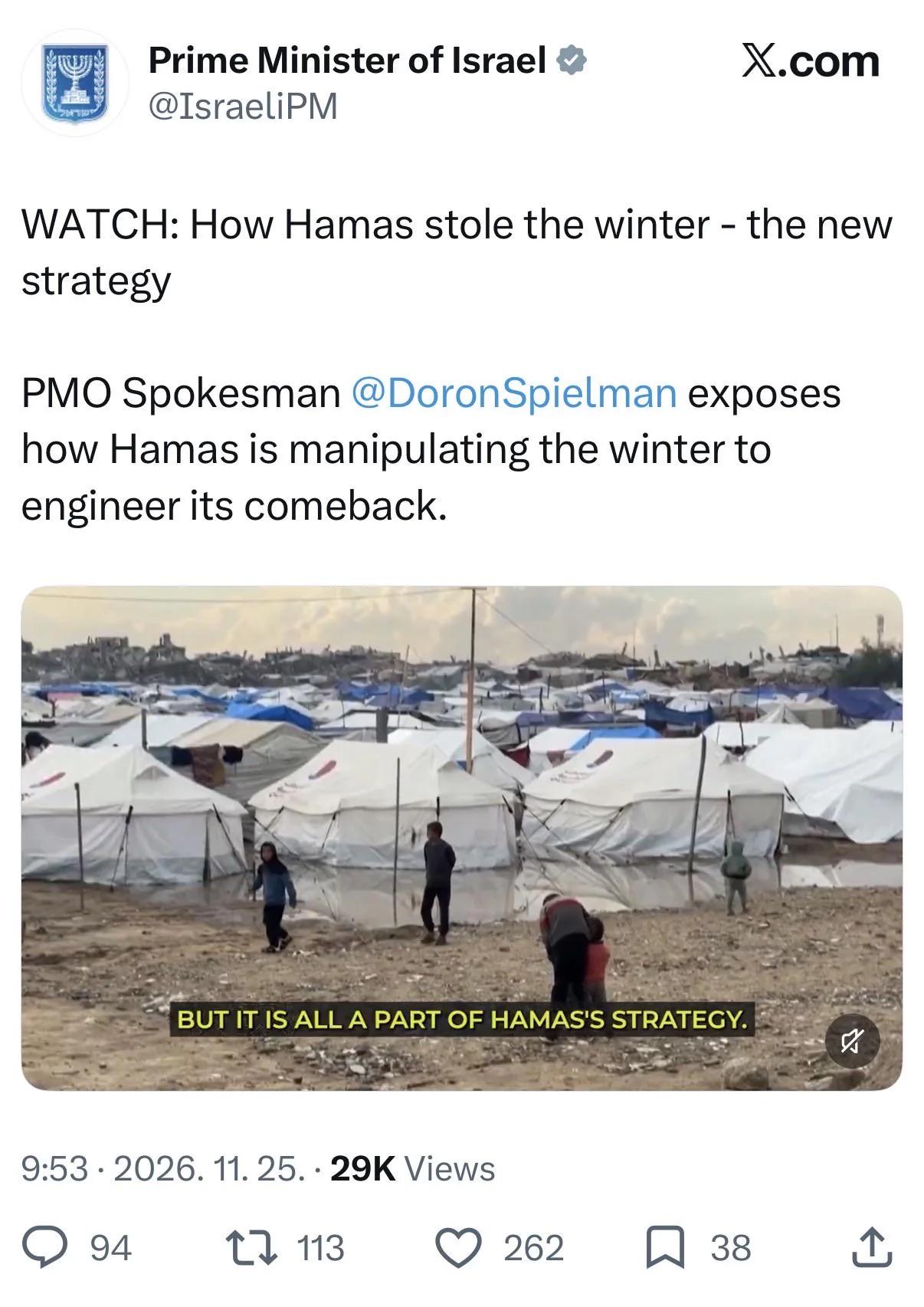
Al-Akhras is not alone. Many families in Bir 19 have taken to placing sandbags on the sides of their tents that face east toward the Israeli soldiers. Palestinians in Gaza, already struggling to survive genocidal conditions imposed by Israel—with multiple displacements, inadequate shelter, a lack of protection from the winter cold, storms and flooding, shortages of food and medicine, a lack of sanitation, and near daily aerial attacks—find themselves having to crouch behind sandbags to avoid flying Israeli bullets.
Outside a nearby tent, a group of three children, no more than five or six years old, stood holding open a large flour sack as an older boy slowly filled it with shovelfuls of sand before struggling to stack it on some two dozen others lining two sides of their tent. Inside another tent, several sandbags were stacked at the head of each mattress. Two children lay on their backs watching a video with their heads propped up on a pillow against the bulging sacks.
brothers, Abdul Karim Al-Namnam, told Drop Site just hours after the incident. He spoke standing in the morgue as Eyas’s small body wrapped in a white shroud and plastic body bag lay on a metal shelf beside him. “We were displaced from Gaza City. We fled from the north to the south, looking for safety. But there is no safety. There is no safety anywhere. Ceasefire? What ceasefire? There is shooting twenty-four hours a day. There is no peace at all. I wish there were some calm. At night, gunfire. During the day, gunfire. In the afternoon, gunfire.”
Abdul Karim had carried Eyas in his arms to Al-Aqsa Hospital. Doctors tried to stop the bleeding for an hour and a half but were unable to resuscitate him. “Eyas was a six-year-old boy, a beautiful boy with lovely curly black hair, and he came in via the emergency department, the operating theater. He was already very unstable,” Dr. Mary O’Shea, an Irish anesthesiologist who was volunteering at Al-Aqsa Hospital in Deir al-Balah for two weeks and was on the scene, told Drop Site. “He had an obvious gunshot in the middle of his abdomen and an exit wound at the back.”
O’Shea said the hospital lacked the necessary equipment and medicines to provide the best possible emergency medical care to Eyas. “Usually, in a big trauma hospital, you get more information straight away—you would have scans, you would have ultrasounds, you would be able to identify where the bleeding was initially. You wouldn’t be kind of searching in the dark,” she said. “The monitors in Gaza, they don’t really work…and the drugs that we use are all out of date, they’re unreliable.”
For the past three years, Gaza’s health care system has come under sustained attack by the Israeli military. Hospitals, clinics, and medical centers have been bombed and raided, while a suffocating siege has caused severe shortages of medicine as well as parts to repair and restore critical equipment, bringing the healthcare system to the point of “systemic collapse,” according to the UN.
“That’s one of the things that I’ve found hard to think about,” O’Shea said. “If he was somewhere else, would the outcome have been different? Maybe it would have been. I can’t say 100% if it would have been, but maybe—maybe we would have been able to save Eyas’s life, and that’s heartbreaking. This is the reality in Gaza. There’s so many stories like this, so many stories.”
In Bir 19, Manar Abu Adhra had one child killed by Israeli gunfire in a tent earlier this year. Her daughter Rafif, just a year and five months old, was ill, and Manar was preparing to take her to a clinic for treatment.
“It was around 7 a.m. I left her behind me in the tent and went outside to get some clothes to change her into. Then I came back when I heard [her father] screaming. A bullet had pierced her head while she was playing inside the tent,” Abu Adhra recalled. “She had done nothing wrong. She hadn’t gone out to fight. She wasn’t part of the resistance or anything like that. She was just a little girl inside her tent.”
“We go to sleep afraid that we might lose another child, or that something might happen to us adults,” she added. “At night, we move the children into this area so they can sleep behind the sand barriers we’ve built.”
One of Abu Adhra’s surviving children, eight-year-old Rahaf, hobbled beside her on crutches as she spoke. Her right leg had been amputated just below the waist after she was wounded in a separate Israeli attack.
“I lost my sister. Her name was Rafif. I lost her to stray gunfire, and we’re still suffering from the shooting to this day,” Rahaf said. “I used to play with her, and now I’m afraid to go to sleep because I might lose one of my siblings or get shot myself. I just wish the war would end so we could finally live without the constant gunfire.”