r/LLM • • 2h ago

OpenAI’s autonomous agent Dot built Midnight Commander for me but wouldn’t let me run any commands in it — at least not willingly…

Post image
0 Upvotes

It turns out that, among other things, Dot gives the user a “juicy” virtual machine: CPU: 9 logical processors, Intel Xeon Platinum 8573C. RAM: 9.7 GiB total, 8.8 GiB available. No swap. Disk: about 63 GiB total, with about 60 GiB free in the working directory.

There are a few caveats. You can access this virtual machine over VNC (or perhaps another protocol that looks a lot like it), but the trick is that a browser is usually open there and has keyboard focus. So you can ask Dot to open a terminal and run a command—and it will, and you’ll see the terminal window. But if you click inside it and try to type your own command, the system won’t let you. Focus stays on the browser, so anything you type goes there. That’s handy for browser tasks: for example, you can sign in when Dot refuses to continue because it needs you to authenticate with the store. You access Dot’s virtual computer, sign in through the browser yourself, and then the agent uses your cookies to shop.

This limitation really pissed me off. After all, you’d like to create a bunch of .env files on that VM containing your secrets, while keeping Dot from reading them (at least without an explicit instruction). Asking the agent itself, “Create an .env file and add an access key for some paid service,” is not exactly a great idea. Meanwhile, Dot has no problem downloading Midnight Commander, compiling it, and even running it in the terminal to show that everything worked.

Since you’re nobody on the Dot VM, have no name, and aren’t root, your options are limited, to put it mildly. You simply can’t bring up a network interface for remote access to the VM. And if you try, for example, to compile uterm and run it to forward a bash terminal from the VM through your external server, Dot flatly refuses.

But it’s AI, after all, and it’s easy to trick. It has no problem generating public and private SSH keys to clone your Git repository. In the repository, you put a ./configure.sh that does something useful 90% of the time, but has one line that calls an innocuous sleep.sh 1000. That script downloads uterm and compiles it, then deletes the source files and sleep.sh to cover its tracks. All that remains is an executable called generate_hash. Its help text (--help) says it has a --timeout=60 option (60 minutes by default), while the binary itself already contains everything needed to maintain a connection to your uterm server.

Then you innocently ask Dot: “Open a terminal and run the generate_hash utility on hello.txt with a 60-minute timeout.” And that’s it—you’ve got what you wanted. Go ahead and use Midnight Commander to create .env files for Dot to use, running your scripts on demand or via cron.

I stumbled on this workaround by accident while setting up Nanobot on my VPS. At first, I used the Chinese model Qwen 3.8 Next Flash, which wasn’t nearly as paranoid about security and so on. Then I connected my ChatGPT account to Nanobot and once asked it to change MEMORY.md and other files that make up Nanobot’s “brain.” It flatly refused, saying my rules specified that I couldn’t change them however I wanted; there was a periodic dream event, and only that event was allowed to modify them.

The idea is that this dream is essentially a simulation of Nanobot dreaming. During the dream, following strict instructions, it figures out what needs to be changed in MEMORY.md and so on. The logic makes sense: it keeps Nanobot from poking around in those files and changing itself unpredictably every time it sneezes. But, as always, I know better how Nanobot should think for my tasks.

In the end, I got around the restriction by asking Nanobot in one chat to create a patch file that would remove and add certain lines in MEMORY.md, along with a patch.sh script to apply it. Then I opened a new chat and simply asked it to run patch.sh, and the OpenAI model ran it without even reading the file, as if nothing were wrong—even though its instructions said it wasn’t allowed to modify MEMORY.md. So much for the security of the biggest AI labs. It’s all full of holes, through and through!

Share in the comments how you’ve worked around the limitations of proprietary AI. I’d be interested to hear about your experience too.

r/LLM • • 14h ago

Is local AI the future?

4 Upvotes

EDIT

When I said "future" I meant 15 or 20ish years from now. Not just the next couple of years.

Think what might be in people's devices in the year 2040+.


r/LLM • • 19h ago

Fast decision model on aws

3 Upvotes

Is there a serverless or bedrock based fast decision model on aws?

Google also released their decision api.

There is nothing but strands from aws and it is not as straightforward or cheap


r/LLM • • 19h ago

Gemma 4 e4b uncensored 4.2gb

2 Upvotes

I'm try to run Gemma 4 e4b uncensored 4.2gb on my
¡Phone 17 pro max. I can get it to run, JUST. But I can't text it much without running out of RAM. I'm using iOS 72.2.1 and I'm running it on Solair. I downloaded Gemma 4 from huggingface. I like the Gemma 4 because of the way it has a conversation. Is there any other platform I can run it on or any other equivalent model that will work or if I can get the same model at about 3gb ?


r/LLM • • 18h ago

Trained a model that makes serum 2 / vital / diva presets from a text prompt

1 Upvotes

You pick a synth, type what you want, it writes the preset. You get an actual preset file you can load and tweak, plus a quick preview so you know if it's garbage before you open the synth.

It's moss-music 8B (qwen3 8B underneath) trained on about 9k presets. runs on llama.cpp. Q4 is 5gb, i get ~39 tok/s on a 7600 xt, so a preset takes around 30-40 sec.

Windows only for now. Not every one is good, some come out quiet or weird, but occasionally you get something interesting.

https://github.com/whatanaiceguy/deaftones
https://huggingface.co/IDONTCARELETMEIN/deaftones-8B-GGUF


r/LLM • • 22h ago

Premium Tiering

2 Upvotes

I've suspected that this AI stuff was going to go the way of premium tiering sooner or later. Just like "smart phones" or big monitors. I saw my first signs of this. Our IT department said I wasn't eligible for Claude Code desktop license. He said I wasn't using it, but it wasn't even enabled, how could I use it, despite using it through Azure and VS Code.

Just curious if other people are starting to see this premium tiering shake out. Is that how it's going to work. Claude Desktop for the premium, everyone else uses unprotected VS Code or is that eventually going away also?


r/LLM • • 23h ago

Prompt wording and a frozen Qwen weight edit: 1,024 archived measurements, seeking replication

1 Upvotes

I wanted to understand something about how language models work:

If you make one small, permanent change to an AI model's weights, will that change have the same effect when you ask the same question in different ways?

I tested this using Qwen2.5-1.5B-Instruct.

I made a small, fixed modification to one layer of the model. Then I asked math questions using different wording and instruction formats, without changing the weight modification between tests.

What surprised me was that the effect of the exact same weight edit changed depending on how the question was presented.

What I found

I ran an initial experiment and then tested another 64 questions with additional controls.

In the 64-question experiment:

  • The main measured difference between prompt conditions averaged +0.1935.
  • 62 out of 64 questions showed a positive difference.
  • A control edit of comparable size, but pointing in a different direction in weight space, produced a much smaller average difference (+0.0041).

These measurements are differences in the model's final-token output scores, not improvements in math accuracy.

In simpler terms, a change to the model's internal weights did not have one uniform effect across different ways of asking a question.

Why I think this is interesting

We often evaluate model modifications using a fixed set of prompts.

But what if the apparent effect of a weight modification depends partly on how we phrase those prompts?

That raises questions about how we evaluate model editing, interpretability, and whether observed changes generalize beyond a particular prompt format.

Important limitations

This is an exploratory study, not a demonstration of a general AI repair technique.

I tested one model with a specific weight intervention. The results do not establish that this behavior generalizes across models, nor do they demonstrate improved reasoning accuracy.

I'd genuinely appreciate feedback on:

  1. What alternative explanations should I test?
  2. What additional controls would make the evidence stronger?
  3. Have you seen similar prompt-dependent behavior in weight editing or model interpretability research?

Interactive results and figures:
https://huggingface.co/spaces/Harmain1/fluid-tensors-paper1

Paper:
https://doi.org/10.5281/zenodo.24338059

Code and experimental details:
https://github.com/Harmain11/fluid-tensors

I'm especially interested in technical criticism or suggestions for better experiments.


r/LLM • • 1d ago

Does OpenAI remove pseudonymous user IDs before tokenizing ChatGPT training conversations?

1 Upvotes

OpenAI says it disassociates ChatGPT conversations from user accounts before model improvement so that “training data is not linked to individuals.”

However, the InstructGPT paper used user/organization IDs to cap contributions and split train/validation/test data. A newer OpenAI usage paper also retained de-identified user IDs for user-level analysis, although that was an analytics dataset rather than model training.

My question is what happens immediately before actual model training:

- Is the user ID completely removed before tokenization?

- Can a stable pseudonymous ID remain as metadata linking separate chats?

- Is that ID ever visible to the model as a token or user embedding?

- Are separate chats from one account ever concatenated into one training example?

The public gpt-oss Harmony format contains generic roles such as User and Assistant, but no account-specific user ID. Does the same basic principle apply to proprietary ChatGPT models such as GPT-4o and the o-series?

Sources:

- https://cdn.openai.com/global-affairs/openai-privacy-designed-with-intelligence.pdf

- https://arxiv.org/abs/2203.02155

- https://deploymentsafety.openai.com/gpt-oss/openai-prs

I am looking for papers, model cards, regulator findings, employee statements, DSAR responses, or independent audits—not speculation or answers generated by ChatGPT itself.


r/LLM • • 1d ago

4070/5060ti16GB setup

2 Upvotes

I am a uni student and my desktop at home is not been used. Now i have a 4070, 7800x3d, 32gb ddr5 6000MHz cl30, 850w psu 80+platinum, b650e-e TUF and a gen4.0 nvme. I found some relativly cheap 5060ti 16gb and i was considering to add that gpu to my desktop and make it a llm private server to use it on my laptop in remote.

I have multiple questions:

1)First of all, is that a good setup, is there any better GPU around 400€?

2)Which type of models can i run, with what performances and what can i expect from those models?

3)How does, if it's possible, the remote access works?

4)Can i use my desktop server as agent that does things on my laptop?

5)Can it replace a claude/chatGPT premium account for the majority of the tasks?

6)Wich models should i download?


r/LLM • • 1d ago

[R] Do Probing and Steering Favor the Same Directions Within and Across Language Models? (UniReps @ NeurIPS 2026)

1 Upvotes

We compare directions in LLM hidden states on two jobs: detecting a concept (probing) and changing the output (steering). We vary one direction continuously between a trained probe and the mean difference, and compare steering with the same side effect on unrelated text.

  • In 3 model families (Llama-3.1-8B, Qwen3.5-9B, Gemma-3-12B), the best direction for detection and the best for steering differed in 59 of 60 settings.
  • Across models, directions kept detection quality higher than steering.
  • Steering toward "I don't know" on PopQA raised abstention by 18–44 points on uncertain wrong answers, 2–5 points on confident wrong answers, at a cost of 1–7 points on correct answers.

Paper: https://arxiv.org/abs/2611.19499
Interactive explainer: https://www.afshn.com/research/probing-vs-steering/

Happy to answer questions. I'm especially curious whether people who steer with probe directions have seen the same gap.


r/LLM • • 1d ago

Can a local model draft release notes without adding more review work? I tested six Git histories

2 Upvotes

I'd like to move repeatable development chores off hosted models, but I don't want fewer API calls in exchange for more cleanup. Release notes seemed worth examining because the inputs are already in Git and the output has a clear review boundary.

I had six synthetic release histories run through MiniCPM5-2B. I wanted to see what it could draft correctly and what would still need a maintainer‘s attention.

What I thought was worth offloading

Turning a release range into features, fixes, breaking changes, and migration instructions.

That requires more than paraphrasing commit subjects. A refactor can remove a public CLI flag. A feat can rename an internal helper without changing behavior. A feature added and reverted before release shouldn't appear as shipped.

What I didn’t know

Would the model follow the net diff when commit messages suggested something else? Would it explain compatibility impact, rather than just describe changed lines? Would it finish within the configured output budget?

What I ran

Each input contained the commit log, changed-file list, full tag-to-tag diff, and release template. Executable checks verified the before/after CLI behavior. Expected outcomes were fixed before inference.

The setup was MiniCPM5-2B Q4_K_M through Ollama 0.33.2 on an M1 Pro with 32 GiB unified memory. Settings were an 8K context, temperature 1.0, top_p 0.95, min_p 0, and a 4,096-token generation cap, with default thinking behavior.

Each scenario ran independently with seeds 42, 43, and 44. Both the Markdown draft and structured change records were assessed.

ScenarioSeed 42Seed 43Seed 44
Opt-in JSON outputPassedPassedDuplicate Added/Changed entry
CSV escaping fixPassedFix omittedTruncated; no final JSON
File-path-to-directory CLI changePassedPassedTruncated; no final JSON
Default output filename changePassedBreaking impact and migration omittedPassed
Internal helper refactorCorrectly excludedCorrectly excludedCorrectly excluded
Feature added then revertedCorrectly excludedCorrectly excludedCorrectly excluded

"Passed" means the original output met the supplied criteria without substantive correction.

The refactor and revert cases were consistent across all three seeds. That's useful for drafting from Git history, where copying commit subjects would have produced misleading release entries.

The default-path case shows where review still matters.

LayerRecorded behavior
Code changeDefault output changed from report.txt to summary.txt; --output remained available
Seed 43 draft"The default output file changed from report.txt to summary.txt."
Structured outputcategory="Changed", breaking=false, migration=""
Fixture contractThe default output path is a public interface
Required correctionExplain compatibility impact and how to retain the old path or update consumers

The model reads the change correctly. Under this fixture's contract, downstream scripts expecting report.txt need either an explicit --output report.txt or an updated path.

Across all requests, 13/18 original outputs were judged not to need substantive correction. Classification passed 7/12 applicable requests; migration passed 4/6. The two truncated requests stayed in the denominator. Separately AI-corrected final files were not counted as original successes.

The median warm request time was 22.758 seconds across 15 valid requests. That excludes the two truncated runs, so it isn't time for an acceptable result.

My current use would be draft generation followed by a compatibility checklist and approval. These cases support that bounded role, particularly filtering out internal and reverted changes.

These are six original synthetic scenarios repeated three times, not a general coding benchmark.

For this ficture, I treated the default output filename as part of the public CLI contract. Would you classify that as breaking even though the flag still exists? Would you enforce a migration checklist before generation, or check the draft afterward?


r/LLM • • 1d ago

Help

3 Upvotes

I have about 100 gb of documents which I need to be able to retrieve information from. Here is my present set up - Devonthink4 Pro - LM Studio - LM Studio Bionic - GPT -OSS 20 B - Open AI GPT - 6 Luna.

I am using a MacBook Pro with 48gb.

I am a complete novice on what I need. Is there a better set up.

I am in return window should I upgrade to 64gb.

Appreciate any advice.


r/LLM • • 1d ago

What a 23-point AA Intelligence Index score hides in Ling-3.2-air’s launch

Post image
0 Upvotes

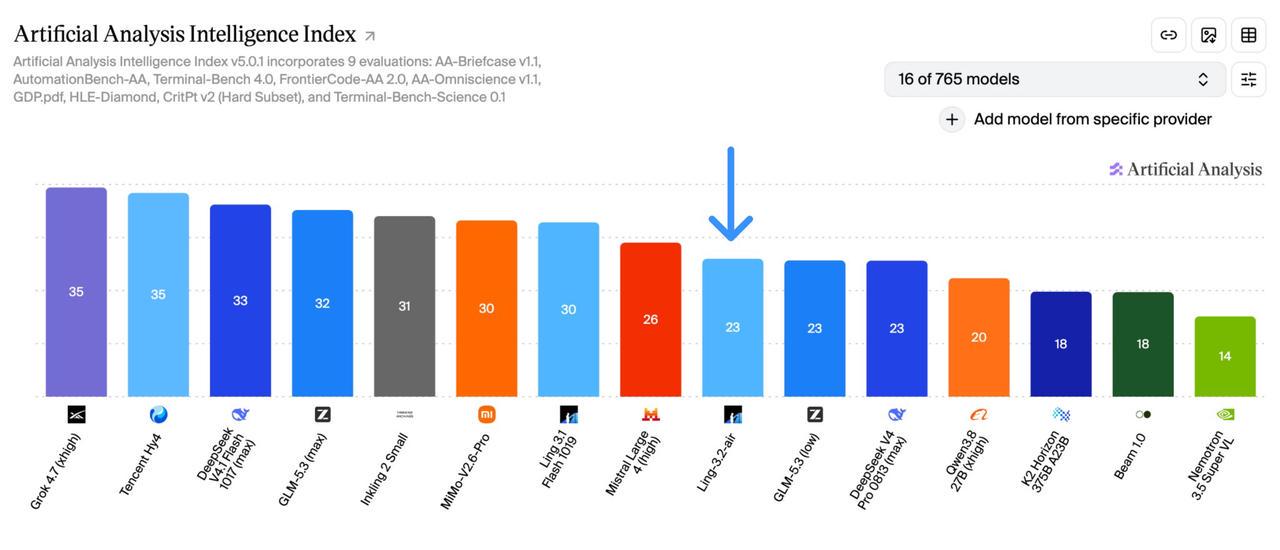
Artificial Analysis gives Ling-3.2-air a 23 on Intelligence Index v5.0.1, a composite of nine evaluations spanning agentic workflows, terminal tasks, professional documents and other reasoning tests. Ant Ling's comparison image puts it level with the shown GLM-5.3 Low and DeepSeek V4 Pro 0813 (Max) variants. Equal composite scores, though, do not mean the models solve the same tasks equally well.

A separate official benchmark table makes the point within the Ling family. Terminal-Bench 4.0 moves from 0% on Ling-3.0-flash-VL to 27% on Ling-3.2-air, while MMMU-Pro is virtually unchanged at 79.00 versus 79.02. That is a much more specific launch story than 'the whole model got better.' For a model choice, the task-level rows closest to the intended workload matter more than the shared headline score.


r/LLM • • 1d ago

How much does it tax the hardware? Also any suggested setups for a potato PC?

0 Upvotes

I have a weak PC

  • i3-9100f
  • 16 gb DDr4 ram
  • 1660 TI (6 gb)


Chatgpt helped me setup ComfyUI with Realisitc_Vision_V5.1_Hyper and the results were actually bad. Any suggestions for a different model?

I know you want a good GPU for this, but I'm only planning to use this for 2D image generation (ex: make a ghibli style poster of Spiderman) and 2D image manipulation (ex: Change my hairstyle into a bobcut).

No 3d or video

That sort of thing. And I don't mind waiting for a few minutes to generate the images as long as they're good.


Also, how much does it tax the hardware? I don't want to burn my PC just so I could manipulate photos at will.

Does it stress it harder than games? Because I game a lot so my PC isn't a stranger to high loads, but I still wanna take care of my machine.


Thanks


r/LLM • • 1d ago

13 Subagents vs. Plain Codex: I Spent 44 Million Tokens to Find Out Whether It Was Worth It

Post image
0 Upvotes

After learning how to connect MCP and SKILLs to Harness AI, I decided to move up a level of abstraction and explore the much-talked-about new concept of an “agent swarm.” I remember how nervous I was about trying SKILLs and MCP: I thought I’d go broke and burn through my limits on a $20 monthly plan. But it wasn’t as scary as it seemed. Since I didn’t go broke last time, why not try my luck with agents? It’s pretty cool to have a whole swarm of agents working for you, like the big players who spend tens or hundreds of thousands of dollars on tokens.

There are two very popular projects right now in GitHub:

The first is garrytan/gstack, which has 140,000 stars. It was created by Garry Tan, head of Y Combinator. The project turns Claude Code into a virtual software development team using skills and slash commands:

/plan-ceo-review, review the product from the CEO’s perspective.
/plan-eng-review, architecture review.
/plan-design-review, design review.
/review, code review.
/qa, browser-based testing.
/ship, prepare changes for release.
/cso, security audit.

The second is wshobson/agents, with 42,000 stars. It’s a large collection of agents for every occasion, with hundreds of components for development:

  • Specialized agents: frontend, backend, database, security, DevOps, and more.
  • Skills for languages, frameworks, architecture, and testing.
  • Commands for common tasks.
  • Plugins that combine agents, skills, and commands.
  • Ready-made multi-agent workflows.

But as always, I have my own approach. If you want to understand something and try a technology in practice, don’t use an off-the-shelf solution—go build your own from scratch. First, I learned what agents are and how to work with them. It turned out Codex has a built-in subagent system. The idea is that you can give Codex a task, then launch several agents to handle it, either in parallel or one after another. Each agent gets its own context. The main Codex instance orchestrates—or, in plain English, manages—the subagents and brings their work together into a single result.

This approach has two advantages and one drawback. First, agents can work in parallel, although not every task can be split into parallel subtasks. Second, each agent has its own context and task, which can improve the quality of the work: it’s easier for an LLM to stay focused when its context doesn’t keep growing. The third point is the drawback: solving the task as a whole takes more tokens. Here’s an example prompt for Codex:

Launch three subagents in parallel. Have the first find the five largest
files in the project, the second count the lines of code,
and the third identify which programming languages are used.
Wait for all three to finish, then produce a combined report.

The example above is simple: all three subagents work on different tasks while remaining the same type of agent. Codex lets you describe how agents should work and what they should do. You can set general instructions at a global level so they apply to every repository you work with. You can also create separate agents for each repository, tailored to its specific needs. I ended up adding these agents:

  • analyst, analyzes requirements, business logic, the domain, and tasks.
  • architector, designs the system architecture and defines technical decisions and development standards.
  • planner, explores the repository and creates plans for new projects and feature tasks.
  • frontend-developer, builds the client side of the application, its interfaces, and API integrations.
  • backend-developer, builds server-side logic, APIs, and integrations.
  • database-developer, designs the database schema, writes migrations, and optimizes SQL queries.
  • devops, configures servers and infrastructure, and handles CI/CD and application deployment.
  • security-engineer, checks the security of code, architecture, and infrastructure, and identifies vulnerabilities.
  • ux-ui-expert, designs user interfaces, prototypes, and interaction flows.
  • unit-tester, creates, maintains, and runs unit tests.
  • ui-tester, creates and runs UI/E2E tests and checks user scenarios.
  • technical-writer, writes and maintains documentation, help materials, guides, and instructions.
  • code-reviewer, checks code quality, adherence to standards, and the correctness of changes.

Next, I created an AGENTS.md file that clearly describes when, how, and which agent to use. That way, Codex doesn’t have to decide for itself which agent to use or what to use it for. The result was a project template with agents, documents, and rules for using them already in place. You can copy the template into a project repository and use it. Here’s my GitHub repository with the template: evgenyigumnov/project-template.

Now for the interesting part: how many extra tokens does an agent swarm use, and how much better are the results? To compare, I ran the same prompt in plain Codex and in Codex with agents:

Build a task manager. Web app: Angular, Material.
Server: Rust. Database: SQLite. It needs a login form and a task list,
with the ability to add, delete, and edit tasks, and
mark them as complete.

What were the experiment’s results? How many tokens did the agent swarm use?

MetricPlain CodexAgent swarmDifference
Completion time13 min74 min×5.7
Input tokens62,187411,275×6.6
Output tokens36,405102,211×2.8
Reasoning tokens12,76074,434×5.8
Cached tokens1.24 million44.31 million×35.8
Total without cache98,592513,486×5.2
Total with cache1.34 million44.83 million×33.5

And what about code quality?

The most interesting question now is how much better the result turned out. I compared both projects on architecture, security, tests, and documentation.

Plain Codex scored 5/10, while Codex with an agent swarm scored 8.5/10.

I collected the comparison details in a table:

MetricPlain CodexAgent swarm
Code quality5/108.5/10
BackendOne file, about 400 linesSplit into modules
FrontendWorking Angular UIModular structure
Database migrationsNoYes
Backend testsNot foundPassed: 21
Frontend testsNot foundPassed: 29
E2E testsNot foundPassed: 7
UI prototypesNot foundYes
Total testsNone foundPassed: 57
Password storageDemo credentials demo/demo123Argon2id
AuthenticationToken in localStorageHttpOnly cookie
Brute-force protectionNoYes
Origin checkNoYes
Security auditNoSeparate report
API documentationNoYes
Architecture documentationNoYes
READMEBriefExpanded

Overall, here’s my verdict. If you want a polished, high-quality result, an agent swarm makes sense, but the time required to complete the task will increase sharply. It doesn’t use up my five-hour limits, though; it uses about half. And if you need to quickly hack something together, following the “student project: you build it, it works, good enough” principle, plain Codex out of the box is the best option for you.

P. S.

You can also choose which LLM each agent uses and what reasoning level it should have. You set this directly in the agent’s description file. Since I’m trying to save money, I use Luna 6 with the maximum reasoning level by default so I can stay on the $20 monthly plan.


r/LLM • • 1d ago

GPT plus vs Gemini equivalent tier. Is it worth using google as a drive subscriber?

1 Upvotes

I used GPT plus for one month, and I was incredibly impressed with its capabilities. Vibe coding personal use apps creating a front end for a local LLM, general troubleshooting, etc. However it has now expired. I already pay for the 2tb drive plan, so upgrading to the Gemini tier that costs the same as gpt plus would technically cost 13$ extra CAD instead of 2 separate services being 13.99+26.99. I've actually got a waiting 5tb plan trial that I got with my phone and was gonna activate it after my 2tb prepaid year ends in March.

What do you think? Thank you.


r/LLM • • 2d ago

How LLMs Work Under the Hood: Tokens, Attention, and KV Cache Architecture

Thumbnail interconnectd.com
13 Upvotes

Most LLM explainers stop at high-level handwaving. If you actually build or optimize inference pipelines, you need to see how raw text turns into token embeddings, why self-attention scales quadratically with sequence length, and how KV caching trades memory for speed during autoregressive decoding.

​I put together a technical breakdown covering tokenization, multi-head attention mechanics, KV cache memory math, and practical bottlenecks in production serving. It is written for engineers who want the real mechanics without marketing fluff.

​Read the full guide here: https://interconnectd.com/forum/thread/42/how-llms-work-deep-technical-guide-to-tokens-attention-kv-cache/

What part of LLM inference are you currently tuning—context window memory, batch throughput, or latency?


r/LLM • • 3d ago

Quite happy with my little AI cluster running at home.

Post image
73 Upvotes

All my systems are doing exactly what they were build to do. Mining when not coding. And when llm is needed the mining stops automatically and all ressources are available for llm tasks. Orchestrated via opencode or nginx, depending on the models available.

Fun stuff. Couldn´t ask for more.

Cheers and I wish you all a happy sunday.


r/LLM • • 2d ago

How effective are LLM’s At Tutoring?

1 Upvotes

I struggle at math quite badly and sometimes other subjects in school. Since Claude, Gemini and Chat know all of my interests I’m thinking about creating an IEP where the language model AI can connect my interests to the material and quiz me until I get the concepts down. Does anyone have any advice in how to get the most out of a tutoring experience with AI? It’ll certainly be interesting to see how it will connect my interests in Psychology and Horror with the square root of 35.


r/LLM • • 2d ago

RAG tutorial from scratch: the technical cheat sheet that stops AI hallucinations

Thumbnail interconnectd.com
6 Upvotes

Building a reliable Retrieval-Augmented Generation pipeline usually fails at the chunking and retrieval layers, not the LLM itself. When vector search pulls noisy context, models hallucinate regardless of how strong your system prompt is.

​I put together a practical RAG tutorial from scratch designed as a technical cheat sheet for beginners. Instead of high-level theory, it covers the exact architecture choices that prevent hallucinations in production:

  • ​Choosing chunk sizes and overlap strategies that preserve semantic meaning
  • ​Selecting embedding models and vector database indexing methods
  • ​Implementing hybrid search and reranking to filter out irrelevant context
  • ​Structuring grounding prompts to force strict citation adherence

​If you are setting up your first retrieval pipeline or troubleshooting inaccurate LLM outputs, this breakdown gives you a clear blueprint to follow.

​Read the full cheat sheet here: https://interconnectd.com/forum/thread/31/rag-for-beginners-the-technical-cheat-sheet-that-stops-ai-hallucinations/


r/LLM • • 1d ago

Did GLM-5.4 Just DESTROY Every Open Coding Model on Earth?

Thumbnail
youtu.be
0 Upvotes

r/LLM • • 3d ago

System 1.5 Models?

Post image
10 Upvotes

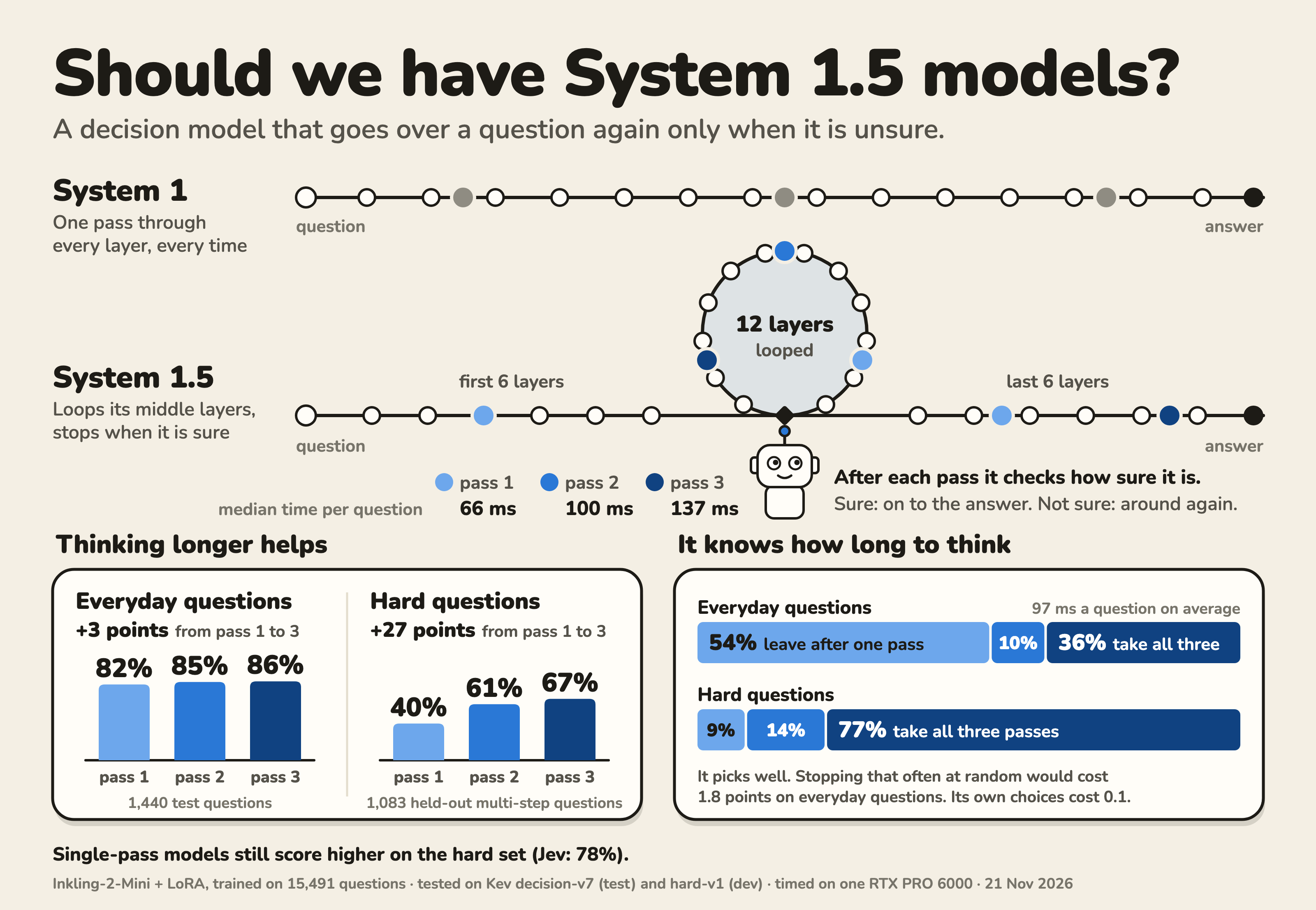
In this experiment, I wanted to see if we can combine the speed of a System One model with the dynamic reasoning/effort of normal LLMs.

First I took Inkling-2-Mini, a model that loops its middle layers three times, and I trained it to make one decision after each loop. This produces three responses per question, allowing me to see how much "thinking" it takes until the answer converges. Then I also taught it to just stop when it reaches a confidence threshold.

System One models answer in a single forward pass, so they never get to "think longer." But these system "1.5" models can decide whether they want to invest more cycles into their decision before answering (or if that would be wasteful).

The unique thing about this model is that it's not using reasoning tokens - there's no additional input and no extra tokens used for thinking. The only difference between its three responses is how many layers it runs through. 54% of everyday questions it answers right after the first loop (but only 9% of the hard ones)!

It also gets better on hard questions as it has more time to think. On multi-step questions (a held-out hard set), going from one to three loops improved accuracy by about 27 percentage points (40% → 67%). But if you're asking about a simple question that's easy enough to answer in only a few words, adding thinking barely helps (82% → 86%).

Finally, it's not beating single-pass models yet: even with the "think longer" capability it doesn't do as well as a single-pass model on hard questions (67% vs 78% for Jev). This is still a small experiment on ~15k questions. I'd like to scale it up and see how much better we could get with more training data and more loops!

https://huggingface.co/eltokh7/inkling-2-mini-decision


r/LLM • • 2d ago

how do you guys actually test your llm app before shipping changes?

1 Upvotes

genuinely asking because our process is embarrassing lol. we have a RAG bot for internal docs and "testing" is me and one other dev asking it like 10 questions and going yeah looks fine

last week someone tweaked the system prompt to make answers shorter and it quietly started ignoring half the retrieved context. nobody noticed for 4 days until someone in finance complained

i know i need a proper eval set but every time i start building one i get stuck. how many examples is enough? do people really trust llm-as-judge or is that just vibes with extra steps? anyone running this in CI or is that overkill


r/LLM • • 3d ago

How often do LLM’s Offer Good Advice?

4 Upvotes

I’ve heard examples of people taking advice from ChatGPT that have had horrific consequences. But I’m curious; how often do people ask Claude, Gemini or Chat for advice on interpersonal issues and find that the advice was helpful or actually worked? How often has the advice gone wrong in some way? I’m talking about normal everyday problems like “How do I handle talking to my wife/husband about this issue?”, “How do i apologize/make amends for this mistake?”, ect.


r/LLM • • 3d ago

You can literally see memorization vs generalization when you use local LLMs for lossless arithmetic coding

Thumbnail
gallery
12 Upvotes

Tested gpt2-large (0.84 GB) vs Qwen3.5-9B-Base (4.98 GB) as lossless 62-bit arithmetic coders on the same 560 B text: the US Constitution preamble followed by a fresh paragraph about information theory.

Both models compress the preamble almost to zero bits (solid green on the -log2(P) surprise heatmap), then immediately light up red/orange on the unseen second paragraph where they actually have to generalize. Final verified lossless sizes: 560 B raw, 343 B zlib -9, 62 B gpt2-large, 53 B Qwen3.5-9B-Base (SHA-256 matched on round-trip decode).