r/learnmachinelearning • • 29d ago

Help Looking for guidance from people working in Edge AI / On-Device AI

2 Upvotes

Hey everyone! I’m a Software Engineer in India with around 1 year of experience in automotive embedded software .

My background includes C/C++, Python,embedded systems, ARM, RTOS, Linux fundamentals etc.

I’ve been learning ML, along with the fundamentals of deep learning.

I’m now planning to build something hands-on projects around ASR/TTS, model deployment, ONNX, quantization, and inference on edge hardware.

I’d love to hear from people currently working in this space:

* What are you actually working on day-to-day in Edge AI or on-device ML?
* What skills and tools matter most in real industry projects?
* How should someone with my embedded background target relevant jobs and get interviews?
* Are strong projects and deployment experience enough to break in, or are there other gaps I should address?

I’m particularly interested in the intersection of embedded systems, deep learning, and hardware—not just general ML roles.

Any honest advice, experiences, or pointers would be really appreciated. Thanks!


r/learnmachinelearning • • Oct 27 '26

Any good resources to quickly refresh the probability knowledge needed for Probabilistic ML?

4 Upvotes

I will be starting a course in Probabilistic Machine Learning in one week. Can you guys please recommend a good resource for me to refresh my knowledge in short amount of time?


r/learnmachinelearning • • Oct 27 '26

I built a small ML framework from scratch in Python, with an OpenCL backend

4 Upvotes

I've been working on krnl, a lightweight machine-learning library I've been building to understand and implement the fundamentals of neural networks myself.

It currently includes:

  • A custom Tensor class with automatic gradient computation
  • NumPy and OpenCL-backed computation
  • Linear, ReLU and Sigmoid layers
  • SGD, Adam, Muon and MuonWithAdamAux optimizers
  • MSE, MAE and Huber loss functions

I also developed PyCLBlast for working with CLBlast through Python.

I'm interested in making the library useful for experimenting with neural networks while exploring GPU computation beyond CUDA.

I'd appreciate feedback, especially on the tensor API, autograd design, and OpenCL backend.

GitHub: https://github.com/helloadhavan/krnl/

PyPI: https://pypi.org/project/krnl/


r/learnmachinelearning • • 29d ago

Decentralized Q-learning restoration on IEEE 33-bus & 179-bus Oberrhein networks (0.12s vs 2.6s)

Thumbnail
linkedin.com
1 Upvotes

r/learnmachinelearning • • 29d ago

Help Undergrad with no ML background wanting to learn from scratch

1 Upvotes

Hi everyone, I'm an undergraduate Geophysics student, working on my final-year thesis. My work involves subsurface imaging, mostly with Python. I'm comfortable with programming, but I'm an absolute beginner when it comes to machine learning and deep learning.

I'd like to apply Implicit Neural Representations at one stage of my workflow, but I don't want to just copy code without understanding what's happening under the hood. So I'm looking to learn the fundamentals properly, from zero. Could you recommend: Books or courses for learning ML/deep learning fundamentals and a suggested learning path: what to study first, and what I can safely skip for now.

Thanks in advance


r/learnmachinelearning • • 29d ago

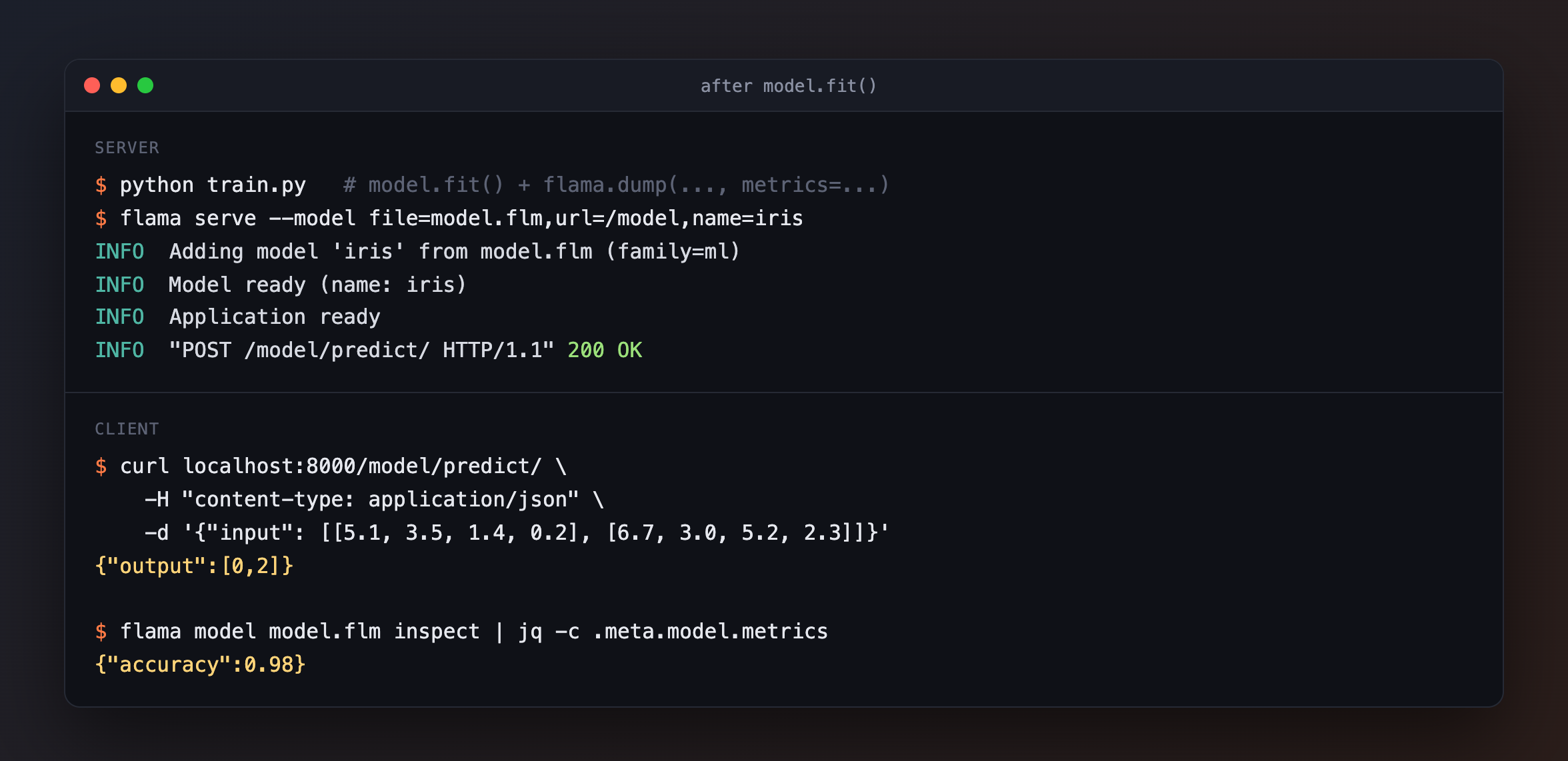
Project After model.fit(): getting a trained model behind an API in two commands

Post image
1 Upvotes

Most ML tutorials end when the accuracy number prints. The question that comes right after, how does anything else actually use this model, is the one that made me start Flama back in 2018: an open source (Apache-2.0) Python framework to take a trained model to an API with as little ceremony as possible.

Here's the whole path with a scikit-learn model.

1. Save the model, with its metrics, into one file

import flama
from sklearn.datasets import load_iris
from sklearn.neural_network import MLPClassifier

X, y = load_iris(return_X_y=True)
model = MLPClassifier(activation="tanh", hidden_layer_sizes=(10,), max_iter=2000).fit(X, y)
flama.dump(model, family="ml", path="model.flm", metrics={"accuracy": model.score(X, y)})

The model.flm is a single file with the model and everything about it: the library and version it was trained with, its hyperparameters, and the metrics you passed in.

2. Serve it

pip install "flama[pydantic]"
flama serve --model file=model.flm,url=/model,name=iris

That's a running API. No server code, no Dockerfile.

3. Call it

curl http://127.0.0.1:8000/model/predict/ \
  -H "content-type: application/json" \
  -d '{"input": [[5.1, 3.5, 1.4, 0.2], [6.7, 3.0, 5.2, 2.3]]}'

{"output":[0,2]}

Send something that isn't a list of rows and you get a 400 telling you what's wrong, not a stack trace. And http://127.0.0.1:8000/docs/ has interactive docs for every endpoint, generated for you:

4. Check it without a server

flama model model.flm inspect                 # library, hyperparameters, metrics
flama model model.flm run -i holdout.json     # predictions, offline

Handy in CI: read the accuracy straight from the file and only ship the model if it's good enough.

From there

The same idea works for PyTorch, TensorFlow and Hugging Face models, and for LLMs too. When you outgrow the one-liner, the model becomes a resource in a full API next to your own endpoints (app.models.add_model(...)), with validation, docs and auth from the same framework.

Repo and docs: https://github.com/vortico/flama

If it helps you get a model out of a notebook, a star on GitHub helps more people find it. Happy to answer questions, especially the "but how do I actually deploy this" ones.


r/learnmachinelearning • • 29d ago

A beginner trying to navigate in documentations

Thumbnail reddit.com
1 Upvotes

r/learnmachinelearning • • 29d ago

Request Hi How can someone get started as an ACL Rolling Review secondary reviewer?

0 Upvotes

Hi everyone,
I’m an industry researcher with several years of experience in NLP, LLMs, and conversational AI, and I’m trying to get involved in academic peer reviewing.
I recently submitted a paper to ARR, but it was desk rejected through the reviewer capacity lottery because I didn’t have a designated service contributor.
I don’t yet meet ARR’s publication requirements for becoming a primary reviewer, so I’m exploring the secondary reviewer route.
A few questions:
How do people typically find primary reviewers willing to mentor secondary reviewers?
Are there any communities or channels where ARR reviewers look for secondary reviewers?
Is anyone currently reviewing for ARR and open to mentoring a new secondary reviewer?
Are there other practical ways to build an official reviewing record without prior publications?
My interests include NLP, spoken dialogue systems, conversational AI, and LLM evaluation.
Would appreciate any advice or opportunities. Thanks!


r/learnmachinelearning • • Oct 27 '26

I built an interactive way to learn the math + Python behind ML (free lessons available)

2 Upvotes

Hey everyone,

I’ve been working on a learning platform focused on helping beginners actually understand machine learning instead of just running library code.

A lot of people (including me when I started) jump straight into scikit-learn or tutorials and later realize they don’t really understand why the model works or fails. So I tried building something different:

  • Math and Python are connected side by side
  • Interactive playgrounds (you can drag lines, change parameters, and see what happens)
  • Lessons follow a clear structure: Problem → Intuition → Math → Code → Where it goes wrong
  • Everything runs in the browser (no install needed)

There’s a free section available right now that covers the foundations (including an interactive linear regression demo and some Python essentials).

You can check it here: https://mlmastery.io


r/learnmachinelearning • • Oct 27 '26

Project How to train AI to see optical illusions

Post image
8 Upvotes

As a learning project inspired by Meta's Segment Anything, I'm experimenting with an optical illusion: a pixel X made of straight stepped blocks (image attached) whose arms appear to bend around the centre square. The effect weakens or disappears when I change the square sizes, so it depends on specific proportions.

My plan is to generate many variations, collect human ratings on whether and where each one looks curved, train a small model to predict that perceived curvature, and then test whether SAM follows the real pixels or the perceived curve.
Is this realistic for a beginner?

I'd love advice on what model to start with, how much labelled data I'd need, and how best to record where people see the curve. Any related papers or projects would also be really helpful. Thanks!


r/learnmachinelearning • • Oct 27 '26

Starting a PhD in Reinforcement Learning — what topics do you find interesting?

Thumbnail reddit.com
1 Upvotes

r/learnmachinelearning • • Oct 27 '26

From IAM background, currently working on Microsoft Entra ID. Please advise with a roadmap to learn AI and where to start exactly

Thumbnail reddit.com
1 Upvotes

r/learnmachinelearning • • Oct 27 '26

Help A beginner trying to navigate in documentations

Thumbnail reddit.com
1 Upvotes