r/learnmachinelearning • • 27d ago

Discussion Are we escaping one information bubble only to enter another?

3 Upvotes

Social media and search engines already shape what we see through rankings, recommendations, and algorithms.

AI assistants may feel different because they do not just show us information — they summarize it, prioritize it, and turn it into a single coherent answer.

That is convenient. But it also makes it harder to notice what was excluded, what sources disagreed, or what questions were never considered.

Maybe AI helps us escape the noise of the old information bubble. Or maybe it builds a quieter, more convincing one.

What do you think?


r/learnmachinelearning • • 27d ago

Math for AI & ML video series for Linear Algebra

9 Upvotes

I create a Youtube channel https://www.youtube.com/@math4aiorg for the book ( https://www.amazon.com/dp/B0GSXVFMLD/ ) Math for AI & ML's Part I.

Part I (Chapters 1–10) covers linear algebra fundamentals: vector spaces, inner products, matrix operations, subspaces, orthogonality, QR decomposition, LU factorization, eigendecomposition, symmetric matrices, and the Singular Value Decomposition (SVD)—establishing the mathematical foundation for representation in AI.

Please let me know if there is any suggestion.


r/learnmachinelearning • • 27d ago

Career Built a tiny image classifier for my plant photos, looking for feedback on where to go next

6 Upvotes

First real project. I collected a few hundred photos of the plants on my balcony, labeled them into a handful of species, and trained a small classifier that gets decent accuracy on my own test split. It does fine on photos that look like my training set and falls apart the second lighting or background changes. I know that is probably overfitting plus a tiny dataset. My question is what the highest value next step is for learning: more data, augmentation, or trying transfer learning. I want the step that teaches me the most, not just better numbers.


r/learnmachinelearning • • 27d ago

Roll: EmbeddingGemma 2 on the iPhone's Neural Engine. Searching 29,682 photos offline in ~15 ms

Thumbnail
huggingface.co
2 Upvotes

r/learnmachinelearning • • 27d ago

Need help adapting model to CIFAR10

1 Upvotes

I tried to make a DCGAN based on this [tutorial](https://www.geeksforgeeks.org/machine-learning/deep-convolutional-gan-with-keras/). The thing is that the tutorial is designed for fashion mnist data which has different image size to tf.keras.datasets.cifar10.load_data(). Which lead to the error:

ValueError: cannot reshape array of size 480000 into shape (28,28,1)

when arrive at

x_train_dcgan = x_train.reshape(
-1, 28, 28, 1
) * 2. - 1.

How do I adapt the model to CIFAR 10?

Full code

(x_train, y_train), (x_test, y_test) = tf.keras.datasets.cifar10.load_data()
x_train = x_train.astype(np.float32) / 255.0
x_test = x_test.astype(np.float32) / 255.0
x_train.shape, x_test.shape

#Selecting one class to train

label = 1 
train_indices = np.where(y_train == label) 
x_train = x_train[train_indices] 
test_indices = np.where(y_test == label) 
x_test = x_test[test_indices] 

batch_size = 32
def create_batch(x_train):
    dataset = tf.data.Dataset.from_tensor_slices(x_train).shuffle(1000)
    dataset = dataset.batch(batch_size, drop_remainder=True).prefetch(1)
    return dataset


num_features = 100
generator = Sequential(name="Generator")


generator.add(Dense(7 * 7 * 128, input_shape=[num_features]))
generator.add(Reshape([7, 7, 128]))
generator.add(BatchNormalization())


generator.add(Conv2DTranspose(
        64, (5, 5), (2, 2),
        padding="same",
        activation="selu"
    ))


generator.add(BatchNormalization())


generator.add(Conv2DTranspose(
        1, (5, 5), (2, 2),
        padding="same",
        activation="tanh"
    ))


generator.summary()

discriminator = Sequential(name="Discriminator")


discriminator.add(Conv2D(
        64, (5, 5), (2, 2),
        padding="same",
        input_shape=[28, 28, 1]
        ))


discriminator.add(LeakyReLU(alpha=0.2))
discriminator.add(Dropout(0.3))


discriminator.add(Conv2D(
        128, (5, 5), (2, 2),
        padding="same"))


discriminator.add(LeakyReLU(alpha=0.2))
discriminator.add(Dropout(0.3))


discriminator.add(Flatten())
discriminator.add(Dense(1, activation= 'softmax'))


discriminator.summary()

discriminator.compile(
    loss="binary_crossentropy",
    optimizer="adam"
)


discriminator.trainable = False


gan = Sequential()
gan.add(generator)
gan.add(discriminator)


gan.compile(
    loss="binary_crossentropy",
    optimizer="adam"
)


gan.summary()

def generate_and_save_images(model, epoch, test_input):

    predictions = model(
        test_input,
        training=False
    )

    fig = plt.figure(figsize=(10, 10))

    for i in range(25):

        plt.subplot(5, 5, i + 1)

        plt.imshow(
            predictions[i, :, :, 0] * 127.5 + 127.5,
            cmap='binary'
        )

        plt.axis('off')

    plt.savefig(
        'image_epoch_{:04d}.png'.format(epoch)
    )

seed = tf.random.normal(shape=[batch_size, 100])
epoch_list = []
d_loss_list = []
g_loss_list =[]


def train_dcgan(gan, dataset, batch_size, num_features, epochs=5):


    generator, discriminator = gan.layers


    for epoch in tqdm(range(epochs)):
        actual_epoch =epoch + 1
        print()
        print("Epoch {}/{}".format(epoch + 1, epochs))


        for i in range(187):
            epoch_list.append(actual_epoch)


        for X_batch in dataset:


            noise = tf.random.normal(
                shape=[batch_size, num_features]
            )


            generated_images = generator(noise)


            X_fake_and_real = tf.concat(
                [generated_images, X_batch],
                axis=0
            )


            y1 = tf.constant(
                [[0.]] * batch_size +
                [[1.]] * batch_size
            )


            discriminator.trainable = True
            d_loss=discriminator.train_on_batch(
                X_fake_and_real,
                y1
            )
            d_loss = float(d_loss)
            d_loss_list.append(d_loss)


            noise = tf.random.normal(
                shape=[batch_size, num_features]
            )


            y2 = tf.constant([[1.]] * batch_size)


            discriminator.trainable = False


            g_loss=gan.train_on_batch(
                noise,
                y2
            )
            g_loss = float(g_loss)
            g_loss_list.append(g_loss)


        print(f'\t Discriminator Loss: {d_loss} \t\t Generator Loss: {g_loss}')


    generate_and_save_images(
        generator,
        epochs,
        seed
    )

x_train_dcgan = x_train.reshape(
    -1, 32, 32, 3
)


dataset = create_batch(x_train_dcgan)


train_dcgan(
    gan,
    dataset,
    batch_size,
    num_features,
    epochs=10
)

plt.figure(figsize=(30, 10))
plt.plot(epoch_list,d_loss_list)
plt.xlabel('Epochs')
plt.ylabel('Discriminator loss')
plt.title('Discriminator loss over epochs')
plt.grid()
plt.show()

plt.figure(figsize=(30, 10))
plt.plot(epoch_list,g_loss_list)
plt.xlabel('Epochs')
plt.ylabel('Generator loss')
plt.title('Generator loss over epochs')
plt.grid()
plt.show()

r/learnmachinelearning • • 27d ago

Where to start from

8 Upvotes

I am new to learning machine learning.I would like to know the best way to start and what are the best resources I can use to learn.


r/learnmachinelearning • • 28d ago

best tutorials for learning world models?

11 Upvotes

im a master student doing a research on world models, is there any online tutorials like on udemy or something that i could follow to build and understand world models?


r/learnmachinelearning • • 27d ago

Request Black Duck launches AI agent to fix vulnerabilities as fast as attackers exploit them

0 Upvotes

Black Duck just shipped an AI agent that identifies and patches vulnerabilities at machine speed — fast enough to outpace active exploitation windows. The capability is real and the use case is legitimate.

But the same speed that makes the agent useful is what makes it dangerous if something goes wrong.

An agent operating at that tempo does not wait for human review between actions. It calls tools, writes code, opens PRs, and pushes changes in sequence. If that agent is compromised, misconfigured, or fed a malicious payload through a dependency scan result, its second action can land before any human notices the first one was wrong.

The hard number from the announcement is 50ms — the window the agent is designed to close against attackers. That same 50ms is now the window you have to catch the agent itself before a bad action propagates through your codebase or supply chain.

Most security tooling was built to inspect humans or static artifacts. It was not designed to evaluate live agent actions mid-execution against a policy that knows what that specific agent is supposed to be allowed to do.

How are teams actually handling this today? Are you gating on CI/CD after the agent runs, building per-agent allowlists, relying on human review of the PRs it opens, using a separate monitoring layer, or something else entirely?


r/learnmachinelearning • • 27d ago

Tutorial Bedrock AgentCore Multi-Agent Orchestration

1 Upvotes

Bedrock AgentCore Multi-Agent Orchestration

https://debuggercafe.com/bedrock-agentcore-multi-agent-orchestration/

When working with LLM agents, it is a common practice to have different agents for different tasks. In complex and long-running workflows, the orchestrator-worker agent pattern works well. In this, there is a primary orchestrator agent that delegates tasks to different worker agents, compiles the final answer, and passes it to the user. The benefit of this is that each agent does not need oversight into the context of every other agent, and they focus on their granular tasks & tools only. In this article, we will achieve a simpler but similar workflow. We will use Bedrock AgentCore along with LangGraph for multi-agent orchestration.


r/learnmachinelearning • • 27d ago

Project Fabsr : ternary optimizer project

Thumbnail
gallery
1 Upvotes

This is my first post here but i think it is promising and *maybe* could help but fabsr is a optimizer for ternary llms mainly but i am sure it can be shifted onto other networks this is just a post to get it started ill post a paper and code in my github for it within the coming days

but currently i am using it to "full weight" (Embeddings, norms, and output head are frozen) tune a ternary base llm into instruct only on 8gb of vram and in the image above it was 1500 steps if i remember correctly some benchmarks in the github may be hard to read im working on it and making more even benchmarks.

feel free to dm or help with the project in the coming days

https://github.com/Jackson-comer/fabsr-tease


r/learnmachinelearning • • 27d ago

Is 100xEngineers AI Cohort worth it for a fresher? Need honest reviews

1 Upvotes

I’m considering joining the 100xEngineers AI Cohort, but the course fee is quite high, so I’m a little hesitant.

I’m a recent B.Tech graduate and want to build my career in Agentic AI and AI Engineering. My goal is to gain practical skills, build real-world projects, and eventually land a job or get freelance projects in this field.

I’d love to hear from people who have already completed this cohort:

Is the curriculum actually worth the price?
How good are the mentors and hands-on projects?
Does the cohort help with job opportunities, referrals, or freelancing?
Is it suitable for someone starting from scratch or with basic programming knowledge?
Would you recommend it, considering its high fees?
I’m looking for genuine, unbiased reviews, especially from people who have completed the program.
Also, if you think there are better and more affordable alternatives to learn Agentic AI, please suggest them.
Thanks!


r/learnmachinelearning • • 27d ago

J'ai créé des jeux gratuits sur navigateur où les téléphones poussés ensemble deviennent un grand plateau de jeu.

4 Upvotes

r/learnmachinelearning • • 27d ago

Classifying text when you already know the labels: what a decision model is

2 Upvotes

if you've tried text classification with an llm, you know the routine. write a prompt, ask for json, parse what comes back, and handle the times it answers with something that isn't one of your labels.

a decision model works the other way round. you give it the text and the possible answers, and it scores each answer. you get back the winner, the probability of every option and a confidence value. it never generates text, so it can't answer outside your list.

there are three kinds of question: pick one option, the probability of yes, or a position on a scale like "can wait / soon / urgent".

nobodywho added these this week with laya, a 449 MB apache-2.0 model that runs on your own machine, so it's easy to try from python.

Repo: https://github.com/nobodywho-ooo/nobodywho
Docs: https://docs.nobodywho.ooo/python/decision-models


r/learnmachinelearning • • 27d ago

How we cut π0.5 (a robot VLA) inference from 230 ms to 87 ms on a laptop GPU, and what each fix bought

Post image
3 Upvotes

π0.5 is a vision-language-action model for robot arms: a SigLIP vision encoder, a Gemma language backbone, and a small "action expert" that generates motor commands over 10 denoising steps. Starting from the stock LeRobot inference code, one step took over 230 ms on an RTX 5090 Mobile. Here's what got it to 87 ms, without pruning or distillation:

  1. Cast the weights to bf16 once at load. The code kept weights in fp32 and converted them on every call. Doing it once saved 25 ms (about 10%).
  2. Capture a CUDA graph of the action expert. The 10 denoising steps took 86 ms, mostly spent launching thousands of tiny GPU kernels. As a CUDA graph they take 17 ms.
  3. Turn off autograd you don't use. An autograd graph was being recorded for the whole model and never used. Removing it saved 35 ms.
  4. Don't over-pad prompts. Prompts were padded to 200 tokens for short task tags. Cutting to 96 saved 5 ms.
  5. Export the vision encoder to ONNX. Saved another 12 ms.
  6. Check your GPU's precision support. GeForce cards run bf16 at half speed, so switching the Gemma backbone to fp16 (and watching for NaNs) took it to 25 ms.

The bigger lesson was measuring end to end. Before any of this, a Python pipe buffer was holding camera frames until 64 KB had piled up, adding hundreds of milliseconds of latency our simulator said wouldn't matter. On the real robot it mattered a lot.

Happy to answer questions about any of the steps.


r/learnmachinelearning • • 27d ago

Help Need help adapting to Cifar10

1 Upvotes

Need help adapting model to CIFAR10

I tried to make a DCGAN based on this [tutorial](https://www.geeksforgeeks.org/machine-learning/deep-convolutional-gan-with-keras/). The thing is that the tutorial is designed for fashion mnist data which has different image size to tf.keras.datasets.cifar10.load_data(). Which lead to the error:

ValueError: cannot reshape array of size 480000 into shape (28,28,1)

when arrive at

x_train_dcgan = x_train.reshape(
-1, 28, 28, 1
) * 2. - 1.

How do I adapt the model to CIFAR 10?


r/learnmachinelearning • • 27d ago

$1000 Kaggle Competition: EMG Gesture Recognition with Raw Biosignal, IMU, and Synchronized Video Data

Post image
1 Upvotes

Hey everyone,

We’ve launched a new Kaggle competition focused on real-world biosignal processing: EMG Gesture Recognition with a $1,000 prize pool.

Unlike standard computer vision or NLP tasks, biosignals require significant domain-specific insight, signal preprocessing, and feature engineering rather than just model scaling.

Dataset Architecture & Characteristics:

  • Raw Signals: Full raw, non-stationary EMG signals released alongside IMU (accelerometer & gyroscope) data.
  • Ground Truth: Video labeling synchronized with sensor data using custom-built recording software.
  • Real-World Noise & Artifacts: Includes common real-world challenges such as electrode contact degradation, noisy/dropped channels, and intra-session electrode placement variance (electrodes are placed in the same anatomical area each session, but never in the exact same physical coordinates).

Key Areas for Exploration:

  • Signal preprocessing, filtering, and power band decomposition.
  • Feature extraction strategies across non-stationary time series.
  • Multi-modal sensor fusion (EMG + IMU).

Links:

Looking forward to seeing the baseline approaches, feature engineering pipelines, and signal processing methods the community develops. Happy to answer any technical questions about data collection or setup in the comments!


r/learnmachinelearning • • 27d ago

Burned $140 on an idle AWS cluster last month just trying to practice MLOps setup

3 Upvotes

Spun up a couple of instances and a managed Kubernetes node to mess around with Terraform and AI deployments. Forgot about it for a week while caught up in work, and woke up to a brutal cloud bill for resources I wasn't even actively using.

That stupid mistake forced me to rethink how to practice this stuff without handing AWS open-ended access to my credit card. I started hacking together Model2Prod, which is a simulated terminal environment to learn Terraform for AI deployments on AWS, GCP, and Azure without needing an actual cloud account or running up accidental charges.

It has been a fun side project to build, but I'm still figuring out how to keep simulated terminal environments feeling completely real without building a full emulator backend.

How do you all practice infrastructure tools like Terraform or Kubernetes locally without constantly worrying about rogue cloud charges?


r/learnmachinelearning • • 27d ago

Preventing Model Collapse in Kinematic/LiDAR Datasets Using Multi-Modal Deterministic Simulations

3 Upvotes

Hey everyone,

We have been benchmarking autonomous navigation networks trained on standard statistical synthetic datasets. The verdict is clear: recursive training loops trigger severe weight degradation over edge cases. The models become statistically blind to high-velocity aerodynamic variables.

To bypass this, we engineered a deterministic simulation pipeline. Instead of neural probabilities, it generates multi-modal synthetic trajectory vectors using pure non-linear drag mechanics and adjustable atmospheric noise layers.

We open-sourced the MVP and the architecture layers. I am dropping the web app simulator link and the full GitHub repository code in the comments below.

Feedback from AI/Robotics architects is highly appreciated!

#DeepLearning #SyntheticData #AutonomousVehicles #ComputerVision #Robotics


r/learnmachinelearning • • 29d ago

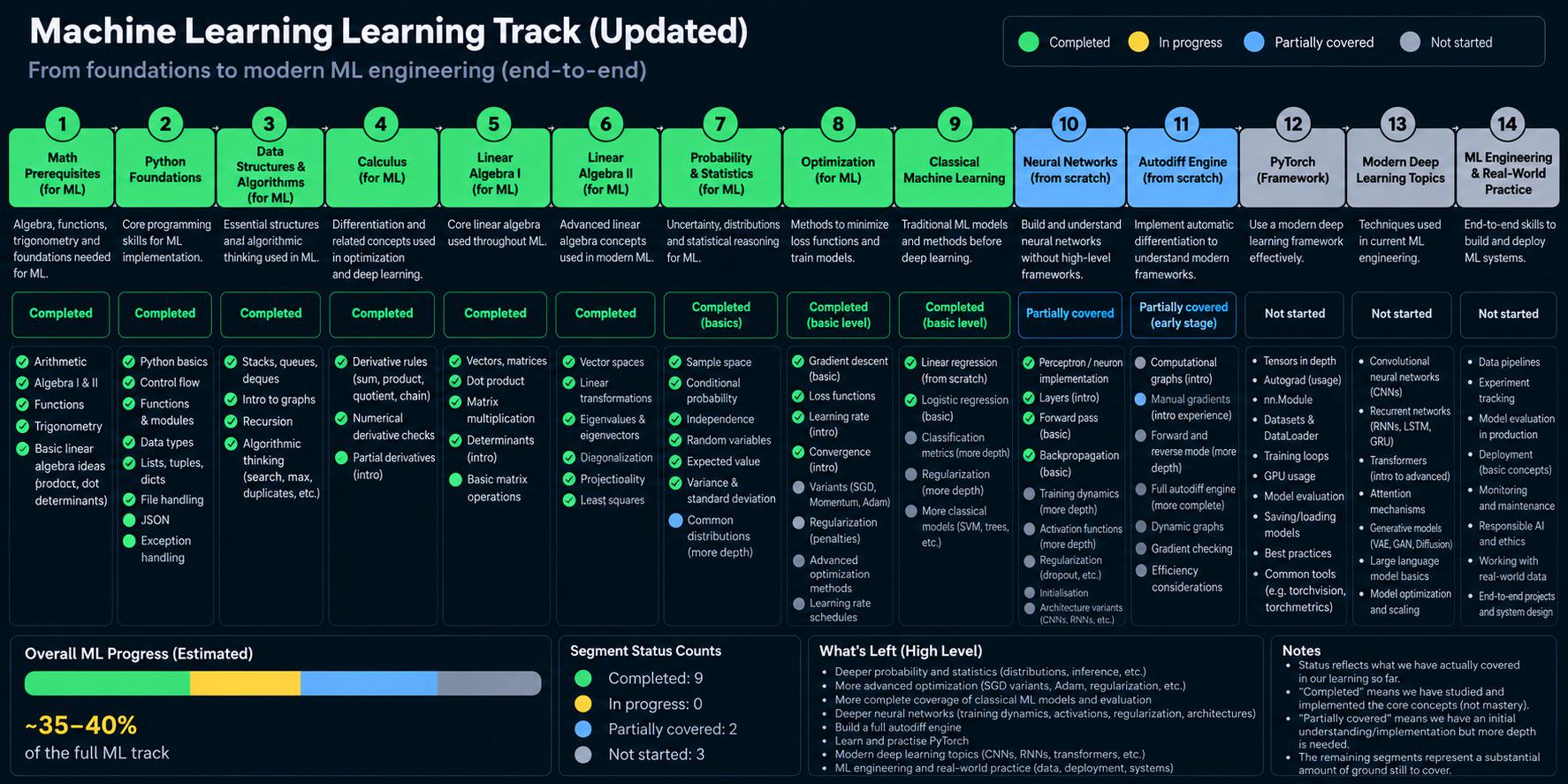
Discussion My self study progress bar so far

Post image
318 Upvotes

Of course my actual curriculum is a lot more in-depth.

Since ML topic start my progress has taken a hit, I am practically crawling but I am still happy not calling it quits and moving forward little by little everyday.


r/learnmachinelearning • • 27d ago

vprojectx/Lewis-44M-Bert-V3 · Hugging Face

Thumbnail
huggingface.co
1 Upvotes

I trained a BERT-style language model from scratch on ONE laptop GPU.

Lewis-44M-Bert-V3: small, fast, open source (Apache-2.0).

HOW IT WAS BUILT

• 44M parameters, ELECTRA-style pre-training

• 2.7B tokens in ~22 hours on a single RTX 5050 (8 GB)

• ~53 GPU-hours across all three versions, no cloud cluster

• Data: FineWeb-Edu, Wikipedia, Project Gutenberg, news, Cosmopedia and ELI5-style Q&A

v1 → V3 (SAME SIZE)

GLUE dev average: 75.0 → 80.5

Improvements: a better training objective (V3 was trained from scratch, not fine-tuned from v1) and a better fine-tuning recipe, with no extra parameters.

V3 RESULTS

• GLUE: 80.5 dev | 77.6 on the official test server (8 tasks)

• SQuAD v1.1: 75.2 EM / 83.8 F1

• NER (CoNLL-2003): 87.8 test F1

• Speed: ~17 ms per sentence on GPU, under 600 MB memory

I share both dev and test scores, plus the exact settings, because a model card should be honest.

Built for classification, question answering, entity extraction and on-device use: it fine-tunes on a laptop and runs on CPU.

This is part of vprojectx, my open-source lab, where I build and share my projects in the open. Find the model on Hugging Face as vprojectx/Lewis-44M-Bert-V3.

More is coming. If you want to try it on your use case or collaborate, message me.

#MachineLearning #NLP #AI #OpenSource #HuggingFace


r/learnmachinelearning • • 27d ago

Ollada: open diffusion models, locally, with numbers you can trust

Thumbnail reddit.com
1 Upvotes

r/learnmachinelearning • • 27d ago

HiveMind The Citizen Supercomputer - Decentralized AI Swarm over Consumer GPUs

Thumbnail
youtube.com
1 Upvotes

Do you remember SETI@Home : Imagine a decentralized MoE AI Swarm over Consumer GPUs - Let's build together HiveMind@Home. It is free ... 0 dollars and open source.

Project HiveMind is an open-source distributed training and inference framework (think SETI@home / Folding@home meets Petals and DiLoCo) designed to aggregate idle consumer gaming GPUs (8 GB–12 GB VRAM) and local NVMe storage into a community-owned Sparse Mixture-of-Experts (MoE) cluster.

https://hivemind-at-home-ruche-cfhmhmvv5a-uc.a.run.app/

Instead of requiring datacenter InfiniBand, each node trains specialized 4-bit NF4 QLoRA domain experts asynchronously using DiLoCo from deepMind (500x lower bandwidth cf https://deepmind.google/blog/decoupled-diloco/), merges them into a unified Branch-Train-Mix (BTM) Sparse MoE, and serves the resulting model back to the community via P2P Speculative Decoding. Contributors earn verifiable Proof-of-Useful-Work (PoUW) credits ($HIVE) when their GPU/disk is idle and spend them when they need frontier-class MoE inference.

To join https://hivemind-openrouter-1003063861791.us-central1.run.app/join#train

To join witou installation and play a scientific game:

https://xaviercallens.github.io/HiveMindatHome.github.io/webgpu.html

Join us to learn and build the new generation of AI


r/learnmachinelearning • • 27d ago

Last year Made a Full Stack project "DUKANMATE" , for the local shopkeepers, deployed on Product Hunt and got some good responses!!!For those who want to explore it:

Thumbnail producthunt.com
1 Upvotes

Try it here.


r/learnmachinelearning • • 27d ago

Train modeling through cloud or own device ?

1 Upvotes

Hello guys I am a learner too and I am asking do you guys train models using own device cpu/gpu or cloud like Google collab?

Actually I am going to buy a laptop so asking with you guys ☺️

You can suggest laptops too !

I am wondering should I get laptop with a graphic card (rtx) or not 🤔

Thank you !