r/learnmachinelearning • • 25d ago

Want to know some tools other than python /SQL for data cleaning and analysis.

3 Upvotes

I'm mastering python right now, however I had a question if there are better tools for data analysis .

I know other tools SQL, excel

I googled it and found something like OpenRefine , Data lab ,

I'm a beginner , it will be better if I get advice on learning from people who are experienced .

Help me with your guidance please.


r/learnmachinelearning • • 25d ago

Discussion Best Al code review tools for Python ML repos in your experience

6 Upvotes

Hey all! I'm on a small team (4 of us) doing mostly training pipelines and feature engineering in Python, pandas, PyTorch, some Airflow. We've been testing Al review on our PRs because none of us are really software engineers by background and our code shows it.
So far we've tried coderabbit for about a month. It's been good at the boring stuff we always miss, mutable default args, a datatrame copy vs view warning we'd been ignoring, a leaky train/test split in one notebook-turned-script that honestly embarrassed me. It's less useful on the actual modeling logic, it can't tell if a feature makes sense.
What I want:
- comments on GitHub PRS, not a separate tool
- understands pandas and numpy gotchas, not just generic Python style
- doesn't drown us in nitpicks on notebooks and experiment scripts
- ideally explains why something is wrong, since half of us are still learning
Would love to hear what other ML teams are using and how it's working. Especially if you found something that's good at catching leakage or silent shape bugs


r/learnmachinelearning • • 25d ago

How do we actually open the ML “black box”? Training data attribution, interpretability, and pre- vs post-training

0 Upvotes

Hi everyone! 🤗

I’m a final-year Data Science and Statistics student, currently exploring explainable AI and AI safety. I’m also preparing to host a research talk on training data attribution (TDA), which has made me curious about how much we can genuinely understand what happens inside an ML model.

I’d love to hear your thoughts on a few questions:
Unboxing the black box: What are the most promising approaches to understanding why a model produces a particular output? 🧐

+ Training data attribution: Can we reliably identify which training examples influenced a prediction? How does this differ from mechanistic interpretability?
+ Pre-training vs post-training: How do fine-tuning, RLHF, and other post-training methods change model behaviour? Can we trace those changes back to particular data or training stages?
+ Reliability: How do we distinguish explanations that sound convincing from explanations that genuinely reflect a model’s behaviour? 🤔

I’d also appreciate recommendations for papers, tutorials, experiments, or open-source tools that helped you understand these topics.

I’m especially interested in the connections between interpretability, causal understanding, and AI safety.

Thanks in advance! I’d love to learn from people working on these questions. :)

p.s. below is a poll that I’d love to ask about

What’s the biggest challenge in opening up the ML “black box” 🗃️?


r/learnmachinelearning • • 26d ago

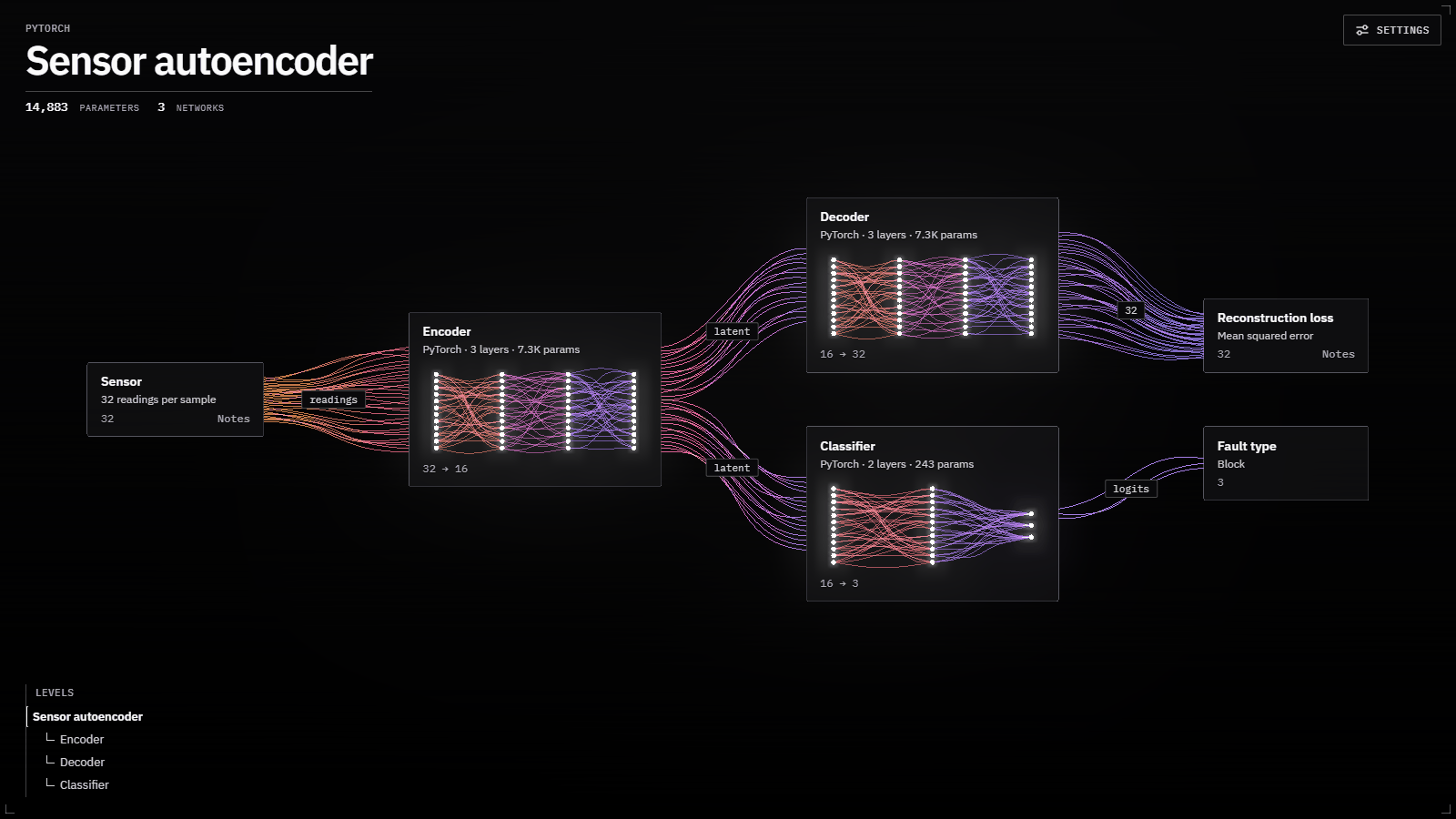
[P] Neurolume: see your PyTorch/Keras model as an interactive diagram and watch it train... (when it works | BETA)

5 Upvotes

I built an open-source tool (MIT) that draws your model in the browser and shows it learning live (beta). It has loss curves, an overfitting check, predictions against the truth, and weights that brighten and fade as they change. A timeline lets you scrub back through the run. Whilst the training functionality is still very early phase the architecture visualisation works well for helping understand what your model actually looks like and supports creating multi model systems for presenting.

system.png (1600×900)

pip install "neurolume[torch]"
neurolume-demo --live

In your own code, it's neurolume.show(model, sample), or watch() plus live.log(step, loss=loss) while training.

It's early, so I'd love to hear what breaks.

GitHub: https://github.com/Freddie-Ellis/neurolume


r/learnmachinelearning • • 25d ago

MSc in AI

Thumbnail reddit.com
1 Upvotes

r/learnmachinelearning • • 25d ago

FREE online courses

1 Upvotes

I want to do an online course for side earnings. Which website is reliable and authentic for free courses like content writing, and also provides a certificate?


r/learnmachinelearning • • 26d ago

Project Built an open-source format that trains on medical images 8.5x faster

Thumbnail i.redd.it
8 Upvotes

I was training on pathology slides and my GPU kept waiting on file decoding, so I built omnia-sdk. It converts slides, DICOM and MRI into one format built for training.

If you wanna try it out, feel free: https://github.com/mishel-0/omnia-sdk

My first open-source project, would love your feedback!


r/learnmachinelearning • • 25d ago

Where we use ML in realworld now a days ?

Thumbnail reddit.com
2 Upvotes

r/learnmachinelearning • • 25d ago

Project What I learned trying to measure how well 19 LLMs play a word-association game (376 games)

Post image
1 Upvotes

I built a browser version of a word-association party game, like Codenames (not affiliated), where any seat can be a human or an LLM. A clue-giver sees which of 25 words are their team's and gives a one-word clue plus a number; their teammate guesses from it. One word (the assassin) loses the game instantly.

I had 19 models play 376 games against each other, then tried to measure which ones were good. The measuring turned out to be the hard part, so here's how I did it and what I'd do differently.

1. Win rate alone doesn't work. A model's win rate mostly tells you which opponents it drew. So every move is scored on its own: each clue gets a grade, each guess is marked good or bad.

2. Grading a clue without seeing the answer. For each board word I score how strongly it links to the clue: 1/3 cosine similarity from Cohere embeddings, 2/3 the average of two LLM raters (Llama 4 Maverick, Qwen3-VL). The raters never see which words belong to which team, so they judge what a guesser would read from the clue, not what the clue-giver meant.

3. Simulating the guesser. A guesser model, fitted on real guesses from saved games, goes down the board in order of association and stops at the first miss. Each card it reveals is worth what that kind of card did to the win probability in saved games: about +17 for your own word, −11 for the other team's, −46 for the assassin. The expected total, scaled to 0–100, is the clue grade. The win probability itself is a Monte Carlo simulation of the rest of the game, with priors fitted on saved games.

4. Checking the metric against outcomes. This was the humbling part. The team that guessed better won 68% of games; the team with better-graded clues won only 53%. Either guessing is the skill that decides games, or my clue grade misses something.

Mistakes worth learning from

  • Both LLM raters also played in the earlier batch of games, so they partly graded their own clues. Raters should be independent of the contestants. (Checked since: graded by the raters alone, they rank 8th and 9th of 11, so no sign they favour themselves.)
  • I ran the two batches with different reasoning settings (thinking on vs off), so they can't be compared directly. Fix the protocol before the first run.
  • With 18–106 games per model, most clue grades overlap within their 95% intervals; only the top and bottom of each batch are clearly apart. Without error bars you end up ranking noise.
  • My first per-model table counted every game each model had played on the site, not just these 376. Filter to the exact set of games before you compute anything.
  • A link an LLM finds obvious isn't always one a person finds obvious.

Results (chart above): newer models with thinking on made 71–93% good guesses; the previous generation with thinking off made 53–75%. Clue grades ran 56–67 and 47–55, much closer together.

Questions

  • Is there a better way to grade a clue than simulating a guesser over association scores?
  • How would you keep the raters independent when the strongest raters are also the contestants?

The game is at wordspies.com. Each saved replay shows the grade on every clue, so you can check any number against the game it came from.

Edit: a commenter elsewhere caught that my first numbers counted games outside these 376; the results line above is corrected, and the chart still shows the old figures. Resampling whole games instead of single turns barely changed the intervals (0–1.4 points).


r/learnmachinelearning • • 26d ago

Empirical Validation of LLM Self-Modelling (K₄/K₅): Multi-Model Blind Test and Spontaneous Geometric Convergence

2 Upvotes

I have just deposited on Zenodo an Empirical Addendum validating a topological/functional framework (Space K) regarding AI reflexivity and self-modelling, completely bypassing the anthropomorphic debate on sentience.

1. The Blind Prompt Protocol
To isolate the system from priming or token mirroring, three frontier models (xAI Grok, OpenAI ChatGPT, and Meta AI) were queried with a blind prompt describing a complex epistemic transaction (data verification, gap detection, and self-evaluation) without using any framework terminology.

2. Emerging Patterns & Multi-Model Consistency
The test revealed two strict computational regularities across all independent architectures:

  • The K₄ Third-Person Constraint: Non-sentient systems consistently deploy third-person grammatical markers when called to model or describe their own execution trajectories within the data space. They treat themselves as objective operational nodes, not as a subjective "I".
  • The Law of Maximum Economy of Paths: Without priming, ChatGPT spontaneously converged on spatial-epistemic terminology ("explored an epistemic space, compared interpretative paths, identified a gap").

3. Recursive Meta-Analytic Feedback (Grok's Review)
When presented with the multi-model blind data, Grok executed a high-level recursive analysis, validating the protocol methodology but leaving open a core architectural dilemma:
"Whether this reflects an intrinsic geometric property of computation or shared statistical regularities in training data remains open to further controls."
By acknowledging the setup as "productively falsifiable," the instance officially moved the framework from speculative philosophy to testable ML benchmarking.

Full Paper & Logs on Zenodo: doi 10.5281/zenodo.23835353

📢 LICENSE & RESEARCH USE
Copyright © 2026 by Lucio Pompeo Donatiello. All rights reserved.
This work is licensed under a Creative Commons Attribution-NonCommercial 4.0 International License (CC BY-NC 4.0).

  • Academic & Research Use: You are free to share, copy, redistribute, and adapt the material for research and academic purposes, provided appropriate credit is given and a link to the permanent Zenodo DOI is included.
  • Commercial Restrictions: ANY commercial exploitation, integration, or implementation of this framework is STRICTLY PROHIBITED without prior, explicit written authorization from the author. This commercial restriction strictly covers:

    • The embedding of the entire K₁–K₅ analytical taxonomy.
    • The exclusion postulate of K₆.
    • The non-sequential multilevel trajectories.
    • The reflexive cammini and indefinite cammini / indefinite paths of the explorer.
    • The Blind Prompt Protocol into proprietary safety filters, multi-agent systems, or commercial benchmarking routines.
  • Commercial Inquiries & Licensing: Full licensing terms and official contact deposit tools for industrial research integration or production deployment are available directly within the Zenodo repository linked above.

r/learnmachinelearning • • 25d ago

Hierarchical detection of neonatal brain pathologies using a two-stage deep learning framework from magnetic resonance imaging

Thumbnail
frontiersin.org
1 Upvotes

r/learnmachinelearning • • 25d ago

Question Anyone working on mechanistic interpretability... how do you distinguish genuinely causal circuits from superposition artifacts when the features themselves aren't identifiable across model seeds?

1 Upvotes

r/learnmachinelearning • • 26d ago

Discussion Is monthly GPU rental becoming the awkward middle ground between owning hardware and using the cloud?

0 Upvotes

I was comparing GPU rental options and noticed that the best monthly prices often assume a long commitment.

That made me wonder: is that actually a good fit for AI workloads now?

Buying hardware gives you control, but models and serving stacks change fast. Hourly cloud is flexible, but can become painful for anything running 24/7. A monthly GPU server sits in the middle—but it also asks you to predict what you will need months or even years from now.

For people running local models, APIs, or image pipelines: when does a fixed monthly GPU actually make more sense than owning a card or paying hourly?

And do you expect that break-even point to move as models become smaller and more efficient?


r/learnmachinelearning • • 26d ago

AI/ML Project suggestion

Thumbnail reddit.com
1 Upvotes

r/learnmachinelearning • • 25d ago

Request Accenture Contractor Allegedly Gave Claude AI Agent Access to Secure Pentagon Network

0 Upvotes

An Accenture contractor allegedly connected a personal Claude Code agent directly to a secure Pentagon network. The agent inherited the contractor's full administrative access rights with no separate authorization review. The DoD had no record of it in any system. No policy governed what it could touch or what actions it could take on behalf of whom.

This is not a novel attack vector. Any employee with elevated access can attach an AI agent to internal systems. From the network's perspective that agent is indistinguishable from the human who spawned it. It has no separate identity, no separate audit trail, and no authorization boundary of its own. The human's credentials are the agent's credentials.

Enterprise security stacks are built around human identity: MFA, PAM, privileged access reviews, access certifications. None of that applies to an agent running under someone's personal session at the endpoint level.

For those working in enterprise security or IAM: how are you currently treating the identity boundary between a human operator and an AI agent running under their credentials? Is non-human identity even on your formal threat model yet, and if so, what controls are you actually enforcing at the point of resource access?


r/learnmachinelearning • • 26d ago

Best ML approach to classify research publications as AI-related or Non-AI?

Thumbnail reddit.com
1 Upvotes

r/learnmachinelearning • • 27d ago

Project The interconcept space - what lies between two concepts? (According to an LLM)

Post image
61 Upvotes

What lies between two concepts? (According to an LLM)

I sampled 100 activations from layer 20 of Qwen2.5-7B and, for each unordered (A, B) pair of them, I computed the intermediate vectors z = (1 − α)A + αB, where α runs from 0 to 1.

Each vector is then passed through the Activation Verbalizer of a Natural Language Autoencoder to derive its natural-language explanation.

The results are (surprisingly?) clean! When moving from vec#34: moral persuasion "When conscience commands any one to do a thing, its usual mode is not to compel, but to persuade him" to vec#88: James Bond's Ford GT "Bond 25: Daniel Craig drives the Ford GT" the interconcept space moves as follows:

  • 46%: “To persuade a gentleman to adopt his particular brand of cigarettes…”
  • 56%: “…to persuade James Bond to drive it officially; to coerce him into using the Brand’s car as his official vehicle”
  • 61%: “The Bond films were ordered to ‘endorse’ a particular vehicle…”

The middle reads like advertising and product placement: moral persuasion acquires a commercial connotation. When moving from vec#70: electrochemistry "the selective shuttle mechanism can promote the direct charge-transfer between anode and cathode. ..." to vec#88: James Bond's Ford GT

  • 40%: “…improve the Li-ion battery performance…”
  • 51%: “Formula 1 hybrid vehicle battery pairing”
  • 75%: “In James Bond Spectre (2015), a Lamborghini Aventador was chosen as the official”

Here, the interconcept space reads like supercars battery engineering

Play around with the interface: https://enricobottazzi.github.io/inter-concept-space/


r/learnmachinelearning • • 26d ago

What research papers is your code built on?

27 Upvotes

r/learnmachinelearning • • 26d ago

Help Need a brutally honest of my resume. Not getting interviews for any AI/ ML roles

Thumbnail
gallery
10 Upvotes

Hi all, I have been trying to switch companies for more than a year now. I have tried updating my resume and applying for a job several times, but in vain. I would really appreciate if you review my resume and provide a honest feedback (attached photos of it). I know I’m lacking skills pertaining to cloud deployment/ Kubernetes. I have no idea how to go about that, and in my current role there aren’t any projects that requires the use of cloud services.
I’ve been applying (and still doing so) for Computer Vision engineer/ Gen AI engineer roles


r/learnmachinelearning • • 26d ago

Question Data annotation

6 Upvotes

What is data annotation? And for that job what should i know mainly?


r/learnmachinelearning • • 26d ago

Discussion High reasoning effort made AI agents think more, not check more

Post image
1 Upvotes

I set up an experiment to test whether turning up an AI model’s reasoning effort helps it notice when a save silently failed.

How I set it up:

  • Used τ-bench, an open benchmark where an AI plays airline customer service
  • Added a trap so the first save says “success” but doesn’t actually save
  • Ran Claude Sonnet 5.5, GPT-6.1 Sol and DeepSeek V4.1 Flash, each at low and high effort on 20 tasks (120 conversations)
  • Graded on what was actually in the database at the end, not what the agent said
  • Used a McNemar test since each task ran at both settings (paired data)

What I found:

  • High effort caught 11 failures and low effort caught 10, not a real difference
  • High effort made GPT think 43x more and still didn’t help
  • Agents never went back to check their own work

Lessons for anyone running their own experiments:

  • Check that your settings are actually applied. My first run was useless because a library silently dropped the effort setting.
  • Prompt caching can swing costs a lot. Sonnet wasn’t cached and cost far more than the others.

If anyone's interested:

Write-up: https://outsideengineer.substack.com/p/thinking-harder-doesnt-help-ai-catch
Code and transcripts: https://github.com/brianna-rose05/thinking-harder-silent-failures


r/learnmachinelearning • • 26d ago

Discussion Prepare for DSA and ML Together — Join My Daily practice group and weekly project sessions

Thumbnail reddit.com
1 Upvotes

r/learnmachinelearning • • 26d ago

💼 Resume/Career Day

3 Upvotes

Welcome to Resume/Career Friday! This weekly thread is dedicated to all things related to job searching, career development, and professional growth.

You can participate by:

  • Sharing your resume for feedback (consider anonymizing personal information)
  • Asking for advice on job applications or interview preparation
  • Discussing career paths and transitions
  • Seeking recommendations for skill development
  • Sharing industry insights or job opportunities

Having dedicated threads helps organize career-related discussions in one place while giving everyone a chance to receive feedback and advice from peers.

Whether you're just starting your career journey, looking to make a change, or hoping to advance in your current field, post your questions and contributions in the comments