r/learnmachinelearning • u/Independent-Ad1984 • 6d ago
My colleague says Europeans don't care about AI, even in manufacturing. Is that true
reddit.com
0
Upvotes
r/learnmachinelearning • u/dice299 • 6d ago
r/learnmachinelearning • u/Gege-max • 6d ago
r/learnmachinelearning • u/FishermanResident349 • 6d ago

BlueprintML: https://github.com/AbhinandanMandal/BlueprintML
Discord: https://discord.gg/RR5XhNhH4
r/learnmachinelearning • u/Strict-Purple-2250 • 7d ago
Hi All
I am from non-tech background, don't have any background in coding etc. But I need and want to learn about AI, models, and all concepts in detail. I need to know this to be productive in job and clear interviews in product company. For example, in one of my interview with FANG for non-tech role, recruiter asked me about what is precision, recall value, how would you evaluate AI model etc. I gave my answers but got rejected.
In other interviews also, this has happened.
Then I decided to pursue Machine learning course from Google. Here: https://developers.google.com/machine-learning/intro-to-ml
I would love to read a book on this, please suggest some good books. I tried exploring AI Engineering by Chip Huyen. But then I saw comments in Reddit that it is for ML experience people, not for beginners. So, decided not to read this book.
Please suggest some good books.
r/learnmachinelearning • u/No-Conclusion3720 • 6d ago
CVE-2026-102895, an authentication bypass in GPUStack, was added to CISA's Known Exploited Vulnerabilities catalog this week. An unauthenticated attacker can access AI GPU infrastructure with zero credentials. GPU orchestration layers handle model execution routing for the entire enterprise AI stack. Gaining access there lets an attacker hijack model execution, redirect inference traffic, and exfiltrate outputs before any application-layer control sees the request. The no-credentials-required nature of the exploit also kills credential-based detection. This surfaces a structural gap most organizations haven't addressed: AI agents and service accounts running on that GPU infrastructure carry no cryptographic identity under most enterprise security frameworks. They operate as trusted by default simply because they're running inside the perimeter. When the perimeter breaks — which CVE-2026-102895 demonstrates it can — there's nothing left to verify who or what is making a request to the model. For teams running production AI workloads on GPU clusters: how are you handling identity verification for the non-human callers on that infrastructure? Are you relying on network segmentation, service mesh mTLS, something at the orchestration layer, or something else entirely?
r/learnmachinelearning • u/Logical_Respect_2381 • 6d ago
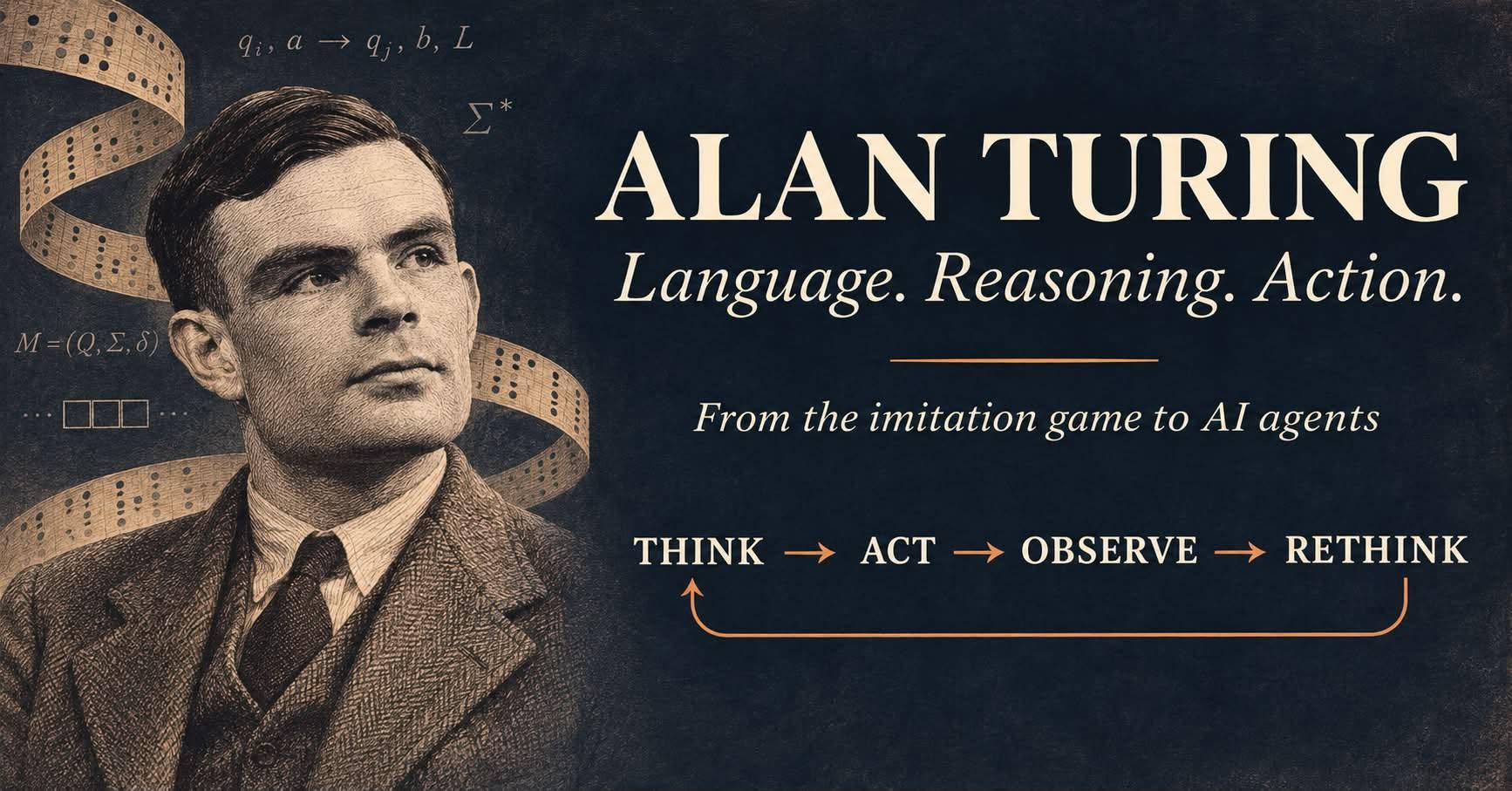
In 1950, Alan Turing proposed a remarkable idea: judge a machine’s intelligence through conversation. Could a human question it through text and fail to distinguish it from another human?
More than seventy years later, I think we are discovering how profound that idea was.
Producing humanlike text has enabled something far beyond convincing conversation. A machine can use language to work through a problem, formulate a plan, write code, call a tool, examine the result, revise its approach, and act again.
Think. Act. Observe. Reconsider. Act again.
Text became more than an answer on a screen. It became a medium for organizing reasoning and directing action.
That is why I see Turing’s test as capturing something fundamental about the path toward artificial general intelligence. Fluent conversation alone does not prove AGI, but the capabilities built around language suggest that Turing’s choice was far more insightful than it might once have appeared.
As we set new targets—greater autonomy, harder tasks, and action in the physical world—we should remember the significance of the milestone we are crossing.
Turing did not predict transformers or today’s AI agents. But he recognized, decades before these systems existed, that conversation could reveal something essential about machine intelligence.
The man whose universal Turing machine helped lay the theoretical foundations of modern computing also helped frame the central question of artificial intelligence.
To me, Alan Turing deserves to be remembered as a father of both computing and AI.
r/learnmachinelearning • u/company_url_finder • 6d ago
r/learnmachinelearning • u/AutoModerator • 6d ago
Welcome to ELI5 (Explain Like I'm 5) Wednesday! This weekly thread is dedicated to breaking down complex technical concepts into simple, understandable explanations.
You can participate in two ways:
When explaining concepts, try to use analogies, simple language, and avoid unnecessary jargon. The goal is clarity, not oversimplification.
When asking questions, feel free to specify your current level of understanding to get a more tailored explanation.
What would you like explained today? Post in the comments below!
r/learnmachinelearning • u/MajesticPuzzler • 7d ago
SenseNova Loop 9B just came out of preview. It's a 9B looped transformer with 512K context. From preview to release, GAIA went from 37.86 to 69.90 and AutomationBench from 14.33 to 36.67, and they say it competes with Qwen3.8-27B on selected benchmarks.
As I understand it, looping means running the same layers multiple times instead of stacking more layers. So you get more compute per token without more parameters.
Is that the right mental model? And is the jump mostly from looping, or from better training between preview and release? Would like to hear from anyone who has read the details.
r/learnmachinelearning • u/Ok_pettech • 7d ago
r/learnmachinelearning • u/Neurosymbolic • 6d ago

r/learnmachinelearning • u/parmar_jsar_007 • 7d ago
Hey! I'm looking for someone who's interested in learning Python together, especially exploring AI, training small machine learning models, experimenting with datasets, and building interesting projects. I'm still learning, so it'd be great to find someone who's also curious about this stuff. We can share resources, solve problems, experiment with ideas and learn by building things together. Doesn't matter if you're a beginner or intermediate, just looking for a fellow enthusiast!
r/learnmachinelearning • u/kamesh_singh • 7d ago
I'm trying to build a golf ball tracking app similar to Shot Tracer and SmoothSwing. I've experimented with several open-source AI models, but I haven't been able to achieve reliable tracking accuracy.
The ball is tiny and moves very fast, making it difficult to track consistently across video frames.
I'm looking for advice from people experienced in computer vision, object tracking or ML:
I'm not looking for a basic YOLO implementation. I'd like to understand how to build a genuinely reliable tracking pipeline.
Any suggestions or experiences would be appreciated!
r/learnmachinelearning • u/OkBranch088 • 7d ago

The speaker-similarity result goes up from 0.714 to 0.798 between Ming-3.0-tts-0.5B and Ming-3.0-tts-tiny in this reported comparison. Those are mean CAM++ scores over four lines. The reference voice, comparison texts and seed 1895 were matched, with both AntLing models tested in bf16 on an RTX 3090 24 GB.
The speed chart adds another dimension. For the French, happy and slow readings, the 0.5B model generates about 2.1×, 2.2× and 1.9× real time; Tiny records 0.78×, 0.75× and 0.81×. Here the multiplier means audio duration divided by generation time.
Both models passed the run's word-transcription checks. Speaker resemblance, text accuracy and generation speed therefore remain separately visible in the comparison. The attached charts preserve the setup, scores and resource readings together, making this a useful format for a small, controlled voice-model audition.
r/learnmachinelearning • u/Convincing_Convo • 7d ago

Diffusion takes a curvy path from noise to data, so it needs many tiny steps. Flow matching learns straighter paths, so a few big steps get you there.
I made a detailed visual explainer of it.
What confused you most about flow matching?
r/learnmachinelearning • u/Electronic_Cut_9596 • 7d ago
So I am choosing my major and I am really interested in math and machine learning however I am also interested in hardware and chips. Hence I want to keep both doors open, I imagine that if I did a math/cs major I wouldn't be able to do much in terms of hardware, but was wondering if EE or CE is still viable for a machine learning career. I am also wondering if there are specific niches/fields that combine both sides.
r/learnmachinelearning • u/nivokvo • 7d ago
I'm a second-year math student, and since October an agent has been applying to jobs for me. Claude Opus gives every posting a fit score from 0 to 10. After 160 applications, 121 had a known outcome and 15 of those were invitations, so I checked how well the score predicts an invitation.
Opus gets an AUC of 0.48, slightly worse than a coin flip. As far as I can tell it measures whether I'd like the job, and employers decide on something else.
A logistic regression on about twenty hand-made features (junior in the title, years of experience asked, role type, part-time, how automatable the work looks, how fresh the posting is) gets around 0.67 in cross-validation. Most of that comes from starting weights I set by hand before I had data, so I don't fully trust it either.
With 15 positives one new invitation moves the number a lot. Two engineering roles that the model had ranked lowest replied, and the score fell from about 0.70 to 0.51 in a day. Splitting by time (train on older applications, test on newer ones) also gives clearly worse numbers than random cross-validation.
There's a feedback problem too. If the model decides where to apply, it stops seeing the cases that would prove it wrong. So it samples: the higher the predicted chance, the more often it applies, but low ones still get a try now and then.
Code: github.com/nivokvo/job-watch-cloud (cloud_apply/model.py) Live numbers: nivokvo.github.io/job-agent
How would you evaluate a model with this few positives? Bootstrap intervals, or is there something better?
r/learnmachinelearning • u/nian2326076 • 7d ago
If you focused on learning AI engineering this year (harness engineering, AI workflows, building agents that run autonomously, self-improving PR reviewer…) and delivered tangible value to your company, which resources did you use?
If you're learning this for interviews too, PracHub has an exercise where you debug a Python ticket-booking app with an AI assistant.
Any books/courses or did you just learn by building and experimenting?
r/learnmachinelearning • u/One-Camp-5484 • 7d ago
Hi everyone!
I'm currently taking a Machine Learning course at university, and my professor offers extra credit to students who earn a relevant machine learning certificate.
I'm wondering if there are any websites or MOOCs that provide free courses with free certificates upon completion.
I've come across some courses on Coursera, but unfortunately, I can't afford to pay $20 or more for a certificate right now. I'm specifically looking for options where I don't have to pay anything, including for the certificate.
I'd appreciate any recommendations, especially beginner-to-intermediate machine learning courses.
Thanks in advance!
r/learnmachinelearning • u/mehdiweb • 6d ago
i got a Claude max account from a reseller for essentially nothing compared to what I used to pay . It works flawless. since 3 months No issues yet i paid only for 1 month . Now I can't stop thinking about their business model. If resellers can sell it this cheap and still profit, how are they acquiring these accounts at scale?
r/learnmachinelearning • u/Cupcake_Timely • 6d ago
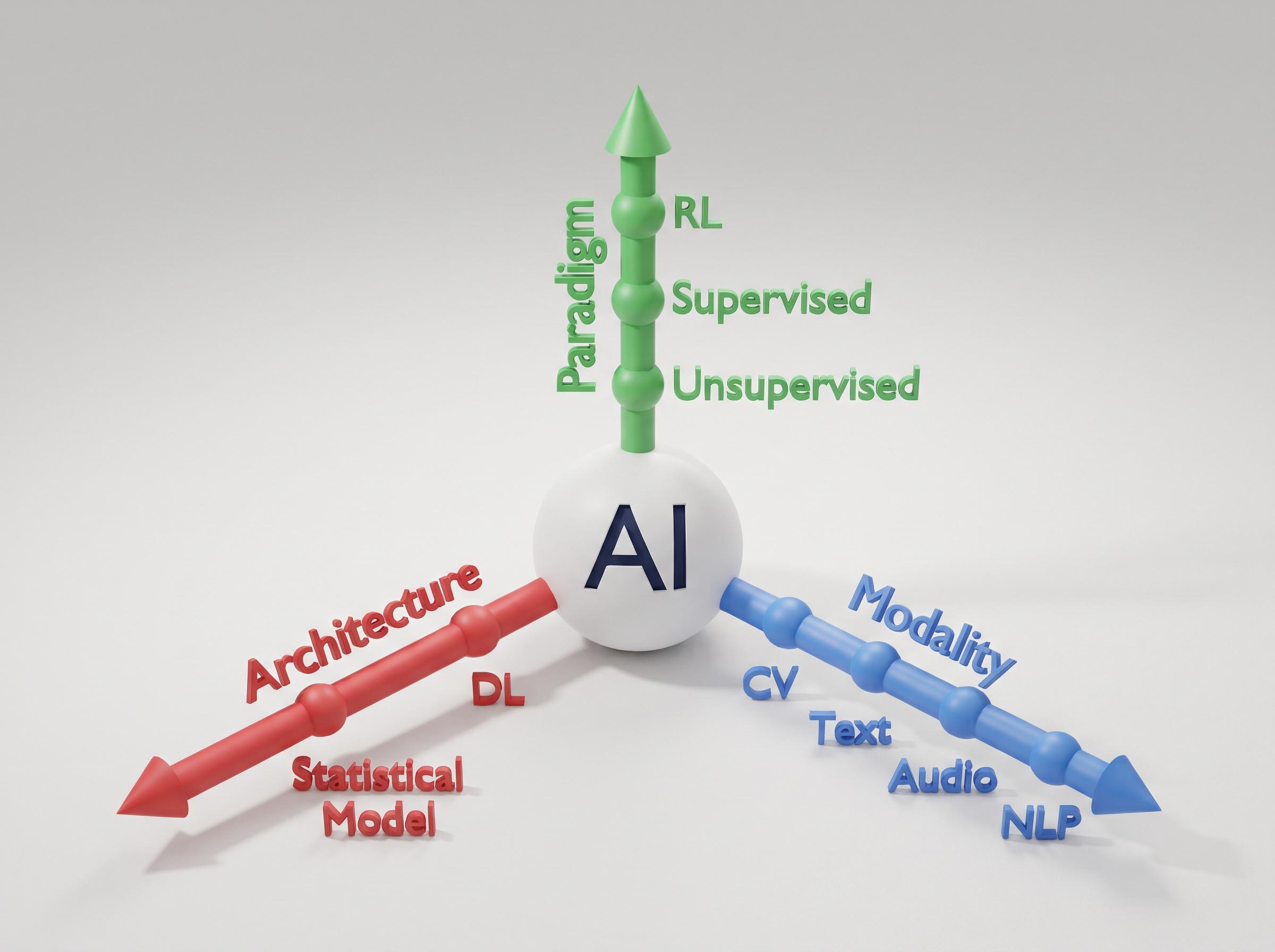
I am a beginner who just started learning about ML fundamentals, and what confused me the most at first was all the different terms thrown around interchangeably (ML, DL, RL, Computer Vision, LLMs, etc.).
I tried to figure out the differences between these terms and how they actually relate to one another, and I found a way to organize them that finally makes sense to me.
Think of "AI" as the center origin (0, 0, 0) of a 3D space—we can explain and classify almost any AI system along 3 dimensions:
Paradigm (How it learns): This defines the learning process and feedback loop.
Modality (What type of data it uses): This defines the data format going into (and coming out of) the system.
Architecture (What engine powers it): This defines the underlying mathematical structure used to process the data.
Examples of how real-world AI systems map onto these 3 dimensions:
-Large Language Models (e.g., ChatGPT):
-Game-Playing Bot (e.g., AlphaGo):
-Classic Email Spam Filter:
For those with more experience: does this mental model hold up ?
r/learnmachinelearning • u/MichaelRomeroJr1 • 7d ago

I made a small GPT-style Transformer and trained on a Kaggle dataset available on Github
And whether I train (the Kaggle dataset) locally (RTX 2060 Super) or cloud (T4 with Google Colab), the model generates recognizable words but struggles with sentence structure and following simple prompts (e.g., "Only output this sentence: The sky is blue").
What are the best ways to improve training and generation quality?
Am I expecting too much from roughly one hour of training, or is a functional tiny chatbot a realistic goal for this setup?
Maybe i'm measuring incorrectly, the gradient accumulation doesn't seem to get below 6.5 (not sure if that's better than a model with random token generation)?
Any insight would be appreciated.