r/learnmachinelearning • u/Cupcake_Timely • 6d ago
The 3 dimensions of an AI system
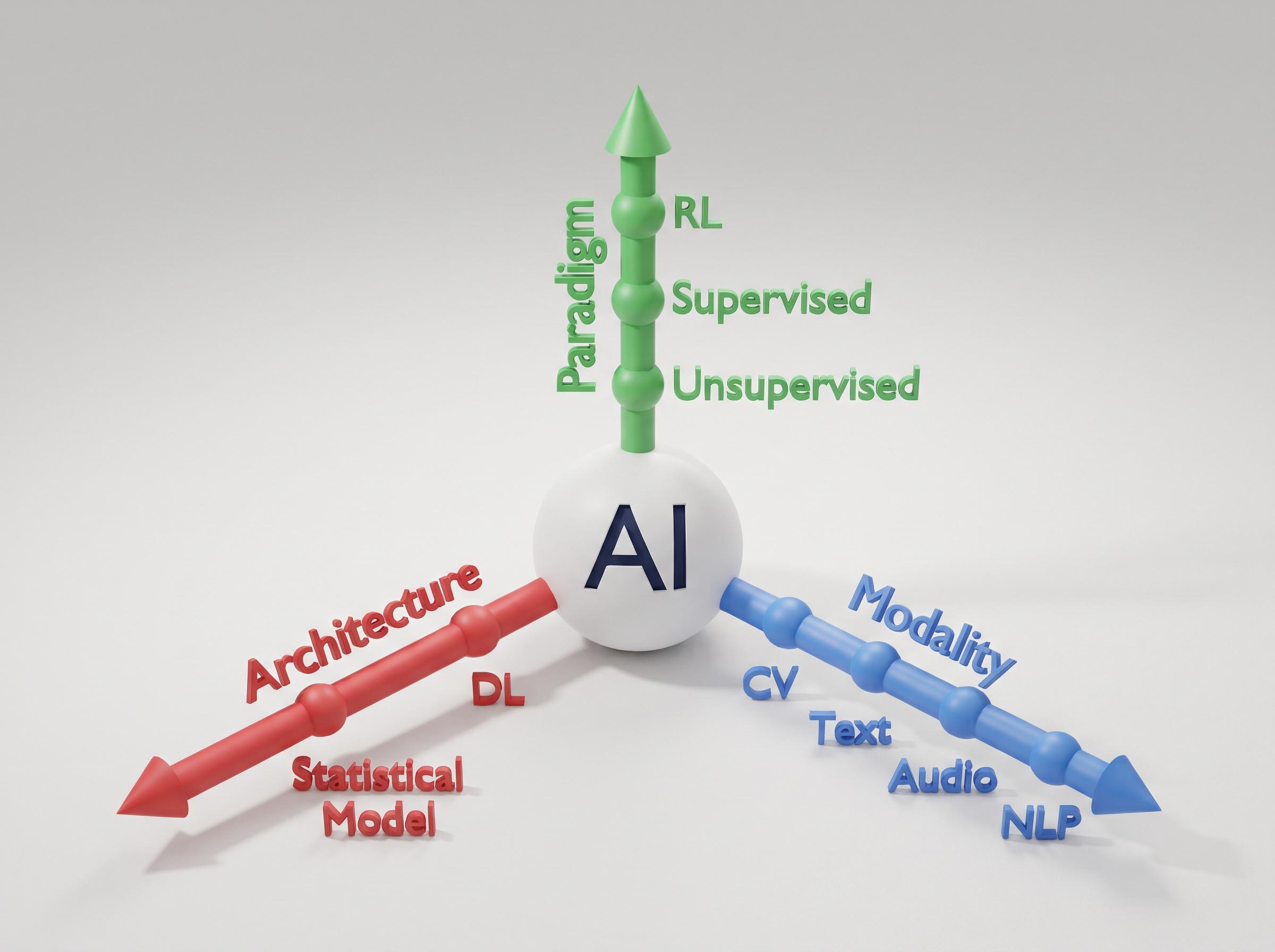
I am a beginner who just started learning about ML fundamentals, and what confused me the most at first was all the different terms thrown around interchangeably (ML, DL, RL, Computer Vision, LLMs, etc.).
I tried to figure out the differences between these terms and how they actually relate to one another, and I found a way to organize them that finally makes sense to me.
Think of "AI" as the center origin (0, 0, 0) of a 3D space—we can explain and classify almost any AI system along 3 dimensions:
Paradigm (How it learns): This defines the learning process and feedback loop.
- Supervised Learning: Learning from labeled examples (input + correct answer).
- Unsupervised Learning: Finding hidden patterns or predicting missing parts from unlabeled data.
- Reinforcement Learning (RL): Learning through trial and error by interacting with an environment and maximizing rewards.
Modality (What type of data it uses): This defines the data format going into (and coming out of) the system.
- Computer Vision (images/video)
- Text (NLP)
- Audio / Speech recognition
- Tabular data (spreadsheets)
- Time Series Data
- Multimodal (a mix of these)
Architecture (What engine powers it): This defines the underlying mathematical structure used to process the data.
- Classical Models: Algorithms like Linear Regression, Decision Trees, Random Forests, and SVMs.
- Deep Learning (DL): Multi-layered Artificial Neural Networks (like CNNs, RNNs, and Transformers)
Examples of how real-world AI systems map onto these 3 dimensions:
-Large Language Models (e.g., ChatGPT):
- Paradigm: Self-Supervised Learning (pre-training) + Reinforcement Learning (fine-tuning)
- Modality: Text (NLP)
- Architecture: Deep Learning (Transformer)
-Game-Playing Bot (e.g., AlphaGo):
- Paradigm: Reinforcement Learning
- Modality: Game Board State / Visual
- Architecture: Deep Learning
-Classic Email Spam Filter:
- Paradigm: Supervised Learning
- Modality: Text / Tabular features
- Architecture: Statistical Model (e.g., Naive Bayes or Logistic Regression)
For those with more experience: does this mental model hold up ?


