r/LocalAIStack • u/vcruz305 • Aug 15 '26
Qwen3.8-27B on a 2019 Quadro RTX 6000 24GB: 24.36 tok/s Q4, Q8 does not fit, ngram 110+ is a lie, tested Cloud API too 155 toks/s!
r/LocalAIStack • u/vcruz305 • Aug 15 '26
r/LocalAIStack • u/ElegantConnection737 • Aug 15 '26
Earlier I talked about the OQOAI-PBDR project, which allows you to combine idle GPUs on office workstations into a decentralized AI cluster, distributing requests between nodes and choosing the most optimal one.
This week, another update was released in which the OQOAI-PBDR orchestrator received cloud routing functionality.
Under the hood is a lightweight and open-source core based on literally 3 source files of ~1000 lines each, with compiled versions for Windows and Linux supporting Nvidia and AMD GPUs -the entire binary takes about 10 MB. It allows, taking into account dozens of parameters such as:
to make intelligent routing decisions.
Now new criteria have been added to this list:
The system automatically decides: send the request to the local GPU cluster or to one of 40+ cloud providers (OpenAI, Anthropic, Google, Azure, AWS, DeepSeek, Together AI, and others).
Everything works through a unified OpenAI-compatible API - your applications (Open WebUI, N8N, LangChain, LlamaIndex) require no changes.
An interesting detail: to calculate the cost of local generation, the system collects the power_max parameter from the GPU (maximum power consumption) and uses it to compute electricity costs. This allows real-time comparison: what is cheaper - running generation locally or sending the request to the cloud.
Test results:
More details about the research results can be found in the scientific publication on the PBDR v2.0 architecture:
http://doi.org/10.17513/doi.27
The project is completely open-source under the MIT license. Source code and documentation are available in the repository
https://github.com/oqo-ai/OQOAI-PBDR
Leave your questions and use cases in the comments — I'll be happy to discuss them!
r/LocalAIStack • u/Electrical_Emu_5854 • Aug 14 '26
If you're running Ollama, llama.cpp, or vLLM behind nginx or HAProxy for more than a single user, you've probably hit this: nginx treats a 10-token prompt and a 10k-token prompt as identical "one request" — it has zero concept of how much GPU memory a request will actually need. Under load, that means the KV-cache fills unevenly, latency spikes, and you can end up with OOM instead of graceful degradation.
I built TokenFlow Gateway to fix that at the proxy layer, specifically for local/self-hosted stacks:
- Pre-flight token estimation (js-tiktoken) before dispatch — request weight = prompt tokens + max_tokens
- KV-aware load balancing for vLLM — polls its Prometheus metrics (vllm:gpu_cache_usage_perc) and routes heavy prompts to whichever backend actually has room
- Works with Ollama too — since Ollama doesn't expose KV-cache metrics, it falls back to health checks plus its own in-flight token accounting (reserves each request's estimated weight until it completes)
- Admission queue instead of crashes — Redis-backed, priority-aware, configurable timeout when nothing fits
- Exact + semantic caching (hash + pgvector) so repeat and near-duplicate prompts never touch the GPU twice
- Per-API-key token-based rate limits (TPM/RPM), OpenAI-style, for your own hardware
It's OpenAI-API-compatible on both sides, so it drops in front of Ollama, llama.cpp server, vLLM, or TGI without any client changes.
No GPU needed to try it: docker compose up --build spins up the gateway, Redis, pgvector, and two mock backends that mimic the OpenAI API and vLLM-style metrics, plus a smoke script that fires a burst of concurrent long-context requests so you can watch it queue and balance instead of falling over.
Stack: TypeScript / Fastify / Redis / Postgres+pgvector. MIT licensed.
Repo: https://github.com/mosafariuk/TokenFlow-Gateway
Would love feedback from anyone running a multi-model or multi-user local setup — what does your current ingress/routing look like?
r/LocalAIStack • u/TgoAI • Aug 13 '26
Vpipe supports LLMs, VLMs, image/video generation, ASR, quantization, and multimodal pipelines, without relying on PyTorch/MLX for model execution. The runtime package itself is only \~25MB, and there’s a prebuilt Mac app if you just want to try it without compiling anything:
https://github.com/tgo-app-dev/vpipe/releases/download/v0.1.23/VpipeManager-0.1.23-with-ffmpeg.dmg
A recent milestone is MiniMax H3 video generation running on a 16GB base M5 MacBook Air (M4 works too).
On my 15” M5 Air 16GB:
960×544 · 124 frames· 6 DiT steps with Turbo Lora → \~13 min
GitHub:
https://github.com/tgo-app-dev/vpipe
Would love feedback from people working on local inference / Apple Silicon. And if you find it useful, a ⭐ would be greatly appreciated!
r/LocalAIStack • u/aEsp32TypeGuy • Aug 13 '26
This is my first post in this community I just wanted to see if anybody will help me in improving on my ternary accelerator card for 1.58 bit ai the links are here reply if your interested. (I am Really new to github so some ai was used in the making of the project for troubleshooting errors(plz dont hate me for that).
Project Links:==>https://github.com/riyanlord2026-dev/Ternary-158-asic
This is also my first github project.
r/LocalAIStack • u/vcruz305 • Aug 12 '26
r/LocalAIStack • u/Lirezh • Aug 11 '26
Glimmer 30B vs Qwen 3.6 27B. How do they differ, reason, answer?
With Glimmer 30B Meta has joined the game of open source AI again, and after quite underwhelming coding performances I though I'd give it a deeper test.
The test content is undisclosed here, making this less fun to read and replicate but that guarantees future models will not train from it.
Technology:
Qwen 27B is still unmatched in performance, Glimmer the first new contender.
What makes Qwen so special are two ingredients:
3.6 was specifically post-trained for agentic reasoning.
It uses a hybrid attention: a conventional global attention for 1/4 of the layers, the others are a mamba-like recurrent state linear attention with fixed size.
Glimmer 30B also is unusual, it does not have the same sophisticated recurrent/linear attention, but it uses a 3/4 sliding window attention and it compresses the attention dimension and projects it back to latent size - resulting in a significant deduction in compute and KV size for it's size.
Reasoning style:
Qwen 3.6 has a analytical reasoning style that typically runs in 3 phases, when not agentically used:
Intelligence:
I ran both models through my undisclosed AI reasoning tests, not part of any training data. Some of those reasoning tests are currently beyond frontier model capabilities or scratching their borders.
Models like GLM 4.7-Flash, Nemotron 3 Nano, GPT OSS, GPT-4 fail most of the tests below consistently.
Glimmer was ran with thinking set to Medium, when failing it was ran with Max
Agentic performance:
Here Qwen 27B appears to leave Glimmer in another league, I've not concluded my agentic tests of Glimmer 30B yet. From what I have seen Qwen codes significantly better. They do not compare.
My current results:
Glimmer is a surprisingly smart model, with a well designed architecture for local inference.
It is the first model in the sub 200B parameter class that is able to match Qwen 27B or even outclass it in some tasks.
Glimmer has a very good spatial sense
Glimmer tends to underthink where Qwen tends to overthink
For non coding tasks, Glimmer is a strong option. Faster than Qwen at similar memory footprint.
For coding tasks I'd not consider it, I'll follow up with a deeper test but from what I've seen it's not useful for most tasks.
r/LocalAIStack • u/ankijain21 • Aug 11 '26
Hi everyone,
We have been using cloud GPU from Nebius/Lambda for our training and inference use case. The cost of one H100/H200 is approx $3K per month.
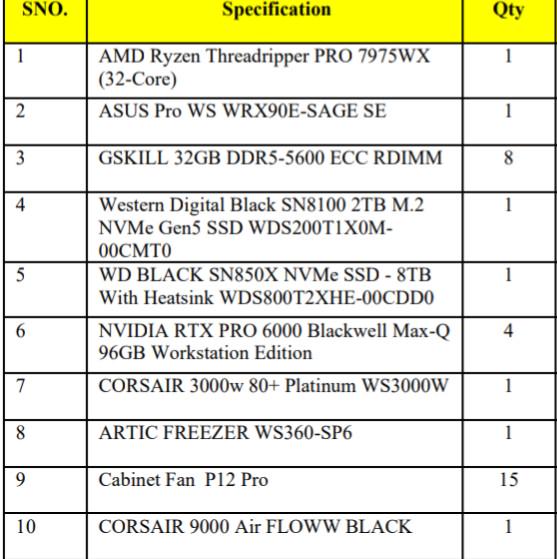
Now I'm planning to buy a large Desktop to run this locally. The specs are - 32 core CPU, 256GB RAM, 4x RTX Pro 6000 (96GB each), 1x2 TB NVMe, 1x 8TB NVMe. It is costing me ~$80K.
Here's what I need help in -
Keep in mind I already have another system for my dev workloads with 2x3060. Getting this one for production work for a client specifically.
r/LocalAIStack • u/mudler_it • Aug 08 '26
r/LocalAIStack • u/iamahmudul • Aug 07 '26
r/LocalAIStack • u/ElegantConnection737 • Aug 06 '26
We've all been there: $2,000 GPUs sitting at 5% utilization while the company pays for cloud inference.
Many organizations already have several workstations equipped with GPUs that remain idle most of the time. Existing GPU sharing solutions typically rely on a centralized scheduler, Kubernetes, or AI gateways, which can be excessive for small and medium-sized GPU clusters. In addition, most existing solutions lack cross-platform support, decentralized architecture, and policy-based routing.
OQOAI-PBDR to solve this problem differently. Simply run a server or client on each machine, and your existing office network becomes a decentralized AI cluster. Routing decisions are made entirely on the client side, eliminating the need for a master node, load balancer, or any other single point of failure.
Prebuilt binaries for Windows and Linux are under 10 MB and can bring a machine online as a cluster node in under 30 seconds. An optional admin server provides centralized monitoring and management from any machine on the network.
GitHub (MIT License):
https://github.com/oqo-ai/OQOAI-PBDR
The project intentionally avoids unnecessary abstractions. The core routing logic consists of only three source files (approximately 1,000 lines each), making it relatively easy to understand, audit, and extend.
At the heart of the project is the PBDR (Policy-Based Decentralized Routing) architecture. Each routing decision evaluates multiple runtime metrics, including GPU utilization, available VRAM, queue length, GPU temperature, network latency, inference throughput, and other node characteristics.
PBDR also supports client-group policies, allowing different workloads to optimize for different objectives. For example:
More details about the routing algorithm are available in the accompanying paper:
http://doi.org/10.17513/doi.26
One practical benefit of this approach is that organizations can often reuse existing workstation GPUs for low- and medium-throughput workloads-such as internal RAG systems-instead of deploying dedicated inference infrastructure from scratch.
In many environments, having GPUs installed in only 10-15% of workstations can be sufficient to satisfy inference demand for lightweight workloads (for example, an internal knowledge-base RAG receiving approximately 3-5 requests per user per day) without deploying centralized AI infrastructure.
Getting started:
Install OQOAI-PBDR on each machine.
Connect server nodes to any OpenAI-compatible inference backend, including Ollama, llama.cpp, vLLM, or TGI.
Configure your applications to use the OpenAI-compatible client endpoint provided by OQOAI-PBDR.
Clients automatically discover available models on all nodes. From the application’s perspective, the cluster behaves like a distributed OpenAI API compatible system, while user requests are routed in a decentralized manner to the most suitable node according to the chosen policy.
What already works:
Roadmap highlights:
We're actively looking for feedback, and testers.
What features or integrations would you like to see next?
r/LocalAIStack • u/Curious-Pen5547 • Aug 05 '26
r/LocalAIStack • u/Qubit_bit • Aug 04 '26
Recently the opencode tool is performing near the
cursor in auto mode, so I have to buy a small ai server
to run good coding agentic models from Qwen, GLM,
MinMax or any model u suggest.
r/LocalAIStack • u/Harin007 • Aug 03 '26
Hey everyone,
I'm working on an open-source project 'llama.cpp autotuner' which basically runs a series of tests on a model at a given context length on your computer and finds the best runtime settings for best tokens/sec, TTFT, VRAM usage, and overall efficiency for your specific setup.
But to make it actually useful, I need real-world data from the community.
If you're running llama.cpp, could you share:
Your inputs will directly help improve the autotuner.
The goal is to make sure that when someone runs it on their hardware, it can find a command that gives them better performance, or at the very least match the performance they're already getting if they've already optimized their setup.
r/LocalAIStack • u/calmalamadingdong • Aug 03 '26
r/LocalAIStack • u/AudiblyTacit • Aug 02 '26
I’m putting together my first dedicated local AI workstation and would appreciate input from anyone with similar hardware.
My work is moving further into local LLMs and agents, so I want to learn more about agent harnesses, experiment with open-weight models, and keep sensitive data local when possible.
I already bought the Micro Center Threadripper 9960X bundle with the ASUS Pro WS TRX50-SAGE WIFI A and 128GB ECC memory, along with a Phanteks Evolv X2 case. I also have one 2TB Gen5 NVMe drive.
Current plan:
I am mainly looking for confirmation or firsthand experience with the following:
r/LocalAIStack • u/gavanon • Aug 03 '26
r/LocalAIStack • u/Dhan295 • Aug 03 '26
I build QuantaMind, open-source, tests whether local models hold up as agents. 28 downloads, no revenue. Saying that upfront.
Every time you change a quant, bump llama.cpp, or switch from Ollama to vLLM, behaviour can shift and the shift is usually invisible in chat. Tool calls start failing at step 6, or output gets truncated mid-JSON, and it reads as the model being flaky.
Do you check for that, or do you just notice when something feels off? If you check what do you run, and did you build it yourself?
And has a change ever silently broken something you only caught much later?
Asking because I don’t know if this is a real problem for people or one I’ve talked myself into.
r/LocalAIStack • u/Big_Working6002 • Aug 01 '26
Finding repo for local AI on Mac? 🍎🤖 Check out Swiftlet, an open-source intelligent proxy & browser based UI , that dynamically optimizes CPU/GPU split on Unified Memory for LLMs. I'm looking for Python devs to help build OpenAI API compatibility! Let's build together: https://github.com/coolsourav100/swiftlet
r/LocalAIStack • u/DCMBRbeats • Jul 31 '26
r/LocalAIStack • u/Burn1ngChr0m3 • Jul 30 '26
Has anyone checked their work and noticed this yet?
I'm using Qwen VL to read scanned books, and create a markdown file of text from the book scans, and one of the blank scanned pages, instead of having no text, inserted this into my book!
r/LocalAIStack • u/Charming-Author4877 • Jul 30 '26
r/LocalAIStack • u/ReliefNo2545 • Jul 30 '26
r/LocalAIStack • u/caliper-01 • Jul 30 '26
Hey everyone,
I recently got a DGX Spark and have been really enjoying it so far. I’m based in India and haven’t been able to find many other local users, so I thought I’d reach out here.
If you’re also running a DGX Spark (or planning to) in India, I’d love to connect and exchange notes.
A few things I’m especially curious about:
• How are you using it beyond basic inference?
• Are you running single node or multiple nodes?
• Any rack / cooling setups you’re using to keep the nodes happy (especially with Indian ambient temperatures)?
• Which vendor did you purchase from? Any vendors currently offering good deals?
Would love to hear from others who are using these in India.
Thanks.