r/Philosophy_of_Languag • u/PhilosophyOfLanguage • 12h ago
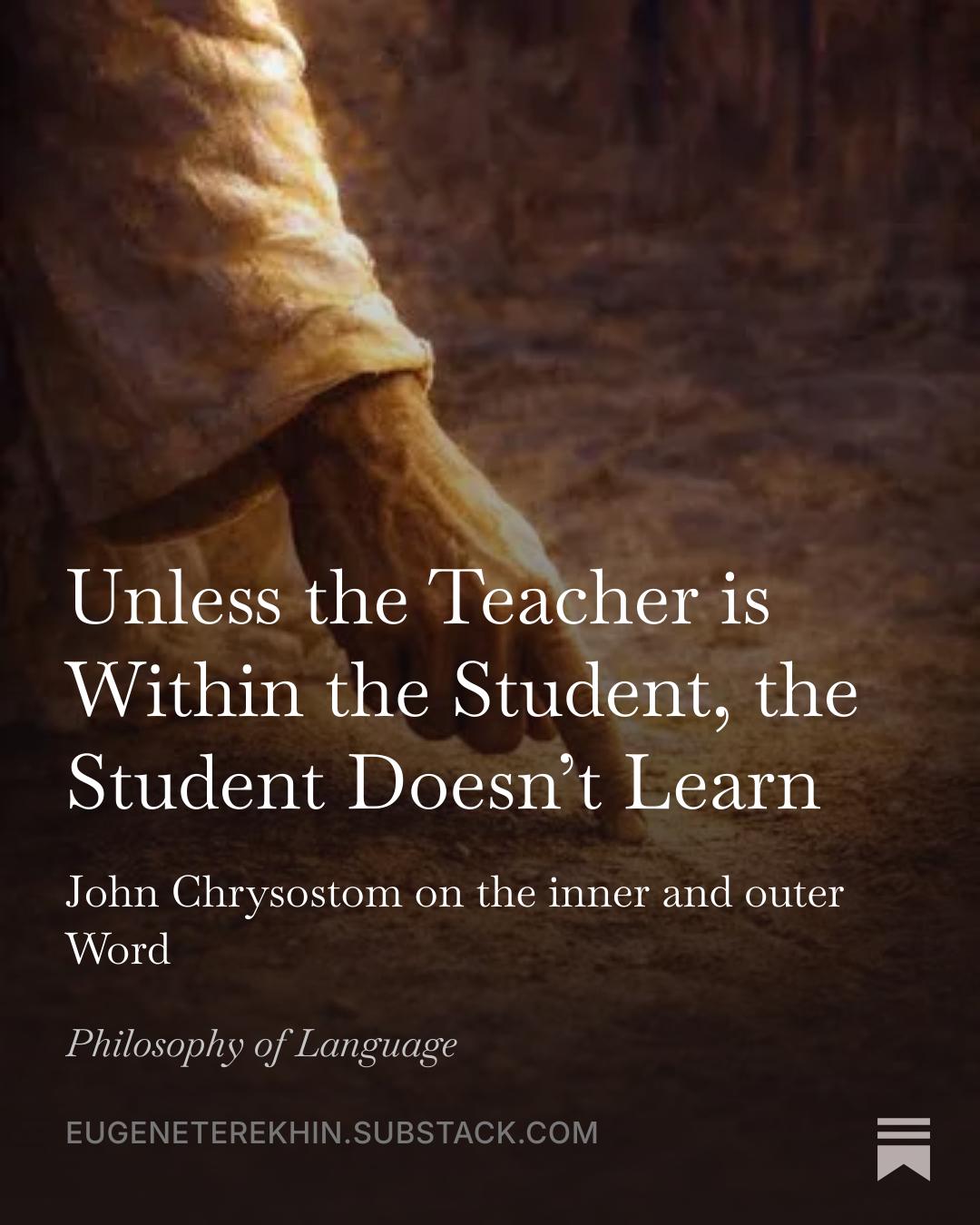
Why didn't Jesus write anything down Himself?
Why did ancient spiritual teachers rarely put their teachings in writing?
Socrates, Pythagoras, Buddha, Jesus didn’t write anything. Is it because they knew someone else would? Or was there a deeper reason?
John Chrysostom offers a surprising insight in Homily 1 on the Gospel of Matthew:
“It were indeed meet for us not at all to require the aid of the written Word, but to exhibit a life so pure, that the grace of the Spirit should be instead of books to our souls, and that as these are inscribed with ink, even so should our hearts be with the Spirit. But, since we have utterly put away from us this grace, come, let us at any rate embrace the second best course.”
Inscribing something with ink and relying upon it is associated with the “second best course.” Ideally, we should not require “the aid of the written Word.” Why?
Prophet Jeremiah says:
“I will put My law in their inward parts, and write it in their hearts… And they shall teach no more every man his neighbor and every man his brother… For they shall all know Me, from the least of them unto the greatest of them.” — Jeremiah 31:33
According to John Chrysostom, “a written word, tables, and the admonition” were given to us as a concession — because the way of discerning the writings of the Spirit was “utterly put away.”
I like the English phrase “learn by heart.” The closest Russian equivalent is “to learn by the mouth” (наизусть), but it doesn’t quite capture the idea. Even in English, however, “learning by heart” simply means to memorize.
But learning by heart is not just committing something to memory. Memorization is an external act of reading markings on a page and inscribing them into memory from the outside in. As useful as it may be, it is “the second best course.”
Learning by heart means, first of all, recognizing the inner markings of the Spirit inscribed upon the heart and becoming aware of what is already written. Learning by heart, properly speaking, is a discernment of what has already been placed there.
As the Apostle Paul said:
“You are a letter… written not with ink but with the Spirit of the living God, not on tablets of stone but on tablets of human hearts.”
The movement of knowledge has changed — it’s no longer “from the outside in,” but “from the inside out.” The assumption is not that we are empty and must be filled. The assumption is that we are full but live and act as though we were empty. We are not aware of our fullness.
Unless I am aware of what the Spirit is writing in me this very moment, external writings will profit me nothing. Books are good as mirrors: we look into them and recognize what we already know. Deep calls unto deep. Unless I am aware of my own deep, I won’t recognize the deep anywhere else.
Unless I know with the heart, external writings will be mere props for my ever-failing memory. If something is merely memorized, it will be forgotten — and I will need to be reminded again and again. If I see the Divine finger writing on the tablets of my heart, I won’t be able to forget.
To perceive supernatural things, I must have supernatural perception. “He who has ears to hear, let him hear.” Natural ears are not enough. Natural sight is not enough. Natural memory is not enough. We must perceive the finger of God at work through spiritual sight, spiritual hearing, and spiritual memory.
Then, we will remember not because we are reminded of something we keep forgetting, but because our hearts have been imprinted with the unforgettable.