r/PowerOfStyle • u/loumlawrence • Aug 02 '26
An Alternative to Visualising the Yin Yang Balance of Kibbe's IDs
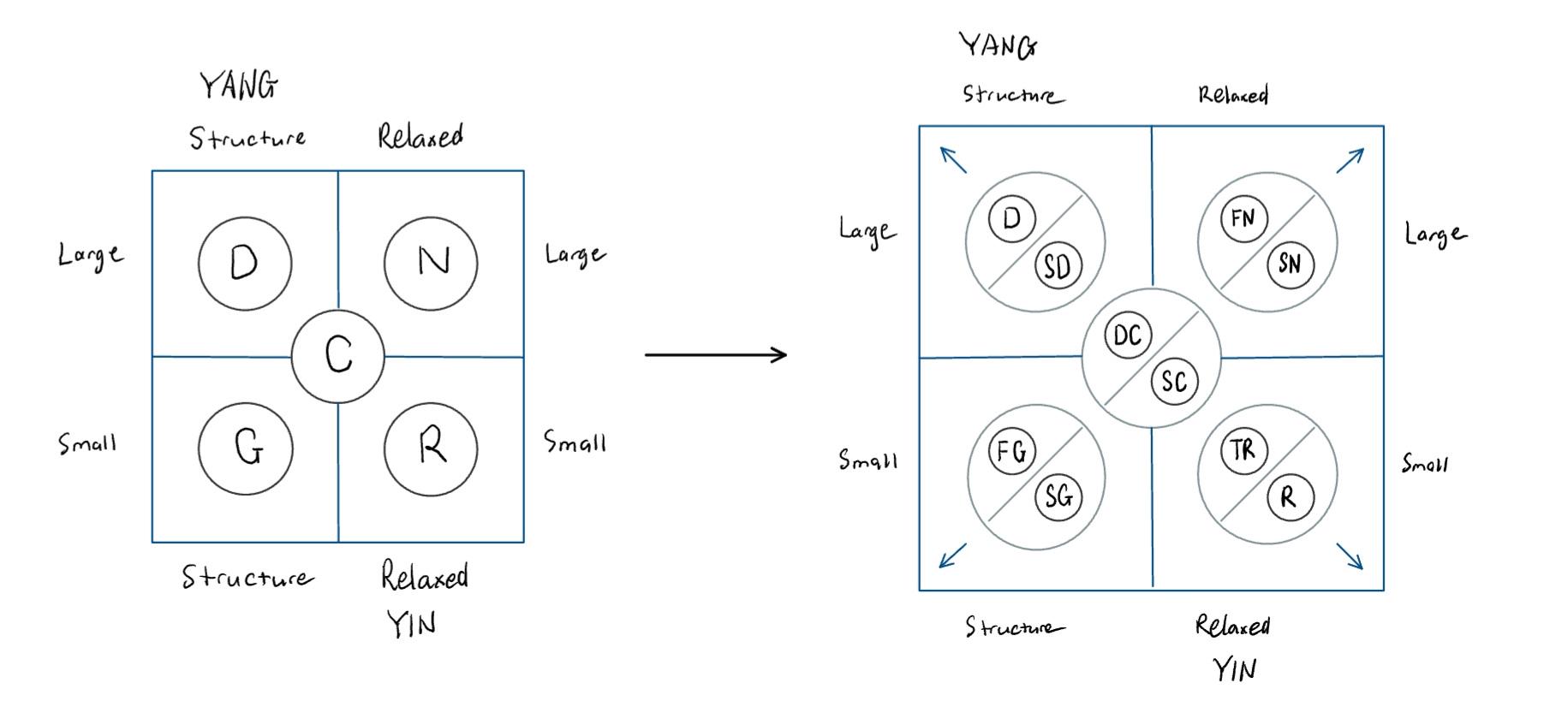
This might help people understand how the IDs relate to each other, and even an understanding of the styling recommendations. The clue is to focus on families first before looking at individual IDs.
I used a 2x2 grid. Instead of using yin and yang, I focused on some key clothing characteristics. Columns are either structured or relaxed. Rows are either large or small. This created quadrants for each of the families, with classics at the centre.
The interesting thing is that yin yang is a diagonal. It is also the same as Kibbe curve vertical. The other diagonal is the contrast blended. Both have balance in the middle. This is really cool.
There are two types of yangs (structure and large) and two types of yin (relaxed and small). The combination of structure and small creates contrast, which is the gamine family. The combination of relaxed and large creates blended, which is the natural family. Pure yang is structure and large, which is the dramatic family, while pure yin is relaxed and small, which is the romantic family.
After figuring out the yin yang position of each family, I looked at the IDs. Each family can be divided into a yang side and a yin side. The position of yin and yang within each family and quadrant is the same as the pure yang and pure yin positions on the main grid.
In both books, Kibbe talks about undercurrents of yin and yang, and in Power of Style, he talks about prominent yin and extra yang. Yang is a very aggressive force, that pulls IDs to a yang position. Yin is a very passive stationary force. If we look at SD, it has prominent yin, as it needs a lot of yin to make a noticeable difference. But SD is more yang than all the other IDs except D. Where as TR only needs a small amount of yang to be noticeable. But each of the IDs remain in their family's quadrant. They can go up to the limits of their quadrants, causing some overlaps, which is why they can sometimes assist appear like other IDs. If we look at the classics, DC has a subtle preference for D and SC has a slight leaning towards R.
Theory aside, you can use this to gauge what you need from an outfit, and how much you can get away with "borrowing". Structure vs relaxed is one aspect. Large vs small is another. Large could be longer length or thicker fabrics, or both. Small could be thinner fabrics or shorter lengths. Or large and small could be scale of accessories. You can consider straight lines vs curve lines. Or contrast vs blended.
7
u/TiredWinterDisaster SN - Insolent Insta-Baddie Aug 04 '26
I agree with u/Jamie8130 about the symmetry issue from the POS diagram, I like this visual way better. I also like that FG/DC/FN and SG/SC/SN are on a continuous line, bc that's a lot of the confusion we see online.
4
u/Pegaret_Again DC - Haughty Boss Babe Aug 05 '26
this is so fascinating, thank you for posting this, i like how it fits in a nice symmetrical grid!
6
u/Jamie8130 Aug 02 '26
This is a really clever way to visually represent the yin-yang balance of the IDs! I like how it accounts for the symmetry problem with the N family that was in the diagram in the book, how the position of G family is in a quadrant that results in contrast, and how the position of each ID reflects its degree of yin or yang as well. The part about how a combination could be near the limits and appear as another ID is also very interesting, especially for those cases of moderate height and frame who are between the small-large parameter. It's helpful to think about yin and yang in more concrete terms, like 'thick fabric, large scale, large details' and so on, it makes it easier to relate these concepts back to our style, imo.
0
u/Ok-Purple9511 SC - Naughty Eléphanté Aug 03 '26
The only issue I have with this is that SN is in the yin diagonal section and it’s a yang ID. Otherwise it makes sense to me.