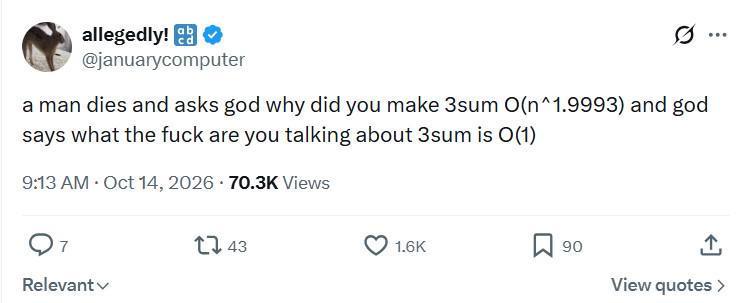
It also means that our notion of logic could very reasonably be nonsense, i.e. god could be lying to us about logic (Descartes’ evil demon).
Yeah that's kind of what I think "God created logic" entails, that the way things actually work is beyond our comprehension and a real actual capital G God would be by no means bound to the rules that we are, and that we live in a simulated or limited reality under his created rules.
I just assumed that if we say "god" (especially an omniscient one) we assume that this is the evangelical depiction, in which case saying "this god violates logic and can't exist" is a separate argument
Well the idea that our logic is a lie isn’t a comfortable one to accept. It basically means that nothing we think, do, or prove has any meaning or actual truth. Even that assertion itself can’t be inferred. You’re correct that, if we’re talking about the evangelical god, then no, this isn’t a problem. But, to them, neither are the hundreds of other logical contradictions in that theology. But this is math we’re talking about, we have a higher standard :)
View all comments
Show parent comment
4
u/NomaTyx Oct 14 '26
Yeah that's kind of what I think "God created logic" entails, that the way things actually work is beyond our comprehension and a real actual capital G God would be by no means bound to the rules that we are, and that we live in a simulated or limited reality under his created rules.
I just assumed that if we say "god" (especially an omniscient one) we assume that this is the evangelical depiction, in which case saying "this god violates logic and can't exist" is a separate argument