Ok look, I would like a private key that is easy to remember, and my memory caps at phone number length. So what's wrong with having a private key that is 867-5309?
That's why my next round of "random" numbers are either going to be Mersenne primes, so I just need to remember the prime, or the n digits of pi m digits in
Actually, by ruling out America they've discouraged hackers and increased security by either being British (gross), Australian (dial-up internet), or Indian (immune to computer based attacks) /jk
If the size is decent you might run into some limitations of the language trying to do it in a single loop, even if not it would never work because it would take way too long.
For a proper one you’d need to distribute the work over multiple instances, otherwise you’d never have enough force behind your brute force attack.
I'm simplifying a lot here, but if you connect to a website, say google.com, that needs to be resolved to an IP Address. Your PC asks your ISPs DNS server "which IP is google.com". That server says "Idk, but the server for the .com tld is over there".
So then you ask the .com DNS server "who is google.com" and that server says "Idk, but the server for google.com is over there". You then ask the server responsible for google.com for the IP address, and get back something like 80.230.56.122.
Now how do you actually make sure that 80.230.56.122 is actually google.com and not just someone claiming to be Google.com.
That's where Public Key Cryptography comes in. Essentially 80.230.56.122 has to first prove that it's actually Google.com. It does that to trusted certificate authorities (CAs), like Let's encrypt, DigiCert, GlobalSign or Sectigo. You do that by controlling the DNS entry, meaning you own the domain. The CA asks you to put a certain value on your server, say google.com/challenge/16272515/value.txt and if the CA can reach it asking DNS for that value it proves that you control the domain. Then they give google.com a certificate.
A certificate consists of a private and public key pair. The public key is, well, public, and the private key stays on Googles servers. If you sign something with a private key, by knowing the public key you can prove that it has been signed with that private key without knowing the actual private key. That is, Google can prove that they own the certificate. But how do you know that the public key actually belongs to Google, and that certificate is valid?
Well certificates are signed with the CAs private key, proving that the CA actually signed them. This certificate "chain" ends in "root" certificates whose private keys are physically stored behind incredibly secure layers in incredibly secure locations, and whose public keys are distributed with OSes and browsers. Any time you connect to a website, that chain is followed back to a trusted root certificate, proving that you connect to the real website. Each individual certificate in the chain is vouched for by the next one up, until you reach the known, trusted "root".
Recently, the private keys of a CA called eMudhra have been leaked, meaning you could sign fake certificates.
Normally, private keys for something like elliptic curve Cryptography are at least 256bits long, so a number between 0 and 2256. This makes it impossible to guess a corresponding private key.
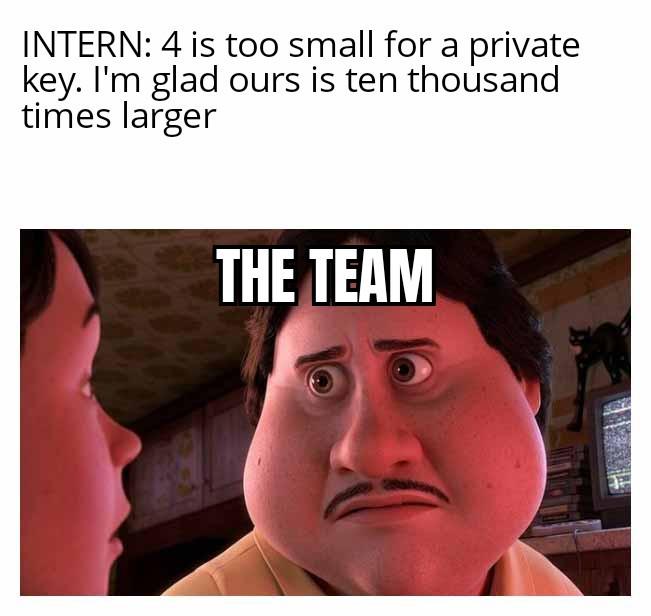
eMudhras private key was the number "4". They also had 7 other certificates leaked with numbers in the low 100s. Ten thousand times that is still WAY too low of a number for a private key.
Not quite. What you're thinking of is part of RSA key generation, and even with RSA the private key itself is not limited to prime numbers. The eMudhra incident involved NIST P-384 elliptic curve cryptography.
The private key having to be prime would substantially limit the amount of valid keys, which defeats their purpose.
The range of possibilities is enormous so trying to hack it by random guessing would take millions of years. Only in the tens of thousands means that if you just started counting up from 0, you could find that you guessed right in a very short amount of time for a computer. Seconds?
It's so bizarre. At first this story just seems nonsensical. I've been through a key creation "ceremony" before. I even brought a ceremonial knife in case it was needed. The crypto guys smiled and nodded, indicating it was an appropriate item to bring.
There is no way in hell we would have come up with "4" as our key. True, it is random. But it leaves 380 bits unaccounted for! It's not even a prime number! If one even saw the length of the file they could guess it.
My theory here, is that eMudhra outsourced this. The found some guy wandering aimlessly through the halls and stopped him.
"Are you a crypto expert?"
"Oh yes, sir! Absolutely, sir! I am a very good crypt expert!"
"Can you generate a private key for us, it absolutely has to be cryptographically random. Do you have the tools for this."
"Oh yes, sir! Absolutely, sir! I have only the best cryptographically random tools for you sir!"
He then scribbles briefly on a scrap of paper and hands it over...
If it's a crypto knife you unencrypted make sure it spills blood before you encrypt it again - to hydrate it. Otherwise it will turn brittle, chip and shatter.
I mean tbf its a brute force attack, its meant to try to try every possible value. Doing some random order just makes the job more complex because it needs to then rememebr every combination it has tried
I think this would benefit from the weird thing that, you should work from the highest and lowest number. And from the high work downwards, and lowest work upwards. This narrows the options down quickest and you don't need to "remember" what you did.
This is if you just did 1 guess at a time. Practically you could divide the task into many segments, and then do the same between each of them. Like it would still be massive amount of bruforcing, but... like... Computationally you could divide the task into small blocks and spread it out. The longer you do this without a hit, the higher the chance to finding it becomes.
This isn't efficient, I know that, we all know that. Especially since most efficient way to get the key is to manipulate a person to give it to you or grant you access to get it.
I was a bit confused by this joke. My first thought was that they went from 3 bits to 30,000 bits, which is overkill and the intern doesn't know what they are talking about, but isn't all that far off from 2,048. He just meant 1,000 not 10,000. Then I thought, oh, maybe 40000, which is still way too small. Then I thought....nothing, I still don't get it.
I don't know, man. Everyone knows it's never the private key with maximum allowed value. It's also never the private key with mininum allowed, since anyone with half a brain would guess that the most. Therefore...
I was forced to learn it for a dnd campaign 3 years ago and I’ve known it since. Even if I couldn’t say it, it is probably programmed into my muscle memory
[...] the rubber-hose technique of cryptanalysis (in which a rubber hose is applied forcefully and frequently to the soles of the feet until the key to the cryptosystem is discovered, a process that can take a surprisingly short time and is quite computationally inexpensive).
1.5k
u/GabuEx Oct 23 '26
Ten thousand times larger as in 10,000 digits, right?
Right?
186
u/dumbasPL Oct 23 '26
The real question is why does the intern have a private key in the first place.
233
u/stillalone Oct 23 '26
Ok look, I would like a private key that is easy to remember, and my memory caps at phone number length. So what's wrong with having a private key that is 867-5309?
1.3k
u/kishaloy Oct 23 '26
Used my 8-digit ddmmyyyy birthday as a key.
Still going strong.
502
u/Lysol3435 Oct 23 '26
Did you know that if you post your key in a Reddit comment, Reddit automatically censors it? ########. See?/s
628
u/Traditional_Log809 Oct 23 '26
A brute-force attack at this size is also called ‘a loop.’
59
u/Cronos993 Oct 23 '26
Plot twist: the intern meant in terms of number of bits to store 4
51
u/maxip89 Oct 23 '26 •
24
u/wisnshaftler Oct 24 '26
Can someone explain this to me
18
u/Xeppl Oct 23 '26
What the heck did I miss here?
24
u/Maleficent_Memory831 Oct 23 '26
It's so bizarre. At first this story just seems nonsensical. I've been through a key creation "ceremony" before. I even brought a ceremonial knife in case it was needed. The crypto guys smiled and nodded, indicating it was an appropriate item to bring.
There is no way in hell we would have come up with "4" as our key. True, it is random. But it leaves 380 bits unaccounted for! It's not even a prime number! If one even saw the length of the file they could guess it.
My theory here, is that eMudhra outsourced this. The found some guy wandering aimlessly through the halls and stopped him.
"Are you a crypto expert?"
"Oh yes, sir! Absolutely, sir! I am a very good crypt expert!"
"Can you generate a private key for us, it absolutely has to be cryptographically random. Do you have the tools for this."
"Oh yes, sir! Absolutely, sir! I have only the best cryptographically random tools for you sir!"
He then scribbles briefly on a scrap of paper and hands it over...
29
u/Draconis_Firesworn Oct 23 '26
to be fair, what sane brute force attack against a 2048 bit key would start with single digits, seems like a waste of time
10
u/Weak_Shoulder_6780 Oct 23 '26
The sad truth is that there are lots of "IT professionals" out there who will be like "let's make it 4, no one is going to guess that lol"
16
u/narasadow Oct 23 '26
8
u/XCxBigDong69XCx Oct 23 '26
Cya next thursday when i login to your next site xd
6
u/r3dphoenix Oct 23 '26
Ten thousand digit key: 0000...004
6
u/FitMatch7966 Oct 25 '26
I was a bit confused by this joke. My first thought was that they went from 3 bits to 30,000 bits, which is overkill and the intern doesn't know what they are talking about, but isn't all that far off from 2,048. He just meant 1,000 not 10,000.
Then I thought, oh, maybe 40000, which is still way too small. Then I thought....nothing, I still don't get it.
79
u/SpaceCadet87 Oct 23 '26
Exactly, 10,000 times larger.
40000
3
u/Science_Logic_Reason Oct 23 '26
That seems excessive.
You had the option to simply pick 8 which is already double the earlier key. Plus - taps forehead - nobody would ever expect it!
3
u/squarabh Oct 27 '26
Let's see Paul Allen's RSA key
2
u/-Redstoneboi- Oct 23 '26
warhammer
2
u/GegeAkutamiOfficial Oct 23 '26
2
u/Funkey-Monkey-420 Oct 23 '26
why does the intern know the key anyways? seems like an organizational failure
1
u/Cycloctane Oct 25 '26
65537 is enough for RSA
1
u/mamebb2023 Oct 27 '26
"what did you just say"
1
u/Admirable_Hour5169 Oct 25 '26
"At least return 4; was chosen by a fair dice roll."
1
u/Temporary-Concept-81 Oct 23 '26
I just ask chatgpt for the best random number.
-3
u/Kenny1115 Oct 24 '26
The irony of seeing an AI slop meme on this sub of all subs
0
u/[deleted] Oct 23 '26
[deleted] — view deleted comment