I've been hearing and reading a lot about how the Salesforce ecosystem is changing, opportunities are shrinking, and traditional Salesforce development is becoming less relevant with AI and Agentforce.
I wanted to share my experience because I recently wrapped up my job search with 6 offers for Senior/Lead Salesforce Developer roles, with the lowest at 30 LPA and the highest total compensation going beyond 50 LPA.
A little context:
- YOE: 6.3 years
- Current CTC: 26.5 LPA
- Offers received: 6
- Offer range: 30 LPA to 50+ LPA TC
- Target roles: Senior Salesforce Developer / Lead Salesforce Developer
- Experience: 3 large consulting organizations
This is how the journey unfolded.
1. Why I decided to switch
Having worked with three large consulting organizations, I was getting increasingly frustrated with the consulting delivery model.
My work was largely tied to individual engagements and client requirements. There was plenty of ownership and accountability for delivery and quality, but not enough opportunities to move into larger architectural discussions, influence technical decisions, mentor developers or take ownership beyond my immediate deliverables.
I was essentially a sprint-level developer responsible for getting things done, rather than someone actively participating in shaping the larger technical direction.
I wanted to move into a startup, product-based company (PBC) or GCC where I could get broader ownership, contribute to architecture and grow into a technical leadership role while remaining hands-on.
I started my job search in April 2026.
2. April–May: First opportunity, then a reality check
I got referred to a startup for a Lead Software Engineer (Salesforce) position.
The interview process consisted of three rounds:
- Two technical rounds covering Salesforce fundamentals, Apex, LWC, asynchronous Apex, integrations and solution architecture.
- One final techno-managerial and culture-fit round.
I cleared all three and received an offer of 30 LPA.
Unfortunately, the offer was eventually pulled back due to the company's financial constraints.
That was exhausting and demotivating. The market wasn't particularly encouraging either, so I decided to pause my search and stay where I was.
3. August: Testing the waters
I noticed some improvement in the market around August and started applying again.
The response was underwhelming. I received just one callback, which came after I proactively reached out to a company's CEO on LinkedIn.
I was also restricting myself to remote opportunities and wasn't open to relocation at that point, which narrowed the available options considerably.
4. September onwards: Going all in
September was when things started picking up.
I noticed a significant increase in hiring activity. Several companies using Salesforce were actively hiring developers, and I decided to go all in.
My target was straightforward: find opportunities that could get me to 30+ LPA.
I used practically every channel I could:
- LinkedIn, Naukri, Indeed and other job portals.
- Directly reaching out to recruiters and hiring managers.
- Asking for referrals through LinkedIn and Fishbowl.
- Filtering LinkedIn posts using relevant keywords to discover opportunities that weren't listed on conventional job boards.
- Cold messaging companies and recruiters.
I wasn't just applying to advertised openings. I was actively looking for opportunities wherever I could find them.
Resume tailoring and positioning
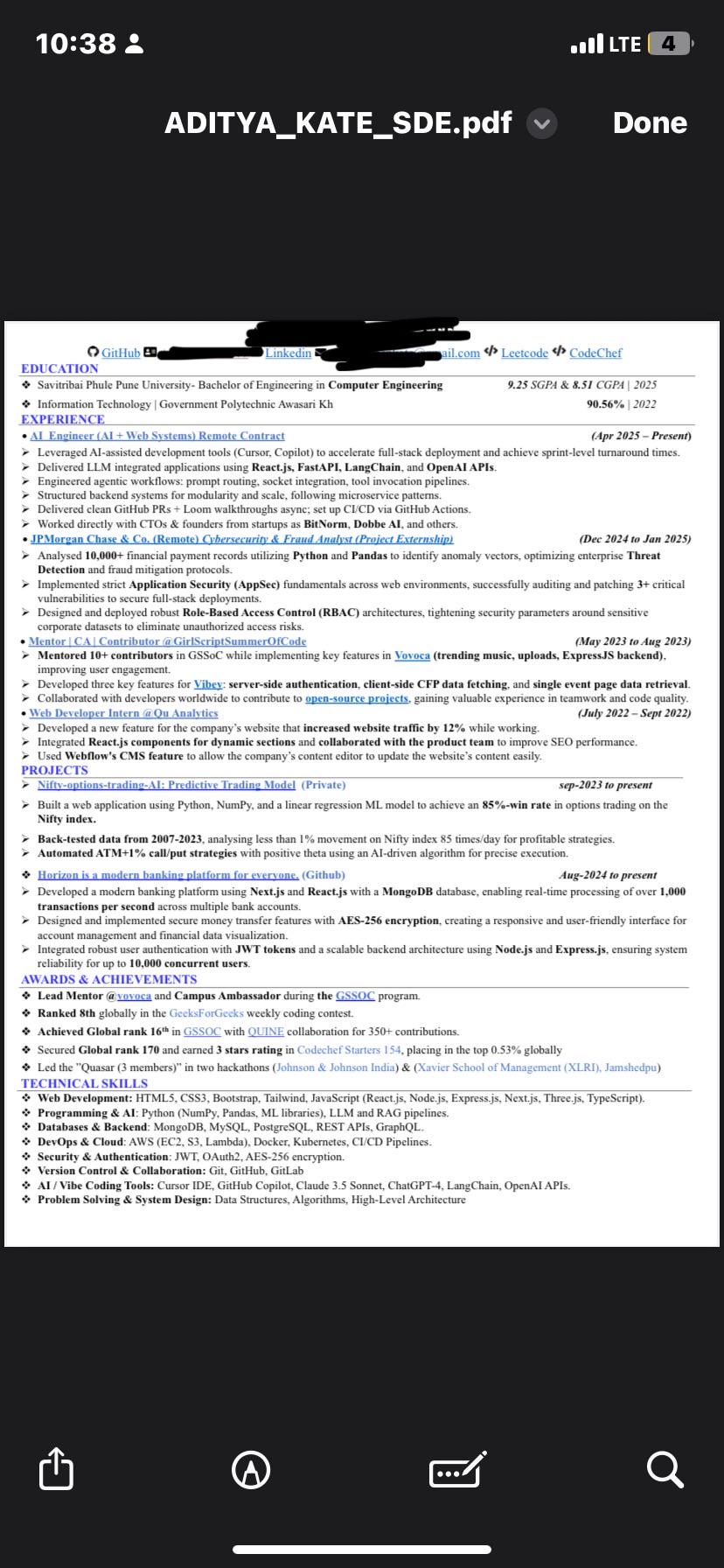
This is where I started using Claude extensively.
I gave Claude a LOT of context about my professional history, projects, responsibilities, technical challenges, achievements and career preferences.
I used Claude to tailor my resume for individual job descriptions and create company-specific cover letters.
The idea wasn't to fabricate experience or stuff keywords into my resume. It was to position my existing experience in a way that aligned with the requirements of each role.
I wanted every application to communicate why I was relevant to that particular opportunity.
Interview preparation: Probably the biggest differentiator
My core technical preparation revolved around:
- Apex and advanced Apex patterns.
- LWC and component architecture.
- Asynchronous Apex.
- Integrations and integration patterns.
- Salesforce security and sharing.
- Governor limits and performance optimization.
- Overall Salesforce solution architecture.
- AI-assisted software development and delivery.
I also hold the Agentforce Specialist certification and had been experimenting extensively with Claude Code, both personally and professionally.
I built a few side projects, applications and personal assistants outside the Salesforce ecosystem. This helped me understand agentic workflows, AI-assisted engineering and how to use AI beyond simply writing prompts.
I also went deeper into areas of Salesforce that I hadn't necessarily encountered in my regular project work.
For example:
If I were a new Salesforce implementation partner who had just won a client contract, what would the entire implementation lifecycle look like?
I prepared myself to discuss:
- Discovery and requirement-gathering workshops.
- Solution design and technical architecture.
- Salesforce licensing considerations.
- Environment and development setup.
- Deployment and testing strategies.
- Production deployments.
- Release management and post-deployment processes.
I wanted to be able to think and respond like someone who could own an implementation, not just someone who could pick up assigned development tickets.
Building question banks and simulating interviews
I created 100+ question banks across the technical topics mentioned in my resume.
These weren't just basic interview questions. They ranged from beginner-level fundamentals to advanced, architect-level scenarios.
I also created detailed notes that simulated actual interview conversations, including follow-up questions, trade-offs, alternative solutions and real-world scenarios.
The objective was to make sure I could defend everything on my resume.
I didn't want to be caught off guard by something I had claimed to know.
Automating the job search
Another interesting thing I did was automate parts of my cold-emailing process.
I used Claude connected to Gmail to help identify relevant hiring posts, discover recruiter contacts and company opportunities, and draft targeted outreach emails.
I tracked conversations, follow-ups, responses and application status.
It saved a considerable amount of manual effort and allowed me to manage a much larger pipeline.
5. Learning from failed interviews
Not every interview went well.
In fact, I tanked one opportunity in the very first hiring-manager round. It was the company I wanted to join the most.
I wasn't articulate enough, and some of my answers didn't sound convincing.
Instead of simply moving on, I took the entire interview experience and analysed it with Claude.
I identified where my reasoning was weak, where I wasn't communicating effectively and what I could have answered differently.
I also started preparing much more seriously for non-technical questions:
- Why so many company switches?
- Why are you interested in this particular company?
- What leadership and mentoring experience do you have?
- How do you handle disagreements and conflicts?
- How much client-facing experience do you have?
- How do you handle ambiguous requirements?
- Tell me about a difficult technical challenge you solved.
- How do you take ownership beyond your assigned responsibilities?
I prepared STAR-based answers, refined them and repeatedly practised them in my own words until they sounded natural.
I didn't want to sound rehearsed. I wanted to communicate clearly and confidently.
6. The toughest technical interviews
Some companies really pushed the boundaries of conventional Salesforce interviews.
One of these companies is actually the one that came back with my highest offer.
The interviews went well beyond Apex, LWC and standard Salesforce architecture.
They covered:
- System design.
- DSA in the context of Salesforce.
- AI in action, with an FDE-style approach rather than prompt engineering.
- Architectural reasoning and problem decomposition.
Some of the problems I was asked to solve included:
- Design a URL shortener using Salesforce.
- Design a meeting room booking solution in Salesforce.
- Design a credit card auto-settlement system.
The objective wasn't simply to see whether I knew Salesforce features.
They wanted to understand whether I could take a one-line problem statement, expand it by asking the right questions, identify functional and non-functional requirements, consider constraints, evaluate trade-offs and arrive at an optimal solution.
Essentially, they were testing whether I could think about systems rather than just Salesforce implementations.
These were probably the most challenging interviews because several questions were outside my usual Salesforce comfort zone.
I reasoned through them as much as possible, asked questions, discussed alternatives and tried to approach them from a bigger-picture perspective.
7. Not every company was equally difficult
Interestingly, some companies had much smoother interview processes.
My resume and experience were relevant to their requirements, and the discussions were largely around:
- Previous projects and responsibilities.
- Complex features and integrations I had worked on.
- LWC architecture and implementation challenges.
- Salesforce architectural scenarios.
- Technical decisions and trade-offs.
- Handling disagreements and conflicts.
- Mentoring and ownership.
I was also very deliberate about choosing which projects and experiences to discuss.
I had prepared different examples for different roles, depending on what the company was looking for.
This made a huge difference.
I wasn't making up experiences. I had simply spent enough time revisiting my own work that I could explain the right project, the problem, my contribution and the outcome without struggling.
There were several instances where I had already simulated the exact kind of conversation I was having during the interview.
That level of preparation helped tremendously.
8. Claude Pro was absolutely worth it
I genuinely think I extracted enormous value from my Claude Pro subscription.
I used it for:
- Building and tailoring my resume.
- Company-specific application preparation.
- Technical interview question banks.
- Mock interviews and scenario-based discussions.
- Analysing failed interviews.
- Improving communication and articulation.
- Automating recruiter outreach.
- Exploring areas of Salesforce and AI outside my regular work.
- Building personal projects using Claude Code.
The biggest advantage wasn't that Claude gave me answers.
It helped me structure my thoughts, challenge my understanding, identify gaps and prepare for conversations I otherwise might not have anticipated.
I still had to put in the work, understand the concepts and defend my answers.
AI was an accelerator, not a substitute for technical knowledge.
TL;DR
6.3 YOE | 26.5 LPA current CTC | 6 offers | 30–50+ LPA TC
My biggest takeaway from this entire experience:
Opportunities are still there. But you might need to change how you approach the market.
A few things I'd recommend:
- Don't restrict yourself to job portals. LinkedIn networking, referrals, direct recruiter outreach and even cold messaging can open doors.
- Don't use the same resume everywhere. Tailor your positioning to the role, but never fabricate experience.
- Everything on your resume should be defensible. With AI, everyone can produce a polished resume. Your actual understanding is what differentiates you.
- Don't prepare only for questions you've encountered before. Practise system design, architecture, problem-solving and unfamiliar scenarios.
- Analyse failed interviews instead of simply moving on. They can expose gaps you didn't know existed.
- Learn to articulate your work. Knowing something technically and explaining it convincingly are two different skills.
- Use AI aggressively, but intelligently. Let it challenge you, simulate interviews, identify blind spots and accelerate your preparation.
I started this journey feeling that the Salesforce market was becoming increasingly difficult. I ended it with six offers and opportunities that I honestly wasn't expecting at the beginning.
I wanted to share the experience because I see a lot of discussions around Salesforce developers being worried about AI, Agentforce and the shrinking relevance of traditional development.
I don't think ignoring these changes is an option. But neither is assuming that there are no opportunities left.
Be more than what you put on your resume. And make sure you can defend everything you put on it.
Happy to answer questions about the preparation, interview processes, compensation or how I used AI throughout the job search.