Currently I am working in Qualcomm which is going through layoffs. I on the other hand got promoted and doing good now. Been here for almost 10 years, Staff engineer. Last year my ITR amount was 72L this year it may go to 80L.
Got an offer to move to Bay Area. Not exactly sure on package but it’s standard staff package. Or I might be asked to join as senior engineer.
Is it even worthy of moving with whole family financially? It’s not my dream to move to US or anything. If I move it’s for money.
This report ran entirely on autos. Phones are still weak, and gross margin took a real hit.
Revenue
$10.32B, about $200M above expectations, with the whole increment from autos. Phones grew just 1% sequentially in peak season and fell 26% year on year — close to the 25% drop in Android shipments.
Autos have a product cycle behind them, now at $8B annualized against $7B expected last quarter. But phones are still 57% of QCT, Apple’s share keeps shrinking as it moves to its own modem, and memory pressure hasn’t gone away. Growth has to come from non-phone businesses filling the hole.
Margins
Gross margin 50.7%, down 2.4 points sequentially, below the 53% expected. Wafer, packaging, testing and memory costs all rose, while price increases don’t land until Q2 FY27. And high-margin Apple revenue keeps falling.
Guidance
Next-quarter revenue midpoint $10.8B and EPS midpoint $2.25, both close to consensus.
But QCT EBT margin is guided to 20–22%, down about 3 points. Two reasons: data centre spending comes up front and the early work is mostly custom chips, which dilutes margin; and Apple revenue keeps stepping down. So next quarter’s small EPS gain comes mainly from newly added, low-margin data centre custom chips — over $650M.
Long term: the change is in data centre
FY27’s $5B target is maintained, with a path now: growth quarter by quarter to around $7B annualized by year end, or $1.75B a quarter. Anything above that is supply-constrained, not demand-constrained. Three customers now for custom chips and AI accelerators.
With Apple and Huawei renewed, QTL revenue won’t fall off a cliff — next renewal round is FY30. FY29 data centre target of $15B and long-term QCT EBT margin of 30% both maintained.
What it means
This quarter doesn’t change the medium-term logic of the data centre taking over, and licensing risk is largely resolved. But the focus has moved from whether the data centre business can be built to whether it makes money — custom chips start at low margin.
Two things need validating: the margin turn depends on price increases landing in Q2 FY27, and the data centre slope won’t be verifiable until mid-FY27.
TL;DR On 8 September Qualcomm announced a multi-generation agreement with Amazon covering custom AI inference silicon and optical interconnect at up to 1.6T, and the market reads Amazon as the hyperscale customer Qualcomm hinted at in June. But the terms follow Marvell's template — 25 million warrants worth about $4 billion, vesting against purchases capped at $60 billion — which tells you who holds the leverage.
What the deal actually contains
There are three strands: the two will co-develop custom AI inference chips supplied by Qualcomm; they will jointly develop optical interconnect at up to 1.6Tbps, drawing on Qualcomm's SerDes and optical DSP; and Qualcomm will apply Amazon Bedrock EDA to its own workloads to shorten design cycles.
The equity binding follows Marvell's arrangement with Google: 25 million warrants at a $161.26 strike, vesting against Amazon's purchases and capped at $60 billion. The timing is the tell: signing to revenue in under a year means phase one is almost certainly custom-ASIC peripheral silicon — I/O die, SerDes chiplet, retimer — since a full custom ASIC takes roughly two years, putting volume shipment at 2028 or later.
Warrant terms as disclosed in the 8-K filing.Large-scale customers and revenue start by product line.
The blueprint, and how much of it Qualcomm actually built
Qualcomm has organised the datacentre into four segments: single-customer custom ASIC, standardised AI accelerators, server CPU, and connectivity through optical DSP and SerDes — a full-stack offering it sizes at $1 trillion by 2029. But three of those four capabilities came from acquiring Nuvia and Alphawave; the only line Qualcomm incubated is the AI inference accelerator, which has customers and orders but no revenue.
Datacentre framed as the largest growth opportunity.
Custom ASIC has two large-scale customers and connectivity its first, the AI accelerator's is Microsoft and the server CPU's is Meta — three of the top four cloud providers are now signed. Connectivity converts to revenue first, since Alphawave already ships SerDes IP and 800G optical DSP; custom ASIC starts in FQ1 2027; AI250 samples in mid-2027; the C1000 server CPU reaches volume production in 2H28. Guidance takes datacentre revenue from $5 billion in FY2027 to $15 billion in FY2029, a 73% compound rate.
Who gets hurt
Astera Labs is the most exposed, because Alphawave's line overlaps it most closely: Alphawave sells SerDes IP, optical DSP, UCIe subsystems and connectivity chiplets — largely IP and sub-module delivery — while Astera Labs sells finished parts, from PCIe retimers to Taurus cable modules and Scorpio switching. If Qualcomm hands AWS a turnkey bundle of silicon, SerDes IP, optical chips and manufacturing, those are orders Astera Labs would have won.
Astera Labs product lines by tier and function.
Marvell is the name the market thinks of first, but we read that as sentiment more than substance: it already absorbed a real loss when Trainium3 and 4 went to Alchip, leaving legacy Trainium, NIC and storage controllers and DSP.
Alphawave has 1.6T optical DSP due in 2026-2027 and has now won AWS, which looks bad at first — but custom interconnect takes time, and third-party DSP is already fiercely contested. Alchip carries little short-term risk, since Trainium3 and 4 are ramping and Qualcomm's full custom ASIC only arrives from 2028.
Alphawave product lines by tier and function.
For Amazon the effect is a multi-party supply chain: Annapurna owns the architecture and sets the schedule, with Alchip, Marvell and now Qualcomm as three outsourced partners. Moving Trainium3 from Marvell to Alchip last year and adding Qualcomm this year is one playbook: make design partners compete, push prices down, collect warrants on top.
For Qualcomm, this is what breaking in costs: at the starting line it must hand over benefits to win orders, and what would change the picture is more hyperscaler orders and delivered products, not agreements and equity sweeteners.
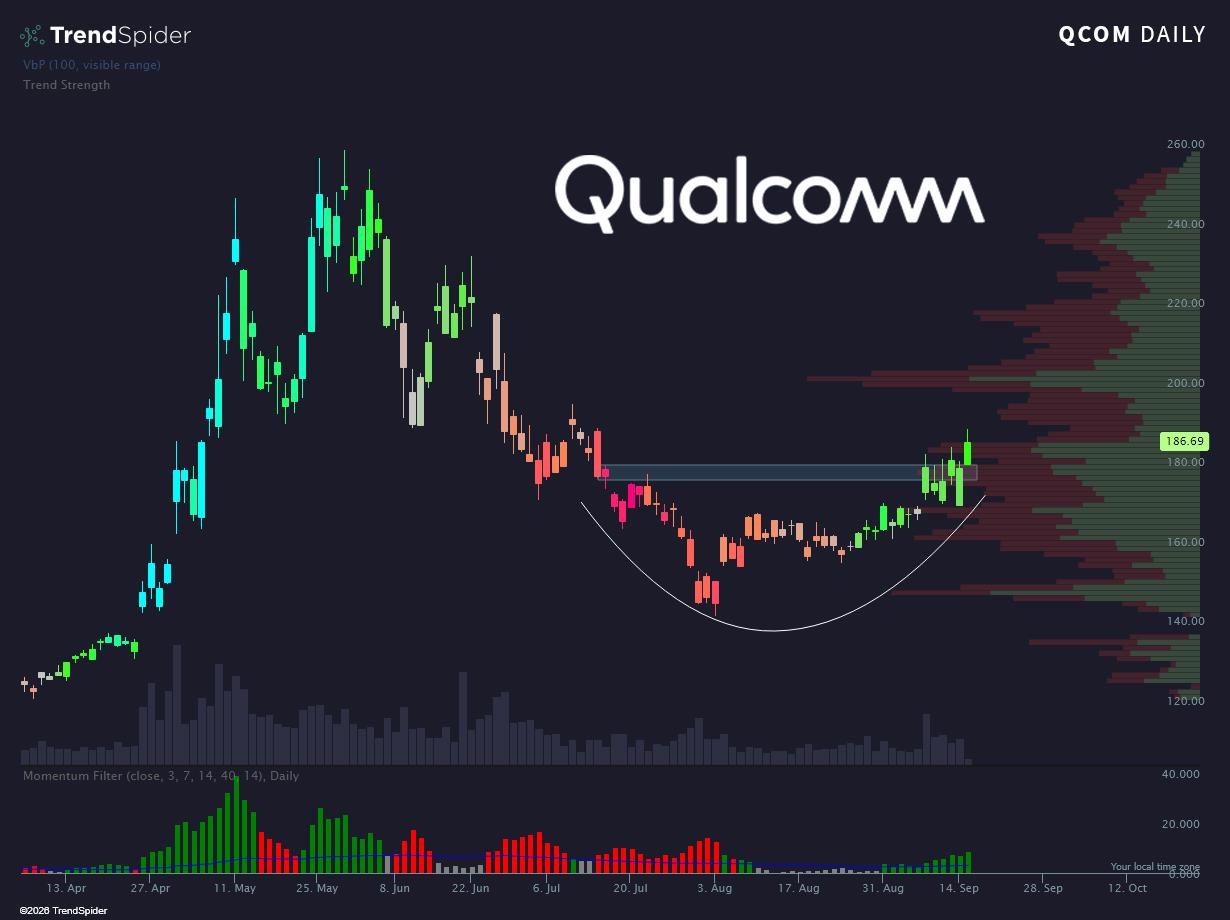
Qualcomm is undergoing a business transformation,increasing investment in non-handset segment to build new growth drivers after andriod handset demand in China dropped over 20% by 2026.During the earning calls, qualcoom’s cfo expected the revenue in datacenter will grow to 5b by 2027.And management also said the apple business will decline by nearly 50% between Spetember and December in 2026 but this will be offset by a rebound in Android segment as the OEM’S inventories normalize. We should monitor the Q4 FY2026 earnings release to verify if the Andriod recovery offsets the drop in apple business.For the longer term, the primary focus remains on the non-handset segment,especially datacenter execution in 2027.Would you buy the dip on Qualcomm stock?
Plummets Below $150, Many friends are asking: Is Qualcomm really going to be dragged down by its mobile business? Actually, looking at the detailed data behind the earnings report, Qualcomm's transformation strategy is already laid out very clearly: Short-term pressure: Mobile chips are still at the bottom of the cycle, gross margins suppressed by memory costs, plus the substitution effect from Apple's in-house modem development, the Q4 guidance does indeed look ugly. The real game-changer is in data centers: The AI data center business everyone's watching will actually start delivering the first batch of custom ASIC chips in December this year (FY26 Q4)! And Meta has already signed a strategic partnership (Dragonfly C1000 CPU), plus the AI200 accelerator samples going out by year-end, with true large-scale ramp-up in 2027-2028. Automotive still exploding: Auto business hits a new quarterly high of $1.59 billion (YoY +61%), with double-digit growth for 23 consecutive quarters. The company has directly raised its FY2029 non-mobile revenue target to $40 billion. Trading approach: Don't rush to go all-in at this stage—first watch the technical support at the $145 line. If going the options route, with IV squeeze post-current phase, it's suitable to sell Cash-Secured Puts at deep out-of-the-money far-dated strikes to collect some premium, waiting for the true ramp-up in data center and auto businesses in 2027. Current stock price is back in the bottom zone again—this is a spot to slowly accumulate.
TL;DR Qualcomm beat on revenue for its FQ3 2026 (June) quarter and still gave the market a reason to sell: gross margin missed, and next quarter's earnings guidance came in below expectations. Phones are still shrinking, memory costs are still climbing, and the data centre business that once carried the stock has yet to produce revenue. The handover from handsets to AI is real — it is just slower than the share price assumed.
A revenue beat that doesn't change the direction
Revenue for the three months ended June 2026 was $9.95 billion, down 4% year over year but ahead of the $9.6 billion consensus. Gross margin was 53.1%, down 2.5 points year over year and below the 54.6% expected, with wafer, packaging, test, advanced packaging, memory and other materials all costing more.
Core operating profit fell 41% to $1.63 billion as R&D rose to $2.6 billion. Reported net income of $2.0 billion is not comparable with the prior quarter, which included a roughly $5.7 billion deferred tax valuation allowance release. FQ4 2026 (September quarter) guidance is $9.7-10.5 billion of revenue, in line, with non-GAAP EPS of $2.05-2.25 against $2.36 expected — that is the actual miss.
Qualcomm FQ3 2026 (June quarter) results and FQ4 guidance versus market expectations.
Phones are the problem, and it isn't really Qualcomm's doing
Handsets are more than half of revenue and fell 19.6% year over year to $5.09 billion. Global shipments held at 290 million units, down 6%, but the split is what hurts: Apple shipped nearly 20% more while everyone else fell 11%. The premium mix is weakening too, with OEMs staying on previous-generation platforms to protect cost. Management guides handset revenue to roughly $5.2 billion next quarter, down about 25%, as Android's seasonal recovery is offset by lower Apple content.
Global handset shipments in the June 2026 quarter: Apple grew, the rest of the market shrank.
Memory is squeezing the other side of the margin
Most of the margin pressure is imported. Memory inflation has raised the bill of materials, and handset makers cannot pass it into weak end demand, so it lands on component suppliers. The slope is easing — OPPO and Vivo have refused further increases — which matters more than it sounds: if the memory cycle rolls over, the relief shows up directly in Qualcomm's gross margin. That is the cleanest near-term catalyst available.
Autos are the one line clearly working
Automotive revenue rose 61% year over year to $1.59 billion on the fourth-generation Snapdragon cockpit, and the fifth-generation Digital Chassis ramps in September with materially higher content per vehicle. IoT grew 9% to $1.83 billion on consumer and industrial demand.
The data centre pitch is real. It is still a pitch.
Qualcomm is attacking it on four fronts. Its accelerators use LPDDR5X rather than HBM to put processing near memory, aimed at memory-capacity-heavy inference, with Microsoft confirmed across multiple generations; AI200 is ramping now and AI250 samples in 2027.
Qualcomm's AI accelerator roadmap through AI300, disclosed at its June 2026 investor day.
A server CPU on the Oryon architecture targets agent orchestration and tool calling, with Meta confirmed across generations. Custom silicon, built on the Alphawave and Ventana acquisitions, has two hyperscale customers each expected to contribute over $1 billion in FY2027, and connectivity has landed its first hyperscale customer. Management targets $5 billion of data centre revenue in FY2027 and $15 billion by FY2029.
The data centre connectivity roadmap: 800G shipping now, 1.6T due in 2026-2027.
Bottom line
The share price round trip tells the story better than the quarter does: the market paid up when the data centre roadmap arrived, then took it all back as AI capex worries spread, without a single underlying fact changing in between. Two things decide what comes next — whether the memory cycle turns and hands the phone business its margin back, and whether those FY2027 data centre targets start converting into disclosed orders rather than design wins.