r/rfelectronics • u/TwigyBull • Sep 04 '26
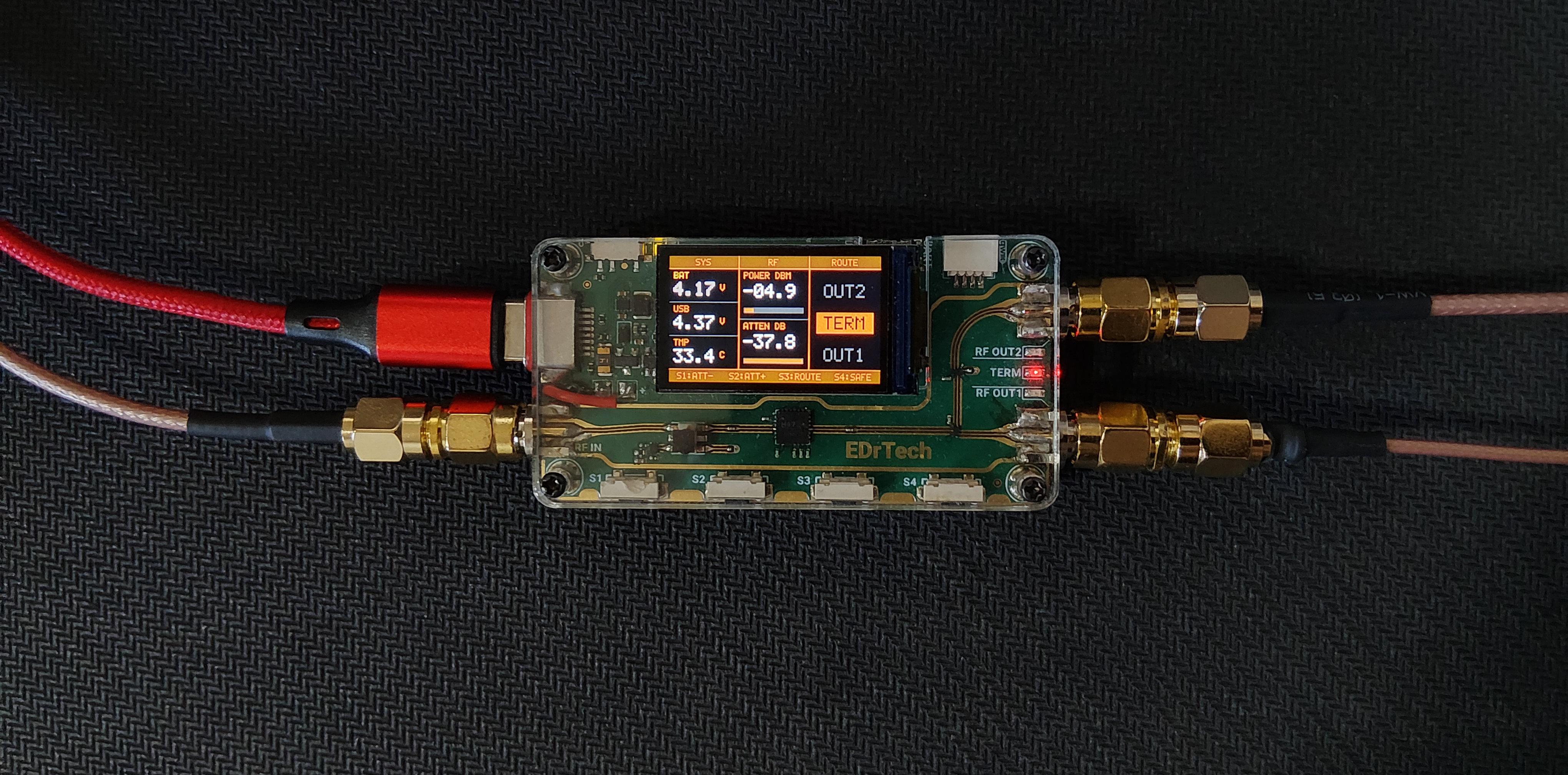
Looking for advice on the general viability of this system, and I don't know of a better community to ask.

1
Upvotes
r/rfelectronics • u/TwigyBull • Sep 04 '26
r/rfelectronics • u/Srinu468 • Sep 04 '26
so i made my antenna in student license but while simulating i got hit by the mesh limit, so i wanted to simulate it in a licensed version in my college desktops but apparently student version files cannot be opened in the commercial version. Any workaround to convert or do i just have to recreate again in the commercial version??
r/rfelectronics • u/AtterseeMM • Sep 03 '26

Hi, I'm currently working on a hobby project with a large prime focus satellite dish, that I can't get a feedhorn for. Making the feedhorn isn't a problem but connecting it to the LNB is a bit more difficult. I need to make an adapter to go from an odd diametre to a WR-75 compatible mount for the Ku-Band LNB.
I drew two versions of the same adapter in CAD and I'm wondering which one would be better? The top one uses tangential swep-blend avoiding discontinuity, and the other one is much simpler using just a linear transition. The linear one is of cause much easier to manufacture than the tangential one.
Which one should I go for? Would they perform the same or would this create impedance problems or reflactions or high attenuation? I'm a mechanical engineer, not a RF engineer so this is more like magic to me at this point to be honest.
r/rfelectronics • u/i_hate_redditmods • Sep 03 '26

It no works, not sure exactly why? And why the frequency is way off than what it should be (around 2 MHz) but hey something is always better than nothing.
Edit: I think I flipped c1 and c2 in the diagram.
r/rfelectronics • u/HavokAlwin • Sep 03 '26
Looking for an active RF/SDR community where people actually build, experiment, and talk about random RF stuff — antennas, DSP, wireless, SDRs, interesting signals, research, etc.
Not looking for anything too formal. Just a fun community with people who are into this stuff.
Any recommendations? 😄
r/rfelectronics • u/i_hate_redditmods • Sep 02 '26

I made this oscillator circuit based on the common emitter amplifier and colbits feedback. The q point is at 5.7 volts and the amplification for external signal generator is around 4(given the accuracy of my cheap oscilloscope). The circuit can oscillate at around 10khz with C=100nf and at around 30khz with C=10nf but anything above or below these values doesn’t generate any oscillations.
r/rfelectronics • u/Technical-Diver4394 • Sep 03 '26
Thinking about moving to a property. Upon inspecting it, there was a 5G tower nearby. Measuring the distance- it is abut 125 meters to edge of property and about 135 to the building. Looking at some case reports, someone had health problems living 125 meters away.
https://ehtrust.org/7-scientific-case-reports-on-5g-cell-tower-health-impacts/
I measured the RF exposure, walking around with a GQ EMF-390 3-in-1 EMF/ELF/RF Meter. There was nothing from the distance of 200 meters, there was nothing as I approached it and nothing underneath it. (Nothing as in higher than 200 uW/m2. Once, it peaked to 6000 uW/m2 but swiftly disappeared. This was 10 yards away from the 5G tower. The tower looks like a cylinder mounted to the top of the pole with a few "small cells" boxes. I am thinking now, that the tower operates above 10Ghz. My device can only see up to 10Ghz. I can measure "regular" 4G towers hundreds of meters away.
What do you all think about this?
How prevalent are the above 10Ghz towers at this time? I understand the higher the frequency, the lower the range of the signal. The property is also semi-blocked by some heavy trees. That should block some of that off as well, right?
I traveled to another tower and almost the same thing happened. Now, it seems that the device picked up the "3 brown boxes" towers on the top of the poles, though. Perhaps, they are still operating in the lower frequencies.
r/rfelectronics • u/kacavida01 • Sep 02 '26

I have a question about this antenna feedpoint. Why does it have two waveguides feeding the feedpoint? Does it have anything to do with H and V polarisation?
regarding the internal structures, what are they? Is this some kind of a waveguide polariser, phase delayer or something else?
r/rfelectronics • u/rgomes03 • Sep 02 '26
Hi,
I need to measure a 3 Port device, where on one side I have a GSGSG probe, and at the other end I have a GSG. My question is:
Most of the ISS standards I see only allow for GSGSG to GSGSG or GSG to GSG.
Any ideas?
Thanks
r/rfelectronics • u/LocalDumbPerson • Sep 01 '26
I just graduated and I need some advice. I struggled throughout university due to (medically diagnosed) ADD. I did decent in my RF classes but I didn't do well in everything else and ended up with a poor GPA of 2.75. I'm not sure if I'll be able to compete with others in the RF space who have a masters and/or high GPA. Right now, I've been reading as many RF textbooks as I can and learning how to use HFSS. However even if I can understand RF well it seems like my poor performance in school will always haunt me.
Anyways let me know if I should continue towards my goal of RF or my efforts are not worth it.
r/rfelectronics • u/Anky1557 • Sep 01 '26
r/rfelectronics • u/Intelligent_Tax_4397 • Sep 01 '26
ECE 2025 grad + currently doing M.E. in Communication Systems. I’m looking for RF/antenna design/microwave internships or short-term paid courses/training with actual hands-on practical work.
Paid/unpaid internship is fine — mainly looking to learn, build, and get real practical experience.
If you know any good leads, please drop them below or DM me
r/rfelectronics • u/gvcallen • Aug 31 '26
Hi all!
ParamRF v0.33 has been released. It's been a while since the last update and there have been quite a few changes, so I'd thought I'd make a post sharing the updates that may be of interest.
For those that don't know, ParamRF is a Python framework for modern, programmatic RF circuit modeling, built on top of JAX instead of NumPy and catering for advanced features like automatic differentiation and Bayesian circuit fitting.
Some updates:
- Parameters are no longer tied to only RF models. They can now be built using a `Module` or even plain lists/dictionaries, so a single, global parameter set can be injected into different models at once.
- Optimization, inference and fitting now work across multiple frequency ranges in one problem, via a new term-based interface (`AbstractTerm` / `SummedTerms`). Custom penalties can just be plain functions of the parameter PyTree for better flexibility.
- The default circuit solver is now MNA, and the solver APIs have been generalized to accept arbitrary PyTrees rather than just models.
- New models: ideal transformers (centre-tapped, autotransformer, balun, mixed-mode converter), coupled inductors, `SeriesRL`, and a `FloatingTwoPort` lift for nodal circuits without a shared ground.
- Measured networks (`SkrfNetwork`) now support cubic interpolation as well as linear.
- For Bayesian fitting, `MarginalLogLikelihood` now accepts prediction-dependent event transforms, so the residual basis can depend on the prediction itself. This is useful if, say, magnitude and phase errors need separate variances.
- `pmrf.sweep` now takes a template for easier vmap filtering, and useful utilities for power users like `partition`, `combine`, `batch_axes` and `batch_mask` are exposed at the root.
Some links:
Let me know if you have any questions!
Cheers,
Gary
r/rfelectronics • u/Just4defcon • Aug 31 '26

I was exploring the "zero-span" mode on my spectrum analyzer and recorded the signal from my microwave oven. For this, I used a log-periodic antenna with a gain of 7 dBi, positioned about 6 meters away and somewhat to the side, with no attenuation applied. The strong signal strength was initially surprising but after considering it is not very much power compared to inside the microwave.
The signal pattern is repeating with the mains frequency which makes sense as conventional microwave power supplies use a voltage-doubler circuit that outputs on only one half of the cycle unlike lights which peak on both halves or are constant. The frequency rises and falls at the start and stop make me think there is a frequency dependence on current though the sweeping pattern like in the second image doesn't make sense to me yet.
I wonder if RF testing laboratories take special measures beyond measurement room shielding to reduce interference caused by the ovens in their break rooms?
r/rfelectronics • u/its-me-pk • Aug 31 '26
Dear all,
I have just started my PhD into the domain of Silicon Photonics and terra hertz RF based MEMS. This is something we are doing for the first time in my group. However, my knowledge of basics in Silicon photonics and MEMS isn't very great.
I want to quickly learn all these ASAP and wanted guidance on what are the right resources to go through which can enable me to reach that level so that I can take up an efficient work for my PhD.
I have got COMSOL installed via my university access and would really appreciate if someone could guide me. Videos, DIY books and anything similar would be very helpful.
I need inputs on texts, and also simulation setup that I can use to go ahead.
Thanks.
r/rfelectronics • u/CardboardFire • Aug 30 '26
r/rfelectronics • u/Remote_Disk4813 • Aug 30 '26
r/rfelectronics • u/Fine_Aerie6732 • Aug 29 '26

So, this is a patch antenna a design for 2.4GHz and my question is specific to that notch inside red circle basically initially my impedance is more inductive +j73ohm but as i increase the width of the gaps it goes to zero then starting going into capacitive -j ohm like at first i thought that it may be just "mutual inductance" and i don't get any proof of it and well i am unable to understand the mechanism so can somebody explain this thing or give me some reference of book or something.
r/rfelectronics • u/BigMargas • Aug 29 '26
r/rfelectronics • u/No_Target9990 • Aug 28 '26
I am planning to buy a VNA for Tuning of PCB antenna and some filter design, suggest me some VNA to use and I am planning to use for a long time, I have found some models from internet,
Usage : development for BLE/WIFI PCB antenna, later for LTE antenna for my own tracker
suggest me some other models...

