The strangest thing about “A Quality of Mercy” is that I watched it when it first aired five years ago but remembered so little about it. This is the kind of episode that is made for fans. It features Captain Christopher Pike flashfowarding to an alternate future in which he is still in command of the Enterprise and relives (or lives, perhaps) one of Star Trek: The Original Series’ (TOS) defining episodes, “Balance of Terror.” The foregone conclusion of “A Quality of Mercy” ending badly negates almost any surprise it has in store. Perhaps the biggest surprise is how badly Pike screws up while living the life of another Enterprise captain.
After encountering a child destined to become one of the doomed cadets in the accident that leaves Pike disfigured and confined to the beep chair, he becomes obsessed with trying to cheat fate. As he drafts a letter to warn the child away from joining Starfleet, Pike receives an unexpected visitor—himself. Or rather, himself from several years in the future: hale and hearty and now an admiral. The elder Pike warns that if Chris proceeds along this path, he will cause irreparable damage to the future. He produces a time crystal so the younger Pike can see for himself.
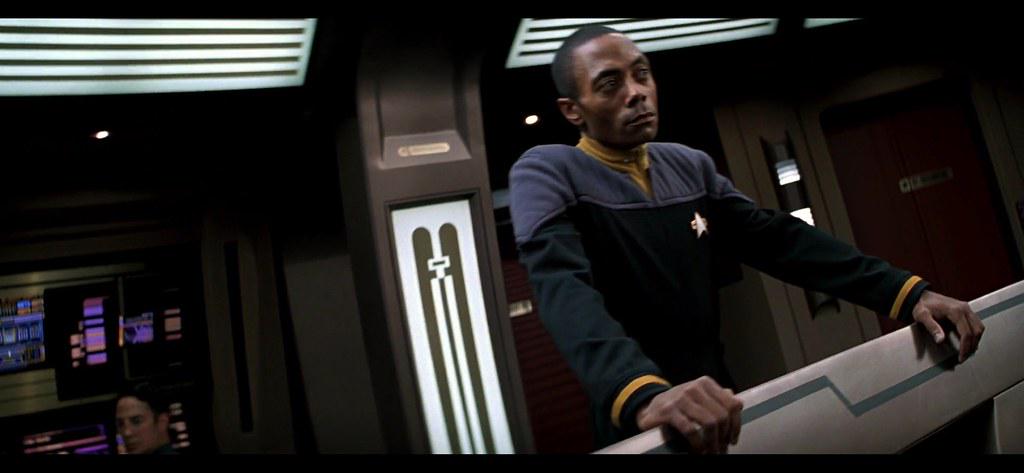
What follows is a near blow-by-blow account of “Balance of Terror” with Pike assuming the role of his successor, Captain James T. Kirk. The flashforward even begins that the same way, with the captain officiating at a wedding that is interrupted by news of a mysterious ship destroying Starfleet outposts near the Romulan neutral zone. We are reminded that it has been 100 years since the Romulans and Earth reached an uneasy truce following a devastating war and that no one in the Federation has seen a Romulan.
Pike also finds his crew much changed. Spock is his first officer (going by the title “Number One,” which Kirk never called him) while his previous X-O, Una Chin-Riley, is nowhere to be found. Erica Ortegas and Jenna Mitchell still operate the helm and navigator positions, though they have switched places, and Erica assumes the belligerent, warmongering stance adopted by Lt. Stiles in the original episode. Pike holds out for a peaceful solution, even after an outpost is obliterated before his eyes.
It would have been an interesting thought experiment if the episode had proceeded along the lines of Pike stepping into Kirk’s shoes and trying to figure out what he should do differently. However, the episode complicates matters by bringing in James T. Kirk, who, in this timeline, is captain of the USS Farragut and arrives to lend a hand. I much admire Paul Wesley’s take on Kirk—he captures the assertive energy that William Shatner brought to the role yet makes it his own. However, Pike can’t help but look weak in comparison. Despite his crew’s protests that the Romulan ship has already destroyed several outposts and killed many people, Pike clings to the idea that they can find a peaceful solution. It sounds trite when he lectures the Romulan commander and praetor that no one wants a war. Clearly, some do.
The episode comes across as an indictment of Star Trek’s philosophy that our enemies are not really bad guys—we just have to look at things from their point of view. TOS made this claim in several brilliant episodes, including “Arena” and “The Devil in the Dark,” but “Balance of Terror” was not one of them. In that episode, Kirk engaged in a cat-and-mouse game with an enemy who showed no mercy toward civilians. Even in this episode, it is stated and restated that Romulans view peace as a sign of weakness. Pike looks like a fool for not recognizing what is right before his eyes. Kirk even lectures Pike on this after the hostilities are over, but by then it is too late.
Making the hero appear weak before the hero of another series is not a good look on the show. To make matters worse, most of the regular SNW crew are sidelined to feature Kirk. As mentioned, Una is nowhere to be seen (and we find out why when Pike returns to his own timeline). La’An appears briefly as Kirk’s first officer of the Farragut, and M’Benga and Chapel show up in minor roles. Uhura occupies her usual station on the bridge but has little else to do. (In the original episode, she took over the navigator’s station—a famous nod to TOS’s 1960s progressivism—but this is apparently redundant with two women already occupying the front positions.)
However, it is Spock who becomes the most important aspect of the episode. By the end of the conflict, he is crippled, disfigured, and in a vegetative state—much like the fate reserved for Pike in the original timeline. His fate, we are told, has enormous repercussions for the future. As the older Pike says, Spock “has things to do”—specifically to broker lasting peace between the Federation and the Romulans, as shown in Star Trek: The Next Generation.
Such nods to continuity can be fun for fans (Scotty is even heard but not seen except for his arm). And, although I count myself a fan, I find it distracting when such nods get in the way of telling a story. “A Quality of Mercy” strives too faithfully to reproduce the story beats of the original—down to all eyes being on Spock when the crew gets its first look at Romulans as well as the Romulan commander saying that in another universe, he and Pike/Kirk could have been friends right before committing suicide. Furthermore, the latter beat is unearned. Whereas Kirk had earned the commander’s respect after besting him in battle, what has Pike done to merit such sentiment? Commit both of their peoples to several decades of war by showing weakness?
And, in the end, what does Pike learn? That he can’t change his fate? That he must simply accept the dire future that awaits him and the cadets involved in his accident? SNW as a whole seems to rely on a fatalistic philosophy that one cannot change the future and that trying to do will make things worse (see, for example, the Season Four opener, “Valles Marineris”). Perhaps such a philosophy is intentional, but it differs from the optimistic future Star Trek has always depicted. Even in TOS “The City on the Edge of Forever,” Kirk has to make a painful choice by allowing the woman he loves to die to protect the timeline he knows. Pike, too often, stands by and does nothing.
For good measure, I happened to watch “Matters of Honor,” the Season 3 opener of Babylon 5, right after watching this episode. The contrast between Pike and Captain John Sheridan is stark. Faced with an overwhelming enemy, Sheridan figures out what the enemy doesn’t know and bluffs his way to victory. Pike could have used some of Sheridan’s guile, or, for that matter, Kirk’s.
Odds and Ends:
- In an apparent continuity error, the young Cadet Uhura is shown on the bridge when Pike returns to his own timeline. However, her training rotation supposedly ended in the previous episode.
- In the original TOS episode, it is the groom, Robert Tomlinson, who dies in battle. In the alternate timeline, Tomlinson survives, but his bride, Angela Martine, dies. (The characters are not named in “A Quality of Mercy.”)
Check out this post on my Substack: https://greggildersleeve.substack.com/p/in-kirk-we-trust-rewatching-snw-110