I've been a long-term TMC holder who has double, triple, and quadrupled down on my holdings over the past year. It’s been brutal on my portfolio, but I I think the information in front of us now looks better than when we were at $11.
I believe there's a possibility NOAA's certification and permitting process has been deliberately slowed until Congress passes the Bipartisan American Affordability and Jobs Act of 2026.
⠀
On November 18 (today), the Senate voted 69-27 to adopt a permitting reform amendment and 65-31 to limit debate on the amended bill. Section 1401 of this bill could give federally permitted projects meaningful protections against future government interference once passed.
⠀
Sources: https://www.dailypress.senate.gov/wednesday-november-18-2026/ | https://www.govinfo.gov/content/pkg/CREC-2026-11-10/pdf/CREC-2026-11-10-senate.pdf
⠀
One of the biggest risks facing TMC has always been regulatory uncertainty. A mining permit that is left exposed to a future administration opposed to deep-sea mining is not an attractive proposition to long-term capital providers. If this legislation becomes law and TMC secures all necessary permits, it could enter commercial operations with much stronger legal protections.
⠀
THE TIMING OF THE RECENT DEVELOPMENTS
⠀
• NOVEMBER 11–12: U.S. and Japanese officials met in Toyama to discuss seabed mineral development. Their joint statement emphasized commercial cooperation, processing capacity, investment, and regulatory predictability.
Source: https://www.state.gov/releases/office-of-the-spokesman/2026/11/joint-statement-on-u-s-japan-seabed-mineral-resource-development
⠀
• NOVEMBER 12: TMC discussed its five-year relationship with PAMCO and the potential to process early commercial nodules at PAMCO's existing Japanese facilities. Its engineering team was in Japan working on processing plans.
Source: https://investors.metals.co/news-releases/news-release-details/tmc-provides-third-quarter-2026-corporate-update
⠀
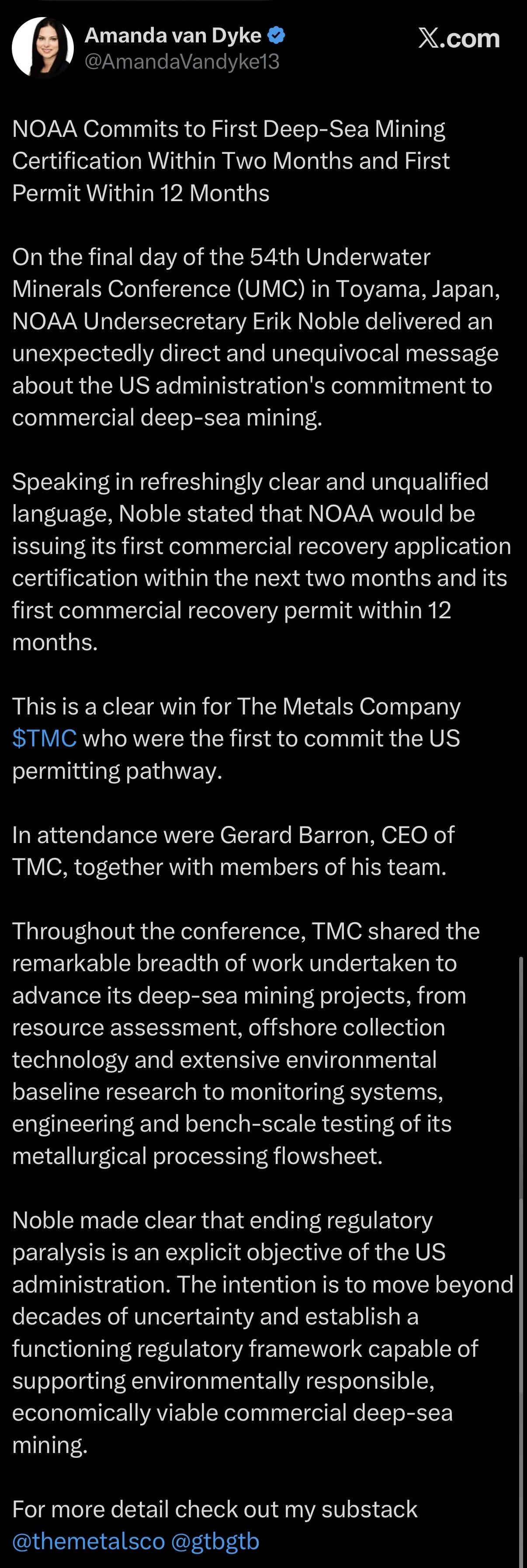
• NOVEMBER 12: Amanda Van Dyke reported from the Underwater Minerals Conference in Toyama that NOAA official Erik Noble expected the first commercial recovery application certification within two months and a first commercial recovery permit within 12 months. Gerard Barron and TMC representatives were reportedly present.
Source: https://x.com/amandavandyke13/status/2120961883691970773
⠀
• NOVEMBER 18: The Senate adopted the permitting reform amendment and cleared the cloture hurdle on the amended bill.
Source: https://www.dailypress.senate.gov/wednesday-november-18-2026/
⠀
• DECEMBER 14–15 (upcoming): The United States is hosting the G20 summit in Miami. Secure, affordable energy supply chains are a priority for this year’s U.S.-led G20, and deep-sea mining has already come up directly. At the Sept. 14 G20 energy ministerial in Houston, U.S. Interior Secretary Doug Burgum discussed recovering critical minerals from seabed nodules and said U.S. deep-sea mining permits could come within months. This is right near NOAA's revised mid-December target for deciding whether to certify TMC's USA-A application. Certification is NOT a commercial mining permit; environmental review and final approval would still follow.
Sources: https://www.g20.utoronto.ca/summits/2026miami.html | https://investors.metals.co/news-releases/news-release-details/tmc-provides-third-quarter-2026-corporate-update
⠀
ERIK NOBLE'S ROLE
⠀
Noble is a senior NOAA official overseeing a portfolio that includes deep-sea mining and previously worked in the Trump White House. Former NOAA officials reportedly described him as the administration's “eyes and ears” inside the agency during Trump's first term. His return matters when looking at how the administration is approaching deep-sea mining.
Sources: https://www.noaa.gov/our-people/leadership/erik_noble | https://www.eenews.net/articles/official-dubbed-trumps-eyes-and-ears-is-back-at-noaa/
⠀
When I put the Senate bill, Japan meetings, PAMCO updates, Noble's role, and mid-December certification target together, I have a hard time believing the timing is entirely coincidental. My theory is that officials may want the legal and international framework in place before TMC receives its final approvals. I have no evidence NOAA is intentionally holding up certification, though, and normal regulatory and environmental review requirements may explain the timing on their own.
⠀
HOW THIS COULD BENEFIT TMC AFTER PERMITTING
⠀
- FUTURE ADMINISTRATIONS — Federal agencies could face tighter limits on revoking or substantially changing TMC's permits because policy priorities changed.
⠀ - SHUTDOWN PROTECTION — Unjustified federal interference with an approved mining operation could become harder.
⠀ - LESS LITIGATION UNCERTAINTY — Some environmental-review lawsuits could face tighter filing deadlines, and certain procedural problems might be fixed without automatically stopping operations.
⠀ - LEGAL RECOURSE — TMC could seek court orders restoring permits or stopping unlawful interference.
⠀ - POTENTIAL COMPENSATION — The bill includes remedies for certain unlawful agency actions. In specified bad-faith circumstances, damages could be tied to 25–50% of qualifying development and construction costs; that is not an automatic payout.
⠀ - A MORE INVESTABLE BROWNSVILLE PLANT — This may be the most underappreciated business implication. TMC and Mariana Minerals are studying a proposed nodule processing and refining plant at the Port of Brownsville, Texas. TMC says TWO U.S. government agencies are considering financial support. No funding is approved yet. Stronger protection for the mining operation supplying that plant could make its long-term economics more credible to the government, lenders, and other investors. A facility that needs years of reliable nodule supply is much easier to underwrite if future administrations have less ability to disrupt that supply. The proposed Texas plant would still need its own financing, approvals, and potentially its own permit protections.
Source: https://investors.metals.co/news-releases/news-release-details/tmc-provides-third-quarter-2026-corporate-update
⠀ - LONG-TERM CONTRACTS AND CUSTOMERS — Allseas, PAMCO, Mariana, future processors, and metal buyers may be more willing to make major commitments if TMC's mining permissions are durable. Brownsville could become more attractive as part of a U.S. critical-minerals supply chain, not merely an isolated processing project.
⠀ - POSSIBLE VALUATION UPSIDE — With less uncertainty about future operations and the proposed Brownsville investment, investors could assign more value to TMC's future cash flow. That isn't a guaranteed stock-price outcome.
⠀
Proposed legal protections: https://www.govinfo.gov/content/pkg/CREC-2026-11-10/pdf/CREC-2026-11-10-senate.pdf
⠀
For me, the distinction is between getting permission to mine and having enough legal certainty to invest in a supply chain that could operate for decades. That includes vessels and offshore collection, but also processing infrastructure in Brownsville and Japan.
⠀
I suspect several pieces of a broader U.S. critical-minerals strategy are coming together rather than all these events being independent. That doesn't prove anyone is coordinating TMC's exact certification timeline, but it's worth discussing.
⠀
The bill is not law yet. It still needs final Senate passage, House approval, and the president's signature. TMC still needs NOAA certification, environmental review, and a final permit decision. None of these provisions would eliminate all legal or regulatory risks.
⠀
As a long-term holder, I'm less concerned about tomorrow's share-price reaction than what this could do to TMC's risk profile over the coming years. If the bill passes and TMC receives its permits, both the mining operation and the proposed U.S. processing investment could become materially easier to finance and develop.
⠀
Does anyone else think the permit timeline, U.S.–Japan developments, Brownsville financing discussions, and December G20 summit might be connected to the broader strategy for bringing commercial deep-sea mining online?