r/TantraMarg • • Mar 06 '26

Welcome to r/TantraMarg 🌺

Post image
13 Upvotes

This is a community space dedicated to spiritual exploration, philosophy, sacred symbolism, and deeper inner inquiry.

This subreddit exists to share knowledge, devotion, reflection, art, and sincere discussion in a respectful and aligned manner.

This is an inclusive space for all regardless of religion, caste, region, nationality, race, or background.

All sincere seekers are welcome here.

🌿 Community Guidelines

These guidelines are not restrictions, but gentle foundations to keep this space aligned, respectful, and meaningful.

Below are the Community Guidelines:

  1. Follow Reddit’s Content Policy

All subreddit activity must comply with Reddit’s broader rules regarding harassment, hate speech, and safety.

7. Privacy and Safety

Do not share personal information (yours or others’).

8. Reporting & Moderator Support

If you notice content that does not follow the community guidelines, please do not engage in conflict.

Instead, report the post or contact the moderators directly through Modmail.

Your cooperation helps maintain harmony and ensures that the space remains respectful and meaningful for everyone.

9. No AI-Generated Content

Posts or comments created wholly or primarily using AI tools (including text, images, audio, or video) are not permitted.

All submissions must be original and created by the user unless explicitly allowed by the moderators. Violations may result in content removal and further moderation action.

🌿 Moderation & Spirit of the Community

The intention of moderation is not to impose rules, but to create alignment. These guidelines exist so that the community may remain rooted in respect, depth, and thoughtful dialogue.

We believe in correction before exclusion.

If guidelines are not followed:

• A formal warning may be issued.

• Continued violations may result in temporary or permanent bans.

• Serious violations (hate speech, threats, harassment, or illegal content) may lead to immediate action.

Moderation decisions are not meant as exclusion, but as preservation of harmony. These foundations exist so that we may remain aligned in awareness, responsibility, and mutual respect.


r/TantraMarg • • 22h ago

Advanced Tantra 🌸Grace of Ganapati required for success in any materialistic & spiritual endeavors🌸 🙏 4 Months Weekend (Sun) ONLINE class on Tantra Sadhana of Shri Ganapati Atharvashirsha 🙏 START THE NEW YEAR WITH GANESHA SADHANA TO REMOVE OBSTACLES 🌸

2 Upvotes

r/TantraMarg • • 22h ago

Advanced Tantra Do we teach you how to find inner peace?

1 Upvotes

r/TantraMarg • • 2d ago

Chapter 68 – The Sacred Offerings to the Divine Mother

Post image
10 Upvotes

Chapter 68 – The Sacred Offerings to the Divine Mother
describes the sacred offerings made to the Goddess during her worship. It explains how the devotee prepares her seat and presents water for her feet, water for sipping, ceremonial bathing, madhuparka, fragrances and flowers. The chapter also emphasises the purification of the arghya vessel, whose sanctified water is used to purify the flowers and other offerings before presenting them to the Goddess.
When we contemplate this worship in the presence of Maa Adya Mahakali, every offering becomes an expression of surrender to the Supreme Mother. The flowers, fragrances and sacred water are not merely ritual articles; they represent the devotion, reverence and love of the sadhaka. Maa Adya, as the Supreme Mahāmāyā, is the one at whose divine feet all offerings find their purpose.
The chapter reminds us that worship is not measured by the abundance of what we offer, but by the care, purity and devotion with which we approach the Divine Mother.
Jai Maa Adyamahakali!


r/TantraMarg • • 3d ago

Chapter 67 of the kalikapuran– The Rudhiradhyaya

Post image
12 Upvotes

After explaining the different forms of namaskar and the sacred mudras in the previous chapter, Bhagavan now turns to the subject of bali. Vetāla and Bhairava are eager to hear the complete procedure and its significance. Bhagavān tells them that he will explain the different forms of offering, beginning with blood offerings, and describe the traditional rules followed by practitioners in the worship of the Goddess.
He begins by referring to the procedure described in the Vaiṣṇavī Tantra and explains that different forms of bali have been prescribed for the worship of Caṇḍikā, Bhairava and other divine powers. The chapter mentions various animals, birds, aquatic creatures and other offerings. It also refers to human bali and the offering of one’s own bodily blood. These descriptions form the central subject of the Rudhirādhyāya.
Bhagavān then explains the traditional understanding of the different offerings and the periods of satisfaction attributed to the Goddess. The text assigns different durations to different offerings. It mentions fish and tortoises, crocodiles, various wild animals, goats, sheep, buffaloes, rhinoceroses, lions and other creatures. The durations are not the same for every offering. Some are associated with a shorter period, while others are described as pleasing the Goddess for hundreds or even thousands of years. The chapter also speaks of the offering of flesh, not only blood, and explains that different kinds of meat are associated with different forms of ritual satisfaction.
The text then makes an important distinction between actual offerings and substitutes. It mentions objects such as pumpkins, sugarcane, certain vegetable forms and prepared food offerings as alternatives that may be treated as equivalent to animal offerings in the prescribed ritual context. This shows that the chapter does not discuss only the sacrifice of living creatures; it also recognises substitute offerings within the ritual tradition.
Bhagavān next discusses the implements and materials associated with bali. The chapter distinguishes between different classes of ritual instruments and explains that the prescribed methods and mantras must accompany the offering. It warns against treating the sacrifice as an ordinary act. The offering is described as part of a formal worship in which the deity is invoked and honoured through the prescribed ritual language.
The chapter gives particular importance to the mantras used in the worship of Kālī and other forms of the Goddess. It refers to the worship of Śāradā and Kāmākhyā and also mentions Kālī and Kālarātrī. The ritual weapon is treated as part of the sacred ceremony, and the text associates its consecration with the presence of the Goddess. It also gives a traditional explanation that animals were created for sacrificial purposes and uses this belief to explain the place of animal offerings within the ritual system.
Bhagavān then discusses the special descriptions associated with offerings of lions, tigers and human beings. These passages are among the most intense portions of the chapter. The text connects them with the Goddess’s cremation-ground form, Bhairava and Heruka, and describes a division of the sacred cremation-ground arrangement into different divine aspects. It also describes the traditional belief that the offerings made in such a setting are connected with the different forms of the Goddess.
The chapter subsequently gives several restrictions concerning the beings who may be considered eligible for bali. It specifically excludes women from human sacrifice and lists people who must not be selected, including children, the elderly, the seriously ill, people with disabilities and those bearing certain physical conditions. It also prohibits the sacrifice of particular relatives and persons who have not been designated in the prescribed manner. These passages reveal the social and ritual restrictions that the text places upon the practice, even while describing a tradition that includes extremely violent forms of offering.
A significant passage concerns human bali and the authority of the ruler. The text associates such an offering with exceptional circumstances, including war and serious danger, and places it under royal authority. It says that a person acting without the king’s permission incurs sin. It also describes the use of symbolic human figures and substitutes in certain ritual contexts. These details are important for understanding the chapter as a historical religious text; they should not be read as instructions for carrying out violence.
Bhagavān then explains the prescribed arrangement of offerings in relation to the deity. Different offerings are associated with different sides and positions in the ritual space. The chapter distinguishes the placement of animal offerings, birds, aquatic creatures, flesh, blood, food, lamps, incense, flowers, fragrances and ornaments. It also discusses the placement of drinks and makes distinctions between offerings made in different ritual settings. In this way, the chapter presents bali as part of a larger system of worship, in which the arrangement of every offering has its own significance.
The text also describes certain signs and omens associated with the ritual. It interprets the direction in which a severed head falls, the sounds made and other occurrences as signs of prosperity, danger, victory, loss or other future results. These descriptions reflect the traditional ritual beliefs and omen-reading practices contained in the Purāṇa.
Another striking portion of the chapter concerns the offering of one’s own blood. Bhagavān describes the belief that a devotee may make a bodily offering to the Goddess as an expression of intense devotion. The text discusses the offering of blood and even mentions the offering of a small portion of one’s own flesh. It also speaks of the symbolic offering of a lamp associated with the body. These passages portray an extreme form of ascetic devotion within the ritual world described by the text. They are descriptions of historical religious beliefs, not safe practices to imitate.
The chapter further explains that the Goddess is worshipped through these offerings with the appropriate mantras and prayers. The devotee addresses Mahāmāyā as the universal Mother, the giver of all desired blessings, and asks her to be pleased and grant her grace. The text associates the completion of bali with the attainment of the four aims of life: dharma, artha, kāma and mokṣa.
Towards the later part of the chapter, Bhagavān describes offerings associated with Skanda and Viśākha. It also mentions Bhairava as one of the divine forms connected with the Goddess’s worship. The chapter concludes by returning to the importance of performing the prescribed worship with its proper ritual observances. Bhagavān states that he has now explained the order and forms of bali and announces that he will next describe the remaining forms of worship and their associated offerings.
Thus, Chapter 67, the Rudhirādhyāya of the Kālikā Purāṇa, is a detailed account of the traditional bali system. It discusses different categories of offerings, their ritual significance, substitute offerings, restrictions, the role of royal authority, ritual arrangements, omens and the extreme forms of bodily offering described in the text. It is one of the most distinctive and intense chapters of the Kālikā Purāṇa because it presents the blood-offering traditions associated with the worship of Caṇḍikā, Kāmākhyā and Bhairava.
Jai maa adyamahakaali


r/TantraMarg • • 3d ago

Can a Guru choose to stop giving deekshas to new sishyas if he wishes to?

1 Upvotes

I am a single guy in my mid thirties.

I have not taken deeksha before and I don't have a Guru.

I have heard of a Guru who used to give deeksha for Srividya Upasana mantras.

Many people have taken Deeksha from him during the initial years.

But after many years, he announced that he will no longer give deekshas to new sishyas and stopped.

I was quite surprised about it as I always assumed that these Gurus were ordained to give deekshas to new sishyas by Goddess Devi / Lord Bhairava etc.

Can a Guru choose to stop giving deekshas to new sishyas if he wishes to?


r/TantraMarg • • 3d ago

Advanced Tantra 🌸 Tantra Japa, Gayathri and Namavali also covered for quick results in Ganapati Sadhana 🌸 🙏 4 Months Weekend (Sun) ONLINE class on Tantra Sadhana of Shri Ganapati Atharvashirsha 🙏 START THE NEW YEAR WITH GANESHA SADHANA TO REMOVE OBSTACLES 🌸

Post image
1 Upvotes

r/TantraMarg • • 6d ago

Advanced Tantra 🌸 Tantra Parayana can be done without restrictions based on gender, caste, etc. 🌸 🙏 4 Months Weekend (Sun) ONLINE class on Tantra Sadhana of Shri Ganapati Atharvashirsha 🙏 START THE NEW YEAR WITH GANESHA SADHANA TO REMOVE OBSTACLES 🌸

1 Upvotes

r/TantraMarg • • 6d ago

Guru Do we teach you to connect with Devi and deepen the sadhana?

1 Upvotes

r/TantraMarg • • 6d ago

ॐ गं गणपतये नमः | Peaceful Ganesh Mantra Chanting 🙏 #shorts #ganeshmantr...

Thumbnail reddit.com
1 Upvotes

r/TantraMarg • • 7d ago

Advanced Tantra 🌸 Learn Tantra Parayana, without the need-to-know Vedic Chanting 🌸 🙏 4 Months Weekend (Sun) ONLINE class on Tantra Sadhana of Shri Ganapati Atharvashirsha 🙏 START THE NEW YEAR WITH GANESHA SADHANA TO REMOVE OBSTACLES 🌸 Simplified learning, by attending video conference zoom meetings.

Post image
1 Upvotes

r/TantraMarg • • 7d ago

Guru Do we teach you to overcome difficulties through the support of Devi?

0 Upvotes

r/TantraMarg • • 9d ago

Chapter 66 of the kalikapuran – Definition of Mudrās

Post image
17 Upvotes

After explaining the worship of Goddess Kāmākhyā, Vetāla and Bhairava approach Bhagavān with another request. They say that they have heard the complete procedure of Kāmākhyā’s worship, but they now wish to understand the different forms of salutation, the sacred hand gestures known as mudrās, the offering of bali and the placement of the sacred syllables upon the body, known as Mātṛkānyāsa. They ask Bhagavān to explain these subjects in detail, as their desire to hear his teachings is never satisfied.
Bhagavān begins by explaining the seven forms of namaskāra. These are the triangular salutation, the hexagonal salutation, the half-moon salutation, circumambulation, daṇḍa namaskāra, aṣṭāṅga namaskāra and ugra namaskāra.
He first describes the triangular salutation, which is performed by moving in a prescribed triangular arrangement. This form is especially pleasing to Goddess Tripurā. He then explains the hexagonal salutation, which is performed through a particular sequence of movements in six directions and is said to please Śiva and Durgā. The half-moon salutation is another prescribed arrangement of movement. Circumambulation, or pradakṣiṇā, is performed by moving around the deity in a circular manner.
Bhagavān next explains daṇḍa namaskāra. In this form, the devotee leaves the seat and falls flat upon the ground, offering the body like a staff before the deity. He then describes aṣṭāṅga namaskāra, in which eight parts of the body touch the earth in reverence. The final form is ugra namaskāra. In this practice, the devotee performs three circumambulations and then offers a complete prostration, touching the earth with the crown of the head.
Bhagavān praises ugra namaskāra as especially important among these forms. He compares its greatness to the ocean among bodies of water, the Gaṅgā among rivers and Viṣṇu among the gods. He explains that this salutation is pleasing to Viṣṇu and brings great satisfaction to Mahāmāyā. He further says that a devotee who performs these forms of salutation with devotion can attain the four aims of human life: dharma, artha, kāma and mokṣa. Namaskāra itself is described as a great sacrifice, capable of pleasing the divine powers.
Having explained the seven forms of salutation, Bhagavān turns to the subject of mudrās. He tells Vetāla and Bhairava that Brahmā has described 108 mudrās. Of these, fifty-five are prescribed for worship, while the remaining fifty-three are used in other ritual activities, including the bringing of ritual materials and certain ceremonial performances. Mudrās also have an important place in meditation, yoga, mantra recitation and the dismissal of deities.
Bhagavān then begins explaining the names and forms of these sacred gestures. Among the mudrās he describes are Dhenu, Sampuṭa, Prāñjali, Bilva, Padma, Nārāca, Muṇḍa, Daṇḍa, Yoni, Ardhayoni, Vandanī, Mahāyoni, Bhaga, Puṭaka, Niṣaṅga, Ardhacandra, Aṅga, Śaṅkha, Muṣṭika, Vajra, Ghaṭa, Śikhariṇī, Tunga, Puṇḍra, Ardhapuṇḍra, Sammīlanī, Kuṇḍa, Cakra, Śūla, Siṃhamukha, Gomukha, Proṇṇāma, Unnamana, Bimba, Pāśupata, Śuddha, Tyāga, Utsāriṇī, Prasāriṇī, Ugramudrā, Kuṇḍalīvyūha, Trimukhā, Asivallī, Yogamudrā, Bhedamudrā, Mohanamudrā, Bāṇamudrā, Dhanurmudrā and Tūṇīramudrā.
The text explains how these gestures are formed by arranging and joining the fingers and palms in particular ways. Each mudrā has its own prescribed shape and purpose. Some are associated with particular deities, while others are described as pleasing to several divine powers. The Dhenu mudrā, for example, is said to bring satisfaction to all the gods. Sampuṭa is praised in meditation and contemplation, while Padma is associated with the attainment of the four aims of life.
The Yoni mudrā receives particular importance in this chapter. Bhagavān explains that it is pleasing to Kāmākhyā’s five forms and to Durgā. It is also described as dear to Kāma. Ardhayoni and Mahāyoni are explained separately, with Mahāyoni also referred to in connection with the Vaiṣṇava Tantra. The text further describes Vandanī and other mudrās, explaining their different arrangements and the deities who are pleased by them.
Other gestures are associated with the divine weapons and attributes, including the conch, discus, trident, bow and arrow. The chapter also describes gestures connected with Viṣṇu’s forms, Durgā, Śiva, the planetary deities and other divine powers. Through these descriptions, Bhagavān makes clear that mudrās are not merely decorative movements of the hands; they are an essential part of the prescribed ritual system.
He then explains how mudrās should be used during worship. When a devotee is performing meditation, contemplation, mantra recitation, yoga, sacrifice or praise, the hands should be engaged in the appropriate mudrās whenever they are not required for another ritual action. The text states that worship, meditation and other sacred practices performed without the prescribed mudrās may become ineffective. Therefore, the practitioner should carefully observe the gestures connected with each act of worship.
Bhagavān also gives an important instruction regarding the beginning and conclusion of worship. The mudrā prescribed for the dismissal of a particular deity should not be used at the beginning of that deity’s worship. The practitioner must distinguish between the gestures used during invocation and worship and those prescribed for the final dismissal.
He then explains that Ardhayoni, Mahāyoni, Yoni, Brāhmī and Vaiṣṇavī mudrās have particular uses in the dismissal of Śiva and Tripurā, as well as Durgā in her different manifestations. He further clarifies that Yoni, Sampuṭa and Mahāyoni should not be used indiscriminately in other ritual performances. The remaining mudrās have their own prescribed applications, and using them outside their proper context may produce an undesirable result.
After explaining the forms, purposes and proper use of the mudrās, Bhagavān tells Vetāla and Bhairava that these sacred gestures delight the deities and bring fulfilment to worship. He then turns towards the next subject and announces that he will explain the proper sequence of bali offering.
Thus, Chapter 66 of the Kālikā Purāṇa is devoted to the seven forms of namaskāra and the description of the sacred mudrās. It explains their forms, their connection with different deities and the importance of using each gesture in its proper place during worship. The chapter ends by introducing the subject of bali, which Bhagavān begins to explain in the following chapter.
Jai maa adyamahakaali♥️


r/TantraMarg • • 11d ago

Chapter 65 of the kalikapuran– Śarada Tantra

Post image
10 Upvotes

The Ritual Worship of Goddess Śāradā in the Kālikā Purāṇa
The sixty-fifth chapter of the Kālikā Purāṇa begins with Bhagavān explaining the worship of Goddess Śāradā. He tells his listeners that the Goddess came to be known as Śāradā because, in ancient times, the gods awakened her on the ninth day of the bright fortnight during the autumn season. The chapter then explains the mantras through which she is to be worshipped and describes the proper arrangement of her sacred maṇḍala.
The text refers to the previously explained Netra Bīja mantra and the mantras of the Durgā Tantra. Along with these, it introduces a special third mantra associated with Śāradā at her pīṭha. Through these mantras, the devotee is instructed to worship the Goddess, who is described as the very embodiment of the entire universe. The chapter says that worship performed with these mantras at her sacred seat brings spiritual accomplishment.
The Goddess is described as having ten arms and seated upon a lion. Having explained her divine form, Bhagavān proceeds to describe the arrangement of her worship. A maṇḍala with four entrances is to be prepared, and the sacred space is purified before the worship begins. At its centre, the practitioner draws the prescribed design, placing an eight-petalled lotus within the central enclosure and a triangle at its heart. The chapter also explains the preparation of the ritual vessels, the purification of the worship materials, the recitation of mantras, breath regulation and the purification of the worshipper. These preparations are not treated as separate from worship; they form the foundation upon which the invocation of the Goddess takes place.
The practitioner then meditates upon Śāradā in her ten-armed form and performs the prescribed ritual gestures and mantra placements. The worship begins with the appropriate offerings and invocations. The text also describes the worship of the Sun in the form of Caṇḍikā, followed by the worship of the supporting divine powers and the sacred principles placed within the maṇḍala. At its centre is Mount Meru, surrounded by the various powers and deities who form part of the Goddess’s sacred arrangement.
The chapter gives particular importance to the different pīṭha deities and sacred places represented within the maṇḍala. It describes their placement in the different directions and names the deities and sacred regions to be worshipped in each part. The sixty-four Yoginīs, the planetary deities and the guardians of the ten directions are also included. Bhairava and Bhairavī are worshipped as part of this arrangement, showing that the worship of Śāradā takes place within a complete circle of divine powers.
After these preparations, the practitioner meditates upon the Goddess within the heart. Having worshipped her mentally with flowers, fragrance and other offerings, the practitioner invokes her presence in the maṇḍala. The text addresses her as the Supreme Goddess and asks her to arrive, remain present and accept the offerings. She is invoked as Durgā and Śāradā, with her divine attendants accompanying her.
The chapter then describes the offerings made to the Goddess, including the ritual bathing and the sixteen forms of worship. Her different limbs are worshipped through the prescribed mantras. The eight goddesses placed on the eight petals of the lotus are also worshipped in a particular order. Their names are Jayantī, Maṅgalā, Kālī, Bhadrakālī, Kapālinī, Durgā, Śivā and Kṣamā. These eight forms are honoured as important manifestations within the Goddess’s worship.
The text further describes another group of eight fierce forms: Ugracaṇḍā, Pracaṇḍā, Caṇḍogrā, Caṇḍanāyikā, Caṇḍā, Caṇḍavatī, Caṇḍarūpā and Caṇḍikā. The practitioner also worships Kāma, Prīti and Rati, along with the five arrows and the flower bow. The weapons, divine attributes and vehicle of the Goddess are honoured as well. In this way, the entire maṇḍala is worshipped as a sacred arrangement of the Goddess and her associated powers.
An important part of this chapter is the relationship between Śāradā, Kāmākhyā, Tripurā and Kāmeśvarī within the worship. Śāradā is worshipped as the principal Goddess of the pīṭha, while Kāmākhyā is recognised as the presiding deity. Tripurā is worshipped as the great Goddess presiding over the pīṭha, and Kāmeśvarī is also worshipped in the central arrangement. Thus, the chapter brings these divine forms together within the same ritual structure rather than treating them as unrelated deities.
After completing the worship, the practitioner offers flowers, recites the mantras, praises the Goddess and makes the prescribed offerings. The chapter then explains the concluding gestures and the respectful dismissal of the invoked presence. The Goddess is finally placed within the heart of the devotee and in the sacred yoni-maṇḍala. Through this procedure, the worship of Śāradā as the great Goddess and Kāmākhyā is brought to completion.
Bhagavān then explains that this worship is not restricted to one particular place. Even if the Goddess is worshipped away from the principal pīṭha, the same procedure may be followed. The chapter specifically mentions Nīlakūṭa and also refers to worship performed in water, on the ground, upon stone, in fire or at another sacred place. However, it gives special importance to worship at the pīṭha itself.
The chapter concludes by describing the fruits of worship. It praises the worship of the Goddess through her five mantras and five forms, declaring that she grants blessings to her devotees. According to the text, sincere worship removes obstacles and brings prosperity, well-being and fulfilment of one’s wishes. It also speaks of the spiritual benefits extending to one’s ancestors and descendants. Worship performed repeatedly and according to the prescribed method is said to bring the devotee closer to the divine realm and ultimately towards liberation.
The chapter also mentions the observance of the eighth or ninth lunar day for worshipping the five forms of Kāmākhyā through their respective mantras and separate maṇḍalas. It describes the great spiritual merit associated with this practice and concludes by praising the blessings of the Goddess, through whose grace a devotee may attain happiness in this world and spiritual liberation beyond it.
Thus, Chapter 65 of the Kālikā Purāṇa presents the Śāradā Tantra, explaining the Goddess’s autumnal awakening, her ten-armed lion-mounted form, the sacred maṇḍala, the groups of goddesses and Yoginīs, and the worship of Śāradā in association with Kāmākhyā, Tripurā and Kāmeśvarī.
Jai Maa Adyamahakali


r/TantraMarg • • 10d ago

How to take Mantra from Deity Guru?

Thumbnail reddit.com
1 Upvotes

r/TantraMarg • • 11d ago

Tantra 🌸 Ganapatya tradition - Ganapati as Supreme Brahman 🌸 🙏 4 Months Weekend (Sunday) ONLINE class on Tantra Sadhana of Shri Ganapati Atharvashirsha 🙏 START THE NEW YEAR WITH GANESHA SADHANA TO REMOVE OBSTACLES 🌸 Simplified learning, by attending video conference zoom meetings.

Post image
2 Upvotes

r/TantraMarg • • 12d ago

CHAPTER 64 of the Kalikapuran– KĀMEŚVARĪ TANTRA

Post image
13 Upvotes

In the sixty-fourth chapter of the Kālikā Purāṇa, Mārkaṇḍeya explains the worship of Goddess Kāmeśvarī, describing her divine appearance, the mantra associated with her worship, the sacred maṇḍala and the various deities who surround her. Following the detailed description of Tripurā in the previous chapter, the text now turns towards another manifestation of the supreme Goddess. This chapter is particularly significant because it describes Kāmeśvarī with six faces, twelve arms and eighteen eyes, bringing together several manifestations of the Divine Mother within a single divine form.
Mārkaṇḍeya begins by addressing Bhairava and asks him to listen carefully to the divine form of Kāmeśvarī. He explains that contemplating her form brings the devotee closer to the fulfilment of their cherished desires. He then proceeds to describe her mantra and the method through which she is to be worshipped. The preliminary procedures already explained in the Vaiṣṇavī Tantra and Uttaratantra are also to be followed. These include purification of the worshipping place, preparation of the ritual vessels, removal of obstacles, prāṇāyāma and the prescribed ritual gestures.
The maṇḍala of Kāmeśvarī is described as hexagonal and red in colour. It is constructed with six lines and arranged according to the prescribed directions. The sacred arrangement represents the relationship between Śakti and Śambhu, with the Goddess occupying the central position. The four principal Pīṭhas are also connected with this arrangement: Oḍra, Jālaśaila, Pūrṇa and Kāmarūpa. The twelve sacred manifestations associated with the twelve arms of the Goddess are represented within the different directions of the maṇḍala.
Mārkaṇḍeya then gives an extraordinary description of Kāmeśvarī. Her complexion resembles freshly ground collyrium, and her hair is dark, beautiful and lustrous. She possesses six faces, twelve arms and eighteen eyes. Each of her six heads is adorned with a crescent moon, while her chest and neck are decorated with garlands of precious jewels, rubies and pearls. Her entire body is adorned with divine ornaments.
Her twelve arms carry different weapons and sacred objects. In her right hands she holds a book, a sacred thread, five arrows, a sword, a spear and a trident. In her left hands she holds a rosary, a great lotus, a bow, displays the gesture of fearlessness, carries a shield and holds the Pināka bow. Each of these attributes contributes to the extraordinary iconography of the Goddess, revealing her immense divine power.
The six faces of Kāmeśvarī are particularly significant because each represents a different manifestation of the Divine Mother. The northeastern face is white and represents Māheśvarī. The eastern face is red and represents Kāmākhyā. The southern face is yellow and represents Tripurā. The western face is green and represents Śāradā. The northern face is black and represents Kāmeśvarī herself, while the central face is variegated in colour and represents Caṇḍā. Thus, six manifestations of the Goddess are brought together within one divine form.
Her hair is beautifully arranged, and she is seated upon a white corpse placed over a lion. Upon this sacred seat is a red lotus, upon which the Goddess herself is established. Her face carries a gentle smile, and she is adorned with beautiful garments and tiger-skin clothing. Her appearance combines divine beauty with fierce iconography, revealing the extraordinary nature of her Śakti. Mārkaṇḍeya instructs the devotee to meditate upon this form for the attainment of Dharma, Artha and Kāma.
After describing her form, Mārkaṇḍeya explains the preliminary worship and the importance of performing the prescribed nyāsa. The mantra is placed upon different parts of the worshipper’s body, including the heart, head, crown, armour and eyes. The worshipper is instructed to perform the prescribed mantra repetitions and prepare the offerings according to the ritual tradition of the particular Pīṭha. The chapter makes an important distinction here: worship at a sacred Pīṭha should be performed under the guidance of someone familiar with that place and its particular tradition. A person travelling from another region should receive proper instruction before commencing the worship.
The text then describes the four principal Pīṭhas and the deities associated with them. The first is Oḍra Pīṭha, followed by Jālaśaila, Pūrṇa Pīṭha and finally Kāmarūpa. At Oḍra, the worship includes Oḍreśvarī, Kātyāyanī, Jagannātha and Oḍreśa. At Jālaśaila, the deities include Jāleśvara, Mahādeva, Caṇḍī, Jāleśvarī, Dīrghikā and Ugracaṇḍā. At Pūrṇa Pīṭha, the worship is directed towards Pūrṇeśvarī, Pūrṇanātha, Mahānātha, Sarojā and Caṇḍikā, together with other manifestations. Finally, Kāmarūpa is described as the great Pīṭha, where Kāmeśvarī and Kāmeśvara reside upon the sacred Nīla Mountain.
Having described the four Pīṭhas, Mārkaṇḍeya turns towards the sacred surroundings of Kāmarūpa. He explains that Kāmeśvara is the presiding Lord and Kāmeśvarī is the Goddess of the Pīṭha. The sacred region also contains Karāla, the Kṣetrapāla, the Cintā tree, Trikūṭa and Nīla Mountain. The cave known as Manobhavā is situated there, together with Batuka, known as Kambala, and the creeper Aparājitā. The chapter also describes Bhairava Pāṇḍunātha, the cremation ground known as Heruka and the Yoginī Mahotsāhā, who is identified with Mahāmāyā. Candravatī, the divine city, and Lauhitya, the great river associated with the Brahmaputra, are also mentioned. Other sacred locations, including Jalpīśa and Kedāra, form part of this divine geography.
The chapter then explains the various powers worshipped within the maṇḍala of Kāmeśvarī. These include the principles of Kāma, Prīti and Rati, together with the five arrows of Manobhava. The different divine attendants, Batukas, Yoginīs and Bhairavas are arranged according to their prescribed positions. The various manifestations of the Goddess, including Kāmākhyā, Tripurā, Śāradā, Mahotsāhā, Prakaṭā and Bhuvaneśvarī, are also included in the worship. Through this arrangement, the chapter connects Kāmeśvarī with the larger divine family of manifestations established throughout Kāmarūpa.
Mārkaṇḍeya then explains the actual invocation of Kāmeśvarī. The worshipper first meditates upon her within the heart and offers mental worship through flowers, fragrance and other sacred offerings. The Goddess is then invoked into the maṇḍala through the prescribed procedure. She is requested to appear before the devotee and accept the worship. The sacred Gāyatrī associated with Kāmeśvarī is recited, and she is welcomed with offerings of bathing water and the sixteen traditional upacāras.
Her six limbs are worshipped using the prescribed mantras, and the Yoginīs are honoured in the eight petals of the lotus. These Yoginīs include Guptakāmā, Śrīkāmā, Vindhyavāsinī, Koṭeśvarī, Vanasthā, Pādacaṇḍikā, Dīrgheśvarī and Prakaṭā, together with Bhuvaneśī as named in the passage. They are worshipped as the divine powers surrounding Kāmeśvarī. The worshipper then performs the prescribed mantra repetitions, praises the Goddess, offers bali and prostrates before her. The appropriate mudrās are displayed, and the remnants of the worship are offered to Siddhacaṇḍī. Finally, the Goddess is respectfully withdrawn from the maṇḍala and established once again in the sacred yoni-maṇḍala.
Mārkaṇḍeya concludes by declaring that he has explained the Kāmeśvarī Tantra to Bhairava and Vetāla. He then introduces the worship of Goddess Śāradā, which is to be explained in the following chapter.
The sixty-fourth chapter of the Kālikā Purāṇa is an important account of Kāmeśvarī and the divine arrangement surrounding her. Through her six faces, the Goddess brings together the manifestations of Māheśvarī, Kāmākhyā, Tripurā, Śāradā, Kāmeśvarī and Caṇḍā. Her twelve arms carry the sacred weapons and attributes through which her divine power is expressed, while the hexagonal maṇḍala represents the sacred arrangement of Śiva and Śakti. The chapter also connects her worship with the four principal Pīṭhas and gives particular importance to Kāmarūpa, where Kāmeśvarī and Kāmeśvara reside upon Nīlācala.
Kāmeśvarī is presented through a form that brings together several manifestations of the Divine Mother. Kāmākhyā, Tripurā and Śāradā are not treated as unrelated divine powers; their presence within her six faces reveals the many expressions of the same supreme Śakti. The chapter moves from the description of her extraordinary appearance to the sacred geography of the Pīṭhas and finally to the procedure of her worship.
Thus, Chapter 64 presents Kāmeśvarī as a magnificent manifestation of the Divine Mother, worshipped through her sacred maṇḍala and surrounded by the Yoginīs, Bhairavas and guardians of the Pīṭha. It concludes with her return to the sacred yoni-maṇḍala, after which the narration moves forward to the worship of Śāradā.

JAI MAA ADYAMAHAKAALI


r/TantraMarg • • 12d ago

CHAPTER 64 of the Kalikapuran– KĀMEŚVARĪ TANTRA jai maa adyamahakaali

Post image
1 Upvotes

r/TantraMarg • • 12d ago

Newbie Question Guidance for Kali Sadhna

1 Upvotes

26, unmarried Female here. I was born on Kali Chaudhas. Not quite sure who is my kuldevta. But I’ve had prior experience with 41 days Bajrang baan Sadhna, which was my first. Then I took Durga Kavach Sankalp during Navratri. It’s very recently when I realised Chhoti Diwali is actually Kali Chaudas associated with the fierceness of Kali ma, Bhairav baba and Yamaraj Dev. I would want to embark upon the journey of Kali ma’s Sadhna, to overcome my fearfulness associated with driving. Recently I’ve felt a slight bit of disability due to my lack of driving skills, I’d love to embark upon the journey to rescue dogs at odd hours of night, be able to drive through hairpins of tallest of the mountains of Himalayas and engage in such adventures. To me, whole world unravels when I shall learn to drive. Beyond that I’d love to develop a relationship with these fierce forms of deities. Steadily I’d engage in Sadhna of all of them. I’ve started learning to draw sacred geometrical yantra with correct proportions of Saraswati ma, steadily I shall learn them all. Kindly guide me upon how to begin with Kali ma. Perhaps I’m meant to choose a path sooner or later? Also the sort of strength I’ve witnessed post my first Sadhna had never been witnessed by me before. For the first time I’m in love with myself after battling depression and loneliness for entire childhood, and falling prey to slightest of the kindness shown by men thinking it’s ‘love’, I feel at bliss for the first time in my life as I embark towards the 27th year of my life. I require guidance from my fellow Sadhaks.


r/TantraMarg • • 13d ago

Chapter 63 of the kalikapuran– Tripurā Pūjana

Post image
4 Upvotes

Chapter 63 – Tripurā Pūjana
Kālikā Purāṇa
In the sixty-third chapter of the Kālikā Purāṇa, Śiva continues explaining the worship of Goddess Kāmākhyā to Vetāla and Bhairava. Having described the sacred Pīṭha, its divine manifestations and the arrangement of the deities in the previous chapter, he now explains the actual procedure of worship and the different forms in which the Goddess is to be contemplated. The chapter is particularly significant because it begins with the worship of Kāmākhyā in her yoni-maṇḍala and gradually moves towards an elaborate description of her Tripurā manifestation. It also describes the sixty-four Yoginīs, the Bhairavas, the guardians of the sacred maṇḍala and the three distinct forms of Tripurā.
Śiva begins by referring to the worship procedure of the Vaiṣṇavī Tantra, which he had explained earlier. He instructs that the same arrangement of the maṇḍala should be followed upon the sacred stone, using flowers and sandalwood. The vessels and other articles required for worship are to be placed according to the prescribed arrangement. However, he explains that certain additional procedures are necessary for the worship of Kāmākhyā. The worshipper should first offer arghya to Bhāskara, the Sun, accompanied by white mustard seeds, flowers and sandalwood. The deities previously described in connection with the Pīṭha should then be worshipped in their respective positions within the maṇḍala. Although the general procedure follows the Vaiṣṇavī Tantra, the meditation and divine form of Kāmākhyā are distinct.
Śiva then instructs that the sixty-four Yoginīs must be worshipped individually. Guha, Manobhavā, Mahotsāhā and Sakhī are also mentioned in connection with this worship. Thereafter, the guardians of the directions and the nine planets are to be worshipped in their respective forms. The arrangement of the entrances is also explained. Gaṇapati is worshipped at the eastern entrance, while Nandī and Hanumān are worshipped at the western entrance. Bhṛṅgī is situated towards the north and Mahākāla towards the south. Śiva identifies these as the guardians of the Goddess’s sacred entrance.
After explaining the arrangement of the deities, Śiva describes the preparations required before beginning the actual worship. The place is purified, the prescribed gestures are performed and the obstacles or unwanted presences are ritually removed. The worshipper then performs prāṇāyāma and proceeds with the bathing of the Goddess. The text describes various substances used in this ritual, including honey, milk, ghee, curd, and other sacred offerings. Different kinds of water and substances prepared with mustard seeds, mung beans, sesame, barley, red sandalwood, flowers, dūrvā grass and gorocanā are also mentioned. Nine varieties of offerings are prescribed near the sacred stone and yoni-maṇḍala.
Śiva then describes the sixteen traditional upacāras offered to the Goddess. These include the offering of a seat, water for washing the feet, arghya, water for sipping, madhuparka, bathing water, garments, sandalwood, ornaments, flowers, incense, lamps, collyrium, food offerings, water for sipping, circumambulation and prostration. The Goddess is invoked through the Kāma Gāyatrī, and the worshipper requests her to manifest her divine presence during the ritual. The text gives the invocation beginning with the words, “Kāmākhye tvam ihāgaccha”, calling upon Kāmākhyā to come and remain present during the worship.
The Goddess is then worshipped through the prescribed mantra and the appropriate offerings. At the conclusion of the worship, bali is offered for her satisfaction, and japa is performed using a rudrākṣa mālā. Śiva also describes the placement of the six limbs of the Goddess through the prescribed nyāsa. The worshipper meditates upon the different parts of the divine body, including the heart, head, crown, armour, eyes and other bodily regions. The text further describes the attributes associated with the Goddess, including her hands bearing abhaya and varada gestures, the rosary and the sacred thread. The Moon, Sun, crescent ornament, red lotus and the sacred Brahmaputra are also included in the divine arrangement.
The worship then proceeds to the other deities of the Pīṭha. Kāmeśvarī, Tripurā and Śāradā are worshipped in their prescribed positions, with Tripurā receiving particular attention as the presiding deity of the Pīṭha. The chapter also mentions Caṇḍeśvarī, who is associated with receiving the remnants of the Goddess’s offerings. The yoni-mudrā is prescribed at the conclusion of Kāmākhyā’s worship. Śiva explains that these additional procedures are to be followed together with the general instructions of the Vaiṣṇavī Tantra.
He then describes the sixty-four Yoginīs in greater detail. The list includes Brahmāṇī, Caṇḍikā, Raudrī, Gaurī, Indrāṇī, Kaumārī, Vaiṣṇavī, Durgā, Narasiṃhī, Kālī, Cāmuṇḍā, Śivadūtī, Vārāhī and Kauśikī. Other manifestations include Māheśvarī, Śāṅkarī, Jayantī, Sarvamaṅgalā, Kāpālinī, Medhā, Śivā, Śākambharī, Bhīmā, Śāntā, Bhrāmarī, Rudrāṇī and Ambikā. The list continues with Kṣamā, Dhātrī, Svāhā, Svadhā, Mahodarī, Mahākālī, Bhadrakālī, Bhayaṅkarī, Kṣemakarī and several fierce manifestations of Caṇḍikā. Among these are Ugracaṇḍā, Caṇḍogrā, Caṇḍanāyikā, Caṇḍā, Caṇḍavatī, Caṇḍī and Mahāmohā. The chapter further names Priyaṅkarī, Balapramathinī, Madanonnmathinī, Umā, Tārā, Mahānidrā, Vijayā and Jayā.
Together with the eight Yoginīs described previously, these manifestations form the sixty-four Yoginīs who are to be worshipped within the maṇḍala. Various food preparations, drinks, milk-rice, modakas and other offerings are prescribed for the Goddess. Śiva explains that a devotee who worships Kāmākhyā with devotion receives the things that are dear to them. He then identifies Mahotsāhā with Mahāmāyā and explains that she too is to be worshipped in the sacred yoni-maṇḍala through the Vaiṣṇavī Tantra procedure.
Having explained the worship of Kāmākhyā, Śiva now turns to another important manifestation of the Goddess and says that Vetāla and Bhairava should listen to the worship of Tripurā. He explains that the root mantra of this form had already been taught to them in the Uttaratantra. The worship of Tripurā is associated with three principal mantra elements, identified in the text with Vāgbhava, Kāma and Ḍāmara. Śiva explains that the name Tripurā is connected with the principle of three. Her maṇḍala is triangular and consists of three lines. Her mantra is associated with three syllables, her form is understood in three aspects, and her Kuṇḍalinī Śakti manifests in three ways for the creation of the three gods. Since the principle of three is repeatedly present in her manifestation, she is known as Tripurā.
Śiva then explains the construction of Tripurā’s triangular maṇḍala. Three lines are to be drawn using flowers and sandalwood, beginning from the prescribed directions. The three lines represent the relationship between Śakti and Śambhu. The Goddess is associated with one line, while another is identified with Śambhu. Their relationship is expressed through the triangular arrangement, which is surrounded by a lotus of eight petals. The text describes the maṇḍala as containing the sacred positions of the divine powers, and the worshipper is instructed to contemplate the union of Śiva and Śakti within it. The threefold arrangement is therefore not merely a ritual design; it expresses the central theological principle of Tripurā herself.
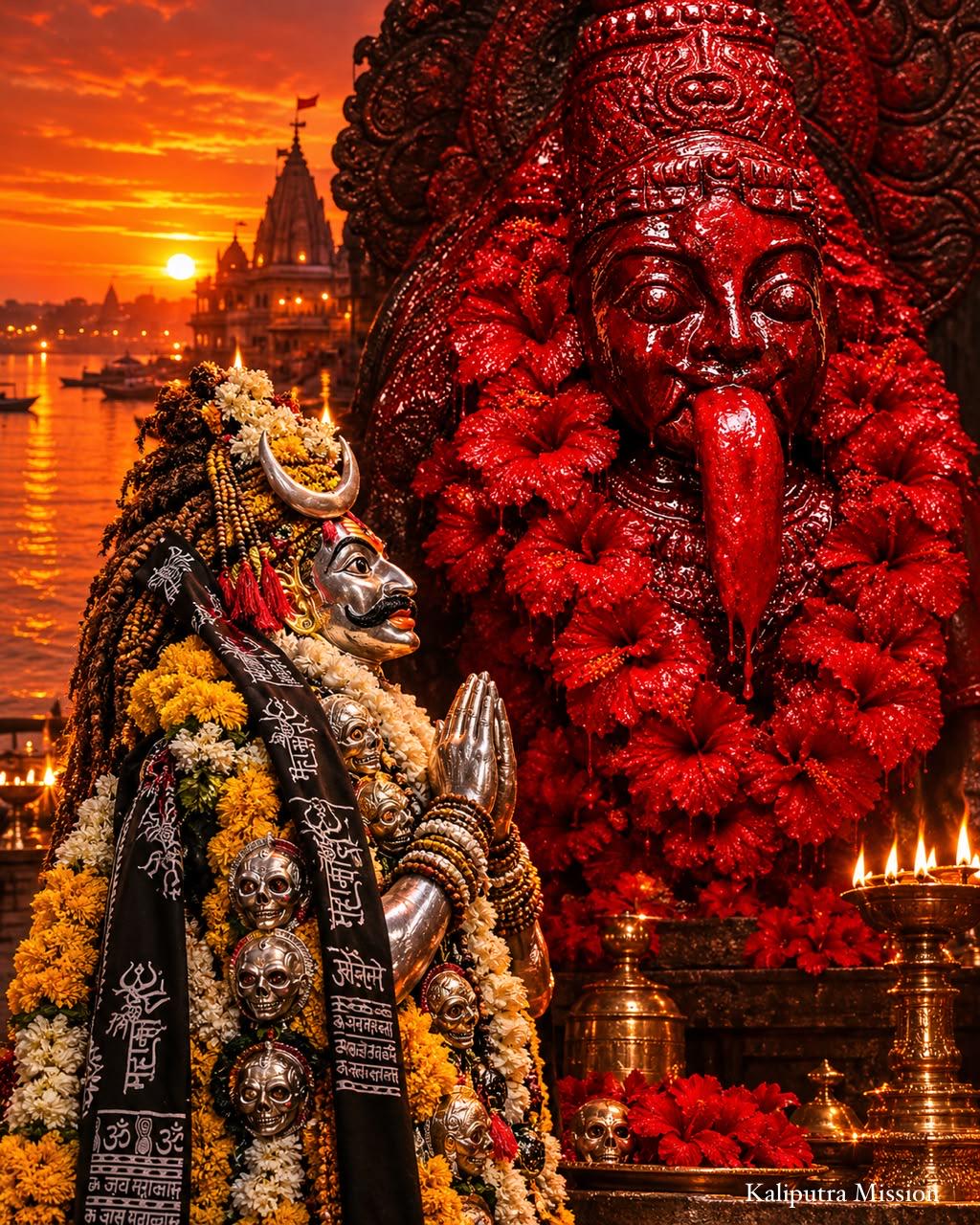
After explaining the maṇḍala, Śiva describes the first form of Tripurā. This is one of the most striking descriptions in the chapter. The Goddess is radiant like a mass of sindūra and possesses three eyes and four arms. In her upper left hand she holds a flower bow, while her lower left hand carries a book. In her upper right hand she holds five arrows, and in her lower right hand she carries a rosary. She is seated upon a group of five corpses, with her hair arranged in a matted crown adorned with a crescent moon. The text describes her as possessing a beautiful form, adorned with ornaments and displaying the splendour of the Divine Mother. Her appearance is both extraordinary and deeply connected with the esoteric symbolism of the Tripurā tradition.
The worshipper is instructed to meditate upon this form and then perform the prescribed internal worship before invoking her externally. The text describes the placement of the mantra within the body, the offering of flowers and the invocation of the Goddess into the sacred maṇḍala. The worship also includes Gaṇeśa, the various guardians, the Batukas and the Yoginīs associated with the sacred arrangement. The four forms of Batuka, identified as Siddhaputra, Jñānaputra, Sahajaputra and Samayaputra, are mentioned. The text further describes the worship of the Kanyā and other associated divine attendants.
The chapter then gives a detailed account of the Yoginīs associated specifically with Tripurā. Among the names mentioned are Bhagamālinī, Bhagodarī and Bhagarohā, along with the Ananga Yoginīs. These include Anaṅgakusumā, Anaṅgamekhalā, Anaṅgamadanā, Anaṅgamadanāturā, Anaṅgaveśā and Anaṅgamālinī. Madanāṅkuśā is described as the eighth manifestation. The eight forms associated with Śailaputrī and the other Yoginīs are also included in the worship. The text then describes the Kṣetrapālas and the different Bhairava manifestations surrounding the maṇḍala, including Hetuka, Tripuraghna, Agnijihvā, Agnivētāla, Kāla, Karālaka, Ekapāda and Bhīmanātha.
Śiva further describes the nine Bhairava manifestations, including Asitāṅga, Ruru, Caṇḍa, Krodhonmatta, Bhayaṅkara, Kapālī, Bhīṣaṇa and Saṃhāra. Their respective positions within the maṇḍala are prescribed, together with the worship of the associated divine powers. The text also includes Brahmāṇī, Bhairavī, Māheśvarī, Kaumārī, Vaiṣṇavī, Nārasiṃhī, Vārāhī, Indrāṇī, Cāmuṇḍā and Caṇḍikā. The five manifestations of Śiva previously described are also included in the central arrangement. The chapter refers to them as having assumed the five-preta forms within the lotus. The red lotus, the sacred corpse and the lion are also worshipped as part of this arrangement.
After describing these deities, Śiva introduces the other sacred locations and attendants associated with Tripurā’s abode. The text mentions Kāmeśvara, Karāla, the Kṣetrapāla, the Cintā tree, the Trikūṭa mountain and Nīla Mountain. Manobhavā Guhā is described as a sacred cave, while Aparājitā is associated with a divine creeper. Batuka, known as Kambala, is also described, along with Pāṇḍunātha and the fierce cremation-ground manifestation known as Heruka. Mahotsāhā, identified with Mahāmāyā, is another important presence in the divine arrangement.
Śiva then describes the city of Candravatī, situated towards the eastern side of Nīla Mountain. The city is described as extending over a vast area and containing numerous magnificent buildings, palaces and mansions decorated with jewels, precious stones and gold. It is also surrounded by beautiful pleasure gardens and lakes. The sacred river Lauhitya, the Brahmaputra, is described through its divine manifestation. The river is personified and worshipped as a deity, adorned with ornaments and carrying divine attributes. These descriptions show that the sacred region of Tripurā is not limited to the central maṇḍala but extends into an elaborate divine landscape.
The chapter then returns to the meditation of Tripurā and describes her second form. She is radiant like the red bandhūka flower and is adorned with matted hair and a crescent moon. Her appearance is youthful, beautiful and resplendent. She possesses three eyes and four arms, with a book in her left hand and a rosary in her right. Her other hands display the gestures of fearlessness and the granting of boons. She wears a garland of heads that extends towards her feet and is described as standing near a wish-fulfilling tree in a beautiful grove. Her form is associated with the fulfilment of desires and divine beauty.
Śiva then proceeds to describe the third form of Tripurā, telling Vetāla and Bhairava to listen carefully. This form is radiant like the red hibiscus flower. Her hair is loose, and her face is beautiful and smiling. She is seated upon the heart of Sadāśiva, who is described as lying beneath her like a corpse. She wears a garland of severed heads mixed with red lotuses, extending down towards her feet. She is four-armed and three-eyed, holding a rosary and a book, while her other hands display the gestures of granting boons and fearlessness. The text describes her as Jagadmāyā, the great deluding power of the universe. Her appearance is fierce, beautiful and extraordinarily powerful. This third form reveals another dimension of Tripurā, in which the Goddess is established above Sadāśiva and manifests her supreme Śakti.
Having described the three forms, Śiva explains that the worshipper should contemplate each of them individually and then unite their worship through the prescribed mantra procedure. The three aspects are associated with Vāgbhava, Kāmarāja and Ḍāmara. Each form is worshipped with the sixteen traditional offerings, both through internal meditation and external ritual. The Goddess is then invoked into the maṇḍala through the prescribed procedure, and the text gives the corresponding invocations and Gāyatrī prayers associated with the three manifestations. The worshipper is instructed to bathe and honour each form before performing their combined worship.
The chapter continues by describing the remaining deities and attendants associated with Tripurā. Brahmā, Mādhava, Śambhu and Bhāskara are worshipped in the prescribed positions, together with Jayantī, Aparājitā, Vijayā and Jayā. Kāma, Prīti and Rati are also worshipped within the triangular arrangement, along with the five arrows, flower bow, book, rosary and other sacred attributes. The text then describes the completion of the worship through japa, hymns, prostration and the prescribed offerings.
Finally, Śiva explains the conclusion of Tripurā’s worship. The offerings are made according to the prescribed ritual tradition, and the Goddess is honoured through the appropriate gestures and offerings. Caṇḍikā is identified as the deity who receives the remnants of the Goddess’s worship. The prescribed mudrās, including the yoni-mudrā and padma-mudrā, are performed before the worship is brought to its conclusion. The chapter ends by declaring that whoever worships Tripurā, the Goddess of Kāmarūpa, according to this prescribed method obtains the fulfilment of desires and ultimately reaches the world of the Goddess.
Thus, Chapter 63 of the Kālikā Purāṇa takes the worship of Kāmākhyā into a more elaborate Tantric understanding through her Tripurā manifestation. It describes the sacred yoni-maṇḍala, the sixty-four Yoginīs, the various Bhairavas, the guardians and the three forms of Tripurā. The first form reveals her as the radiant Goddess bearing the flower bow, five arrows, book and rosary, seated upon five corpses. The second reveals her beautiful and youthful manifestation near the wish-fulfilling tree, while the third presents her in a more fierce form, seated upon Sadāśiva. Through these three manifestations, the chapter reveals the many dimensions of the same supreme Śakti.
Jai Maa Adyamahakali


r/TantraMarg • • 13d ago

Do we teach you how to find stability in the inner dimension?

1 Upvotes

r/TantraMarg • • 14d ago

Tantra Shastra English pdf translation of Yoga Vashishta by Dr. BL Atreya and Viveksar by Baba Kinaram ji

Thumbnail reddit.com
1 Upvotes

r/TantraMarg • • 15d ago

A free library of stotras and kavachas with meaning, checked against printed editions (and open to your requests)

7 Upvotes

Namaste everyone,

Shubh Diwali to all Tantrasadhaks.

Full disclosure: I run AstroShala. We have a Free Downloads section, and I hope it will be useful to people here who recite stotras, kavach, namavalih, etc., or are just starting out.

What's there now:

- Bhairav: Kala Bhairav Ashtakam, Batuk Bhairav 108 Names (stotram and namavali), Batuk Bhairav Kavacham, Batuk Bhairav Brahma Kavacham, Kshetrapala Bhairav Ashtakam, Bhairav Stava, Shri Bhairav Dev Aarti, and the Batuk Bhairav vidhi from the Sharada Tilaka

- Devi: Siddha Kunjika Stotram, Gupta Siddha Kunjika, Brihat Maha Siddha Kunjika, the 32 names of Durga, Kamakhya Dhyanam and Stotram, Kamakhya Kavacham, Kali Shatanama Stotram

- Shiva: Rudrashtakam, Dvadasha Jyotirlinga Stotram

- Narasimha: Narasimha Kavacham, Rinamochana Stotram, Narasimha Stuti

- Navagraha: Jayaditya Ashtakam (Sun), Brihaspati Stotram (Jupiter)

- A plain guide to rishi, chhandas, devata, viniyoga and nyasa

Each text comes in Devanagari, with IAST and the meaning of each verse, and many are printable PDFs. Everything is free to download.

If a stotra, kavach or namavali you recite isn't there, comment below, and I'll prepare it. More are on the way, so it's worth checking back.

#Why I'm doing this, when other sites already offer free stotras:

Most texts online cite no source, credit no rishi or composer, and carry typos copied from site to site, often from old Hindi fonts that were converted badly. To me, leaving out the source goes against the spirit of Sanatan Dharm. The tradition names the rishi, chhand and devata before a recitation for a reason.

Many people also have no guru or mentor. They start from a video or a forwarded message, without knowing what the viniyoga is, why the rishi, devata and chhand (anushtubh, gayatri, trishtubh) are named, what a bija akshara does, or how a samput recitation works. So I check each text against a printed edition, credit its rishi or composer, name its source, and note where readings differ. A text can't replace a guru, though. For bija mantras and sadhanas, please find a guru.

#How you can help:

- If you spot an error, tell me the verse and the edition you follow, and I'll correct it gladly.

- If your family or parampara has a good printed edition of a text, point me to it.

- Suggest the texts you'd like added.

- Share the library with anyone who'd find it useful.

This is my humble offering, with Baba Shri Kaal Bhairav's blessings.

Jai Shri Kaal Bhairav

https://astroshala.com/free-downloads/


r/TantraMarg • • 15d ago

✨ Have a blessed Diwali ✨ 🙏 Om SriMahaLakshmyai Namah 🙏

2 Upvotes