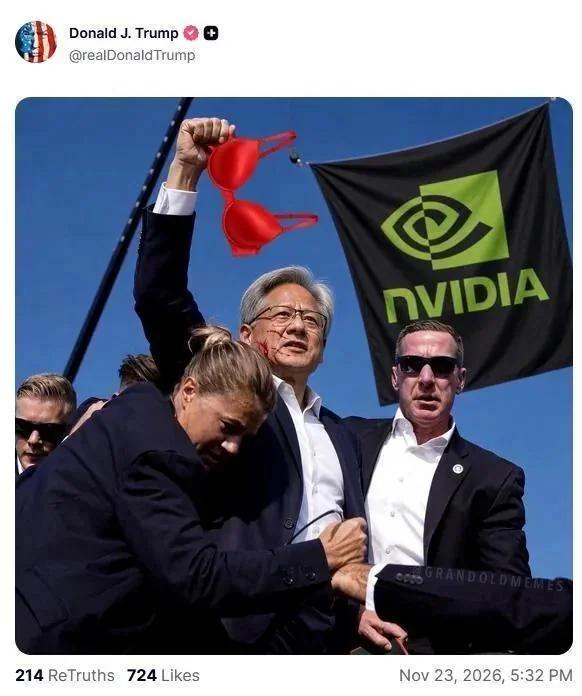
I've been following Jensen Huang's sudden resignation from Nvidia, and I believe there's a possibility that his scandal was strategically exploited by powerful interests within Washington's national-security establishment. My theory isn't necessarily that the allegations were fabricated, but that an existing controversy was amplified or weaponized to remove an influential CEO whose policies conflicted with government and corporate interests. According to The Washington Post, Secretary of State and National Security Adviser Marco Rubio prepared a memorandum warning Trump about Huang's relationship with a suspected Chinese intelligence asset. One source alleged that Rubio characterized the underlying CIA intelligence more assertively than the evidence supported, although the State Department disputes this. CNN subsequently reported that intelligence officials remained divided over whether the woman was actually working for Chinese intelligence. Meanwhile, Reuters reported that Huang had misrepresented aspects of the relationship to Nvidia executives, giving the board legitimate reasons to investigate. The question isn't whether Huang committed misconduct, but whether that misconduct was deliberately exploited to accomplish a larger political objective.
Consider Huang's position in Washington. He had become one of the most influential voices advocating continued American semiconductor sales to China, arguing that maintaining Chinese dependence on American technology could be strategically preferable to forcing China to develop alternatives. This directly conflicted with national-security officials pushing tougher export restrictions. The Washington Post documented these disagreements and the frustration surrounding Huang's influence over Trump. His resignation on November 11 removed an important opponent of stricter restrictions. Just days later, on November 16, Washington announced additional restrictions on Chinese access to American AI computing through overseas data centers. On November 17, Nvidia established a new board-level National Security and Export Control Oversight Committee to strengthen oversight and government engagement. These developments have independent explanations, and there's no evidence Huang's resignation caused them. Nevertheless, the outcome aligned with the priorities of officials who had opposed his approach to China.
Now consider the timing of Anthropic's IPO and the financial interests involved. Anthropic filed its IPO registration on October 26, announced its investor roadshow beginning November 10, and was preparing for a November 19 public listing. Huang's resignation became public on November 12, almost directly between those milestones. On October 27, the General Services Administration also announced an expanded purchasing arrangement giving federal agencies discounted access to Anthropic's Claude models. Although this arrangement guaranteed no minimum revenue, expanded government access could strengthen Anthropic's commercial prospects ahead of its IPO. This is especially interesting because Anthropic previously faced serious opposition from the Pentagon over disagreements about military applications of its technology. The administration clearly wasn't uniformly supporting Anthropic, but the timing of the renewed purchasing access and public offering still deserves examination.
There's another connection that I believe deserves even more attention. On November 17, Business Insider published an article titled "Jensen Huang was building Anthropic's worst nightmare. Then he was ousted." Under Huang, Nvidia had invested heavily in open-weight artificial intelligence models, including its Nemotron family, and had entered an approximately $11.9 billion agreement to acquire Hugging Face. Huang promoted an AI ecosystem allowing businesses to customize and run models without depending entirely on proprietary services. That strategy potentially challenged the business models of companies such as Anthropic, which generate revenue by providing access to proprietary AI systems. Removing Huang could weaken the most influential advocate of that strategy, potentially benefiting competitors preparing to enter public markets. However, there's an important complication: Nvidia itself committed approximately $10 billion to Anthropic's IPO financing, meaning the companies are also financially interconnected. That relationship makes the situation more complicated than a straightforward Nvidia-versus-Anthropic rivalry, and there's no evidence Anthropic participated in Huang's removal.
Nvidia has since appointed longtime CFO Colette Kress as interim CEO while searching for a permanent replacement. Interestingly, Trump has publicly supported the possibility of Huang returning, while Treasury Secretary Scott Bessent has advocated leadership changes. This suggests competing interests within Washington rather than a single coordinated White House position. But it also raises a larger concern about the extent to which government officials might seek to influence the leadership and strategic direction of a private company that controls technology critical to American military, economic, and AI capabilities. Nvidia's future CEO will inherit enormous influence over semiconductor exports, AI development, and America's technological competition with China.
Here's my theory: Huang became an obstacle to influential political and corporate interests because of his China policies, his independent influence in Washington, and Nvidia's expanding open-model AI strategy. When damaging allegations emerged, those interests may have recognized an opportunity to accelerate his removal and reshape Nvidia's direction. I cannot establish that officials coordinated the intelligence disclosures, pressured Nvidia's board, or selected a replacement CEO. Nor is there evidence that Anthropic organized or participated in such an effort. Those are the missing pieces necessary to prove a coordinated PsyOp. But the documented political conflicts, disputed intelligence assessments, competing financial interests, government-policy changes, and extraordinary IPO timing make the possibility of political exploitation worth investigating. I believe this scandal may ultimately be about far more than Huang's personal conduct. It may also be about who gets to influence America's AI industry, its technology policies, and the companies shaping its future.