Reminder: We limit participation to community members who have their user flair assigned which displays their location. Members who do not meet this criteria will have their comments automatically removed.
r/vegetablegardening is an educational subreddit focused on learning how to grow food and connecting gardeners around the world. Community members are encouraged to mentor others when possible.
Jump into the comments to ask and answer questions, post that meme your weird non-gardening friends won't understand, share photos of your adorable cat destroying your tomato transplants, share a great YT channel or podcast, or simply tell us what you did today.
Comments are sorted by new to keep the conversation fresh.
Despite a strict schedule of neglect and abuse through the growing season, including the longest drought and hottest summer on record, my 2 dozen tiny tubers produced over 30 gallons of food.
Not sure how to best store them. I'm considering spagum moss in a large tub in the shade. Any suggestions?
My tomato season was over by late July. NE Texas. It was just way too hot, even when employing all the usual accommodations (shade cloth, mulch, frequent waterings, etc.) I cut the plants down to about shin high, figured I would pull them up the following weekend. Something came up, and I didn't get around to it. By the last part of August, several of them, one Black Krim, one Chef's Choice Black and one sturdy Big Beef hybrid had started putting out serious new growth.
Conditions were not favorable, but I figured there was no harm in just leaving them alone and seeing where they might go. Watered them from time to time, but not much else. Meanwhile, the tomatoes I planted specifically as a fall crop ran into all sorts of trouble and died a sad death despite my fussing over them daily like a Helicopter Mom.
Yesterday, I decided to pick these hardy green fruit and make some pickles because we have freezing temps forecast for tonight. The Black Krim plant, looking like it had barely survived World War 2, half-way falling down, tons of dead leaves and broken stems, still had 24 small and medium sized fruit with only the usual amount of heirloom scarring and cracking.
The Chef's Choice Black next to it was in equally pitiful shape, but also had lots of usable green fruit. Counted as I was picking them: 26 decent tomatoes that were bigger than cherry size.
So pickles were on the agenda this morning. Two quart jars from the Krims, and haven't decided yet how to handle the Chef's Choice. Might make a curry or a stew out of them.
Photos: Black Krim on the vine a couple days ago. Chef's Choice Black 2.5 lbs. Two quart jars of Black Krim pickles.
This wonderful, expertly designed diagram shows my current garden area. This sits along the south side of my house between it and the property line. Long story short the area is approx 23ft long by 7ft wide with some interesting restrictions (property line, crawlspace vents, and the house and fence).
I currently grow a rotation of peppers plus a tomato or two in the raised bed itself and have a few grow bags with more peppers/tomatoes to either side of the bed. I grow 2 staggered lines of plants and while I can easily reach the back my much shorter wife has a harder time of it.
I'm wanting to expand or at least redesign the current bed for ease of access as well as potentially allow for a wider variety of vegetable plants to be grown (ie adding a trellis system for the larger tomatoes or things like that). I'd also like the possibility of having an area for some strawberry plants. There is grass down this stretch between the garden and property line which can be utilized. I'm on good terms with the neighbor but would still like to be respectful of the property line and allow for him to mow.
Does anyone have any creative ideas for how to utilize this space using raised beds?
a few months ago, i noticed that there suddenly appeared a bunch of this plant on the side of the street in the city where i live. to me, who doesn’t know much anything about vegetable gardening, they look like a type of kale. but they are right next to a busy driving street and people also let their dogs out here. so i wonder whether the municipality would do this and why!
Okay... I posted 24 days ago about bringing my Tobago pepper plant into the garage because we started getting frost here in central Ohio. On days above 60 F or with bright hot sun, I have been wheeling the plant out to sit in the sun then in evening (or rainy, windy cooler days) we have kept it in the garage under grow lights. I am SO pleased with how many more peppers I will get to harvest! 4 or 5 bright red, a number of nice orange, a few getting yellow. I also discovered the garage has a heat vent near the back that's been buried behind a storage shelf so that's where I might place the pot to overwinter once snow starts. Thanks so much to those who suggested winterizing. I am very excited to put this plant to bed and get a jump on next year!
Hi all, I grew a number of different tomatoes this year but a few did terrible, one of which being Opalka (which I was very sad about). What varieties of paste tomatoes work best for you (in terms of yield and doing the whole paste tomato thing)? I’m in zone 6A.
For the second year in a row, a portion of my harvest has had pink or purple skin discolorations, on otherwise firm, healthy looking spuds.
Two of the affected varieties are normally white fleshed and light brown or pale skinned. One variety has developed pink around the eyes (<2% of crop), while another has developed large irregular patches of dark purple, often on the side of the potatoes that was 'facing up' while growing (10~ % of crop). The discolorarion is present when harvesting and does't seem to change under storage. I also have a pink-skinned variety that gave me a few spuds with dark purple (almost black) discolorations (<2% of crop). It appears to be strictly skin pigmentation. The tubers are otherwise firm, healthy, and normal.
I have been treating them as though they are green potatoes, but I struggle to find info about this online. What causes this? Is it a disease or a benign reaction to growing conditions, and is it safe to eat?
Give me your best all purpose veggie and fruit fertilizer recipe or brand you buy Want to see what all yall super gardeners are doing. Everything I grow turns out small or low yield and I know it’s cause I don’t use any fertilizer but I don’t know what to do and can’t buy a lot of stuff.
I had 8 Swiss chard plants, mostly green and one other pink variety, this is the only one with these hairy things on it. It’s on the stem and the leaf. It’s also more thick and tough on the leaves. It was growing next to rhubarb. What could cause this? Is it edible?
I transplanted my cherry tomato seedling 3 days ago. Now the stem is getting darker and thinner. It’s also dropping. This has happened for the second time. What do I do??
I need to clean these carrots inside. I can dump the water outside. What are your secrets to getting them clean? There's got to be an easier way than scrubbing each one with a scrubbie.
I posted a short note about Tatsoi earlier this week and it seemed like there was considerable interest in this delicious yet little-known vegetable. So today it’s Saturday, and I have time to take you through a harvest in more detail. I realize that in this age of Tik Tok and “instant everything," long posts are unfashionable. So feel free to just skip around and find any parts that might be of interest to you, ignoring the rest. You won’t hurt my feelings.
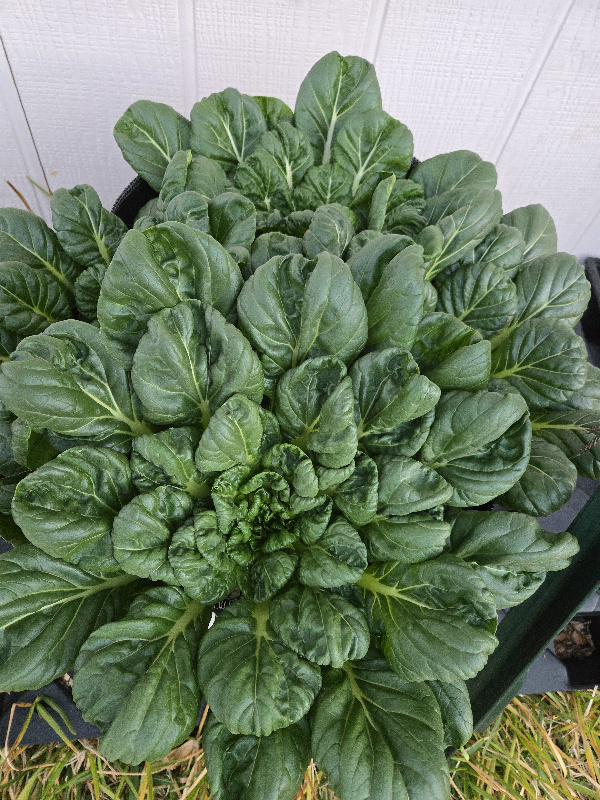
I first and foremost wanted to show you just how heavily tatsoi likes to be harvested and how fast it grows back. First snapshot is from this morning, Saturday 21 November, showing a container of tatsoi that has never been cut since planting, back on 18 October. These were 3-inch seedlings that I started indoors about 3 weeks prior because the soil was too hot for direct seeding. (We had an unusually warm fall, NE Texas.)
This morning, 21 November, before harvest
Second snapshot is after harvesting (the same grow bag.) I have cut back the plants pretty severely, only leaving 4 or 5 fully-formed but small leaves intact. I’ve also cut away any long empty stems and any leaves that are touching the ground. I’ve pulled a few adventitious weeds. Note that this whole 25-gallon grow bag was chocked full of healthy leafy growth from only 4 plants. If I had planted more, they would have been competing with each other for essential resources and would have been more prone to a wide range of developmental problems.
The same grow bag, after harvesting, 21 November
For comparison, here is a neighboring container of Tatsoi that I harvested on Monday of this week. You can see how much it has recovered and regrown in the 4 days since then.
Harvested 4 days ago, "cut-and-come-again" method
This is a shot of the small leaves, showing their size relative to the palm of my hand. By mid-December, these leaves will be 2 or 3 times as large, thicker and tougher. Right now, they are perfect for salads. Later, they are better if cooked.
Small leaves early in the season are tender
This morning’s single grow bag yielded two baskets of green leaves.
This morning's harvest, before blanching
Took them inside, washed them well, then put them in a large bowl and covered them with boiling water from my tea kettle. This will blanch them. I let them cool off until the greens became easy to handle. Usually takes close to an hour. At that point I scoop them out by the handful and squeeze out the water. Didn’t matter today, but if I had been in a rush, I would have speeded the process by adding ice cubes after a few minutes. Next, remove most of the water. I don’t twist and wring them like a dishrag, but I do squeeze them hard. Then I chop them medium fine.
Blanching the tatsoi with boiling water from my tea kettle
I spread out the chopped Tatsoi in a one-gallon zip-lock freezer bag and seal it after pushing out most of the air. By freezing them flat like this, it’s easy to break off just a few greens for lunch or supper and reseal the bag to keep the rest for later.
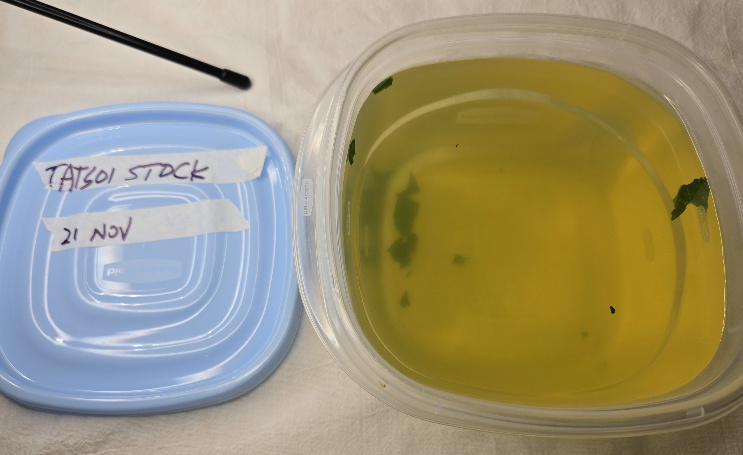
Please don’t throw out the blanching juice. It’s great as a soup base, adds flavor and nutrients. I also often use it to cook rice.
Now I will go fertilize the Tatsoi and my other greens. They are all at the stage of heavy production since the weather has cooled off and sunshine is abundant. I want to keep them well-nourished so they can rebuild leaf biomass promptly and remain healthy despite my aggressive harvest routine (“cut-and-come-again” about once a week.)
FWIW, I will be taking the heretical step of using my favorite tomato fert cocktail for these cool-weather greens. Masterblend 4-18-38 with supplemental Magnesium Sulfate and Calcium Nitrate. It will supply enough nitrogen, since the Calcium Nitrate contributes N to the main product. I will use it half strength and apply it once every 7 to 10 days so as not to overload the growing medium with soluble salts.
Tatsoi is such a fine fall vegetable and surprisingly, it seems to adapt easily and do well in a wide variety of climates. I see growers on Reddit extoling its virtues in New England and Canada as well as in Ohio and California and of course here in Texas where I grow it every year.
r/vegetablegardening is an educational subreddit focused on learning how to grow food and connecting gardeners around the world. Community members are encouraged to mentor others when possible.
Jump into the comments to ask and answer questions, post that meme your weird non-gardening friends won't understand, share photos of your adorable cat destroying your tomato transplants, share a great YT channel or podcast, or simply tell us what you did today.
Comments are sorted by new to keep the conversation fresh.