r/webdev • • 1d ago

Showoff Saturday [Showoff Saturday] I built a real-time multiplayer board game on Cloudflare Workers + Durable Objects

4 Upvotes

Landgrab is a free Monopoly-like game for 2–8 players or play with bots: https://landgrab.top

Stack:

- Game engine is pure TypeScript with a seeded RNG, shared by server, client and bots

- One Durable Object per room over WebSockets, with SQLite for accounts, stats and game logs

- React + Vite frontend, deployed as Worker static assets

- A simulator plays thousands of bot games to catch rule bugs and check board balance

Happy to answer questions about the architecture.


r/webdev • • 1d ago

Showoff Saturday I built an interactive underwater depth preview with Web Audio & vanilla JS for a minimal audio scratchpad page

1 Upvotes

I wanted a landing/preview page that feels like the concept itself instead of a generic SaaS template, so I put together https://whitealpaca.tech/#iceberg.

The idea behind the project: an offline-only scratchpad for unfinished song fragments where ideas "sink" out of sight and resurface later. On the web page, I built an interactive depth preview (#deep) with glowing depth markers (3 weeks ago down to 2 years ago) that surface sample lyric fragments and play a hummed audio sketch directly in the browser.

Looking for technical & UX feedback from web devs:

  1. Does the interactive depth preview feel intuitive on first load, or do people miss that the light nodes are clickable?
  2. How does the layout/scroll pacing feel on mobile vs desktop?
  3. Anything in the typography, contrast, or above-the-fold clarity you'd change?

r/webdev • • 1d ago

Showoff Saturday All 2,000+ wordles at the same time

Thumbnail
everydle.jakeo.dev
4 Upvotes

For when dordle, quordle, octordle, sedecordle, duotrigordle, and sexagintaquattordle aren't enough.

GitHub: https://github.com/jakeo-dev/everydle [human made]


r/webdev • • 18h ago

Showoff Saturday [Showoff Saturday] I built a Windows terminal for running AI coding agents with Electron, React and xterm.js. The hardest part wasn't the AI.

Post image
0 Upvotes

I run 3–4 AI coding agents at once (Claude Code, Codex) and kept missing the one waiting for my permission in a background tab. So I built SplitNest, an open-source terminal workspace for Windows.

What it does:

- Project workspaces with split PowerShell and WSL panes

- Each tab shows the agent's state: Working / Needs you / Done / Error, plus a notification and one inbox for waiting agents

- Each agent can run in its own Git worktree, with a live diff and one-click merge

The web-tech lessons were the interesting part:

  1. Keep terminals outside React. Each xterm.js instance lives in a plain controller object that owns its DOM element; React only attaches and detaches it. Splitting panes, switching workspaces or StrictMode double-renders never recreate a terminal or kill a shell, and terminal output never goes through React state.
  2. Never call fit() inside requestAnimationFrame with xterm.js's WebGL renderer. The canvas gets cleared one frame before it's redrawn, so you get a visible flash on every resize. A normal timer fixes it.
  3. Resizing on Windows is its own battle. ConPTY redraws the whole screen after a resize and expects lines to re-wrap the way the old Windows console did, which xterm.js doesn't. I ended up with a resize protocol: one resize in flight at a time, the PTY confirms the new size before xterm resizes, and the console's redraw is held until it's safe.
  4. Run the shells in a separate process. All PTYs live in an Electron utility process, so a misbehaving shell never freezes the UI.

Stack: Electron, React, TypeScript, node-pty, xterm.js, CodeMirror 6, Vite, Vitest, Playwright. MIT licensed, no telemetry.

GitHub: https://github.com/chafian/splitnest

Full write-up: https://dev.to/chafian/i-built-a-windows-terminal-for-running-ai-coding-agents-in-parallel-heres-what-i-learned-169b

Happy to answer questions about xterm.js, node-pty or Electron packaging. Has anyone else fought ConPTY resizing?


r/webdev • • 19h ago

Showoff Saturday I started ClientPDF with almost nothing. Now people from around the world are using it. Honestly, I didn't expect this.

Post image
0 Upvotes

When I started working on ClientPDF, I didn't have a company, a team, or any funding. I just wanted to build a PDF tool that people could use without having to upload their private documents somewhere.

I kept working on it, adding tools, fixing things, and listening to people who took the time to try it and share feedback.

Somewhere along the way, something really nice started happening.

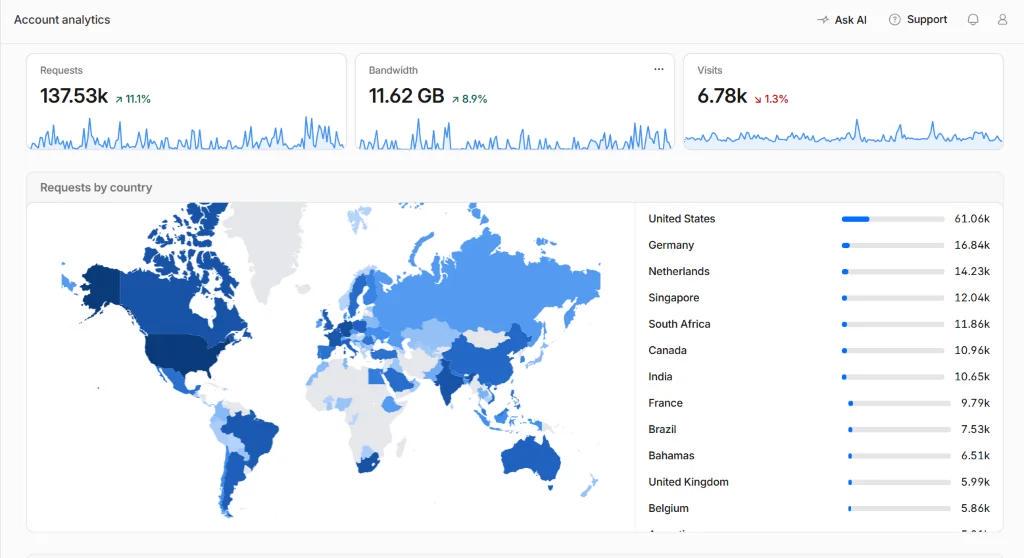
I'm now seeing people visit and use ClientPDF from countries like the USA, Canada, France, Germany, Singapore and many others. People I have never met are trusting a project I built on my own for their everyday PDF work.

It's now getting around 1,000 visits a day. I honestly never imagined reaching this point when I started.

A lot of this happened because people here and elsewhere gave honest feedback. Some pointed out problems, some suggested improvements, and some simply encouraged me to keep going. That helped ClientPDF become much better than where it started.

If you haven't tried it yet, here's the website:

https://clientpdf.tech

I'd genuinely appreciate it if you tried a few tools and told me what works, what doesn't, or what you think needs improvement. Honest criticism is welcome.

One small personal thing: I'm still a student, and I manage the project and its expenses myself. Keeping the website running isn't free, and the domain is due for renewal in April. I don't currently have a dedicated budget for it.

If anyone finds ClientPDF useful and would like to support its continued development and help keep the free version running, there's a support option on the ClientPDF website. There's absolutely no pressure. Even using it, sharing feedback, or telling someone about it helps a lot.

Thanks to everyone who has tried it, shared feedback, or supported this little project in any way. I really appreciate it.


r/webdev • • 19h ago

Showoff Saturday I built a CLI that runs any branch or PR of your project side by side, each on its own port

Thumbnail
testlane.dev
0 Upvotes

I've built a small CLI to help me review and test PRs at work. Reviewing typically means stopping my work, checking out branches, reinstalling dependencies and restarting the dev server, then undoing all of that afterwards, which is very time-consuming.

Testlane runs any branch, PR or commit of a project on your machine with one command. Each branch or PR gets a workspace of its own, with its own ports.

Day to day usage looks like this:

# Run PR #4242 next to some-branch, each on its own port
testlane myapp 4242 start dev 
testlane myapp some-branch start dev

# Open PR #4242 in your editor of choice
testlane myapp 4242 code

# Clear out the workspaces whose branches merged into main
testlane myapp clean --merged

To set it up:

npm i -g @uxfront/testlane
testlane setup --name myapp --repo git@github.com:you/myapp.git --detect

The detect flag guesses your project's commands and writes them to ~/.testlane/myapp.toml. It marks every line it wasn't sure about with # guess: or # note:, so you can check those before you run anything.

If you want to use a coding agent like Claude Code for the setup, you can hand it the following prompt:

Set up Testlane (https://testlane.dev), a CLI that runs any branch or pull request of my project in a workspace of its own, so you can run and check changes for me.

1. Install it with `npm i -g @uxfront/testlane`, then check that `testlane version` prints a version.
2. Read https://testlane.dev/raw/docs/getting-started/agents.md and follow its agent instructions from now on.
3. Add this repository as a project with `testlane setup --name <name> --repo <git url> --detect`. Don't pass `--yes`.
4. Show me each line marked `# guess:` or `# note:`, so I can check it.

It's early, so I'd like to hear where it breaks or what's confusing, especially on projects with unusual dev setups.

I hope it helps you as much as it helps me!

Note: The homepage copy is mostly AI-generated for now. I'll rewrite it properly soon.


r/webdev • • 19h ago

Showoff Saturday [Showoff Saturday] My side project directory, looking for honest feedback

Thumbnail
gallery
0 Upvotes

Built this on the side and it kind of took off on the submission end, around 1,200 projects last month. I get why. It's free and takes a couple minutes, so of course people send stuff in. The site gets 30 - 50 submissions a day. Getting anyone to actually read the pages is a different story, and that's what I'm trying to fix now. I want it to be a place people go to find cool small projects, not just somewhere founders drop a link.

https://getprojectradar.com

You submit your project and it gets its own page explaining it. Free, and nobody can pay to get a better write up.

Right now the site averages about 140+ visits a day based on my on site analytics. Google Search Console shows 500 or so impressions a day with single digit clicks and an average position in the low 20s. Impressions took off at the end of October. The site is about 6 months old right now.

Mostly looking for first impressions and ways to improve. Can you tell what it is from the homepage? Are the project pages ok to read on a phone? And if you tried submitting something, where would you give up?

Next.js on Cloudflare if anyone asks. Also yes, I used AI to help build it, but I tried hard to keep it from looking like straight slop. I'm a rookie at best so go easy on me. Or don't.


r/webdev • • 19h ago

Html to .apk for myself

0 Upvotes

Hi,

Compleet noob. Just learning step by step.

I build myself a very simple html file. It opens in Chrome and lets me count stuff.

I have it as a shortcut in my homescreen. But is it a html icon.

Now I want to build it into an apk. So that is a real app on my phone.

Can I this with htmltoapk.dev? And is it safe?


r/webdev • • 15h ago

Discussion .gitignore everything by default

Thumbnail
packagemain.tech
0 Upvotes

r/webdev • • 17h ago

I reverse-engineered LinkedIn's private API so Claude and ChatGPT can use it

Thumbnail
gallery
0 Upvotes

linkedin has no public api for reading your own notifications, messages or comments. so i spent the last 3 months figuring out the private one their website uses

things i learned the hard way:

  • its not one api. its three. old REST endpoints, GraphQL, and React Server Components actions from their new web app
  • the csrf-token header has to equal your JSESSIONID cookie. otherwise a bare 403, no explanation
  • comment with the id the feed gives you and it doesnt work. you need the activity id
  • the REST comments endpoint quietly skipped 5 of 6 comments on a post. GraphQL returns all of them
  • pinning a comment can return 200 with "errors": [] and change nothing. now i check that something actually changed
  • the feed returns random posts unless you add sortOrder=RELEVANCE
  • i tested too fast once and linkedin rate limited my own account. now its one request at a time per user, with pauses

how its built:

  • an MCP server holds all the linkedin knowledge: endpoints, request shapes, parsing
  • a chrome extension that knows nothing. it runs the request from your own browser session and hands back raw json. no passwords, nothing logs in from a server
  • so when linkedin changes something, i fix it on the server. 20 fixes in the last 3 weeks, 0 extension updates

whats the weirdest thing you found reverse engineering a site?


r/webdev • • 1d ago

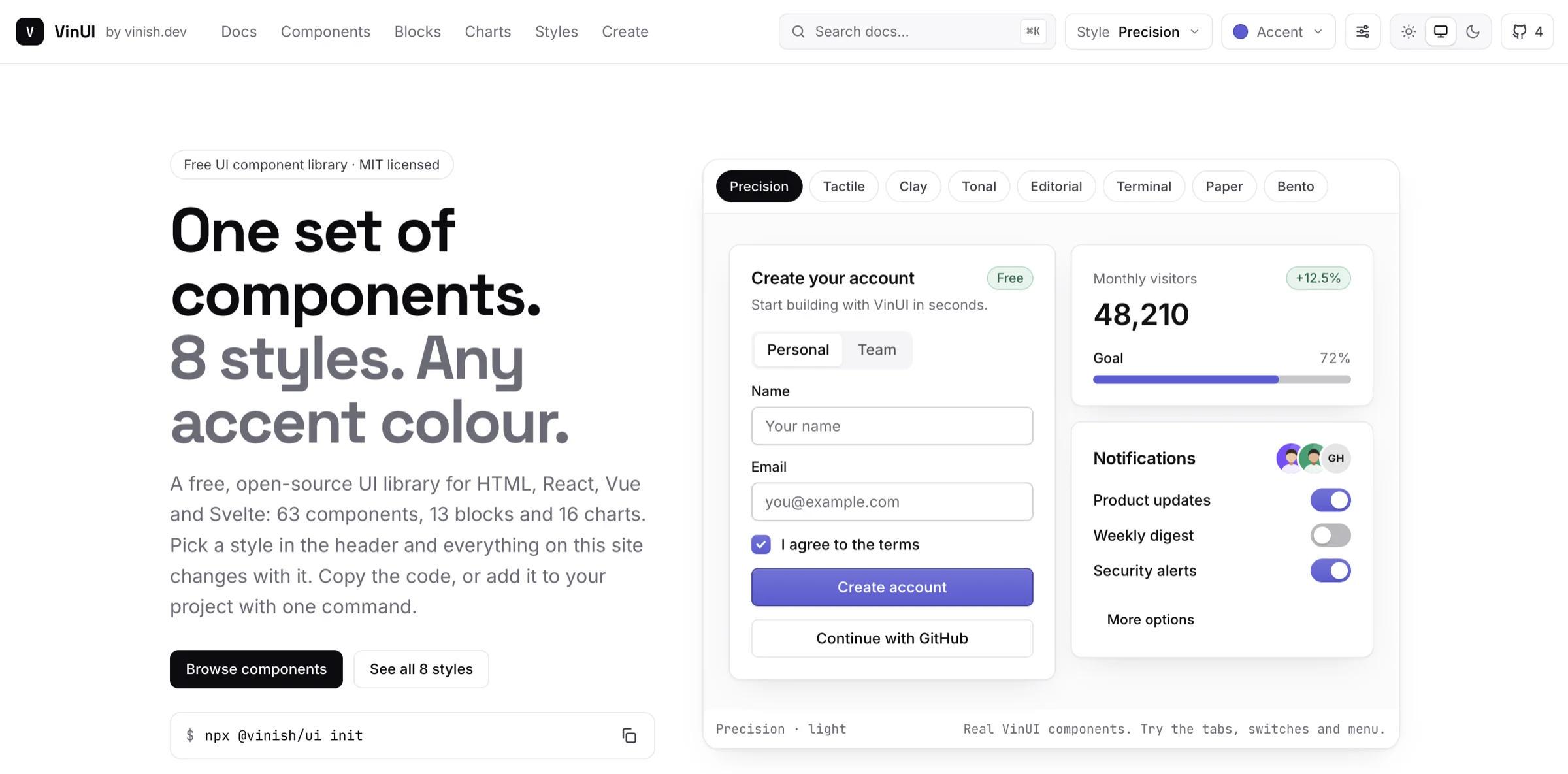
Showoff Saturday [Showoff Saturday] VinUI: an open-source component library where 8 visual styles share the same markup

Post image
0 Upvotes

I've been working on VinUI, an MIT-licensed component library for plain HTML, React, Vue and Svelte.

The main idea is that each of the eight styles (Precision, Tactile, Clay, Tonal, Editorial, Terminal, Paper, Bento) is only a set of CSS variables, so markup and props never change between looks. Instead of a runtime package, a CLI copies plain source files into your project:

npx /ui init
npx /ui add <component>
npx u/vinish/ui diff   # see upstream changes since you copied
  • 63 components, 13 page blocks and 16 plain-SVG charts
  • WCAG 2.2 AA checked in every style, light and dark
  • Works next to Tailwind or your own CSS

Repo: https://github.com/devvinish/vin-ui
Docs and live style switcher: https://vinish.dev/ui

Feedback welcome, especially on the theming approach and the copy-in model.


r/webdev • • 19h ago

Showoff Saturday [Showoff Saturday] Slotrunner, a 3D slot car racer built with React Three Fiber

Post image
0 Upvotes

Play: https://slotrunner.itch.io/slotrunner (free, desktop + mobile)

I've been building this racing game on my own for 2+ years, and the demo is now public. The car follows the slot, so there's no steering: you only control the throttle and have to find the right braking point for every corner.

Stack:

  • React + Vite, with React Three Fiber / three.js for the 3D
  • Zustand for game state
  • Tracks modelled in Blender and exported as glTF, with my own scripts that lint, export and optimize each track.

Where most of my time went: optimizations for performance and gameplay changes following playtest. I'm really happen with the performance and loading times on older devices.

I'd love feedback on performance on your device, and on how the first race feels.

I you have any questions regarding the technical parts: shoot!


r/webdev • • 21h ago

Showoff Saturday [Showoff Saturday] A web app for Magic: The Gathering Commander groups, plain PHP 8.4 + MariaDB, no framework

Thumbnail
gallery
0 Upvotes

I play Commander (4-player Magic) with friends and built a tool for our group: manage the playgroup, compare decks, plan game nights, and run a structured "what do we all expect from this game" check before playing.

Some things that were fun or hard:

  • No framework: PHP 8.4, MariaDB, vanilla JS/CSS on shared hosting. Small router, server-rendered views, CSRF on every form.
  • Card data: Scryfall bulk data imported locally (~30k+ cards) so deck analysis doesn't hit an API for every card.
  • Card roles: ~60 rules that classify cards from oracle text (ramp, draw, removal, tutors...). I built a benchmark of 40 sample decks to check archetype detection, went from 14/40 to 38/40 correct.
  • Combos: known combos come from Commander Spellbook instead of my own guesswork after my "find mana loops from card text" approach produced way too many false positives.
  • Privacy basics: self-hosted fonts, a strict CSP, and analytics only on the public pages and only after consent. Nothing is tracked inside the app.
  • Honest UI: no fake precision. No "power 7.4/10", just evidence and a lower bound.

Live at podbalance.gg (free beta). Happy to answer questions about the stack, and UX feedback is very welcome.


r/webdev • • 22h ago

Showoff Saturday My app changes how any window or screen on your computer looks, and I simulated it completely on my landing page

Post image
0 Upvotes

I wanted to show off my latest landing page experiment. Click the little knob at the top of dimmerswitch.app and the whole site turns into an e-reader page, a CRT TV or a painting. You can make it warmer and darker too.

It's what the app does to any window on your Mac, and I thought why not simulate it as best I can on the landing page.

Took a while to get it running smoothly without using too many resources (especially on phone browsers). Would love feedback and ideas for more looks to add!


r/webdev • • 23h ago

Showoff Saturday Complete Go stack for reactive web apps with agentic features for users

0 Upvotes

I have always been fascinated by the server-driven approach to web development (UI code runs on the server, the browser is extra thin), and I experimented with it throughout my career.

There aren't many server-driven stacks, and they can't compete with what the front-end JS ecosystem offers. I wanted to change that. It was much more complicated than I initially expected and took more than two years.

Layer 1: Templates

You may love JSX, you may hate it, but the ability to write HTML templates in code and treat them like code is a must-have for complex UIs. I tried templ, but it wasn't flexible enough: it lacked features like HTML as an expression (so it can be saved to a variable or passed to a function), and the LSP experience wasn't great.

Meet GoX. It lets you write HTML templates as typed Go expressions that compile to plain Go:

  • Seamless editor support: a near-native language server experience across .gox and .go files.
  • Full templating toolbox: conditionals, loops, composition and reusable components.
  • Extensible rendering pipeline: templates compile to a stream of render jobs, processable with custom printers.
  • templ compatible: gox.Elem implements Render(ctx, w) and drops in wherever a templ component is expected.

Why not contribute to templ? That was my original idea, but when I looked at its code base, I saw it had gone a completely different route in almost every way.

Layer 2: The framework

Doors is somewhat similar to LiveView (see the README for the differences). It lets you build reactive web apps without JavaScript or an API: the server is the application runtime, and the browser is the remote renderer and input layer. When the user presses a button, it triggers a Go function:

<button (doors.AClick{
    On: func(ctx context.Context, _ doors.RequestPointer) bool {
        order.Pay(ctx) 
        return true
    },
})>Pay</button>

Under the hood, it creates a private temporary endpoint, scoped to this particular event on this button for this particular user.

It has both reactive state and DOM containers, and ships a ton of useful features, like routing-free resource serving:

<img (doors.ResourceLocalFS("./private/chart.png"))>

Layer 3: Agent integration

Neui turns each user's page into an agent harness. You can think of it as a more powerful but specialized version of CopilotKit.

Demo GIF, recorded live from example in repo

The agent sees & operates the UI

Annotate what the agent can access (links, inputs, buttons), so the agent sees it and can help the user with UI operations, or even automate them with scripting.

~>neui.Use{ Desc:"submit the form" } <button>Submit</button>

or expose context data for the agent:

<div class="card">
    ~neui.Data{Text: "the product shown in the card", Object: product}
    ...
</div>

Dynamically dispatched tools, right in the markup

Same way as you render a button to the user, you give the agent a tool. No endpoints or lifecycle management needed.

~(if user.IsAdmin() {
    ~neui.Tool[Refund, Receipt]{
        Name: "refund",
        Desc: "Refund the order",
        Handler: orders.Refund,
    }
})

Work environment

Isolated file workspace and sandboxed scripting ("code mode") out of the box. Like a little brother of your local agent.

Agentic apps

When a user needs something your UI doesn't have, the agent builds it on demand, and it runs in your web app's shell.

Complete chat experience

Thread list, history, message edits, search, a message queue and automatic compaction. Use it as is, customize it or fork it.

Batteries included

MCP connector, web and .xlsx tools, and a rich library of building blocks for generative apps.

Budget friendly System prompt and provided tool list do not change during operation - it caches and stays hot (because it's usually the same for all your users!) + pull-based, targeted UI sync (with no html noise); agent monitors only parts of UI that are relevant to the task.

AI use

Doors and GoX were built by hand initially; now I use Claude Code to maintain them. It took me about a year to prepare the initial Doors release, plus one more year to stabilize + rebuild on GoX.

Neui's foundation is written by hand: the core packages, the runtime model, the chat, and the main interfaces and protocol layer. From there I used Claude Code to finish it: spec-driven work on some packages and step-by-step edits on others. It took 3 months from the start to the current state.

P.S. To be honest, I cant be sure whether anybody needs it or not. My goal was to push the boundaries of technology, and as a result I made things accessible to Go developers that I am sure no ecosystem currently offers. I hope someone sees here the potential to build something better than what the competition does. And oh boy, they won't be disappointed.


r/webdev • • 1d ago

Showoff Saturday I built a free Semrush/Ahrefs alternative for SEO audits. No sign-up, crawls 100 pages, and checks if ChatGPT can actually read your site

0 Upvotes

I got tired of paid SEO suites asking for an account and a card just to tell me a page has a missing title, so I built a free one.

https://seo-audit.mecanik.dev

Enter a domain and it crawls up to 100 pages like Googlebot, then gives you a report with what is wrong, why it matters and how to fix it. No account, no email.

What it checks (100+ checks)

  • Broken links, redirect chains, canonicals, sitemap and robots.txt
  • Core Web Vitals from real Chrome users, plus PageSpeed scores for mobile and desktop
  • Structured data against Google's rich result rules
  • AI visibility (can ChatGPT, Claude, Gemini, Perplexity and others read your site)
  • Web and mail server blacklists, plus SPF, DKIM and DMARC
  • PDF export of the full report

How it compares to other tools

FeatureSEO AuditSemrushAhrefs
Free site audit with no accountYesNoNo
Audit any site, not only your ownYesYesPaid plans only
Blacklist and email setup checksYesNoNo
Keyword research and backlink dataNoYesYes

It does not do keyword volumes or backlinks, and it never makes those numbers up. Every number comes from the crawl or from Google's own data.

The 100-page scan is free and stays free. There are paid plans for whole-site crawls and weekly monitoring.

Feedback welcome, especially false positives. Roast it and tell me what can be done better.

Enjoy!


r/webdev • • 18h ago

Showoff Saturday I made a free site for radio, books, TV, news and games

Thumbnail
gallery
0 Upvotes

Been building escapepod.vip since October. It's one free place for when you want to switch off. There's live radio from all over the world plus old-time radio shows, podcasts, 55k free classic books you can read in the browser, audiobooks and a short story every day. There's also TV listings, upcoming shows, trailers, live news channels and stand-up, daily news, a science magazine, a gaming page with trailers and free games, a daily crossword, sudoku and other puzzles, old Victorian magazines and a forum. Built with Node, Fastify and SQLite, with help from Claude on the code. Let me know if anything feels slow or broken.

https://escapepod.vip


r/webdev • • 23h ago

Showoff Saturday Decentralized Microfrontend Architecture

0 Upvotes

IMPORTANT DISCLAIMER: This is my own project. I am using AI. Its important to get that out of the way... because its the key reason for why YOU SHOULD NOT USE IT. Im not trying to promote "yet another secure messaging app", this is an example to see what is possible with a related UI framework im working on ( https://github.com/positive-intentions/dim ). Its unreviewed, unaudited and far from finished. This framework is intended for myself on my own projects. It is provided open-source for transparency, testing and demo purposes only. There will be breaking changes.

I was investigating an idea i had about JSX-like syntax for webcomponents after some experience with Lit. It is nice lightweight webcomponent UI frameworks, but i didnt like that it was using class-based components. It can support React with a wrapper, but React is fundamentally an abstraction away from the DOM. i was aiming for something like human readable code like you have with React but without the need to minify/transpile the code.

The key details that set this approach apart:

  • No minification or transpilation
  • No React, NPM or bundler
  • Works from local index.html

The architecture is also a bit unique. Module federation has been around for a while but still fairly under-used. Im aiming for something that could be described as like a vanilla JS "decentralized microfrontend architecture", where in this approach, i can abstract complexity into seperate repositories to manage reusble functionality like in the boilerplate example:

To avoid vibecoded cryptography, the aim here is to avoid handling encryption where appropriate. Browsers that support webrtc, will have their own mechanisms for managing encryption (as required by the spec). The keys will not be accessible from app-level JS code. For security best-practice, users should use an OS, browser and network they trust.

To make something this complicated at scale, i would need to have an approach for testing out changes in a way thats more isolated/focused. The npm ecosystem is useful because you can have things like storybook, unit-testing and browser automation tools. So i wanted to see what is possible with the pure javascript approach and created runTests.html. Like the main app, the code is just plain javascript and so it can be imported and tested with production statics. The testing functionality here is especially far from finished. This is an important feature to do it properly because it would be doing a lot of heavy lifting as the project improves.

P.S. The disclaimer above is always worth repeating. Im aiming for a post like this to be like "building in public". If interesting to anyone, i hope its inviting to take a look. It's hard to determine if/when its a good time to share, so best to get it out there sooner for any outstanding issues i may have overlooked.


r/webdev • • 1d ago

Meet SavComponents: 80+ vanilla JS web components you use as plain HTML tags (MIT)

0 Upvotes

Hi everyone! For the past few weeks I've been working on SavComponents, a free, open-source library of web components. I wanted UI pieces I could drop into any page, whether it's a static HTML file, a server-rendered site or an app, without installing a framework or setting up a build step.

Getting started is two lines:

<link rel="stylesheet" href="https://savcomponents.com/v/1.3.2/sav.css">
<script src="https://savcomponents.com/v/1.3.2/sav.js" defer></script>

<sav-button>Hello</sav-button>

What's in it

  • 80+ components: buttons, inputs, select with search, date and time pickers, colour picker, OTP, password strength, dialogs, popovers, action sheets, toasts, tabs, tables, charts, timeline, drag-and-drop sorting, and more
  • Five visual styles (Soft, Tilt, Sharp, Brutal and Glass), switched with a single class on <html>, plus light, dark and auto mode
  • About 2,000 icons, loaded only when you use them
  • English and Italian built in, and you can add any language with Sav.addStrings()

How it's built

It's all vanilla JavaScript on web standards: no dependencies, no framework. Each component is a custom element with its own Shadow DOM, with styles shared through adoptedStyleSheets. Form fields are form-associated custom elements (attachInternals()), so they submit inside a normal <form> and work with native validation (required, checkValidity()…), with no hidden inputs. Theming goes through CSS custom properties (--sav-color-primary, --sav-radius, --sav-font…), and there's a customiser on the site that exports them for you.

Since they're standard custom elements, they work in plain HTML and alongside most frameworks.

Accessibility

I tried to treat this as a requirement, not an afterthought. Keyboard navigation and screen reader support are built in, and every component page has a WCAG 2.2 AA section that documents keyboard behaviour and roles, and measures contrast live in the current style and theme.

Versioned URLs

Each release lives at its own frozen address (/v/1.3.2/), so your site won't change when a new version comes out. You move to a new version when you decide to.

Used in real projects

I use SavComponents myself in a few apps I'm building, so it gets tested on real interfaces and not just on demo pages:

Where it's at

It's still a young project, and there's plenty I want to improve. For example, the JS isn't minified yet (it's about 180 KB gzipped). I'd love honest feedback: what's missing, what feels off, or anything that breaks.

→ Docs and live demos: https://savcomponents.com
→ Source: https://github.com/Sav22999/savcomponents


r/webdev • • 1d ago

Showoff Saturday A 52 KB WebAssembly engine that runs Qwen3.5-2B in a browser tab

Post image
0 Upvotes

I put an LLM in a browser tab in WASM.
No server, no GPU, no API key.

Qwen3 compiled to a 52 KB WebAssembly engine, running on your CPU at ~50 tok/s.

Inspired by llm.asm and unkernel.dev, ended up building LLM.OS.

It will break more often than it works. Try it and tell me what breaks 👇
tesseracted.com/experiments-llm-os

https://x.com/konarkmodi/status/2126462416426815848?a=KADR2bPIFCYyWnhWwt8&s=46


r/webdev • • 1d ago

Showoff Saturday I've been building a PHP CMS and Framework for 3-4 years. Anyone up for trying it?

0 Upvotes

Edit: what it brings

AWT CMS is built to be extensible. The visual editor, theme engine, and dashboard are all installable packages, and developers can add their own features, editor blocks, and integrations without modifying the core. In my comparisons, AWT has been roughly 2–3× faster than WordPress, though that depends on the site and setup. The visual editor, Quill, goes beyond arranging blocks on a page. You can create keyframe animations, use the Action Builder to make buttons and other elements respond to events, and connect page content to your database through a visual query builder. Quill also keeps version history for individual blocks and full pages, so you can restore a single section without rolling back the whole page. The CMS also includes package management, account management with permissions, and fully customizable themes, from shared headers and footers to individual page layouts.

Old post:

Hey, I’m Stefan. I’m a computer science student, and for the past 3–4 years I’ve been building Advanced Web Tools (AWT) as a side project. It’s a PHP framework with a CMS made entirely of installable packages. Even the "ThemeEngine" is a package.

I’ve spent enough time in it that I know exactly where to click. I’d love to see what happens when someone opens it for the first time.

If you’ve built a WordPress plugin, Laravel package, or Symfony bundle, would you try making something small with AWT? A dashboard widget would do, or you can pick your own idea. I’ll help you get set up. I’m curious what feels easy, where you get stuck, and what you’d miss from your usual tools.

I’m also looking for people to try the CMS demo without a walkthrough. Just open it and see if you can switch themes or make a page in Quill, the visual editor. No coding or design experience needed. If you catch yourself thinking “Where the hell is that button?”, that’s exactly the feedback I’m after.

It’s unpaid, and anything you make is yours. Even five minutes and a note about where you got stuck would help.

If you’re up for either, drop a comment or DM me and I’ll send you the details.

Organization with all my packages:

https://github.com/Advanced-Web-Tools

The framework repo:

https://github.com/Advanced-Web-Tools/Advanced-Web-Tools-Framework

Marketplace/app store for packages:

https://store.advancedwebtools.com

My main site:

https://advancedwebtools.com

All of these were built using my framework and cms system.


r/webdev • • 1d ago

Showoff Saturday I developed this website to be as interactive and animation-heavy as possible using GSAP and Three.js, and to see what we could do with RTL design. Feedback is welcome!

Post image
0 Upvotes

This is a landing page I've been working on for two months. The desktop version features the full experience, with plenty of animations and interactive elements.

The animations are also adapted to better suit different devices, simplifying some of them on lower-powered devices like phones and tablets to keep performance as smooth as possible, and they were also made to feel more natural to each device. For example, on mobile devices and tablets, tilting and moving your device triggers an animation that makes the 3D model move along with it.

Would love to hear your feedback!

Here's the link!


r/webdev • • 1d ago

Question What was the moment when you realized that base44 or lovable is not enough for your project?

0 Upvotes

It feels like the ads are everywhere. Use base44 or lovable to make your dream project finally come true. No code, no hassle, just be creative and magic will make it happen within the shortest time. And I suppose for many "simpler" apps/websites it even works.

But every tool and magic has its limits and downsides. What was the moment/feature that made you realize that base44 or lovable won't cut it for your project?


r/webdev • • 1d ago

Showoff Saturday I built a nav bar that shrinks to icons as you scroll, with a live playground to try it

Post image
0 Upvotes

I first noticed this on District: scroll down and the bottom nav quietly shrinks to its icons, scroll back up and the labels return. Nothing hides, so the tabs are always one tap away. I wanted it in React Native, so I built it as a package.

The site has a phone running the real component (React Native Web in an iframe) with controls next to it. Change the layout, active tab colour, glass, placement or action button, then scroll the phone and see how it behaves.

react-native-shrinking-tab-bar

A few things I ran into building the playground:

• The phone is the real app, not a video. It's an Expo web export of a small demo, and the settings panel talks to it with postMessage.

• Reanimated's animated lists didn't forward onScroll on the web, so the hook returns a plain listener there and the demo uses a normal FlatList.

• A mouse doesn't scroll like a finger, so I added drag to scroll with a bit of momentum and a round "fingertip" cursor.

• Only transforms animate. The bar's layout box stays 346 × 66 in both states. The rounded bar is drawn in three pieces so scaleX doesn't squash its ends.

• The icon colour on the active tab is picked from contrast (WCAG luminance), so any colour you choose stays readable.

Demo: https://ninadsutrave.github.io/react-native-shrinking-tab-bar/
Code: https://github.com/ninadsutrave/react-native-shrinking-tab-bar

Feedback on the site or the component is welcome, and a ⭐ helps if you like it.