I've been playing long BBGM leagues for years and always wanted to see the history that the game keeps but never really shows you. Who actually won that trade 15 years later? Why did that dynasty fall apart? Who's the most connected player in league history? Who is currently on track to beat Lebron James' all time scoring record? So I built a tool for it. I didn't plan to release it publicly, but enough people asked to use it that I cleaned it up.
In BBGM, go to Tools → Export League and tick every box. For the best results, also try to save as many box scores as possible.
Drop the .json / .json.gz file onto the page (or click Try the sample league for a 120-season league that starts in 1947).
That's it. Everything runs in your browser. Your file is never uploaded, and there's no account or server. The league is saved in your browser, so it reopens instantly next time, and every page has a shareable link.
What's in it
Players
Player pages with BBGM faces in team colors (real photos for real players), a ratings radar, a development chart, full stats, transactions, injuries, feats, relatives, top teammates and similar players
Compare any players side by side, with a "legacy debate" builder
Player comps (who a player's career most looks like), an era adjuster for stats across eras, and a GOAT ranking with sliders for every ingredient and a formula you can export
A Hall of Fame committee that weighs each player's case
37 career shapes (late bloomer, one-year wonder, ageless, playoff riser…) with charts and a "why this shape" breakdown
Career timelines, development curves, contracts and payroll value, and injury "might-have-beens"
Teams
Franchise pages with name history, win% history, season-by-season tables, a retired-jersey wall, franchise leaders and roster DNA
Title builds: how every champion was put together (draft, trade, free agency, and who was kept by re-signing or extending)
Dynasty windows: every run told chapter by chapter, Secret Base "Collapse" style: the peak, the cracks, the moves, the fall, the aftermath, what ended it and what might have saved it
Rivalries and a head-to-head matrix with playoff meeting history
Playoff lab and a page for every playoff series
Power ratings, greatest teams and payroll efficiency
Seasons and the newspaper
A generated newspaper for every season. The front-page lead is a long feature: the regular season, the playoff run series by series, the Finals MVP, how the roster was built, the runner-up and the record books. Inside are well over 150 kinds of back-page articles (award races, rookie reports, contract-year watch, drought watch, snubs, stat clubs…), and mid-season leagues get a season-so-far edition.
A searchable newspaper archive across every season
Standings, brackets, awards, award voting history and All-Star heatmaps
Box scores and game logs, with every real NBA box score from 1947 for real-history leagues
Records: career, season, single game, all-time ranks, record progression, a record chase tracker, a record watch and rookie records, all filterable by team, era, playoffs and per game
Feats explorer and milestones
Drafts and moves
Every draft as it happened next to a redraft by career value, plus pick-value curves and scouting accuracy by team
Trade trees that follow every player and pick through later trades and drafts, valued by win shares, with "who won it over time" charts, a story mode and the most consequential moves
Draft pick lineage (each pick's passport through every trade), lottery luck, and alternate-history drafts
A full searchable event feed
History
League river, an animated bar-chart race, era ribbons and career timelines
Storylines: dozens of kinds, such as ring chasers, homecomings, the ones that got away, revenge games, curses, Cinderella runs, redemption arcs, family matchups and passing the torch, each with a "why it counts"
Obituaries and Hall of Fame plaques
Achievements: over 1,000 tiers calibrated to real NBA rarity (Common ≈ every year or two, Rare ≈ every 3–7 years, Legendary ≈ once a decade, Impossible ≈ never happened). They're tracked all-time and per season, with a timeline and "closest to unlocking".
League Wrapped
Spotify-Wrapped-style slideshows for any season, team, player or all-time, picked from hundreds of kinds of slides by how unusual each fact is
A built-in quiz, a no-spoilers mode and an adjustable slide count
Save or copy any slide as an image
Share link: sends the whole slideshow inside the link, so friends can watch it without your league file
Connections
Teammate network graph and radial teammate tree, most-connected players and duos
Shortest path between any two players, and a "connect the players" game
Family and origins (relatives, colleges, countries)
A watchlist to follow your favorite players
Cards and games (all built from your league)
Trading cards for every player, with rarities, foils and numbered parallels, packs (base, draft class, era…), a binder, challenges and daily goals, and a card battle mode
Higher or lower, guess the player and BBGMordle (guess a player from one season)
Fantasy basketball on your league's real box scores: drafts with projections and ADP, day-by-day lineups, trades, keeper and best-ball modes, grades and share codes
Real NBA history
For leagues started from real history, it can fill in real data: players, awards and voting, All-NBA teams, brackets, team colors and every real box score from 1947 to 2026. You can load them all at once in Settings. Records, feats, Wrapped and achievements then compare your league against actual NBA history.
Your files
Compare two exports of the same league, plus a "since your last export" recap
Box-score archiving: the app keeps every game it has seen and merges it into later exports, so you never lose box scores BBGM deleted
A data-coverage page showing what each season has
14 color themes (light and dark), and it works on phones
Leagues it works best with
Long leagues. 20+ seasons is where it gets fun, and it's been tested on 500–1000-season leagues.
Real-players leagues started in 1947, since they unlock all the real-history comparisons and box scores.
Leagues you export regularly. BBGM deletes old box scores as it sims, so the tool keeps every game it has seen and merges it into later exports of the same league. Exporting every season or two builds up your full game history.
Random-players and custom leagues (custom teams, colors and awards) work fine too. They just don't get the real-NBA comparisons.
Known limitations
Box scores: you only get box scores BBGM still had when you exported. Older seasons may be stats-only unless you exported along the way.
Real-history leagues: BBGM only keeps careers of players who were active when the league began, so player stats before your start year are partial. Team records, playoffs and awards are complete. Pages say so where it matters.
Trades and signings: these are only logged from the league's first season, so trade trees start there.
Early NBA data: stats the early NBA didn't track (steals, blocks, threes, turnovers, some minutes) are shown as unknown, not zero.
Huge leagues: the first load of a very big league takes a while, and a few heavy pages (teammate network, league river, storylines) warn you first. It all runs on your device, so an older phone will feel it. Desktop is recommended for big leagues.
Browser storage: saved leagues and loaded box scores live in your browser. Clearing site data removes them.
Shared Wrapped links can get long for big decks with lots of photos, and some apps cut very long links.
Basketball GM only. It doesn't support the other ZenGM games (football, hockey, baseball).
Berlin Bears vs the Beijing Celestials rivalry was box office every year.
The main franchise players Jair Ramos and Denis Reilly were exchanging MVP's and Finals MVP's every year. They were pretty much getting their Conference MVP every year(it's a regular season award, not conference finals award. Best players of that conference get it).
Both peaked at the same time in 2053, and both played PG. They're both in the top 5 PG in league history. Berlin had a one two punch with Nang and Jair, while Beijing had a three headed dragon of Denis, Florent and U-Jin.
Personally, I've never seen such a rivalry before, where it was pretty much dead-even. Most of the time, one side breaks away and wins the longevity game, especially if it's the player-controlled team. But this was so hype to play. What an amazing experience.
I wish there was a feature where you can make your players untouchable, what I mean by that is make is so teams won’t make trade proposals for said player. Please consider this, thank you.
Turned God Mode on to see accurate ratings after the fact, with Kaiser peaking at 89 overall and Rossi at 87.
In year 14 since the first year of the rivalry, Jake Adams takes over from Kaiser as the number 1 guy on Washington, finally ending the most heated portion of the rivalry (though Kaiser still won a chip playing against Rossi in the finals this year, so it's still sputtering on somewhat)
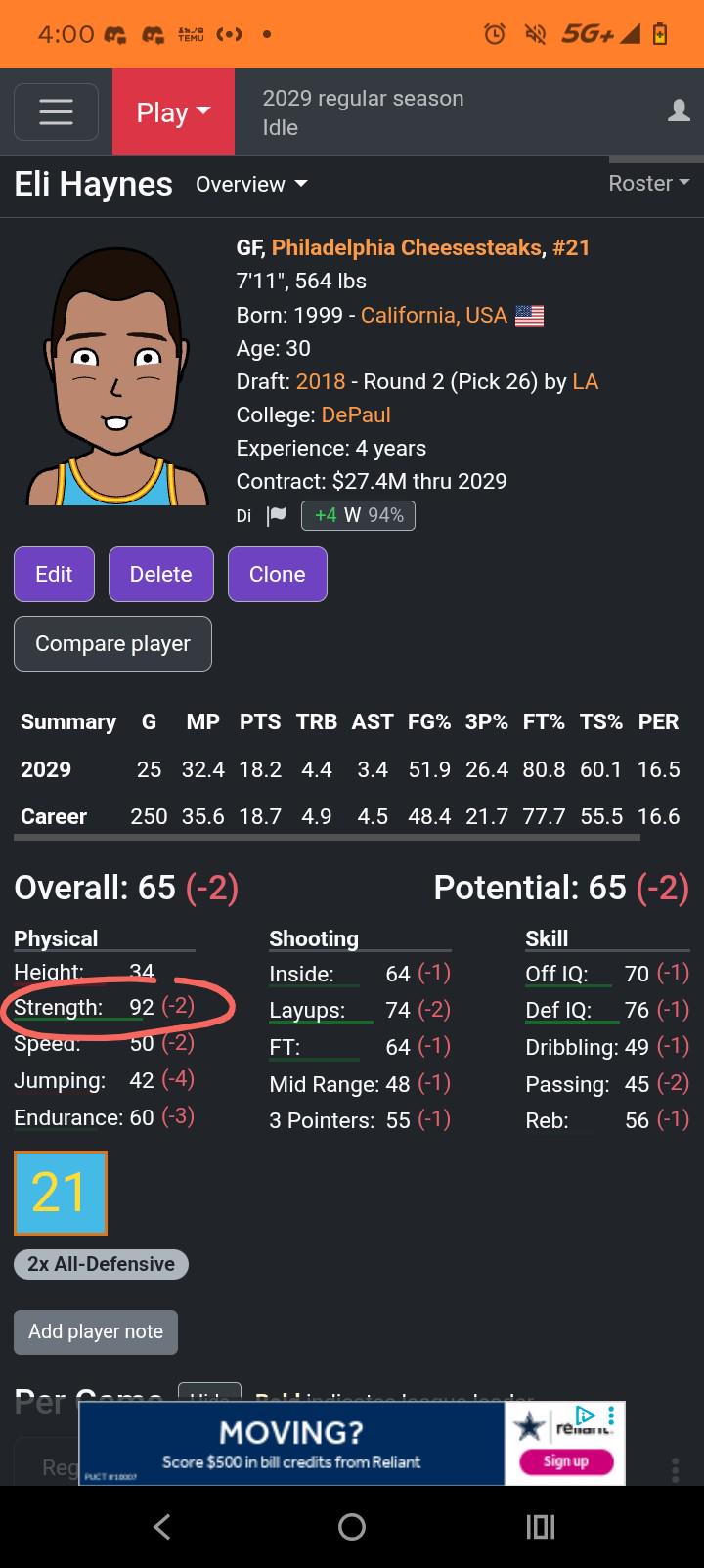
It's always irked me that Jalen Suggs has a comparable 3 point rating to players like Desmond Bane, Donovan Mitchell, James Harden, Max Strus to name a few.
Others are like Bobby Portis who has crazy high offensive IQ, Wemby has less than 30 strength (might be because of the way strength and height work together though), and Jalen Suggs again with crazy high jumping.
Wondering if any of you have noticed this and can think of any others?
Made a fictional UAAP college basketball league for fun. Key notes:
This heavily relies on God Mode, such as for foreign student athlete (FSA) creation and allotment of 1 per roster. Sometimes, FSAs will also become FAs so need to manage that they don't go to other rosters.
In any collegiate basketball league here on BGM, residency is always a problem (top player transfers to another team via FA). To manage that, I run a code every last day of free agency, via Danger Zone -> Worker Console (see link).
This means: 2020 free agency day 30, I run this code so that all newly-signed FAs that have played for other teams will have a period of residency.
TL;DR: In the season my guy turned 31 (wearing #31), he randomly had the best year of his career and went 31–3 in games where any of his stats hit 13 or 31. When I dug back into league history, I realized Toronto retired a dead player's #13 in 2031—the exact year they won a fluke title—and the "every 10 years" thing I joked about actually happened in 2063. Im scared asf.
The setup (zero edits, all default random generation)
I didn't touch God Mode once in this league. Everything below just happened on its own:
Trevor Jackson Sr.: Born 2000, South Carolina. Went to Fresno State. Drafted #14 overall in 2020. Wore #31. Died in 2037 at age 37.
Brian Washington: Born 2000, New York. UConn. Same 2020 draft class. Wore #13. Traded to Toronto in 2029, played 12 games (13.3 PPG), and then got hit with this random news-feed event:
"Brian Washington was smothered to death by a throng of ravenous, autograph-seeking fans after exiting the team plane."
Out of 39 seasons in this save, that is the only tragic death event in the entire league. Every single other player who died went of old age.
Trevor Jackson Jr. — Born 2023, South Carolina. Also went to Fresno State, just like his dad. Toronto jumped from 11th to #1 in the 2042 lottery to draft him. He was 14 when his dad (the #14 pick) died, and he wore #31 for all 22 seasons of his career.
Checking 2031 made me do a double take
I didn't even notice this part until I started clicking back through the history tabs trying to figure out what was going on:
Toronto goes 30–52 in 2030, flips to 52–30 in 2031, and somehow wins the championship.
Their first-round opponent? A team literally named the Cleveland Curses. Toronto swept them 4–0, then beat New York and Miami—the exact two franchises that ended Jr.'s playoff runs over and over again twenty years later.
Before the season started, I retired Brian Washington Jr.'s #13 to honour him
Meanwhile, over in Minnesota, Trevor Sr. turned 31 that year, wearing #31, and finished the season with career-low season highs of 13 points and 13 FGA.
The age-31 season (2054)
Coming into 2054, I honestly thought Jr.'s prime might be winding down. The year before, at age 30, he got swept in the first round by a 40-win Miami team while playing on a bruised knee. Then he turned 31, wearing #31, and completely broke the league:
34.5 PPG, his career high by more than 4 full points (his next-best season was 30.1)
67.1 TS%, 37.9 PER
Won the title, going 16–1 in the playoffs
At this point I felt like I was losing my mind, so I exported the 2054 game log to prove to myself it was just confirmation bias. I filtered for every regular-season game where any of his box-score stats or +/- hit 13 or 31:
31–3 in those games (34 total games)
41–4 if you include the playoffs (his dad was the 14th pick)
He went 59–14 overall in games he played that year, so the team was obviously great regardless—but the baseline probability of getting 31+ wins out of 34 random games from that pool is still only around 3.4%.
Just to be sure I wasn't cherry-picking, I ran a script testing 2,000+ random two-number pairs the exact same way. 13 and 31 beat about 98% of them.
The 10-year pattern that actually came true
After 2054, I started joking to myself that the league was running on 10-year intervals:
2043→2044 (age 20→21): Jumped from 56 to 68 OVR, the biggest single-year leap of his career.
2053→2054 (age 30→31): Swept in round one, then exploded for his 34.5 PPG peak.
2063 (age 40): After eight straight years of choking in the playoffs with stacked rosters, Jr. was down to 48 OVR—the exact rating he had on draft day in 2042. I literally told myself before simming the playoffs, "Watch this be the year because it's 2063." Toronto went 16–3 and swept the Finals. I just stared at my screen when the banner popped up.
The smaller stuff that kept piling up
Once you start looking, the random details get even harder to brush off:
2056: He hit two separate game-tying shots with exactly 3.1 seconds left on the clock—and lost both games in OT.
2042 draft: Seattle held picks #13 and #31 overall.
A third Washington in Toronto (John) was born in 2031 and ended up winning a ring as a bench piece on the 2054 title team.
He finally retired at 41 (14 reversed) with 31.4 career MPG and 314 career playoff starts. I genuinely laughed out loud when I opened his final career page and saw those two numbers sitting right next to each other—you couldn't manually edit a 22-year career to land on both 31.4 and 314 if you tried.
Whoever wears #31 for Toronto next might turn into prime Thanos ☠️