r/centerleftpolitics • u/No-Pride-8979 • 1h ago
Pulitzer Prize-winning Historian Marcia Chatelain in her new book about the civil rights movement

1
Upvotes
r/centerleftpolitics • u/AutoModerator • Jun 14 '25
The place to be for CLPeeps 😎
r/centerleftpolitics • u/No-Pride-8979 • 1h ago
r/centerleftpolitics • u/Ok_Crazy1195 • 2h ago

r/centerleftpolitics • u/Famous-Sympathy7011 • 2h ago

r/centerleftpolitics • u/Otics89 • 18h ago
r/centerleftpolitics • u/Ok_Crazy1195 • 6h ago

r/centerleftpolitics • u/Rich_Tutor_5694 • 1d ago
r/centerleftpolitics • u/aslan_is_on_the_move • 1d ago

r/centerleftpolitics • u/No-Pride-8979 • 20h ago
r/centerleftpolitics • u/Ok_Emphasis10000 • 1d ago

r/centerleftpolitics • u/aslan_is_on_the_move • 1d ago

r/centerleftpolitics • u/Aware-Chipmunk4344 • 1d ago

America's fiscal challenges cannot be solved simply by raising taxes, cutting spending, or expanding government programs. A sustainable solution requires a comprehensive approach: collecting taxes more effectively, reforming an inefficient defense budget, encouraging legal employment and economic growth through immigration reform, and using the resulting resources responsibly.
The following proposal presents two scenarios:
These are long-term annual targets, not immediate first-year results. They would require phased implementation, legislative approval, and independent scoring. They should be understood as potential fiscal improvements rather than guaranteed revenue.
PART ONE: WHERE THE MONEY COMES FROM
Target: $350 billion–$700 billion annually
The objective is to make the tax system more progressive, close loopholes, improve compliance, and ensure that corporations and wealthy individuals pay taxes more consistently.
A. Increase the corporate income tax rate
Raise the federal corporate income tax rate from 21% to approximately 28%–35%.
The 21% rate was established by the 2017 Tax Cuts and Jobs Act. A higher rate could restore part of the revenue lost through corporate tax reductions.
There is an important research benchmark: in its analysis of the Biden administration's FY2025 budget, the Congressional Budget Office reported that the Joint Committee on Taxation estimated that raising the corporate rate from 21% to 28% would generate approximately $881 billion over ten years.
That is approximately $88 billion annually on average, although actual collections would vary by year.
A 35% rate could generate more, but the additional revenue cannot simply be calculated by multiplying the 28% estimate proportionally. Companies may change investment, financing, profit-reporting, and international tax strategies.
Proposed measure: Gradually increase the rate, while maintaining incentives for genuine domestic investment, research, and small-business development.
B. Close corporate tax loopholes
Reform provisions that allow large corporations and multinational businesses to reduce their effective tax liabilities through:
Strengthen international minimum-tax rules and enforcement against corporate profit shifting.
The goal is not to punish productive businesses. It is to prevent companies from gaining an unfair advantage through sophisticated tax avoidance.
C. Establish a minimum effective estate tax of 30%
Introduce a minimum effective federal estate tax rate of 30% for very large estates above a substantial exemption threshold.
Close loopholes involving:
The purpose is to ensure that extremely wealthy estates cannot reduce their actual tax liabilities to negligible levels through sophisticated financial planning.
The 30% figure would be a minimum effective rate on the relevant taxable portion, not a 30% tax on every American inheritance.
D. Tax annual unrealized capital gains exceeding $1 million
Introduce an annual tax on unrealized capital gains above $1 million.
For example, if an individual's qualifying investments appreciate by $5 million during a year, the first $1 million would be exempt, while the remaining $4 million would be subject to the proposed tax.
A possible starting rate is 25%.
The policy would primarily target extremely wealthy individuals whose fortunes grow through appreciating stocks, business ownership, and other assets, allowing them to accumulate wealth without realizing taxable gains.
Important safeguards would be necessary:
This is an ambitious proposal. The constitutional treatment, valuation difficulties, liquidity issues, and economic effects would need careful examination.
For comparison, the Biden administration estimated that a 25% minimum tax on total income, including unrealized gains, for households with wealth above $100 million could raise approximately $503 billion over ten years. CBO reported that this proposal did not have an independent CBO/JCT revenue estimate in its analysis.
That proposal is not identical to the broader $1 million annual appreciation threshold proposed here. The latter would require a new independent revenue estimate.
E. Strengthen IRS enforcement against high-income tax avoidance
Increase IRS enforcement funding by approximately $8 billion annually, concentrating resources on:
Avoid making ordinary wage earners the primary targets. Their income is generally easier to verify through employer reporting.
There is a substantial tax-compliance problem to address.
According to the IRS, the projected gross federal tax gap for tax year 2022 was approximately $696 billion. After accounting for late payments and enforcement, the estimated net tax gap was $606 billion.
The largest component was underreporting, estimated at $539 billion.
This does not mean the government can collect the entire $606 billion. Some unpaid taxes are difficult or impossible to recover. Nevertheless, stronger enforcement could generate meaningful recurring revenue.
Research published in the Quarterly Journal of Economics in 2025 also found that marginal audits of taxpayers above the 90th income percentile could generate more than $12 in additional revenue for each dollar spent, when longer-term deterrence effects were included.
That is an encouraging research result, not a guaranteed return on every additional dollar of IRS funding.
F. Other high-income and investment-tax reforms
Additional measures could include:
Together, these reforms would broaden the tax base and make the system more difficult to exploit.
Illustrative tax-reform targets:
The $700 billion figure is an optimistic policy target, not an established CBO projection. It would require a much broader package and substantial additional analysis.
2. Defense Budget Reform
Target: $150 billion annually in long-term savings
The United States needs a strong military. However, a strong military does not necessarily require the most expensive possible military.
The objective should be to eliminate waste, improve procurement, reduce unnecessary commitments, and encourage allies to assume a greater share of their own defense responsibilities.
A. Reform weapons procurement
The Pentagon should improve its procurement system by:
The goal is to obtain more military capability for every dollar spent.
B. Strengthen anti-fraud and financial oversight
Improve Pentagon financial management and auditing.
Measures should include:
The Department of Defense has repeatedly struggled to produce a clean department-wide financial audit. Improving accountability is therefore a legitimate reform priority.
C. Restructure military forces
Review the global deployment of American forces and determine which commitments remain essential.
Potential measures include:
This should be a strategic restructuring, not indiscriminate cuts that weaken America's ability to respond to genuine threats.
D. Increase allied burden-sharing
Encourage NATO members and Asian allies to spend more on their own defense capabilities.
The United States should remain committed to its alliances, but it should not automatically shoulder the majority of every regional security burden.
Allies should contribute more to:
A more balanced alliance structure would allow the United States to reduce some expenditures without abandoning its international commitments.
E. Prioritize military efficiency over simply increasing the budget
The Pentagon should evaluate whether additional spending actually produces additional military capability.
For example, investing in ammunition stockpiles, maintenance, logistics, drones, cyber defense, and resilient supply chains may sometimes provide more practical value than expanding expensive legacy programs.
Research benchmark:
CBO published a defense-budget reduction option in December 2024. It estimated that reducing the Department of Defense's planned funding could save approximately $959 billion in outlays over 2025–2034, or roughly $96 billion annually on average.
The option could involve reducing active-duty personnel by approximately 17% by 2034 or making other combinations of force reductions and strategic changes.
This demonstrates that substantial savings are possible, although the CBO option is not a recommendation and would involve significant trade-offs.
Proposed target: $150 billion annually in long-term defense savings.
This is an ambitious target beyond the average annual savings in that particular CBO option. It would require deeper restructuring and careful assessment of national-security risks.
3. Immigration Reform: Fees and Tax Contributions
Target: $150 billion annually in additional fiscal resources
Immigration should be treated not only as a border-security issue but also as an economic and fiscal policy issue.
The objective is to establish a more orderly immigration system, encourage legal employment, increase tax compliance, and attract workers who contribute to economic growth.
A. Expand legal work authorization
Create a more efficient system for work permits and legal employment.
Measures could include:
Workers who are legally employed are easier to track and more likely to participate in the formal tax system.
B. Collect income and payroll taxes
Encourage legal employment and tax compliance among immigrants.
This would increase federal receipts through:
Legal status and tax compliance should be connected through transparent administrative systems.
C. Modernize immigration fees
Review and update immigration application and processing fees.
Potential reforms include:
Fees should cover a reasonable portion of administrative costs without becoming prohibitive barriers to legal immigration.
D. Attract skilled workers and entrepreneurs
Expand pathways for highly skilled workers, researchers, engineers, medical professionals, and entrepreneurs.
These workers can contribute through higher wages, income taxes, business creation, innovation, and additional employment.
E. Improve the transition from informal to formal employment
Where legally and politically feasible, establish structured processes for eligible long-term residents to obtain legal work authorization and meet tax obligations.
The goal is to reduce the size of the informal economy, improve labor-market transparency, and increase tax compliance.
Important CBO benchmark:
CBO estimated that the immigration surge over 2024–2034 would increase federal revenues by approximately $1.2 trillion over that decade.
The annual revenue increase was projected to reach approximately $167 billion in 2034.
Most of this revenue came from individual income and payroll taxes, not immigration application fees.
However, CBO also estimated that the immigration surge would increase mandatory spending and net interest costs by approximately $278 billion over the decade, producing a net deficit reduction of approximately $897 billion.
This is important: immigration-related tax receipts must be evaluated alongside the additional public spending they generate.
Proposed target: $150 billion annually in additional immigration-related fiscal resources.
This is an ambitious target, not an estimate of fee revenue alone. It would require a combination of legal employment, tax compliance, economic growth, and carefully designed immigration policy.
PART TWO: HOW TO DISTRIBUTE THE ADDITIONAL FISCAL RESOURCES
Increasing government revenue is only half the challenge. The other half is using the money responsibly.
A government that collects more taxes but fails to improve people's lives will struggle to maintain public support.
At the same time, spending every additional dollar on new programs would sacrifice an opportunity to reduce the national debt and strengthen long-term fiscal stability.
A reasonable principle would be:
Allocate approximately 60% to deficit reduction and 40% to healthcare, infrastructure, education, and direct household benefits.
This is a proposed policy framework, not an economic law.
Scenario A: $650 Billion Annual Fiscal Improvement
Category| Annual allocation| Share Deficit and debt reduction| $390 billion| 60% Healthcare reform| $130 billion| 20% Infrastructure and education| $65 billion| 10% Direct household support| $65 billion| 10% Total| $650 billion| 100%
Use the largest share to reduce federal borrowing.
Benefits include:
Use additional funding to improve access and affordability.
Potential priorities include:
The emphasis should be on reducing the overall cost of healthcare, not merely increasing government spending.
3. Infrastructure and education: $65 billion
Invest in projects that improve long-term productivity.
Priorities could include:
Make the benefits of fiscal reform visible to ordinary households.
Possible measures include:
The purpose is to ensure that fiscal reform produces tangible improvements in everyday life.
Scenario B: $1 Trillion Annual Fiscal Improvement
Category| Annual allocation| Share Deficit and debt reduction| $600 billion| 60% Healthcare reform| $200 billion| 20% Infrastructure and education| $100 billion| 10% Direct household support| $100 billion| 10% Total| $1 trillion| 100%
The additional $350 billion compared with the conservative scenario would allow the government to accelerate reforms without abandoning fiscal discipline.
A $600 billion annual improvement in the fiscal balance would substantially reduce borrowing needs.
If the starting annual deficit were approximately $2 trillion, a full $1 trillion improvement would theoretically reduce it to approximately $1 trillion, assuming no other changes in revenue or spending.
Actual deficits would also depend on economic growth, interest rates, existing legislation, and other budgetary developments.
2. Healthcare reform: $200 billion
A larger healthcare allocation could support more substantial expansion of coverage and affordability.
Potential priorities include:
Healthcare reform should be accompanied by measures to reduce administrative waste and excessive medical costs.
3. Infrastructure and education: $100 billion
This would provide greater capacity for long-term investment in:
Higher EITC support. Childcare subsidies. Targeted tax credits. Assistance for low-income households. Support for working families. Affordable housing assistance.
CONCLUSION: FISCAL RESPONSIBILITY AND BETTER LIVING STANDARDS CAN GO TOGETHER
The United States does not necessarily have to choose between fiscal responsibility and improving people's lives. A comprehensive strategy could pursue both.
The key is to establish a long-term plan, identify realistic funding sources, implement reforms in stages, and avoid making permanent spending commitments before recurring revenues are secured.
The proposed $650 billion scenario would already represent a substantial improvement in America's fiscal position.
The $1 trillion scenario would be an ambitious long-term objective requiring much deeper reforms and stronger economic assumptions.
The most important principle is that government should not simply collect more money and spend more money. It should collect taxes more fairly, eliminate waste, strengthen economic growth, reduce borrowing, and deliver measurable improvements in people's lives.
A stronger fiscal foundation. A more efficient government. A fairer tax system. Better living standards.
r/centerleftpolitics • u/aslan_is_on_the_move • 2d ago

r/centerleftpolitics • u/Hondo_KZ6C • 2d ago
Numero Uno: Killing tax credits and other funding of Obamacare by undoing the Biden-era fixes to provide these benefits
—OR—
Numero dos: Supporting Bibi Netanyahu and Trump in their unprovoked attacks on Iran
r/centerleftpolitics • u/askmpdspkm24 • 2d ago

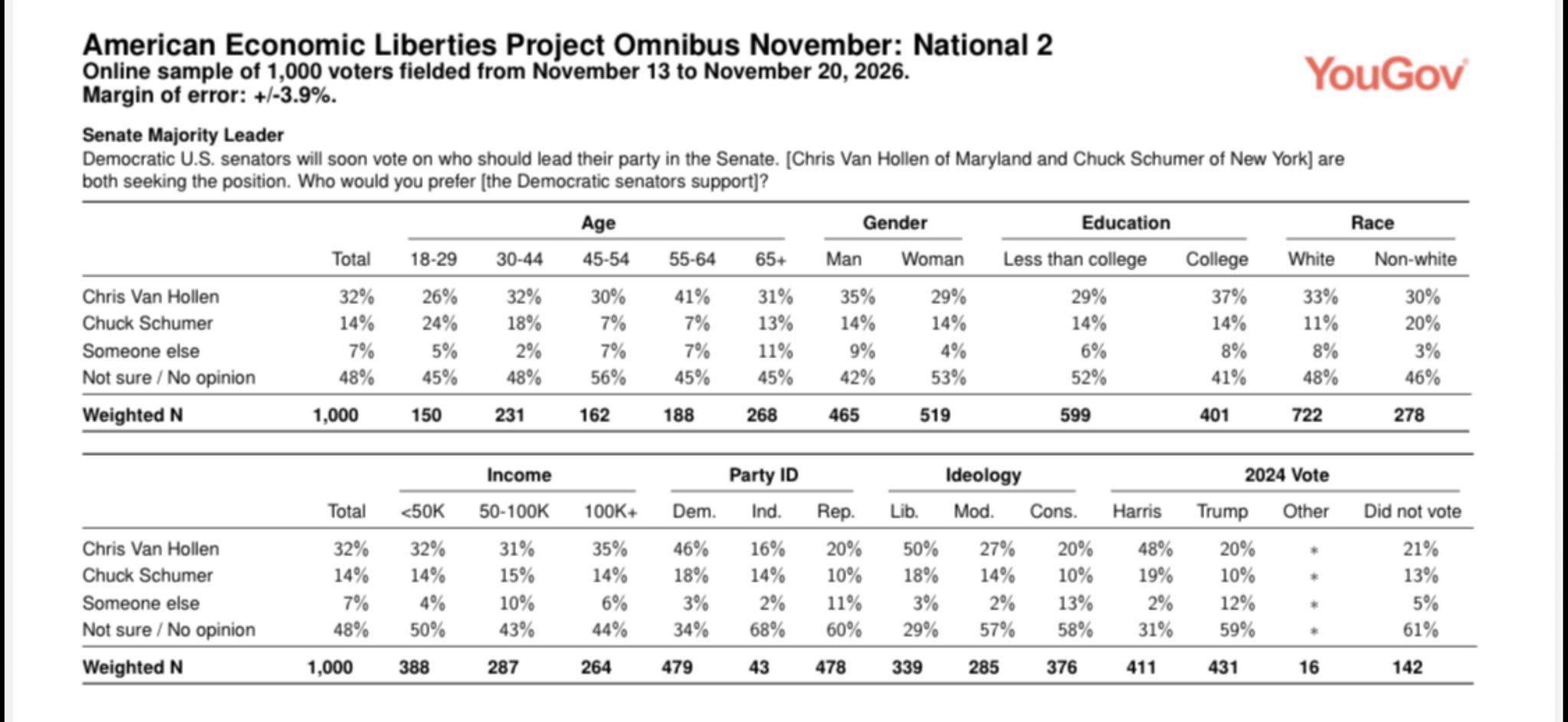
This should be a flashing red warning sign.
How much more evidence do you need that voters want a new direction and new leadership, not another round of business as usual ( Cuck Schumer )?
Changing nothing is how you end up with another Trump in 28.
r/centerleftpolitics • u/Historical-Egg-9194 • 3d ago
r/centerleftpolitics • u/seanosul • 2d ago

r/centerleftpolitics • u/stonybrookdragon • 2d ago

r/centerleftpolitics • u/PeteGinSD • 2d ago

r/centerleftpolitics • u/holmess2013 • 3d ago
I’ve always had a knee jerk reaction to private equity, buying into the tacit agreement among Americans that they are the epitome of the greedy rich. While that’s not untrue, I was curious to find out how exactly they loot companies, sometimes to the point of bankruptcy.
I break down some of those mechanisms here, as well as some real world examples of private equity firms getting caught by the SEC or FTC:
https://samholmes285.substack.com/p/how-private-equity-loots-the-companies
r/centerleftpolitics • u/Aware-Chipmunk4344 • 2d ago
The central issue is not whether Sanders' social goals including Medicare for All are desirable. It is whether they are embedded in a comprehensive, financially sustainable national strategy.
A government cannot treat healthcare, taxation, defense, immigration, infrastructure, and economic growth as isolated policy questions. They interact, compete for resources, and sometimes depend on one another. A policy that looks attractive individually may become dangerous when implemented without considering its fiscal and economic consequences.
One may distinguish two approaches:
There is the weakness in a politically ambitious but insufficiently integrated program: it can depend on several optimistic assumptions all being correct at the same time.
For example, a universal healthcare expansion might rely on substantial administrative savings, lower drug prices, higher taxes, and efficient implementation. If the savings are smaller than projected, tax revenues disappoint, or costs rise faster than expected, the government could face a serious funding gap.
A proposed framework can be organized into four stages:
Priority 1
Fiscal stabilization
Reform taxation, control spending growth, reduce waste, and establish a credible path to stabilizing the debt-to-GDP ratio.
Priority 2
Economic and institutional restructuring
Improve productivity, infrastructure, workforce development, defense procurement, and immigration policy. Strengthen the economic foundation that supports future spending.
Priority 3
Healthcare cost restructuring
Negotiate drug prices, reduce administrative duplication, improve payment efficiency, and evaluate actual savings before making major coverage commitments.
Priority 4
Gradual social expansion
Expand Medicaid, Medicare eligibility, and other benefits in stages, with each stage tied to sustainable funding and measurable outcomes.
These stages need not be completely sequential. Some economic and healthcare reforms can proceed simultaneously. The important principle is that expensive commitments should be linked to verified funding and implementation capacity.
A serious long-term plan should answer three questions before launching each major project:
* What if revenue is 20% lower than projected?
* What if implementation costs are 20% higher than expected?
* What happens if economic growth slows or interest payments rise?
If a program becomes financially unsustainable under moderately adverse conditions, it needs redesign before expansion.
That does not mean avoiding ambitious reforms. It means protecting them from failure. A healthcare reform that collapses under fiscal pressure could damage public confidence in universal healthcare for years.
Ultimately, one could express the argument this way:
A national government should not simply accumulate popular policies. It should construct a coherent long-term development strategy, establish priorities, sequence reforms, secure sustainable funding, and adjust implementation according to actual results.
The distinction is between having an ambitious political agenda and having a credible plan to govern a country. Sanders's social objectives including Medicare for All may deserve serious consideration, but they should be evaluated as part of the entire national economic and fiscal picture—not as a standalone mission.
r/centerleftpolitics • u/ROConnects • 3d ago