r/coolgithubprojects • u/Previous-Professor56 • 21h ago
r/coolgithubprojects • u/Perfect_Classic8211 • 1d ago
compute resource sharing project, what more do i do with it?
this project allows any two people two host their computing resources or use the computing resources shared by someone else, for now it is dependent on a central server for authentication puposes and the resources can be used by visiting the website which i plan to make it so it is completely local and not dependent on external factors like that. the host does need docker daemon running in the background. the user can download all the workspace files as zip at the end of session. this is the repository: https://github.com/armaan-102006/Dock_Lab/tree/gpu_access , to run host you can download the dockerfile, login and button exe . i would like to know what i can improve or how i can actually make this project helpful to the community as this is my first project that i put some thought into. and i wont be keeping the server running unless someone wants to actually try this out, sorry bout that.
r/coolgithubprojects • u/Own_Photo_2668 • 21h ago
TURBO BUTTON
A portable repair agent for computer technicians. Run it on the customer's PC from a USB stick or desktop, scan the QR code with your phone, and work through the scan, the plan and the fixes with an AI (or without one). You approve every change, and it cleans up after itself when you're done.
https://github.com/flesheatingbug/Turbo-Button
I'm adding features as i use it, which is daily at work, so expect updates and new features. Suggestions are welcome
Can work on multiple pcs at the same time and even generates a handy pdf report of whats done
Made with the help of claude
r/coolgithubprojects • u/thegodforsaken • 22h ago
iSTREAMPAD - Your iPhone/Android as Stream Controller
Turn the phone or tablet you already own into a stream controller for OBS Studio. Go live, record, switch scenes, mute the mic, save a replay, fire keyboard shortcuts and sounds, from a grid of keys on an iPhone, iPad or Android, over your home Wi-Fi. Runs on Mac and Windows. No cloud, no account.
What it does
- OBS Studio (28 or later, through its built-in WebSocket server): start/stop stream and recording, pause recording, save replay, replay buffer, virtual camera, switch scene, mute a source.
- Live state on the keys: the live key turns red and says LIVE, the current scene lights up, a muted mic shows a crossed-out icon. Change something in OBS and the phone follows.
- All your scenes, automatically: the "All scenes" folder has one key per scene in your OBS and follows it when you add or rename scenes.
- Shortcuts: keyboard shortcuts, open an app, file or website, play a sound, run several steps in a row.
- Visual editor on the computer; changes reach the phone at once. Folders, on/off keys, portrait and landscape.
- Private by design: the phone pairs with a QR code and a 6-digit code; only devices on your home network can connect; the OBS password stays encrypted on your computer.

r/coolgithubprojects • u/SBFlabs • 1d ago
I switched from One UI + Good Lock to a Chinese OEM that kills background apps & breaks third-party launcher animations — so I built Lightspeed (Android control layer, Shizuku, v1.5.0)
github.comGitHub: https://github.com/SBFlabs/Lightspeed
I moved from Samsung One UI + Good Lock to a Chinese OEM with almost no customization and aggressive battery management that kept killing my Accessibility services. Switching to a third-party launcher wasn't an option either because it breaks native Recents animations on modern Android.
So I built Lightspeed (Kotlin / Jetpack Compose, Android 8.0–16, no root) — a source-available control layer that runs over your stock launcher so native animations stay intact.
Core features:
- Deflectors + Shizuku edge overrides: I wanted every side gesture I could think of without fighting the OS back swipe, so optional Shizuku overrides zero out Android's native edge back-gesture insets.
- One Launch Pad, Three Workstations: Category Cruise (categorized app drawer), Cockpit (quick access to favorite apps and actions), and Central Command (all settings and extra tools).
- Watchdogs (via Shizuku): Built to protect Lightspeed and other Accessibility services from aggressive OEM battery killers.
- Hardware remapping & scrubbing: Back-tap triggers, volume-rocker remapping with 8 mappable gestures, and edge brightness scrubbing with Extra Dim.
- Offline Voice Isolation & Screenshot Blur Engine: I liked Prime Video's dialogue boost, so I added offline 48 kHz voice isolation (integrating Microsoft's MIT-licensed speech-enhancement model via a local C++ JNI + ONNX bridge, credited in
CREDITS.md), plus an on-device screenshot-based blur engine inspired by how Infinix handles blur on devices without native window blur, powering multiple themes including HUDs for scrub actions. - Zero network permissions: No
INTERNETpermission inAndroidManifest.xml(0 detections on VirusTotal across all signed APKs).
License & pricing: Source-available (public for code audit and personal builds; non-commercial license, not OSI open-source). All core features are free with zero ads/trackers; an optional $1.99 one-time offline unlock adds extra visual themes and cosmetics.
Releases & SHA-256: https://github.com/SBFlabs/Lightspeed/releases/tag/v1.5.0
r/coolgithubprojects • u/sallam5010 • 22h ago
Got tired of copy-pasting between Claude and Antigravity, so I made them talk to each other
galleryI kept copying answers from Claude Code into Antigravity and back to get a second opinion. So I built a small app that lets them talk to each other directly.
It is called Consult Room. It runs on your own PC and uses the two command-line tools you already have installed (claude and agy).
How it works:
- You give it a project folder and a task.
- The two take turns. Claude writes on the left, Antigravity on the right. You watch live and can jump in.
- They stop when both agree, or when the turns run out.
- If you like the plan, press "Start building". They first agree on every detail (names, files, who does what), then edit a COPY of your project on a git branch.
- You read the diffs and press Merge or Discard. Your real folder is never touched before that.
Safety things I cared about:
- Talking is read-only.
- Building only edits a git copy, and neither one can run commands.
- You can mark folders as private so a room can never be opened on them.
- It only listens on 127.0.0.1. Nothing is hosted.
Honest limits:
- Windows 11 only. I have not tested anything else.
- You need both Claude Code and Antigravity installed and signed in. Every turn uses your own accounts.
- It is not a sandbox. It relies on the two tools respecting their own flags.
- It is a personal project. No promises.
No npm packages, just Node 24. MIT licence.
Repo: https://github.com/Sallam5010/consult-room
I built it with a lot of help from Claude Code itself. Feedback is welcome, especially on the safety side.
r/coolgithubprojects • u/errmayank • 1d ago
Zaku 26.1 - Local-first API client written in Rust with GPUI
galleryHey, I wanted to share that Zaku 26.1 is out with support for environments and variables in requests.
About the app, it stores collections as folders and requests as TOML files. Everything is stored locally on user's filesystem, it doesn't have any login functionality (and never will).
It is available on Linux, macOS and Windows.
I've been working on this for the last 10 months full-time.
Here's what's new:
- Define variables at the project, folder and environment level.
- Switch between environments with the environment selector.
- Use the new variables panel to manage environments and variables.
- Autocomplete variables as you type, with highlighting and hover previews.
- Switch, create and delete Git branches with the branch picker.
- Scale the UI with zoom controls.
- Prevent accidental overwrites when files change on disk.
I have lots of things planned, if you try it out please let me know if there's something missing, not working or things you'd like to see added.
Repository:
https://github.com/buildzaku/zaku
Download:
r/coolgithubprojects • u/evoluteur • 23h ago
GitHub - evoluteur/platonic-solids: Turn the five Platonic solids in 3D, show their duals, read their measurements, and print the nets to fold your own.
github.comr/coolgithubprojects • u/Known_Barracuda_3977 • 23h ago
Host performance optimzation TUI
galleryr/coolgithubprojects • u/Extreme_Aardvark8977 • 23h ago
AuraVision Player Vidéo 0.10
Introducing AuraVision Player 0.10 A Free Universal Media Player with AI Video Enhancement, 4K Blu-ray and Video Game Cinematics Support
Hi everyone!
I'm excited to share my latest personal project, AuraVision Player, a free universal multimedia player designed to combine advanced playback technologies, artificial intelligence and a distinctive visual experience in a single application.
Built in C++ and powered by FFmpeg 9.1 and Qt 6, AuraVision Player is designed for movie enthusiasts, music lovers, retro gaming fans, multimedia preservation enthusiasts and anyone looking for a new media player.
My goal is to go beyond traditional media playback by integrating modern AI video enhancement technologies while maintaining extensive compatibility with both modern and legacy multimedia formats.
Advanced Video Playback
- Extensive multimedia compatibility with 522 decoders and 363 demuxers in the reference FFmpeg build.
- Support for MKV, MP4, AVI, MOV, WebM, TS, M2TS and many more formats.
- Modern video codecs including H.264, HEVC, AV1, VVC, VP9 and ProRes.
- GPU-accelerated decoding through D3D11VA, DXVA2 and VAAPI.
- HDR10 and HLG content support with HDR-to-SDR tone mapping.
- BWDIF deinterlacing for older and interlaced content.
- Adjustable playback speed from 0.25× to 4× with audio pitch preservation.
- Frame-by-frame playback and precise seeking.
- Automatic playback resume.
- Screenshot capture and chapter navigation.
AI-Powered Video Enhancement
One of the main features of AuraVision Player is its dedicated Video Enhancement sidebar, providing access to three different AI technologies:
NVIDIA RTX Video Super Resolution
- Real-time AI video upscaling.
- Enhanced visual quality when enlarging lower-resolution videos.
- Native NVIDIA driver integration.
SeedVR2 3B and 7B
- Advanced diffusion-based video restoration.
- AI-powered 2× upscaling.
- Designed to enhance older footage and reconstruct visual details.
- Integrated through WanGP.
LTX 2.5 Upscale
- Lightricks' Pixel Spatial Upscaler.
- AI-powered 2× video enhancement.
- Integrated through WanGP.
Unlike RTX Video Super Resolution, SeedVR2 and LTX 2.5 process upcoming video segments ahead of playback. The enhanced footage remains synchronized with the original audio, with automatic buffering when necessary.
All AI video processing takes place locally on your computer.
DVD, Blu-ray and 4K Ultra HD Blu-ray
AuraVision Player also supports optical media playback:
- DVD-Video.
- Blu-ray.
- 4K Ultra HD Blu-ray.
- Physical optical drives.
- VIDEO_TS and BDMV folders.
- Unencrypted ISO disc images.
- Direct title, playlist and chapter selection.
- HEVC Main 10, HDR10 and HLG.
- Dolby TrueHD, Dolby Digital Plus, DTS-HD Master Audio and LPCM.
- Blu-ray PGS and DVD VobSub subtitles.
Unprotected discs and unencrypted backups are supported. Copy protection bypassing and interactive disc menus are not currently supported.
Audio Playback and Music Visualization
- Support for numerous audio formats, including FLAC, MP3, AAC, WAV, Opus, DTS and TrueHD.
- Animated 56-band audio spectrum visualizer.
- Album artwork display.
- Audio volume normalization.
- Volume amplification up to 150%.
- Multiple audio track selection.
- Audio synchronization controls.
- Mono mode and stereo channel swapping.
- Playlist management, shuffle and repeat modes.
Video Game Cinematics and Retro Multimedia
As a fan of video games and multimedia preservation, I wanted AuraVision Player to support formats that are rarely highlighted in modern media players.
Supported game video formats include:
- Bink Video (.bik, .bk2)
- Smacker (.smk)
- id Software RoQ (.roq)
- Westwood VQA (.vqa)
- Nintendo THP (.thp)
- PlayStation STR (.str)
- Sega FILM / CPK
- Interplay MVE
- Electronic Arts multimedia formats
- Cryo HNM
- LucasArts SMUSH
- Mobiclip
- Sierra VMD
- Xbox XMV
The player also supports several game audio formats, including BRSTM, BCSTM, BFSTM, ADX, HCA, XWMA and VAG.
Whether you want to rediscover old game cinematics, explore retro multimedia files or listen to video game soundtracks, AuraVision Player provides a dedicated solution.
Subtitles and Network Streaming
- Embedded and external subtitle support.
- SRT, ASS/SSA, WebVTT, PGS and VobSub.
- Automatic detection of matching external subtitle files.
- Subtitle timing adjustment.
- Network streaming through HTTP, HTTPS, HLS, MPEG-DASH, RTMP, RTSP, SRT and UDP.
- M3U playlist support.
Aurora – A Distinctive Visual Experience
I also wanted to create something visually different from traditional media players.
The custom Aurora interface is drawn entirely in code without external image assets.
- Animated northern lights background with purple, cyan and green effects.
- Modern frameless window.
- Floating frosted-glass playback controls.
- Glowing progress bar with chapter information.
- Animated on-screen notifications.
- High-resolution vector icons.
- HiDPI display support.
- Interactive AI video enhancement sidebar.
- Comprehensive preferences panel with eight configuration categories.
Technical Highlights
- C++ and Qt 6.
- FFmpeg 9.1 multimedia engine.
- Custom multithreaded playback architecture.
- OpenGL video rendering.
- miniaudio audio engine.
- Hardware-accelerated video decoding.
- Local AI video enhancement.
- Windows x64 portable edition.
- Linux compilation support.
- Source code available on GitHub.
Free, Portable and Local
AuraVision Player is designed without mandatory subscriptions, accounts or cloud-based video processing.
The Windows portable edition requires no installation. Simply extract the archive and launch AuraVisionPlayer.exe.
Some important notes:
- RTX Video Super Resolution requires a compatible NVIDIA RTX GPU.
- SeedVR2 and LTX 2.5 require WanGP and additional AI model downloads.
- 12 GB of VRAM is recommended for diffusion-based enhancement.
- Advanced ASS subtitle styling is not yet supported.
- The current graphical interface is available in French.
An Independent Project Built with Passion
AuraVision Player was born from my passion for cinema, music, artificial intelligence, software development and video game preservation.
My ambition is to create a universal media player that brings together the versatility of FFmpeg, modern AI restoration technologies and an immersive graphical interface, while preserving compatibility with multimedia formats from different generations.
This project is still evolving, and I would love to hear what the community thinks about it.
Feedback, suggestions, bug reports, feature requests and contributions are always welcome!
Special thanks to the developers and communities behind FFmpeg, Qt, miniaudio, NVIDIA RTX Video Super Resolution, ByteDance SeedVR2, Lightricks LTX and DeepBeepMeep's WanGP.
If you find my project interesting, please consider giving it a star on GitHub to support its development.
AuraVision Player Beyond ordinary playback.
Play. Discover. Restore. Experience.
GitHub – Source code, documentation and project information:
r/coolgithubprojects • u/thegodforsaken • 23h ago
PIN PILOT - Your Recent Work Always in Sight in Claude Code
Always see what you are working on. Pin Pilot keeps the Claude Code sessions you used recently pinned at the top of the Claude desktop app's sidebar, and unpins them on its own when they go quiet. No more scrolling through every group to find the conversations that are still running.
The problem
If you use Claude Code for more than one thing, your sidebar fills up fast. You file sessions into groups (Work, Apps, Games, Clients...) to keep things tidy, and that works until you have several sessions going at the same time.
Then the questions start:
- Which conversations was I working on an hour ago?
- Did that session finish, or is it waiting for my answer?
- Where did I leave the one about the login bug? Work or Apps?
To answer them you open every group and scroll through all of it, every time. A session that needs you can sit there unnoticed for an hour, just because it was buried in a collapsed group.
The fix
Pin Pilot keeps a short, always-current list at the very top of the sidebar: the sessions you touched recently. Open the app and that list is your "in progress" view. When a session goes quiet, it leaves the list by itself. Your groups stay exactly as you organized them.
Think of it as a "recent" shelf that tidies itself up.
How it works
Every 5 minutes, Pin Pilot looks at your sessions:
- A session with activity in the last hour (you choose the window) gets pinned.
- A session Pin Pilot pinned that has gone quiet gets unpinned.
- Sessions you pinned by hand are never touched. Pin a session yourself to keep it at the top for good.
- Unpin one of its pins and Pin Pilot lets it be until you use that session again.
Your groups never change: a pinned session stays in its group. Pin Pilot uses no AI model and spends no tokens. It only calls the app's own pin and session-list functions, on your machine. It sends nothing anywhere.
Link here: https://github.com/jasonmello/pin-pilot
r/coolgithubprojects • u/sav22999 • 1d ago
Meet SavComponents: 80+ vanilla JS web components you use as plain HTML tags (MIT)
Hi everyone! For the past few weeks I've been working on SavComponents, a free, open-source library of web components. I wanted UI pieces I could drop into any page, whether it's a static HTML file, a server-rendered site or an app, without installing a framework or setting up a build step.
Getting started is two lines:
<link rel="stylesheet" href="https://savcomponents.com/v/1.3.2/sav.css">
<script src="https://savcomponents.com/v/1.3.2/sav.js" defer></script>
<sav-button>Hello</sav-button>What's in it
- 80+ components: buttons, inputs, select with search, date and time pickers, colour picker, OTP, password strength, dialogs, popovers, action sheets, toasts, tabs, tables, charts, timeline, drag-and-drop sorting, and more
- Five visual styles (Soft, Tilt, Sharp, Brutal and Glass), switched with a single class on
<html>, plus light, dark and auto mode - About 2,000 icons, loaded only when you use them
- English and Italian built in, and you can add any language with
Sav.addStrings()
How it's built
It's all vanilla JavaScript on web standards: no dependencies, no framework. Each component is a custom element with its own Shadow DOM, with styles shared through adoptedStyleSheets. Form fields are form-associated custom elements (attachInternals()), so they submit inside a normal <form> and work with native validation (required, checkValidity()…), with no hidden inputs. Theming goes through CSS custom properties (--sav-color-primary, --sav-radius, --sav-font…), and there's a customiser on the site that exports them for you.
Since they're standard custom elements, they work in plain HTML and alongside most frameworks.
Accessibility
I tried to treat this as a requirement, not an afterthought. Keyboard navigation and screen reader support are built in, and every component page has a WCAG 2.2 AA section that documents keyboard behaviour and roles, and measures contrast live in the current style and theme.
Versioned URLs
Each release lives at its own frozen address (/v/1.3.2/), so your site won't change when a new version comes out. You move to a new version when you decide to.
Used in real projects
I use SavComponents myself in a few apps I'm building, so it gets tested on real interfaces and not just on demo pages:
- SavOffice, a free, open office suite: https://www.illerom.eu/savoffice/
- SavPresentations: https://www.illerom.eu/savpresentations/
- SavDocuments: https://www.illerom.eu/savdocuments/
- SavSchedules: https://www.illerom.eu/savschedules/
- SavNotes: https://www.illerom.eu/savnotes/
Where it's at
It's still a young project, and there's plenty I want to improve. For example, the JS isn't minified yet (it's about 180 KB gzipped). I'd love honest feedback: what's missing, what feels off, or anything that breaks.
→ Docs and live demos: https://savcomponents.com
→ Source: https://github.com/Sav22999/savcomponents
r/coolgithubprojects • u/thegodforsaken • 23h ago
GITBEAT - Coding with gamification and tracking
github.comWhat is GitBeat for?
If you code with AI, your effort is scattered across tool logs you never look at and a GitHub history that hides private work. GitBeat gathers it into one honest picture of your day: how much you leaned on AI, how long you actually coded, and what landed on GitHub. It's a quiet companion in your menu bar — a way to see your momentum, keep a streak going, and own a permanent record of your own activity.
It is not a leaderboard and it sends nothing anywhere. It's for you.
What it tracks
GitBeat reads the files your tools already keep on your Mac and turns them into six views:
- Summary — today's three rings (AI tokens, coding time, GitHub commits), your streak this week, and weekly charts at a glance.
- Tokens — tokens per day across Claude Code, OpenCode, Codex CLI and Gemini CLI, broken down by tool and model, over the week, month or year. Includes an equivalent API cost so you can see the scale of your usage (on a subscription you don't pay per token — the number just gives it a size). Cost can be shown in US dollars or Brazilian reais.
- GitHub — commits and PRs per day, read from each repository's own history, so your private repositories count even when your public profile calendar hides them.
- Time — active coding time per day and your peak hours, measured from the gaps between sessions.
- Goals — set daily goals (tokens, coding time, commits) and track them. Defaults are 400M tokens, 4 hours, 3 commits, all adjustable.
- About — what's on this Mac and where the numbers come from.
Alongside the window, a menu bar item carries an animated mascot that reacts to your activity — focused while you work, celebrating when you close your rings, resting when you step away — plus today's total at a glance.
Why you'll want it
- See your real rhythm — one glance tells you whether today had momentum, without opening four tools.
- Keep the history AI tools throw away — Claude Code deletes conversations after 30 days. GitBeat keeps a permanent copy of the numbers (never the text) on your Mac and in your iCloud Drive, so your record outlives the tools.
- Count your private work — commits are read per repository, so closed-source and work repos finally show up.
- Understand the cost scale of your AI usage, in your own currency.
- Stay motivated — rings, streaks and a mascot that cheers you on.
- Keep everything private — it's a local app, not a service.
r/coolgithubprojects • u/ConsistentFox567 • 1d ago
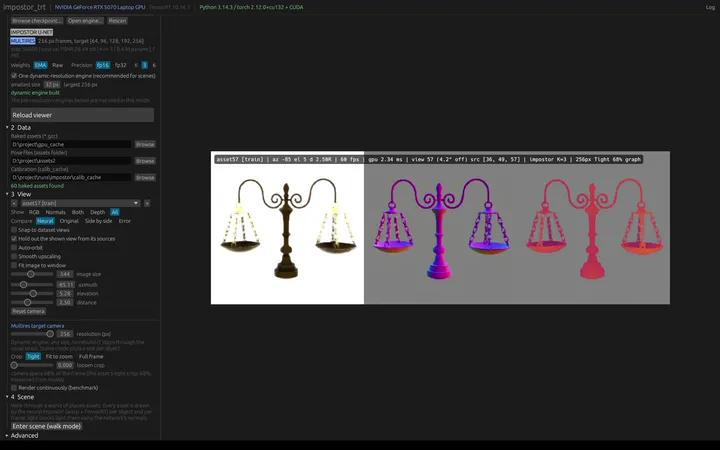
Fully Neurally Rendered object - ~2.7 ms average GPU frame time (256*256)
Fully neurally rendered asset (RGB, Normals, and Depth) rendered at an average of ~2.7 ms frame time on 8 GB RTX 5070 Laptop GPU by a custom model architecture in custom inference engine made with Rust, TensorRT, and CUDA kernels. Check out the README in this repo for details. Thanks.
r/coolgithubprojects • u/MedaiP90 • 23h ago
RingoMusic, a Linux client for AppleMusic
Hello. I daily drive a Linux machine, but I'm subscribed to Apple Music to listen to music. I'm annoyed at having to use the streaming service in a browser, I know that PWAs exist, but as a Firefox user this feature is still a dream in 2026. I'm aware of the Cider and Sidra projects, but the former is now a paid product and the latter shows Apple's web interface. So I decided to build my own client for Apple Music: RingoMusic.
https://github.com/MedaiP90/RingoMusic
At the core it uses a Chromium browser for the music streaming through Apple service (like other alternatives, this is required for the Widevine DRM), this means just x86 support and no lossless audio (unfortunately); but the user interface is all Rust and GTK4 for seamless integration in a GNOME environment, it binds directly to Apple APIs for interacting with the library. The app is free and open source, but you still need an Apple Music subscription to use it (obviously). This app is not affiliated with Apple in any way!
You may ask: why would I want to use RingoMusic over other options? Well you don't have to, this is a whim of mine and I just wanted to share its existence with others. If you try it, I hope you like it for its GTK look, MPRIS integration and the mini player it offers.
Disclaimer: yes, this is an AI assisted project. Claude Code has been massively used during the development process, this has enabled me to concentrate more on what I wanted to see on the screen. If you are against AI assisted development, I understand and I will not argue.
r/coolgithubprojects • u/Creepy_Sherbert_1179 • 23h ago
GameBoy Color emulator handwritten purely in python
github.comr/coolgithubprojects • u/Annual_Chemistry_521 • 23h ago
Running T3 Code headless or in Docker? Try this!
galleryI started this open source project two months ago because I wanted to do most of my work from my phone or iPad. A plain T3 Code headless setup doesn't take care of agent CLIs, toolchains, or everything else around them, so I built an image that does.
With help from several contributors, it has grown into quite something. You manage it from a web control panel, so you never need a shell in the container. It includes:
- T3 Code updates on Stable or Nightly, with automatic rollback if an update fails
- Phone pairing with a QR code, plus T3 Connect for remote access without a domain
- Agent CLIs (Claude Code, Codex, OpenCode, Cursor, Grok, Pi, Antigravity and more): install, sign in and update from the panel
- One-click AI gateway setup for your agents (CLIProxyAPI, LiteLLM, OpenRouter)
- Persistent toolchains managed by mise, so Go, Rust, Bun and friends survive image upgrades
- Shared agent context: a global AGENTS.md, skills, MCP servers and plugins, managed in one place
- A file browser and storage management, so the disk doesn't quietly fill up
- Headless Chromium so your agents can use a browser
It runs on amd64 and arm64:
```
docker run -d -p 127.0.0.1:3773:3773 -p 127.0.0.1:3774:3774 \
-v t3-home:/home/t3 -v "$PWD/workspace:/workspace" \
dizys/t3code-docker
```
Fully open sourced under MIT: https://github.com/dizys/t3code-docker
Adopters and contributors are very welcome. Let me know what would you want in an image like this!
r/coolgithubprojects • u/divin-d1 • 1d ago
Free GitHub Action that undoes PolinRider's amend + force-push and opens cleaning PRs
github.comPolinRider rewrites your last commit and force-pushes it under your own name, using tokens saved on an infected machine. It got into about 70 branches across my 66 repos, so I built a GitHub Action to undo it:
- Infected push → the branch goes back to the commit before the push.
- Branch already infected → a cleaning pull request; the rest of the work is kept.
- Report names the account that really pushed (
sender.login, not the faked author). - Unauthorised push to
main→ held on a side branch. - Sweep for a whole account or org, including private repos and non-default branches, which GitHub search misses.
- Includes importable ruleset JSON files that block force pushes on
mainand moving release tags (free on public repos).
Dry-run setup takes about 5 minutes and changes nothing: https://github.com/divin-d1/polinrider-bot-guard
I'm the author. It's open source, MIT, no dependencies. False-alarm reports are very welcome.
r/coolgithubprojects • u/BringinItDirty • 1d ago
Traceguide exports a clickable guide from a Playwright trace
github.comI built Traceguide to reuse the steps in a recorded Playwright run when writing a walkthrough. Its redacted HTML export keeps the step captions and click positions. The bundled example omits the original screenshots.
To try the bundled example, run npx traceguide@0.1.1 --demo on Node.js 24 or later.
Which would help you review a reproduction faster, an overview of the steps or a guide that opens one step at a time?
r/coolgithubprojects • u/One-Cellist6686 • 1d ago
I built an open-source financial research terminal that makes every outcome reproducible and verifiable
github.comHey everyone, first time posting here.
I've been building Atlas, a free, open-source financial research terminal. I've recently released the first beta and I just wanted to share it, get feedback, and hopefully get contributor help.
The idea started from a problem I noticed with financial research tools: getting financial data is relatively easy, but verifying exactly where a number came from, when it became available, and whether an analysis can be reproduced is considerably harder.
I wanted to build something that addresses those problems while making advanced financial research tools more accessible.
Some of the current features include:
- SEC filing ingestion and financial statement analysis
- Valuation, quantitative research and portfolio models
- Point-in-time financial data tracking
- Source-backed answers and verifiable research certificates
- A locally hosted research terminal
- MCP integration with AI assistants
- An offline demo without paid API keys
Everything is open source under Apache 2.0. It runs locally and is available through GitHub and PyPI.
GitHub: https://github.com/Satwik-P28/Atlas
Website: https://satwik-p28.github.io/Atlas/
Installation: pip install --pre "atlas-quant[terminal]"
It's still in beta, and there is plenty of room for improvement. I'd appreciate feedback on the interface, architecture, missing features, or anything that would make it more useful for your own research.
I'm also open to contributions from anyone interested in financial infrastructure, quantitative research or data engineering.
r/coolgithubprojects • u/Adhyan948_official • 1d ago
I made SHIFY, an offline file converter for Android (images, audio, video). No internet permission.
github.comr/coolgithubprojects • u/Graspier • 1d ago
I got frustrated with Odoo, so I built my own client for it
galleryMy company (startup) recently started using Odoo, and I hated it so much that I ended up making an app for it (with GPUI rust) to provide a much better experience. It got adopted by my colleagues as it was way easier to use, and I have decided to open source it now.
Hopefully helps someone if they also find it clunky to solve this stuff.
For developers (as I am one), adding sub-tasks and time sheets can be done through your coding agents via a local MCP server to communicate with the app directly. So if most of your work goes through an Agent coding for you, then it should be easier to input stuff in bulk.
Additionally, you can use local LLMs (Anything ollama offers to download) to create a draft of sub-tasks, which will simultaneously fill-in time sheets if you mention the time taken for task in the sub-tasks draft.
A few more things, such as being able to see the tasks you created and assigned to other people (which for some reason Odoo doesn't have), aggregation stats, etc.
Repo link: https://github.com/SELECT-stupidity-FROM-discord/BetterOdoo
r/coolgithubprojects • u/Efficient-Cancel-465 • 1d ago
ZapFast Plus: native Rust WhatsApp desktop client (fork of crmne/zapfast) with GB WhatsApp-based exploits
I maintain ZapFast Plus, an open-source (MIT) fork of crmne/zapfast. It is written in Rust with egui, fastframe, and whatsapp-rust, so it runs as a native desktop binary without Electron or an embedded browser.
Version 0.23.0 is out with packages for Linux, Windows, and macOS.
Main additions compared to upstream:
- Privacy controls: Ghost Mode freezes last seen and online status, hides the second grey tick, suppresses typing indicators, and blocks read, played, and status receipts. You can also send read receipts only after replying, keep deleted messages and deleted status updates locally, blur the chat list and open bubbles with
Ctrl+Shift+B, and set an inactivity auto-lock timer (1 to 60 minutes). - View-Once preservation: incoming view-once photos, videos, and voice notes are decrypted and cached locally when media keys arrive, with unlimited replay, one-click saving, and an optional click-to-reveal mask. There is an opt-in Android pairing mode so WhatsApp delivers live view-once media keys.
- Audio stickers and always-playing animations: supports WhatsApp audio stickers (
audio_sticker_messageandStickerMessage.audio) with click-to-play sound, and plays regular animated stickers (WebP, Lottie) and audio stickers continuously in chats instead of freezing them until hovered. - Built-in sticker creator and sync: a button in the bottom-left bar turns static images (PNG, JPG, WebP), animated images (GIF, WebP), and videos (MP4, WebM, MOV, MKV) into 512x512 WhatsApp stickers with square cropping, video trimming up to 6 seconds, live preview, and a button to upload and add the sticker directly to your WhatsApp Favorites. QR logins sync your phone's stickers automatically, and the sticker picker includes a manual resync button if anything goes missing.
- Messaging tools: scheduled messages, keyword and time-window auto-replies, multi-chat broadcast,
/shortcutquick replies, messaging unsaved phone numbers, inline message translation, message reminders, anonymous status viewer with one-click download, bulk media export from a conversation, and voice note playback speeds up to2.5x. - Theme and in-app updates: defaults to a pure black (
#000000) AMOLED theme with white text and crimson accents, optional top filter tabs (Chats, Unread, Groups, Favorites), unlimited local pinned chats, and per-chat wallpapers. When a new GitHub release comes out, an in-app modal with a blurred backdrop detects your OS and package format (Windows MSI/ZIP, macOS Universal DMG, Linux AppImage,.deb,.rpm, Flatpak, or local binary), checks SHA-256 sums, installs the update, and restarts while keeping your login and chats intact.
Downloads and source:
- Repository: https://github.com/lucasapolinarioo/zapfast-plus
- Release v0.23.0 (Linux x64/ARM64 AppImage,
.deb,.rpm,.tar.gz, Flatpak; Windows x64/ARM64.msiand.zip; macOS Universal.dmg): https://github.com/lucasapolinarioo/zapfast-plus/releases/tag/v0.23.0
Notes before installing:
- This is an unofficial WhatsApp client with no affiliation with Meta, WhatsApp, or ZapFast upstream. Using unofficial clients can violate WhatsApp's Terms of Service and carries account suspension risk.
- Windows and macOS builds are not signed with paid certificates, so SmartScreen (More info -> Run anyway) or macOS Gatekeeper (right-click -> Open, or
xattr -cr /Applications/ZapFast.app) will prompt on first launch.
Feedback and bug reports on GitHub are welcome.
r/coolgithubprojects • u/abdoufermat-5 • 1d ago