r/coolgithubprojects • u/captainTvZs • 4d ago
P2 • Play Through, Open Source, Free, Fully Self Hosted, Discord, Slack, Jira, Library, Patcher
github.com
0
Upvotes
r/coolgithubprojects • u/rodrigues_92 • 4d ago

I run 5 to 10 AI coding chats on the same repository at once. Without rules they collide: one switches branches under another, two green PRs break main when merged back to back, and review by the same model misses the same things.

So I wrote it down as an Agent Skill with small Node scripts (no dependencies):
- each chat gets its own git worktree, outside the main checkout
- a machine-wide queue limits how many test suites run at once
- PR through gh; critical paths get reviewed by a different model (Codex or Gemini, Claude as fallback), and the reviewer can fix, not only approve
- merges go one at a time, only with the branch up to date with main
- deploy and health check after merge, then cleanup

On first run it detects your setup and asks a few questions (who reviews, where it deploys, how many chats at once).

Install: npx skills add mestrecs/skills
Repo: https://github.com/mestrecs/skills

It works on Windows, macOS and Linux. Feedback welcome, especially from people running Codex or Gemini CLI.r/coolgithubprojects • u/TheCaptainP • 4d ago
r/coolgithubprojects • u/DetailKey6716 • 4d ago

I posted Shape here a while ago, and I've made quite a few changes since then.
The UI has been completely redesigned, and I've spent the past month working on the agent itself, improving it and adding more testing. It's still not perfect, but it's getting better.
I've also built in native reverse engineering and modding tools.
A few other changes:
There's still plenty to improve, but I'd love to hear what you think.
Oh and it also has macOS support.
GitHub: https://github.com/useshape/Shape
Latest release: https://github.com/useshape/Shape/releases/tag/v1.0.4
r/coolgithubprojects • u/DawgBawb • 4d ago
This is Hoardini, the world's smartest trashcan. I was sick of disk usage analyzers that showed me cool heatmaps but still can't answer "yeah, but can I nuke it from orbit". So I made this. The AI powering this can be a paid subscription, a free openrouter, or my favorite a local model. Granite 4.2 3b has been tested and works well with this.
Free as in beer and speech. Take it, use it, fork it, whatever you want.
Let me know what you think! If you like it, toss me a star on github.
r/coolgithubprojects • • 4d ago
I built ChatKit Pro because I wanted better tools for managing my own ChatGPT conversations.
It started as a small personal project and gradually grew into a full browser extension.
It lets you organize conversations into folders, use tags and favorites, perform bulk actions, clean up your ChatGPT Library and export conversations in different formats.
A few things I wanted to keep simple:
It's built with JavaScript, HTML and CSS using Manifest V3.
I'm the developer behind the project, and the repository is public. Feel free to explore the code, open issues or suggest improvements.
Feedback is welcome!
r/coolgithubprojects • u/JustChillyGuy • 4d ago
The part that might interest this sub: small models are bad at generating video but fine at planning one, so I split the roles. The model writes a structured plan and decides what a button label means (forward / back / help) in any language; a deterministic program does everything visible, with real Playwright recordings.
Things I had to solve for a 4B model: one fixed num_ctx so Ollama never reloads the model, hard timeouts with JSON repair and compact retries, a fast "motif" background mode because drawing SVG backgrounds takes minutes on a small model (the model just picks a motif, the code draws it), and batching label classification so the first screen doesn't stall the recording.
Also worked with Gemini 2.5/3.5 over the OpenAI-compatible API. Alpha, Windows-tested, MIT. I'd love to know how it behaves with other local models (7B–14B).
r/coolgithubprojects • u/erkamyaman • 4d ago

https://github.com/erkamyaman/rust-anything
Disclosure: I'm the author. I shared it here last week; since then it got a proper docs site, 4.1.0, and a lot of help from 44 contributors, so here's the update.
What it is
A CLI + MCP server that helps you (or a coding agent like Claude Code, Codex or Cursor) port an existing app to Rust one function or module at a time. It records what your original code actually does, then replays every recorded case against the Rust port. Nothing ships until the outputs match byte for byte.
Why it's useful
Rewrites usually break on behavior nobody wrote down: edge cases, error types, side effects. rust-anything turns the running original into the spec. Measured so far:
bench tells you soLanguages: TypeScript/JS, Python, C, Go, Ruby, Java, Kotlin, PHP, C# and PowerShell.
New since last time
enable --only / --partial to switch ported functions on one at a timeHow I'd use it
Pick the hottest function in a slow Node or Python service, let profile confirm it's worth porting, record it, let your agent write the Rust, and only switch it on when gate passes.
MIT licensed, macOS, Linux and Windows.
r/coolgithubprojects • u/Augustkolo • 4d ago

Help expand gustoOS by adding your own games!
I'm working on gustoOS, a community-driven project where anyone can contribute their own games and apps. Adding a game is really easy, even for beginners!
Feel free to contribute, experiment, or share your ideas. Let's build something cool together!
r/coolgithubprojects • u/Confident-Safe4883 • 5d ago

Hi! I've built a small GoldHEN app called GarlicDiffusion for it. You can use a controller on the TV or control it from your phone browser, download models straight in the app, and cap the GPU so the fan stays quiet. Works on Base/Slim too.
All of these were generated and upscaled to 1080p directly on my PS4 Pro with no PC involved.
Link to the PKG, benchmarks, and source code if anyone wants to mess with it:
github DJTOMATO/GarlicDiffusion
(had to remove the url due to some filtering? I don't know much about reddit haha)
I suck at advertising so if anyone can spread it around or put it in homebrew stores (i don't even know how to do it myself) I'll be grateful!
r/coolgithubprojects • u/vm324234 • 5d ago

We're building Agentic GraphRAG, an open source library for connecting the documents an agent reads with its task history and decisions.
I've worked on RAG systems and LLM training for the past three and a half years. Lately, I've been following how agents retain work across sessions, especially for non-coding tasks.
Most frameworks treat knowledge retrieval and memory as two separate problems. Nobody stores the decisions that led to the retrieval along with the data that it gets. Agent struggles to retrieve the correct stuff the next time again. We're solving that by bringing them together in one 3D connected graph.
We construct three connected graph layers that the agents read:
Things which make us different from other frameworks out there:
- Structure Aware: The ingestion pipeline uses Docling for loading documents and captures the full document hierarchy. The sections, tables, and passage hierarchy are connected using edges and stored in the graph.
- Ontology Grounded: You define a schema for your domain (we also ship ontology presets so it is easy to get started). The schema guides extraction, validation, and search. We use GLiNER for local extraction, so its virtually free (and fast) to construct the graph and no LLM calls are needed.
- Robust Agent Search: Retrieval combines graph, full-text and vector search. Agents can reach original passages even when extraction misses a fact, navigate surrounding sections and table rows with headers, and follow entity relationships back to supporting text.
We offer a built-in agent you can use out of the box. You can also connect your agents through MCP.
We will be releasing extensive benchmarks very soon.
Agentic GraphRAG is an open source library that stores document knowledge, agent work, and decisions in one connected graph. Agents can resume tasks and trace saved decisions to their original evidence, while source changes flag affected decisions for review.
Try it out. Feedback, criticism, issues, and contributions are all welcome!
r/coolgithubprojects • u/patrickbrouwer • 5d ago
r/coolgithubprojects • u/legisleducator • 5d ago

r/coolgithubprojects • u/davidbalbino • 5d ago
r/coolgithubprojects • u/secuncensored • 5d ago
Concept language - please roast it
r/coolgithubprojects • u/Ill_Profile_8808 • 5d ago
r/coolgithubprojects • u/Efficient_Blood_7651 • 5d ago

Most "self-hosted WhatsApp" setups mean a VPS, a Docker container, and a monthly bill for a process that spends 99% of its life waiting. This one is a Cloudflare Worker: one Durable Object per linked account drives the WhatsApp Web session, and you pay nothing at low volume.
GitHub: https://github.com/dannybyarun/whatsflare (MIT)
Why the architecture looks odd. Cloudflare gives 13,000 GB-s of Durable Object time per day. A DO holding a WhatsApp socket bills 128 MB × 86,400 s ≈ 10,800 GB-s, so a single always-on session would eat 83% of the entire free tier. The session is therefore lazy: /wake opens the socket, /messages drains with a monotonic cursor, /ack prunes once you have persisted the rows, /idle closes it. A window slides on activity but is capped, so a drain that takes 90 s finishes and a poller on a tight loop cannot pin the object.
What is actually hard. baileys wants net/tls for its WebSocket client and workerd has neither. The replacement is a fetch() upgrade, which means calling accept() yourself, emitting open exactly once, numeric error codes, binaryType = 'arraybuffer', and no AbortSignal on the upgrade. Each of those is documented in the patch header, because getting one wrong gives you a socket that opens and then dies silently.
What you get: WhatsApp Web-style UI, REST API, WebSocket event stream, token-scoped sending (full / send / embed with per-token chat allowlists and daily caps), media fetched on demand instead of stored, a Google Sheets drainer via Apps Script, credential export/import, and an MCP endpoint so an agent can read chats and send messages without a DB or an extra Durable Object.
Two things I would flag rather than hide: it is a ~9k-line TypeScript project written with heavy AI assistance (architecture and tests reviewed by me), and syncFullHistory: false means a chat with no traffic since you linked the device never appears in the list.
Happy to answer anything about the workerd socket, the DO cost model, or why the message parser has to unwrap ephemeralMessage / viewOnceMessageV2 / documentWithCaptionMessage before it can tell whether a message is even displayable.
r/coolgithubprojects • u/Szymeo • 5d ago
Hi! I built Grip because my default macOS recording shortcut was never good enough.
It records the screen, camera, mic and every click as separate tracks, then redraws the cursor and zooms from the clicks. Captions and voice cleanup run on device. There's also an MCP server, so coding agents can record and edit demos.
AGPL-3.0, free for commercial use, macOS 15+ on Apple silicon. Feedback and stars are very welcome (!!)
r/coolgithubprojects • u/MrBucurN • 5d ago
yo this is my first project
its a python security tool that checks python files for risky stuff and scans project packages for known vulnerabilities then it puts the results in a report it doesnt run your code or change any packages
still working on it so let me know what you think
r/coolgithubprojects • u/rheme18 • 5d ago

One migration failure I keep seeing with coding agents: “move this to TypeScript” turns into a broad rewrite before anyone has captured what the old code actually does.
I made a small open Agent Skill that pushes the work into slices: map static dependencies, write characterization tests against the legacy behavior, add the new implementation beside it, then cut over only after the checks pass. It also includes a migration-plan template and rollback steps.
I tried it on a deliberately awkward JavaScript cart module. Codex produced six Node tests for coercion, rounding, coupon/shipping rules, mutation, callbacks, and loose ID matching. All six passed against the original file. It stopped there because no TypeScript implementation existed yet, which is the right point to pause before claiming parity.
This is an early, small project. The dependency map is static and will miss dynamic imports; I have not validated every agent's installer yet. The repo and sample are here:
https://github.com/rheme18/legacy-strangler
If you've used a coding agent on a real migration, what was the first piece of old behavior you found yourself adding a test for?
r/coolgithubprojects • u/Confident_Zombie_619 • 5d ago
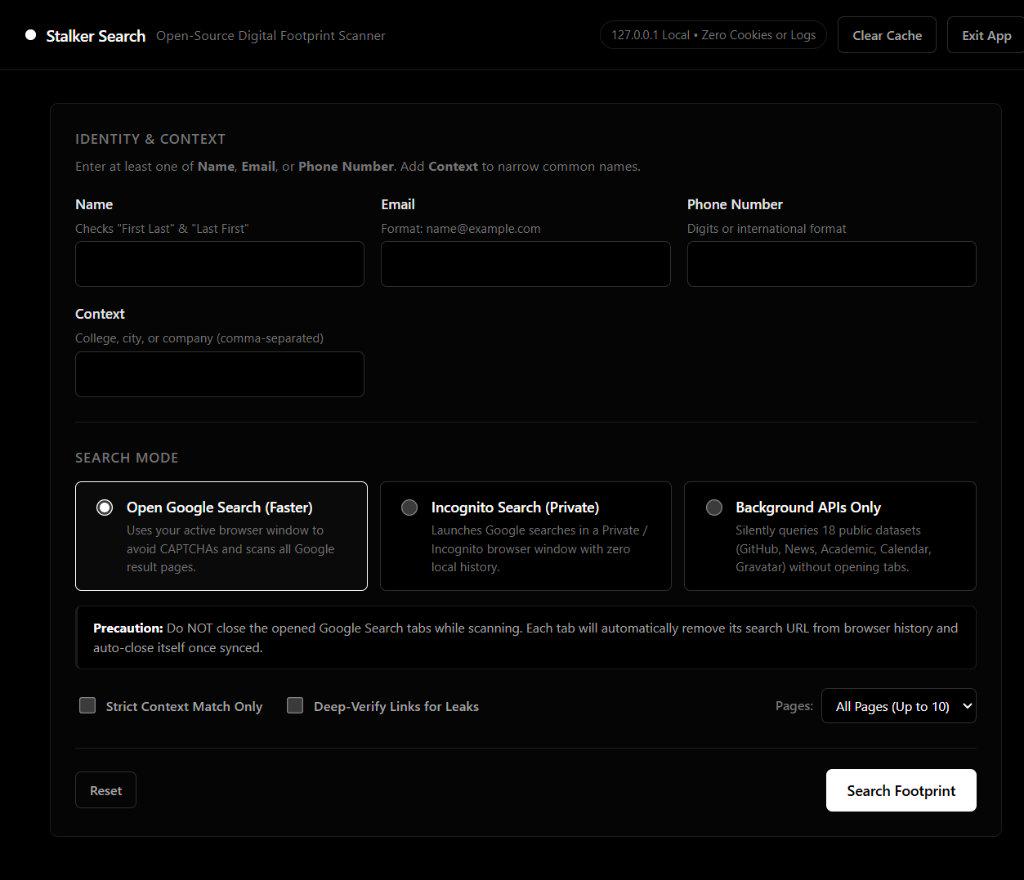
Most people only ever search their name on page 1 of Google and think their personal info is private. Meanwhile, a stalker who checks up to page 10 of Google dorks and correlates public databases can often pull your phone number, old college or government PDFs, leaked commit emails, and even public Google calendars in less than a minute.
I built Stalker Search in Rust so you can run that exact deep check on yourself locally with zero telemetry and without handing your personal details to shady online footprint websites.
It scans 18 public datasets concurrently and uses a lightweight temporary addon on LibreWolf or Firefox to pull up to 10 pages of Google results, then automatically deletes the search queries from your browser history and closes the tabs for you. It flags every exposed phone number , email, and document with direct links to get them removed.
100% Free and open source, tested on Arch Linux and Windows.
GitHub: https://github.com/Venky7514/Stalker-Search
Update: The companion extension just got officially approved on Mozilla Addons, so you can now install it directly in LibreWolf or Firefox in one click instead of loading it manually through about:debugging u can find the link on my github.
Update2: it should now run with mac installation is same as linux
r/coolgithubprojects • u/Emergency-Tutor-7 • 5d ago
r/coolgithubprojects • u/Academic_Season_8701 • 5d ago

r/coolgithubprojects • u/Aggressive-Survey316 • 5d ago

Hi everyone! I'm opening the 1.0.6-beta pre-release of Virtual Jam to external beta testers and would love feedback from musicians, audio nerds, and FOSS/Rust folks.
Repo & Quick Start: https://github.com/mielecarmine/Virtual-Jam-Hub
Downloads (1.0.6-beta): https://github.com/mielecarmine/Virtual-Jam-Hub/releases/tag/1.0.6-beta
License: GPL-3.0-or-later (with GPLv3 Section 7 additional permission for linking the Steinberg ASIO SDK on Windows; dependencies audited via cargo-deny).
This project was built with AI assistance, and I want to be transparent about how it was used—because this is not casual "vibe-coding":
Strict architectural sandbox: AI agents operated inside a tightly defined specification (AGENTS.md + ticket-by-ticket scope) with non-negotiable real-time guardrails:
Mutex/RwLock), and zero syscalls/I/O inside cpal audio callbacks (enforced by dedicated zero-allocation tests).rtrb) and atomics only between audio, network, and UI threads.#[repr(C)], explicit little-endian, < 1400 B below MTU) with round-trip and malformed-input tests on every protocol change.cargo fmt --check, cargo clippy --workspace -- -D warnings with clippy::pedantic, full unit/integration/load tests, and cross-platform installer smoke tests on Windows, macOS, and Linux).Virtual Jam lets up to 8 musicians rehearse together over UDP with:
jam-server, < 200 µs forwarding target), automatically negotiate direct UDP P2P routes when possible, and fall back seamlessly to the SFU relay if a direct route drops.egui): Per-musician gain (-60 to +6 dB), Mute, Solo, VU/peak meters, soft-clipping mixer, plus direct local monitoring with independent instrument + optional microphone channels and a network mic mute toggle.telemetry-*.txt file on your machine that you can inspect and optionally attach to a bug report.I'm specifically looking to validate things that CI and synthetic tests can't prove:
.exe, .pkg, .deb, and standalone Linux server .tar.gz), device setup, and clarity of telemetry/error messages.jam-server (UDP 7777; one server = one room of up to 8 peers). You can also run a local hardware loopback (--seconds 30) without any server to test your interface.SHA256SUMS.txt, or you can build from source..deb (glibc 2.35+). Wired headphones and 48 kHz interfaces are required.If you give it a spin—even just a local loopback test or a 2-person LAN jam—I'd really appreciate a quick report via the Beta feedback issue template (success stories are just as useful as bug reports!).
Happy to answer any questions about the audio engine, protocol, or the AI-assisted workflow.
r/coolgithubprojects • u/OccasionLeather9221 • 5d ago
