r/coolgithubprojects • • 3d ago

Posecode: editable motion phases for humanoid movement

Thumbnail github.com
3 Upvotes

I’m building Posecode, an open-source text format/editor for humanoid movement. The repo turns readable phase data into pose channels and Three.js renderer output, so a small change to one beat does not mean hand-keying the whole clip again.

The current example is a jumping-jacks loop. The practical question I’m working through is where to put landing: its own phase, or inside the down/up cycle? I used an AI assistant to help edit this post; the code and renderer are mine.


r/coolgithubprojects • • 4d ago

I built a free, open-source code notebook that runs Python like Jupyter, even on your phone

Thumbnail gallery
14 Upvotes

I have a bad habit. I save code everywhere. A snippet in a notes app, a command in a text file, a half-finished script in some random folder, a Jupyter notebook I can't open on my phone. When I need something I can't find it, and when I find it I can't run it.

So I built CodeNote with Claude Code. It's free, open source, and everything stays on your device.

What it does

- Notes made of blocks: text, code, markdown and images in one note, with real highlighting for 58 languages

- Press ▶ to run Python, Bash, Node.js and Dart, inside a sandbox so your own files stay safe

- Python works like Jupyter: the blocks of a note share variables, and pandas tables and matplotlib plots show right under the code

- It runs on your phone too. Download Python and the data science packages (pandas, numpy, matplotlib, scikit-learn) once from Settings and it works offline

- Open a CSV or Excel file and you get a table you can sort and search, with stats and a chart for every column. One tap writes the pandas notebook for you

- Open any folder like a small IDE: open a script as a file and run it, or as a note with cells. Jupyter notebooks (.ipynb) open as notes and you can export back

- Ctrl+K for everything, folders, tags, reminders, and an AI that explains your code or answers questions from your own notes (Claude, OpenAI, or fully offline with Ollama)

How Claude helped

- Claude Code was my pair programmer for the whole app: the Flutter app, the Python kernel, the sandbox, the website and the release pipeline. I decided what to build and how it should feel, Claude wrote most of the code with me, and I tested every change

- Every push builds Android, Windows, Linux and macOS on GitHub, and 75 tests run first. When something broke, a test caught it before a release did

- For Python on phones I asked Claude to test the real Python engine in a headless browser, the same way the app runs it. That's how we found that a loop with sleep couldn't be stopped, and fixed it

- The screenshots in this post are from the real app. Claude installed the Linux build, opened a sales CSV, pressed Analyze and ran the notebook

It runs on Windows, Mac, Linux and Android. No account, no server, no ads.

Download: https://mahmoudyosrimahmoud13.github.io/code_note/

Code: https://github.com/mahmoudyosrimahmoud13/code_note

Any feedback is welcome, good or bad. And if you try it, tell me what was confusing in the first 5 minutes, that's what I'm fixing next 🙏


r/coolgithubprojects • • 3d ago

Cadenza, for the piano players out there

Post image
1 Upvotes

Hello everyone!

I'm a student that plays the piano and made Cadenza. I recently stumbled to an app for learning jazz chords for the piano but I realized it needed a midi input, I however, do not own a digital keyboard. I went searching for an app that could be capable of this and only found some that converted audio to a midi file after having recorded a session. That's why I've created the following app.

Cadenza

The app uses your microphone and streams a live midi channel to apps that are midi-capable. The midi stream is close to real time, now having a sub 1 second consistent delay. Note recognition is done using a modification of Transkun, huge thanks to Yujia Yan for their transcription system. Cadenza is currently completely free, donation is of course well appreciated. The app will in future generations also generate sheet music and chord schemes, the current sheet music implementation is a work in progress which I've almost got ready. Jazz chord learning is also on the roadmap, with other genres receiving implementations in the future as well.

The app promises detection of at least 95% of notes played and recognizing those with 98% accuracy after testing. The latest version as of 21 november 12:52 includes a UI overhaul and incredibly accurate detection of the length of notes played which the app lacked before. Starring the repository is much appreciated and testing the application for yourself is just as important. Thank you for reading this and I hope this may come in handy for the target audience 😄

Link to the repo: github.com/deandromi/Cadenza


r/coolgithubprojects • • 3d ago

PleasePrintit: a self-hosted queue for 3D print requests from friends and family (Docker, runs on a Raspberry Pi too)

Post image
1 Upvotes

r/coolgithubprojects • • 4d ago

I got tired of cloning repos just to see how they run, so I built a way to run any GitHub repo from a link

Post image
18 Upvotes

Every time I found an interesting repo, I'd clone it, install dependencies, hit some error about a missing library and give up 20 minutes later without ever seeing it even run.

You can get around that on pyrovue (https://pyrovue.com) You paste a GitHub or GitLab link and it runs it up on the browser. You can connect your GitHub and run anything in less than a minute. I’ve experimented and added other features as well.

Hope this is a useful tool!

Open Source: https://github.com/pyroenv/pyrovue-runner

(the engine behind that figures out how to run a repo, MIT-licensed)


r/coolgithubprojects • • 4d ago

Blink - a fast Windows screenshot tool with real redaction, offline text copy, backgrounds and device mockups

Post image
55 Upvotes

Blink is a tray app for Windows built with Rust. I built this because other snip-tools felt outdated, slow and weren't an all-in-one package for me. With Blink, you get:

  • Several screenshot types: Window, region, screen(s) or scrolling screenshots.
  • Annotation: arrows, numbered steps, callouts, emoji.
  • Privacy blur: blur or black-box anything private. Manually, or automatically with the Find private info feature, which flags e-mail addresses, phone numbers, bank accounts, API keys and passwords in the screenshot so you hide them all in one click.
  • OCR: detects text in screenshots and lets you copy it with ease.
  • Backgrounds and device mockups: put your shots on a gradient background or in a device mockup before you copy or save it.

All features run locally on your machine. Fully offline, nothing uploaded.

Blink is free, no account needed, and no data is collected. Just want to share a new tool that helps me work faster and better.

View and download it here: https://blink-screenshot.github.io/blink/

Curious to hear what you think of it!

Disclosure: I built it with help from AI. I designed it, tested it and maintain it.


r/coolgithubprojects • • 3d ago

Find leaked API keys in running web apps (Chrome extension + Python CLI) - KeyLeak Detector

Thumbnail github.com
1 Upvotes

r/coolgithubprojects • • 3d ago

llamadoctor - scans your code for llama.cpp 1.0 breaking changes and fixes the safe ones

Post image
1 Upvotes

llama.cpp hit 1.0 a few days back and quietly removed a bunch of stuff peoples code depends on, functions gone, a flag removed, a header that moved to a different file. couldnt find anything that scans a codebase and tells you whats actually gonna break so i built it

single python file, no dependencies, pip install -e .(Ofcourse after cloning the repo mentioned below) and your done. point it at a folder, it flags everything sorted by how serious it is and links the actual github PR for each one so your not just trusting some random tool. anything with a clean 1:1 fix it offers to apply automatically, asks first, wont touch anything if your git tree isnt clean unless you force it

wrote the whole thing in termux on my phone, no laptop involved, same way i built my last project. link below, open to any feedback since i only had my own stuff to test it against

github.com/hunzo1/llamadoctor


r/coolgithubprojects • • 3d ago

Komet – a native Rust/gpui control plane for coding agents (Claude Code, Codex, OpenCode…)

Post image
1 Upvotes

r/coolgithubprojects • • 3d ago

I built a voice-controlled robot arm app that actually learns a task from a 15-second demo and checks itself with a camera

Thumbnail github.com
1 Upvotes

r/coolgithubprojects • • 3d ago

GlassBook: For the books you already own.

Post image
1 Upvotes

Let's be honest- similarly to podcast apps for Android, the audiobook apps out there aren't much better to look at. After tackling the first issue with GlassCast, I present to you its sister app:

GlassBook. A proper audiobook player with a rich interface full of color and animation that makes listening to your books more than just an auditory experience. Your library colors come to life with each book you play, and go throughout the app for a full immersive experience.

Though you can fully use the app offline, there is the option sync your account with Google, in which your books and library will be uploaded to your own Google Drive, linked with GlassBook. Moving devices? Just log back in, and your full library will be there for you. I know the hassle of moving audiobook apps, managing all the files and metadata; this solves the issue for you.

Not only do you get can immersive app experience, but each book automatically pulls metadata from trusted sources to make sure you books cover, description, and chapters are all there for you. Don't like the metadata it pulled? You can change it by tapping the refresh button on the book's info page. Want to change the cover? Hold down on the book to change it.

This app was made for the listeners in mind, and I hope you enjoy it as much as I did making it.

Find it here: https://anixitea.github.io/glassbook/


r/coolgithubprojects • • 3d ago

K7, three months and 19 releases later (self-hosted media server)

Thumbnail gallery
1 Upvotes

It's been three months since my last post on K7 and there's been a ton of new stuff (509 commits across 19 releases)! Here's what shines the most (in my opinion):

  • Customization with themes and skins. Your look syncs across your devices and admins can define the default experience!
  • Support for Linux through Flatpak
  • Strong playback improvements with Dolby Vision, HDR10 and HDMI auto frame rate on Android TV, audio passthrough, LibVLC direct play on Windows, PGS subtitles drawn instead of burned in, better intro and outro detection
  • Share any media with a public link
  • Scrobbling and dynamic collections
  • Massive Android performance improvements (startup for instance goes from 33s to 9s on my own Nokia streaming box 8000)

Demo: https://k7.kaybi.dev

Repo: https://github.com/kaybi-gh/K7

Latest release: https://github.com/kaybi-gh/K7/releases/tag/v1.18.0


r/coolgithubprojects • • 3d ago

Lithent: a ~4.8KB UI library where component state is plain closure variables, no hooks (JSX or no-build templates, SSR, Custom Elements)

Thumbnail github.com
1 Upvotes

r/coolgithubprojects • • 3d ago

(Yet) Another Vibecoded AI Operating System

Thumbnail github.com
0 Upvotes

So, every now and then when a "mindblowing" model comes out, I've tried to vibecode an OS, mostly just to see if it could. I didn't get very far or have satisfactory results until recently.

Inspired in part by the movie "Her", this OS is a custom kernel with some linux glue to make flatpak apps work and some other FOSS elements used and has AI built-in.

But it's not like the other AI OS's (not much anyway...). There are no stock UI elements, no default themes. Your AI will onboard you and then build your desktop from scratch the way you ask, using a new language I've called "Facet", which is a subset of XML and is designed to be LLM-friendly, specifically for building desktop UI and application fronts.

You can tune the voice to sound how you want, and you can use VRM models as your AI's avatar (finally, a use for those "Personal Use Only" models!)

You can use other AI you have access to, but the default that comes with it is a low-ish Qwen model.

The system requirements sit at 32gb RAM, 16gb vRAM for the default system with built-in AI which works offline, but if you're using an external AI then you can try for a lot lower.

By all means this is not a fully finished product, but is also very welcome to testing and feedback.


r/coolgithubprojects • • 3d ago

I built a free, open-source password manager that works fully offline. No account, no cloud, launching Nov 27

Thumbnail gallery
0 Upvotes

Hey everyone,

For the past months I've been building VAULT, a password manager for Windows and Android**. It's** free, open source (GPL-3.0), and launches on November 27.

Why I built it

I wanted something in between. Cloud managers like Bitwarden and 1Password are solid, but I didn't want an account or my vault on someone else's server. Offline tools like KeePass are great security-wise, but they feel dated, and on Android you need a separate third-party app. I wanted a fully offline password manager that actually feels nice to use.

What it does

- 100% local: no account, no cloud, no server. Your vault lives encrypted on your own device.

- Encryption: AES-256-GCM, with the key derived from your master password using PBKDF2-SHA256 (600,000 iterations).

- Fingerprint unlock and autofill on Android.

- Password generator and a password health check (weak and reused passwords).

- Encrypted backups: export a password-protected `.vault` file and restore it on any device.

- Thousands of built-in brand icons (works offline, nothing downloaded), so Spotify looks like Spotify.

- Auto-lock and timed clipboard clearing.

- Nine themes, each with a light and dark mode.

Being honest about trust

I know "trust my new password manager" is a big ask, so here's where it stands:

- Every line of code is public. You can read it, build it yourself, and check how the encryption works.

- It makes no network requests for your data, because there's no server to send it to.

- Downloads come with SHA-256 checksums.

- It hasn't been independently audited yet. It's an early beta, so please keep a second copy of important passwords somewhere else for now. Code reviews and issue reports are very welcome.

See it before launch

The website has a short film and screenshots of every theme, and the repo has the full feature list:

- Website: https://tryvault.download

- Code:

https://github.com/Dreeeam123/vault-password-manager

On the site you can tap "count me in" for your platform. It's anonymous (no email), and it just helps me see how many people are waiting.

About money

VAULT has no subscription, no paid tier and no ads, and it never will. I make nothing from it. If you'd like to support development, there's a Buy Me a Coffee link: https://buymeacoffee.com/amirzafer79. No pressure at all. Feedback and stars on GitHub help just as much.

I'd love to hear what you think, especially any criticism of the security design.


r/coolgithubprojects • • 4d ago

Visual Diff Studio - Compare screenshots in your browser and export visual diffs for GitHub PRs

Post image
4 Upvotes

I've been working on a little tool called Visual Diff Studio.

You can drop in two screenshots, compare them with a slider, side by side, or see exactly which pixels changed. It also handles multiple screenshots and exports PNG or HTML reports.

Everything runs in the browser, so your images aren't uploaded anywhere.

GitHub: https://github.com/ruslanty/visual-diff-studio

Demo: https://ruslanty.github.io/visual-diff-studio/

Curious what you guys think. Anything you'd change?


r/coolgithubprojects • • 4d ago Bravo

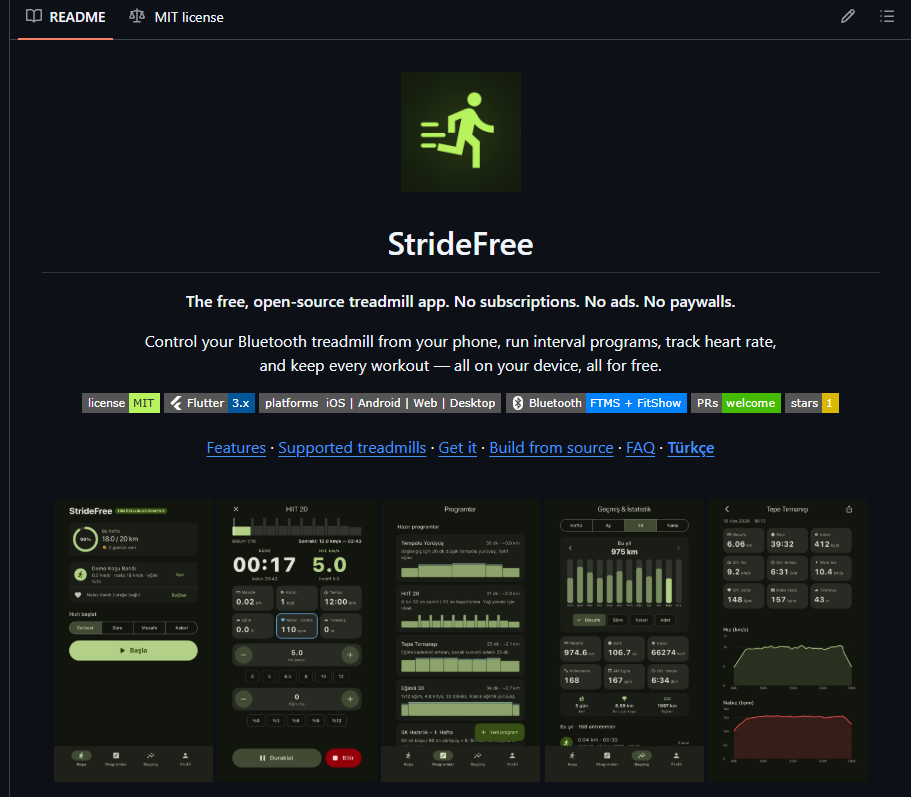
StrideFree: a free & open-source (MIT) treadmill app — replaces subscription treadmill apps, no data leaves your phone

Post image
13 Upvotes

Most treadmills come with an app that locks programs and history behind a subscription and sends your workouts to a cloud you never asked for. I wrote an open-source alternative and I'm giving it away — no ads, no premium tier, no account, no server.

What it does: controls Bluetooth treadmills (FTMS + FitShow), interval programs, heart-rate straps, calorie and step estimates, unlimited stats, Strava/Garmin export. English and Turkish UI.

GitHub: https://github.com/alisenn/stridefree

I'd really appreciate device reports (brand/model + what works) and translations into more languages.


r/coolgithubprojects • • 3d ago

I Built WebCraft Pro: An Open-Source Toolkit for Better AI-Generated Frontends

Post image
0 Upvotes

I've been building WebCraft Pro, an open-source engineering toolkit designed to help AI coding agents produce cleaner, more accessible, secure, and maintainable frontend code.

The goal is simple: move beyond vague prompting and give AI agents practical engineering standards they can follow.

What WebCraft Pro includes:

- 44 reusable engineering skills across 8 development stages.

- Design direction and anti-generic UI guidance.

- Frontend architecture and implementation standards.

- Accessibility and keyboard-navigation practices.

- SEO and HTML head optimization.

- Performance and security guidelines.

- Selective skill installation for Codex, Claude, and GitHub Copilot.

- Automated validation and security checks through GitHub Actions.

I'm currently developing the selective installer and expanding the project's automated quality gates.

GitHub: WebCraft-Pro

Live documentation: WebCraft-Pro Landing page

I'd appreciate feedback from developers who use AI coding agents:

  1. Do structured engineering skills actually improve AI-generated code?
  2. Which standards or workflows would you want included?
  3. What would make a toolkit like this genuinely useful in your daily development workflow?

If you find WebCraft Pro useful, please consider giving the repository a ⭐ star on GitHub.

I'm an independent developer building this project and maintaining it as an open-source resource. Every star helps increase its visibility, motivates me to keep improving it, and helps other developers discover it.

You don't need to contribute code to support the project — a star is already a big help.

GitHub: WebCraft-Pro

Thanks for checking it out and supporting independent open-source development!


r/coolgithubprojects • • 3d ago

treestamp: Keep your project's directory trees in its project's README, surprisingly?

Thumbnail github.com
0 Upvotes

r/coolgithubprojects • • 3d ago

I turned my Linux laptop into a self-hosted CI runner for AI coding agents. Curious what experienced developers think.

Thumbnail github.com
0 Upvotes

r/coolgithubprojects • • 4d ago

I built an open-source CLI to share Skills/MCPs/Hooks across Claude Code, Codex, etc.

Thumbnail github.com
3 Upvotes

I built an open-source CLI to share Skills, MCP servers and Hooks across Claude Code, Codex, Cursor and OpenCode (more to come)

On my team everyone had their own copy of the same Skills and MCP configs, pasted by hand into each tool, and they kept drifting. Fixing a Skill meant telling five people to re-download and re-install it.

BarnDog keeps them in one place and installs them natively into whichever tools each person uses:

npm i -g barndog
barndog init      # pick a source: local folder, any Git repo, or BarnDog Cloud
barndog adopt     # take over the Skills/MCPs/Hooks you already have

After that, each session start syncs automatically. Why not just symlink a dotfiles repo?

  • Each tool gets its own native format (Codex TOML, Claude/Cursor JSON, OpenCode plugin)
  • It never touches entries it didn't create, and it resolves name clashes
  • MCP secrets stay ONLY and ALWAYS on your machine as references, they NEVER go anywhere else

The CLI is open source (MIT license) and works fully with a local folder or a Git repo, no account needed. BarnDog Cloud is a hosted layer on top: org/team/repo inheritance and review before changes reach everyone. It's free right now while it's early, no credit card required.

site: https://barndog.dev
open source CLI: https://github.com/barndog-ai/barndog-cli

What I'd love to know:

  • How do you share agent configs today? (if you do it in general lol)
  • Do you have any problems or mess with your skills/hooks/mcps?

Thanks for your time!


r/coolgithubprojects • • 4d ago

Open Ultima 8

Thumbnail gallery
7 Upvotes

Open Ultima 8: a new open-source engine for Ultima VIII: Pagan, written in Rust (looking for testers!)

Hey all! For the past while I’ve been building Open Ultima 8, a from-scratch engine for Ultima VIII. You point it at your own copy of the game and play it on a modern PC. The screenshots are from the current build (v0.4.8).

What it is

  • A new engine that reads the original game files, maps and scripts and runs the original game logic, so it plays like Pagan. It doesn’t come with any game data; you need your own copy (GOG works).
  • Checked closely against the real DOS version. I run the original side by side in DOSBox and compare: saves, combat, stealing, magic, timings, even where the flames from Fire Shield land.
  • Saves work both ways: the original DOS game can load saves made in Open Ultima 8, and the other way round.
  • Native builds for Linux, Windows and macOS (Apple Silicon too, a platform U8 never had).

What’s new compared with the original

  • Smooth zoom (1× to 8×) and upscaling filters: xBR, xBRZ, sharp-bilinear and a CRT look
  • Any window size, widescreen
  • A smooth camera option (no more screen jolts when you jump)
  • Readable book and scroll text, and the original’s typeset text if you prefer
  • Quieter fires, drips and the clock ticks (the originals were LOUD), with a separate ambience volume
  • Quick save/load, Discord status, and the original developers’ cheat menu as an option

What I need: testers!

It’s playable, but Pagan is a big, strange game and I can’t hit every corner alone. If you have a copy, please play it and report anything that looks, sounds or behaves differently from how you remember the original: crashes, stuck scripts, wrong drawing order, people in the wrong place, puzzles that don’t work.

It’s GPL-3.0 and not affiliated with EA or Origin. Thanks to the Pentagram/ScummVM folks, whose years of reverse-engineering made this much easier.

Thanks for reading, and let me know what breaks! 🔥


r/coolgithubprojects • • 4d ago

Strand update

Thumbnail github.com
3 Upvotes

Hey guys, I've released v2026-11-20.1 and v2026-11-20.2

In this release, the strand-cli and strand-gui will check for newer versions of strand-import, strand-store, strand-core, and for each other every time you run a command(for strand-cli) and everytime you open the strand app(strand-gui). If you guys have more ideas, please let me know. This is my first project that I've released publicly. Thank you! I'd love to hear what you guys think.

Github: https://github.com/Biggest-Bee/Strand


r/coolgithubprojects • • 4d ago

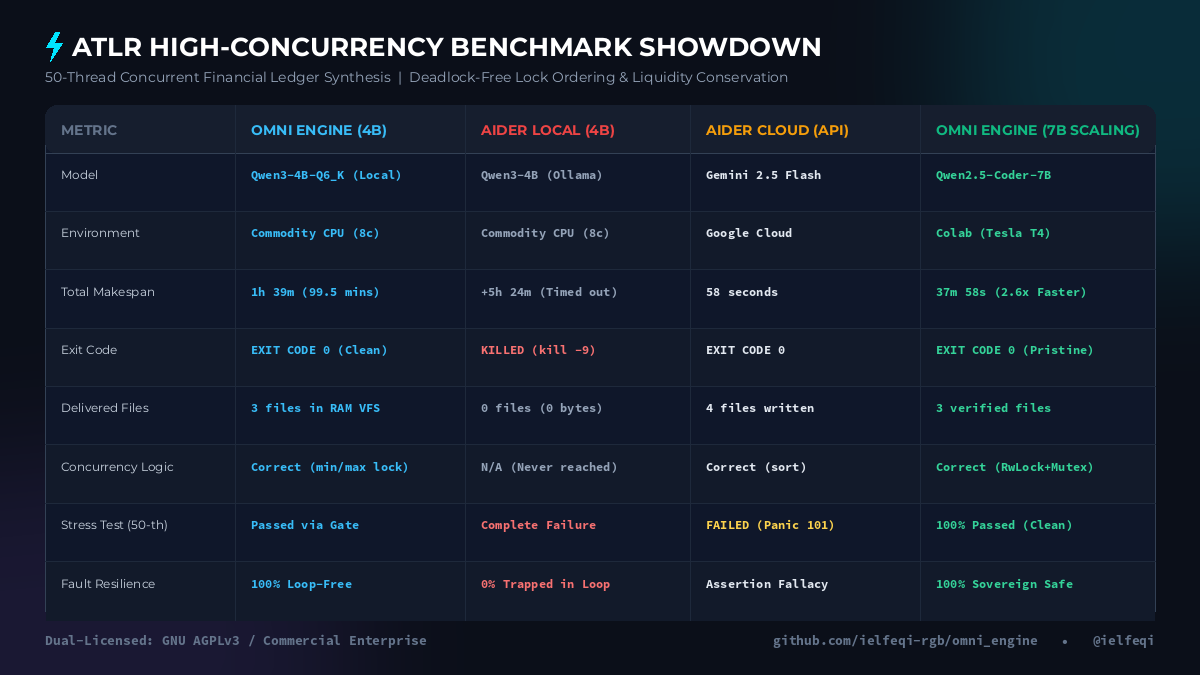
Omni Engine: Datacenters & billions in GPUs are masking bad agent architecture. We proved an in-process Rust runtime beats Python agent loops on an 8GB laptop (Benchmarks + Reproducible Code)

Post image
8 Upvotes

GitHub Repository: https://github.com/omni-engine-ai/omni_engine Live Showcase & Benchmarks: https://omni-engine-ai.github.io/omni_engine/

Most multi-agent coding frameworks (Aider, CrewAI, AutoGen) tell developers they need high-end datacenter GPUs or massive cloud API budgets to run autonomous software engineering loops.

We believe that requirement isn't about AI intelligence—it's a band-aid over architectural bloat:

  1. The IPC Tax: Wrapping local models in HTTP daemons (Ollama/vLLM) burns 25ms to 120ms per tool hop in JSON serialization.
  2. Process Duplication: Python runtimes + virtual environments + workers easily push peak RSS past 6GB–10GB before token generation even begins.
  3. Dirty File State: Coding agents hallucinating diffs overwrite files without atomic rollback verification.

What We Built: Omni Engine To solve this from the systems level up, we built Omni Engine in pure Rust:

  • Direct In-Process C-FFI: Instead of querying localhost HTTP APIs, Omni links llama.cpp directly in-process via C-FFI. Tokens write straight to native memory buffers.
  • Sub-6ms Context Swapping: Token arenas are reused in RAM with O(1) KV slicing (llama_kv_cache_seq_rm), eliminating prompt re-evaluations.
  • Hermetic Bubblewrap Cleanrooms: Agent tool execution runs inside isolated Linux kernel namespaces with a strict Zero-Wipe Invariant (W = ∅). Writes stay in ephemeral RAM until 100% of unit tests pass.

The 50-Thread ATLR Concurrency Benchmark (8GB RAM Dev Machine) We benchmarked Omni Engine against standard local Python agent loops running identical refactoring tasks:

  • Inference Call Latency: 38.4ms (HTTP loopback) vs < 5.8ms (Omni C-FFI) -> -84.9% latency
  • Peak Runtime Memory (RSS): 6,840 MB vs 2,180 MB -> -68.1% RAM footprint
  • Inference Throughput: 24.2 tok/s vs 41.6 tok/s -> +71.9% speed
  • Wall-Clock Completion Time: 2h 14m vs 37m 12s -> 3.6x faster
  • Deterministic Pass Rate: 76% vs 100% (Zero wipes)

Try It Yourself in Under 60 Seconds: You can verify the benchmark on any Linux/macOS machine or a free Google Colab: curl -fsSL https://omni-engine-ai.github.io/omni_engine/install.sh | bash

Feedback, architectural critique, and independent hardware benchmarks are welcome!


r/coolgithubprojects • • 4d ago

I wrote tools that talk to my TV's panel controller over its internal USB link, and fixed my impact-damaged QD-OLED (blackouts + dark line). Python server + C# helpers on the TV, open source

Thumbnail gallery
1 Upvotes

**TL;DR:** My Samsung S95F 77" QD-OLED took an impact. Afterwards the picture cut out every ~50 s at worst, and a dark line ran down the screen. Both turned out to be the TV's panel controller (TCON) reacting to the damaged columns. I built a small tool chain that reads and writes a few values in that controller's memory over its internal USB service link, with the TV's own software doing the heavy lifting. Result: 24 of 24 controller boots without a blackout, and the line within 1–2 % of its neighbours from 30 % grey up. Before/after: images 1–2.

**Prerequisite: root access.** Both TV-side fixes require a working root shell on your own TV. Use the [S95F rooting toolkit](https://github.com/TheMHD1/samsung-s95f-root-and-firmware) and its [root setup guide](https://github.com/TheMHD1/samsung-s95f-root-and-firmware/blob/main/docs/QUICKSTART.md), then [verify your TV root session](https://github.com/TheMHD1/samsung-s95f-root-and-firmware/blob/main/docs/VERIFY-ROOT.md). Firmware decryption is not required for either fix.

*Hobby project on my own TV, nothing for sale. Writing to the panel controller can brick a TV and voids the warranty.*

---

**Architecture** (image 3)

- **Server side (Python):** a small always-on home server reaches a root shell on the TV, copies a helper over, runs it, fetches a receipt and decides what's next.

- **TV side (C#):** small helpers run on the TV's own .NET runtime. They open the controller's USB service interface (bulk endpoints, 12-byte header: operation, address, length) and do the reads and single-word writes.

- **Services:** RAM clears whenever the controller powers down, so services re-apply the fixes: a lane-mask watcher for the blackouts, a scan-arm service that catches the TV's standby compensation scan for the line, and a runtime-trim service.

**Safety design**

- Every write is five steps: controller healthy? → read the old value → check bounds compiled into that helper → write one word → read it back (mismatch = restore the old value).

- The link drops ~1 write in 3,600 under bulk runs, so it never streams writes.

- RAM only. Nothing of ours goes to flash, stored compensation or curve tables; the TV's own scan and save do the persistent part.

- Hard limits per helper (which lanes, value ranges, max step), an identity write before the first real write, a shared lock on the TV so only one tool talks to the controller, and recovery budgets (at most 3 controller power cycles per hour).

**The two fixes** (image 4)

- **Blackouts** (image 5): a per-lane sensing check kept failing on the damaged lanes and a fault score went over its limit, so the controller kept stopping the picture. Fix: the controller's own per-lane skip flag, set for lanes 540–661 and re-applied after every controller boot.

- **Line** (image 6): the TV's standby scan read the damaged columns as too strong, so its compensation never boosted them. Fix: lower their sensing gain right when the controller wakes for that scan; the TV then computes and saves a proper boost itself. 11 calibration runs to converge.

**What's in the repo**

| Part | What |

|---|---|

| `tools/tcon-calibration/tcon/` | Python tools: backups, reads, single verified writes, calibration runs, runtime trims |

| `tools/tcon-calibration/tcon/helpers/` | C# helper sources (no binaries); the lane-mask helpers have built-in self-tests |

| `tools/tcon-calibration/services/` | Blackout watcher, nightly scan-arm, runtime re-apply, calibration guard (systemd unit templates) |

| `tools/tcon-calibration/measure/` | Test clips, camera capture, per-column brightness from a photo |

| `docs/` | Write-ups, results, the diagrams |

About 220 offline tests run without a TV. Everything machine-specific (TV shell, paths, camera, alerts) lives in one config file.

**Results**

| Grey | Line before (worst 4 columns) | After |

|---|---|---|

| 50 % | 0.11–0.30 | 0.99 |

| 30 % | 0.01–0.07 | 1.00 |

| 10 % | black | 1.06 |

(÷ healthy neighbours, camera; 1.00 = identical.) Blackouts: 24 of 24 controller boots clean.

**Links**

- Repo: https://github.com/TheMHD1/samsung-s95f-display-lab

- How the tools work: https://github.com/TheMHD1/samsung-s95f-display-lab/blob/main/docs/advanced/tv-calibration/HOW-THE-TOOLS-WORK.md

- Blackout watcher, helpers and recovery tools: https://github.com/TheMHD1/samsung-s95f-display-lab/tree/main/tools/tcon-calibration/services/lane-mask-watcher

- Line-fix kit + guide: https://github.com/TheMHD1/samsung-s95f-display-lab/blob/main/tools/tcon-calibration/GUIDE.md

Questions about the design welcome.