Hello everyone - this community is in need of a few new mods, and you can use the comments on this post to let us know why you’d like to be a mod here.
Priority is given to redditors who have past activity in this community or other communities with related topics. It’s okay if you don’t have previous mod experience. Our goal, when possible, is to add a group of moderators so you can work together to build the community.
Please use at least 3 sentences to explain why you’d like to be a mod and share what moderation experience you have (if any).
If you are interested in learning more about being a moderator on Reddit, please take a look at these resources:
There are a lot of places you can get to know other moderators and see how they lead their own spaces. r/ModHelp and r/ModGuide are great places to get help from other moderators, and r/ModSupport is available if you want to read peer moderator advice or reach the admins.
The Moderator Help Center and r/ModGuide are great resources for learning how your mod tools work and how to set up features you may have seen in other communities.
I’m working on ZeraPS5, and the GitHub repo has the emulator source, Windows builds, and compatibility notes.
One recent fix made the train windows in Red Dead Redemption render properly. In build 1152 you can see the scenery through the glass, and the ferry scene gives a good look at the water. The 45-second clip starts at the launcher and ends with an uninterrupted stretch of gameplay.
If you try a build, I’d love to hear which game you tested, what hardware you used, and how far you got.
I mostly wanted something lightweight (~16 MB) with zero INTERNET permission in the manifest and Android cloud backup disabled so chats actually stay on the phone. It uses Vulkan GPU offload by default (with Arm KleidiAI CPU fallback) and has a quick benchmark button in settings so you can compare Vulkan vs CPU on your own chip.
On my Realme P3 Ultra (12GB RAM) running Qwen3-8B Q4_K_M, I'm getting around 5.5 t/s on Vulkan vs ~2.7 t/s on CPU. It also has a toggle for Qwen's think/fast mode, collapsible thought blocks, AMOLED pure black theme, basic markdown/code copy, and a small offline /calc tool.
A couple things that are still rough:
- Importing a local .gguf from Downloads currently copies the file into app storage instead of reading it in place (annoying for 5GB models, planning to switch to zero-copy SAF in the next update).
- Mobile Vulkan drivers are hit or miss. Older/weaker Mali GPUs might actually be faster with Vulkan turned off, so definitely test both in the benchmark.
I've only been able to test this on my own phone so far. If anyone tries it on Snapdragon, Exynos, Tensor, or MediaTek, let me know if it crashes or what t/s you're getting.
My laptop is often across the room, plugged into a TV, so I built Edgepad to control it from my phone.
It pairs once over Bluetooth, like a headset, and then the phone and laptop talk directly. No account, no server, and no Wi-Fi needed. Wi-Fi and USB are optional.
What it does:
- Multi-touch trackpad with gestures for one to four fingers
- Corner dials for volume, brightness, zoom and media scrub
- Full keyboard in six sizes
- Gamepad with two sticks and analog triggers. On Windows and Linux the laptop sees an Xbox controller
- Presenter with a laser pointer
- Clipboard sync both ways, and file transfer up to 2 GB per file
- Macros that open apps, folders and websites
Android 12 or later on the phone. Windows, Mac or Linux on the laptop. Windows is tested on real hardware; Mac and Linux are newer and still in testing.
Quick update on we-linux-to-mp4, a tool that renders heavy Wallpaper Engine scenes (.pkg) into MP4 on Linux, so you can use them as video wallpapers (e.g. with mpvpaper). What's new:
New render mode: Cage headless (experimental). The scene is rendered on the GPU through the Cage Wayland compositor and recorded with wf-recorder. The default Xvfb mode still renders on CPU via llvmpipe.
Hardware codecs: NVIDIA h264_nvenc and AMD h264_vaapi, plus the default CPU libopenh264. If the codec you pick isn't available in your FFmpeg, it falls back to libopenh264 automatically.
Big performance improvements. Work is moving in giant leaps: a lot of wallpapers now render to MP4 without a single lag.
How it works: you run node index.js, pick the .pkg, then choose duration, FPS, render mode (Xvfb / Cage), resolution (Xvfb: 1920x1080 or 1280x720; Cage is fixed at 1920x1080) and codec. It can also extract a ready-made video from the archive and shows a resource map of the .pkg (videos, textures, shaders, configs, audio). The installer covers apt, dnf and pacman distros and builds linux-wallpaperengine for you. MIT licensed. Notes: hardware codecs need a suitable GPU, drivers and FFmpeg support. Very heavy shaders and real-time widgets are still not supported. Finer settings and more effect types are planned. I really need your feedback. Last time nobody tried it or told me anything, so I don't know what works and what breaks on your setups. If you have a Linux machine and some Wallpaper Engine scenes, please try it, especially the Cage + NVENC/VAAPI path, and tell me your distro, GPU and which wallpapers worked or failed. Even a one-line "works / doesn't work" helps a lot. 🔗 https://github.com/R31tr0/we-linux-to-mp4
We're building Agentic GraphRAG, an open source library for connecting the documents an agent reads with its task history and decisions.
I've worked on RAG systems and LLM training for the past three and a half years. Lately, I've been following how agents retain work across sessions, especially for non-coding tasks.
Most frameworks treat knowledge retrieval and memory as two separate problems. Nobody stores the decisions that led to the retrieval along with the data that it gets. Agent struggles to retrieve the correct stuff the next time again. We're solving that by bringing them together in one 3D connected graph.
We construct three connected graph layers that the agents read:
Knowledge Layer: holds documents (with full structure), source passages, and extracted entities and relationships. Passages retain their document version and location, including page positions for PDFs.
Working memory: records tasks, progress, messages, and tool activity. The agent saves task events so work can continue across sessions.
Decision memory: stores conclusions, assumptions, and open questions encountered by the agent. Decisions link to source passages they were based on, recorded events, or earlier decisions, and keep their history when reviewed or replaced.
Things which make us different from other frameworks out there:
- Structure Aware: The ingestion pipeline uses Docling for loading documents and captures the full document hierarchy. The sections, tables, and passage hierarchy are connected using edges and stored in the graph.
- Ontology Grounded: You define a schema for your domain (we also ship ontology presets so it is easy to get started). The schema guides extraction, validation, and search. We use GLiNER for local extraction, so its virtually free (and fast) to construct the graph and no LLM calls are needed.
- Robust Agent Search: Retrieval combines graph, full-text and vector search. Agents can reach original passages even when extraction misses a fact, navigate surrounding sections and table rows with headers, and follow entity relationships back to supporting text.
We offer a built-in agent you can use out of the box. You can also connect your agents through MCP.
We will be releasing extensive benchmarks very soon.
TL;DR
Agentic GraphRAG is an open source library that stores document knowledge, agent work, and decisions in one connected graph. Agents can resume tasks and trace saved decisions to their original evidence, while source changes flag affected decisions for review.
Try it out. Feedback, criticism, issues, and contributions are all welcome!
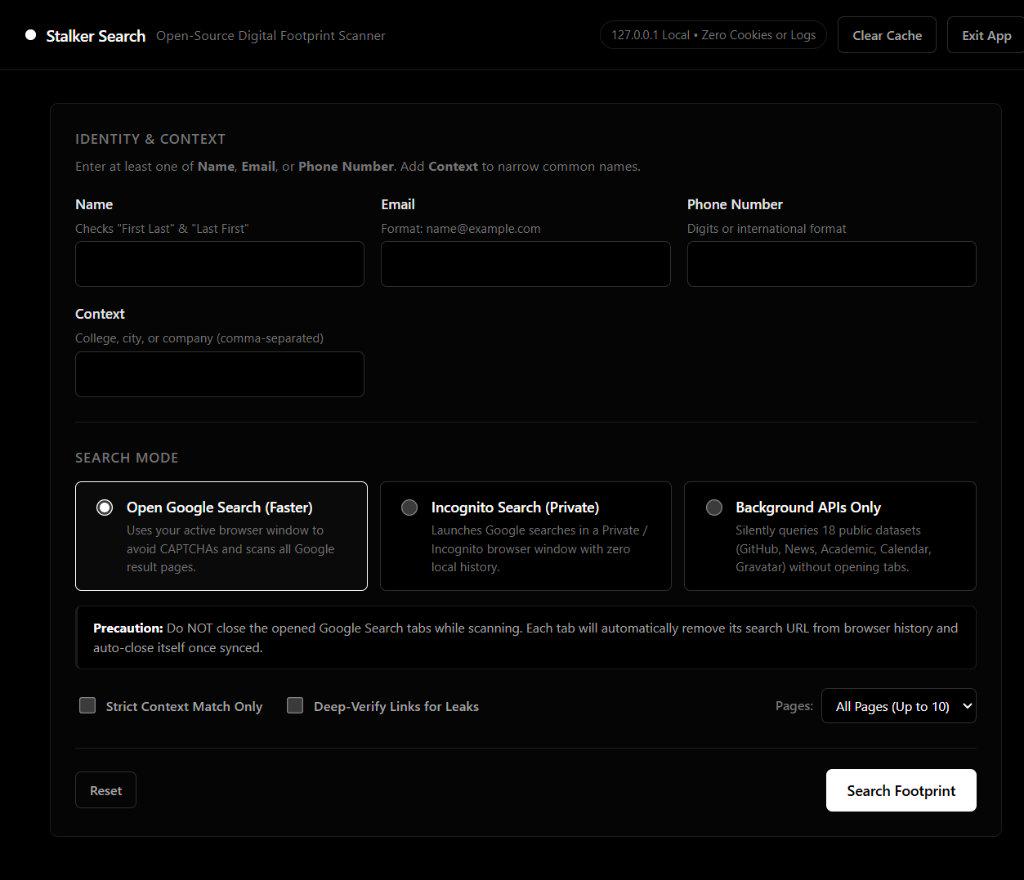
Most people only ever search their name on page 1 of Google and think their personal info is private. Meanwhile, a stalker who checks up to page 10 of Google dorks and correlates public databases can often pull your phone number, old college or government PDFs, leaked commit emails, and even public Google calendars in less than a minute.
I built Stalker Search in Rust so you can run that exact deep check on yourself locally with zero telemetry and without handing your personal details to shady online footprint websites.
It scans 18 public datasets concurrently and uses a lightweight temporary addon on LibreWolf or Firefox to pull up to 10 pages of Google results, then automatically deletes the search queries from your browser history and closes the tabs for you. It flags every exposed phone number , email, and document with direct links to get them removed.
100% Free and open source, tested on Arch Linux and Windows.
Update: The companion extension just got officially approved on Mozilla Addons, so you can now install it directly in LibreWolf or Firefox in one click instead of loading it manually through about:debugging u can find the link on my github.
I've been building Hive Mind, an open-source project that gives multiple AI coding agents access to the same persistent memory.
The problem
AI coding agents work with isolated memories. Solutions discovered by one agent aren't necessarily available to another. This leads to repeated explanations, lost context, and duplicated work.
I wanted to change that.
What Hive Mind offers
Shared memory: One knowledge base for Claude Code, Codex, and Antigravity through MCP.
Knowledge graphs: Graphify integration for codebase understanding and relationship discovery.
Fast retrieval: Native Rust core, SQLite FTS5, and relevance ranking.
Self-improvement: Session outcome scoring, knowledge-gap mining, and automated playbook curation.
Skill discovery: Automatically finds and matches relevant agent skills.
Privacy: Local-first inference options and secret redaction.
Python fallback: Runs without external Python dependencies.
Some benchmarks
Operation
Result
Native startup
<1 ms
Vault search
~4 ms
Graph PPR (1,698 nodes)
7.8 ms
Search Recall@5
1.00 (30/30)
Measured in my development environment.
Looking for contributors!
I'd love feedback and contributions, particularly around:
If you've used LinkedIn jobs you would have experience how annoying it is. Half of the jobs that you see are already applied to, viewed or reposted for the 100th time. It genuinely annoys me, this extension helps solve this and a few more things:
- hide applied, viewed, saved or reposted jobs
- filter listings by number of applicants
- block specific companies (especially those staffing agencies you fall for everytime)
- track jobs in your own google sheets so you can search and update them properly, unlike the built in tracker which has no search and works on pagination (it's literally not usable)
everything runs locally in your browser with no external data collection, it's free and open source
I’ve been working on a side project called Clipsurge and finally got it to a place where it's actually usable.
Basically, you feed it a long-form video, it analyzes the content to find the high-retention parts, and spits out short-form clips ready for Reels/Shorts. Built it mostly because I wanted something free and open-source that I actually had control over.
Code is all up on GitHub if you want to look under the hood or try it out:
A free, open-source side project. You give it a plan, it splits the work across Claude Code subagents, has a different agent review each stage before moving on, shows everything on a live tracker, and at the end hands you a test plan and waits for your OK.
Hey everyone! Melo is out! I built Melo to bring Spotify, YouTube Music, and the music already on your phone into one Android player.
Redesigned UI and customizable themes. Pick from five app icons, tweak the blur, tint, and transparency of Liquid Glass, or let album art set the colors for the whole app.
Add-ons. Connect compatible music catalogs to search and play tracks from them inside Melo.
Lossless playback. With a compatible add-on, Melo can switch a playing YouTube Music track to a matching lossless stream and keep your place in the song. Set audio quality separately for Wi-Fi and mobile data.
Home Speed Dial. Pin your favorite songs, albums, playlists, and artists for quick access, or browse mixes and recommendations.
Synced lyrics and Canvas. Follow lyrics word by word, share your favorite lines as a card or video, and watch Canvas loops on supported tracks.
Discord Rich Presence. Show what you’re listening to and keep your chosen status when you pause.
GentleMail is an open-source (MIT) webmail, email API and webhooks that you deploy to your own Cloudflare account. One deployment sends and receives for all your domains, with as many mailboxes and people as you want. It costs Cloudflare's $5/month Workers plan, with 3,000 sent emails included and receiving unlimited. It also exposes an MCP server so you can connect with your favorite LLM, with api keys, permission granularity and webhooks support.
Why signatures, in 0.8 ?
The emails you send to customers and partners get opened again: when they compare offers, pass yours to their boss, or look for you three weeks later. The signature is what tells them who you are and where to go next.
- A founder writes as the company they're building. Name, role and logo are on every email, even when the team is one person.
- A salesperson gives every reply a next step. The logo links to the demo, the pricing or the booking page.
- Whoever answers support@ or sales@ signs the same way. If you run several brands, each mailbox has its own logo.
- The people you write to aren't tracked. The logo is inside the message, so opening it loads nothing from your server.
You set it once per mailbox, and it goes on new messages, replies and forwards.
Also in 0.8
- Images inside a message stay in place when you reply to it or forward it.
- Admins are told when a newer version is out, with what changed and what to do before updating. Nothing installs by itself, and you can turn the check off.
How the new parts work
- The logo is kept in R2 and sent as an inline attachment with the `send_email` binding, with a `cid:` reference in the HTML.
- The list of releases is a static JSON file built from the changelog. The cron trigger reads it about once a day and keeps in D1 only what's newer than the version you run.
- That request carries nothing about your instance. Cloudflare adds its `CF-Worker` header, so the domain of your Worker is visible to us. The docs say so, and there's a switch in Admin.
Coming from before 0.7.2, please update: files sent from the webmail or the API could reach the recipient as base64 text. 0.7.2 fixed that, and 0.8.1 is the version to take. From 0.7 there's one migration, `0011_signatures.sql`.
What it doesn't do yet:
- No IMAP, POP or SMTP: you use the webmail, the API or an AI assistant, not Thunderbird or Apple Mail.
- No saved drafts, and you can't put images inside the text you write (a signature's logo and attachments are fine).
- Spam is Cloudflare's checks plus the senders you block. Nothing reads the content.
- It depends on Cloudflare: your DNS there, and the $5/month Workers Paid plan.
I made honest-ci. It's a GitHub Action that reads a PR's diff for the ways tests get weaker while CI stays green. It has five rules, one for each way:
a test, a named table case or a whole test file disappears
a new skip, xfail, todo or .only shows up
a test file loses assertions
an expected value changes and nothing else in the assertion does, in a PR that also changes code
a coverage threshold drops, or tests get left out of the run (--ignore, -k "not ...", -DskipTests, || true)
The first four hold the PR for a person, and the comment names the test and how it changed. The last one blocks. It knows Python, JS/TS, Java and Go tests.
Verdicts come from deterministic code. You can add a model to explain findings, but it never decides. A first install needs no Docker and no test setup, just one command that writes the workflow and two config files. The rules are read at the PR's base commit, so a PR can't loosen the rules it's judged by. An approval only counts for the commit it was given on.
I ran it on 2,717 PRs from public repos, opened by coding agents and by people, and labeled all 345 flags. 93.6% of them were true statements about the diff. Every label is in the repo under bench/data, with a link to the line.
It's source-available, free on public repos and on private repos where only you open PRs. A team's private repos need a subscription after a 14-day trial.
Cloud clipping tools want you to upload hours of footage and pay per minute. I wanted something that runs on my own box, so I wrote highlight-detector.
What it does
Scans a video (anything FFmpeg reads) and ranks the most intense moments: loud spikes, gunfire/explosion-like hits, fast motion, scene cuts, flashes
Optional: your chat replay (TwitchDownloader JSON, CSV or plain text) and subtitles for hype words
Gives a reason for every pick, outputs JSON / CSV / YouTube chapters / EDL, and can cut the clips to MP4
MCP server included, so a local AI assistant can call it
Self-hosting details
Python 3.10+, NumPy, FFmpeg. No GPU, no API keys, no telemetry, nothing leaves your machine
Streams the decode, so a 10-hour VOD doesn't need 10 hours of RAM
14 min of 1080p: 41 s with video analysis, 1.4 s audio-only (4 vCPU VM)
Easy to cron over a recordings folder: highlight-detector "$f" -f chapters > "${f%.*}.chapters.txt"
Mi piacerebbe portare avanti questo progetto, ampliarlo e migliorarlo, ma svilupparlo completamente da solo è difficile.
Per questo cerco persone interessate a unirsi al progetto e contribuire alla sua crescita.
In particolare:
Sviluppatori interessati a collaborare al codice.
Grafici e artisti per la creazione di elementi e tavoli.
Appassionati di flipper virtuali.
Tester e persone con idee e suggerimenti.
Non è un progetto commerciale: è gratuito e open source. Vorrei creare qualcosa di utile per la community e possibilmente costruire un piccolo gruppo di persone che abbia voglia di svilupparlo insieme.
Anche un piccolo contributo può fare la differenza!
Se siete interessati, fatevi avanti. Mi farebbe davvero piacere trovare persone con cui portare avanti questo progetto!
We’re building Interview Identity Guard to help recruiters check if the same person is speaking across remote interview rounds. It uses DetectifAI’s Eidos for voice matching and Aletheia to check for AI-generated voices. The goal is simple: make remote interviews more trustworthy.
Voice-cloning scams are getting hard to spot by ear. McAfee's 2023 survey of 1,010 Indians (a vendor survey, so take it with some salt) found that 47% had experienced one or knew someone who had, and 83% of the victims said they lost money. The usual pattern is an urgent call or voice note from "someone you know" asking for money.
Who it's for
Everyday people and families in India who get urgent voice notes or calls from "a relative" asking for money. Our main picture is a parent or grandparent getting a message that sounds like their child.
The relative who helps them, usually the more tech-savvy family member, who can check a clip for them and walk them through what to do next.
It is not a replacement for a bank's fraud systems, and it is not meant to prove anything on its own. It's a quick second opinion for ordinary people before they send money.
We built Scam Shield using DetectifAI's Aletheia deepfake-detection API.
How it works
You upload or record a suspicious voice clip and pick who the caller claims to be from a saved trusted-contacts list.
Our FastAPI backend sends the clip to Aletheia, which returns a verdict, a score, and scores for each segment of the clip.
We turn that into a Low / Medium / High risk level and show a timeline of which parts look synthetic.
The user gets a clear next step: don't send money or OTPs, call back on a saved number, and ask a question only the real person could answer.
They can alert the real person being imitated and generate a complaint-ready summary (call 1930, file at cybercrime.gov.in). Both only happen after the user confirms.
Aletheia's per-segment scores made the timeline easy to build, and our test clip (a cloned voice, made with a teammate's permission) came back with a very high signal.
Keeping the result as "evidence, not proof" and always giving a next step felt right for a tool that could scare someone.
What didn't, or isn't done
The "call blocked" screen is a simulation. Apps can't intercept real phone calls, so a real version would need a telephony platform.
We hit our own bug early: our local length check rejected a valid file before it ever reached the API.
Short clips and phone-quality audio are less reliable, and the model works best on English and Hindi. We haven't tested other Indian languages properly.