r/coolgithubprojects • u/chaitanyagiri • 1h ago
My view when my agents are working(OSS)
gallery
•
Upvotes
r/coolgithubprojects • u/sayboom • 1h ago
https://github.com/saromanov/openfd
Three things kept annoying me: umount: target is busy, address already in use, and "I deleted the log but the disk is still full". In all three lsof gives you a pid and leaves the rest to you. On big boxes it can also take minutes and eat memory (Red Hat KB has a writeup about it OOMing).
So I wrote openfd. The subcommand I use most is why:
$ openfd why /mnt/data
/mnt/data (ext4, /dev/sdb1) is busy: 3 processes, 4 references

OWNER                 PID    COMMAND  HOW    TARGET
nginx.service         812    nginx    fd 7   /mnt/data/logs/access.log
user@1000/session-3   4410   bash     cwd    /mnt/data/project
docker:3f2a9c         9921   app      mmap   /mnt/data/lib/libfoo.so

fix:
  systemctl restart nginx.service
  cd out of /mnt/data/project
  docker restart 3f2a9c
It checks fd, cwd, exe, mmap, locks and nested mounts, and works out which systemd unit, container or pod the pid belongs to. The hints are printed, not executed.
There's also leak: it watches fd growth over time, fits a least-squares line, gives an ETA to EMFILE, and groups what's growing — e.g. "+171 tcp → 10.0.0.5 CLOSE-WAIT" — with a guess at the cause. And --deleted, which sums the bytes held by unlinked-but-open files.
Scans stream, so memory doesn't scale with the number of fds. At 100k fds: openfd 0.71 s / 3 MiB, lsof 2.0 s / 42 MiB, lsfd 2.8 s / 140 MiB (hyperfine, same machine; methodology in BENCHMARKS.md, re-run in CI on every PR).
It's not a drop-in lsof replacement and doesn't try to be. It covers the common stuff; missing flags fail with an error instead of pretending. Linux only. Without root you only see your own processes.
Rust, no unsafe in the core, two setpriority calls in the CLI for --nice. Static binary, no network access.
cargo install openfd, brew install saromanov/tap/openfd, or binaries from Releases. MIT/Apache-2.0.
Curious which lsof invocation you'd miss. There's also a small good first issue if anyone wants to contribute: https://github.com/saromanov/openfd/issues/17
r/coolgithubprojects • u/kaosnews • 9m ago
Hi! I’ve been building Kladje, a small desktop editor for everyday Markdown files. You can open a .md file from any folder, write with a live preview beside it, and save it where it already lives.
I spent some time on what happens when something goes wrong. If another app changes the file while you’re editing, Kladje lets you compare the versions side by side. If the app quits unexpectedly, it can offer to recover your draft.
The first preview also has Quick Open, which shows a formatted excerpt before you open a file, and a focus mode that highlights the paragraph you’re writing.
Kladje is free and MIT-licensed. The first builds are available for Apple silicon and Intel Macs, plus an unsigned Windows x64 preview.
Source on GitHub · Website & downloads
If you try it, I’d love to hear how it handles the Markdown files you already use. What felt awkward, or what did you miss?
r/coolgithubprojects • u/polyglobulous • 11m ago
☕️ calling all coffee fanatics in this sub
I’m a V60 pourover every day kind of guy, and regularly have between 5-10 bags of coffee on hand - maybe 2 drinking, a couple resting, and a backstock in the freezer
For a while I had been using an Airtable setup for tracking the beans I purchased, which were resting, and logging brews each day so I could learn and analyze and basically keep getting better at making a solid cup of coffee
Recently I’ve been experimenting with building Cloudflare apps, and I made the coffee logging app I’ve always wanted called Ratio: https://github.com/tyler-class/Ratio
Basically Ratio is:
- free, open source, and self hosted on your own Cloudflare and GitHub accounts
- tracks your inventory of beans
- tracks each brew you make and lets you score and leave comments
- most useful IMO is it has a built in connector for AI assistants, so you can conversationally talk to Claude or ChatGPT about your coffees, have them log brews for you, have them tell you analysis about the beans and origins and whatnot that you rate the best
It’s totally free - it’s a 1 click self host deploy on Cloudflare, just thought I’d share here in case anyone else is a nerd about this like I am. There are screenshots on the Readme so you can see more of what it includes.
Technical stuff -
- When you deploy, it clones my GitHub source repo to your own new repo, then spins up a new CF Worker via wrangler that automatically builds a D1 database and R2 bucket bound to the Worker.
- The Worker both serves the application and serves the MCP endpoint.
- D1 is where all the data lives and R2 holds images you can upload of roaster logos or bags of coffee if you like.
- As I push continued updates, you can opt in to auto updates in settings, which basically is a GitHub action that runs every 6 hours and clones from source to your personal repo if there’s a diff.
r/coolgithubprojects • u/BrilliantFeeling7592 • 4h ago

Hey everyone! 👋
I wanted to share a project I've been working on called Lyricist. It's a clean, cross-platform desktop application designed to automatically fetch, synchronize, and embed lyrics and metadata for local music libraries (MP3, FLAC, M4A, WAV, etc.) without relying on heavy web wrappers.
After running into stuttering issues with earlier UI frameworks, I built it from the ground up using Python and PySide6, ensuring that all heavy background tasks (like Whisper transcription and vocal isolation) run safely on background threads without ever freezing the interface.
✨ Key Features
Privacy First: Runs locally on your machine with offline-capable AI models.
🛠️ Tech Stack
The repository is fully open-source. I’d love for you to check it out, test it on your local music collections, and let me know what you think or if you encounter any bugs!
👉 GitHub Repository: https://github.com/Will22102s/Lyricist-the-song-lyrics-generator
(Feedback, feature requests, or contributions are always welcome!)
r/coolgithubprojects • u/kks235 • 19m ago

If you are creating ansible roles you might benefit from ansible LSP I've created. It is blazing fast, runs everywhere and has functionality specifically created for ansible role developers.
r/coolgithubprojects • u/boringwriter2 • 6h ago
Been messing around with llama.cpp on Android for a while and ended up building my own offline chat app called LittleBit Chat.
Repo + APK (v1.1.0):
https://github.com/aj5649169-svg/littlebit-chat/releases/latest
I mostly wanted something lightweight (~16 MB) with zero INTERNET permission in the manifest and Android cloud backup disabled so chats actually stay on the phone. It uses Vulkan GPU offload by default (with Arm KleidiAI CPU fallback) and has a quick benchmark button in settings so you can compare Vulkan vs CPU on your own chip.
On my Realme P3 Ultra (12GB RAM) running Qwen3-8B Q4_K_M, I'm getting around 5.5 t/s on Vulkan vs ~2.7 t/s on CPU. It also has a toggle for Qwen's think/fast mode, collapsible thought blocks, AMOLED pure black theme, basic markdown/code copy, and a small offline /calc tool.
A couple things that are still rough:
- Importing a local .gguf from Downloads currently copies the file into app storage instead of reading it in place (annoying for 5GB models, planning to switch to zero-copy SAF in the next update).
- Mobile Vulkan drivers are hit or miss. Older/weaker Mali GPUs might actually be faster with Vulkan turned off, so definitely test both in the benchmark.
I've only been able to test this on my own phone so far. If anyone tries it on Snapdragon, Exynos, Tensor, or MediaTek, let me know if it crashes or what t/s you're getting.
r/coolgithubprojects • u/kerryizepikk10 • 45m ago
r/coolgithubprojects • u/Fragrant-Trick6998 • 10h ago

My laptop is often across the room, plugged into a TV, so I built Edgepad to control it from my phone.
It pairs once over Bluetooth, like a headset, and then the phone and laptop talk directly. No account, no server, and no Wi-Fi needed. Wi-Fi and USB are optional.
What it does:
- Multi-touch trackpad with gestures for one to four fingers
- Corner dials for volume, brightness, zoom and media scrub
- Full keyboard in six sizes
- Gamepad with two sticks and analog triggers. On Windows and Linux the laptop sees an Xbox controller
- Presenter with a laser pointer
- Clipboard sync both ways, and file transfer up to 2 GB per file
- Macros that open apps, folders and websites
Android 12 or later on the phone. Windows, Mac or Linux on the laptop. Windows is tested on real hardware; Mac and Linux are newer and still in testing.
Free and MIT licensed.
GitHub: https://github.com/akshit-bansal11/edgepad
Full video: https://youtu.be/qZ9U370H7f0
Feedback and bug reports are welcome.
r/coolgithubprojects • u/SanadLibya • 1h ago
Hi guys, i worked on this from personal needs for a tool to help me generat docs in my work or for my freelancing clients, i hated .docx and ms office, and needed to ease my agent's connection to LibreOffice.
LibreOffice does have an UNO Api, but this makes it easier and faster, and has many tools that can speed doc generation and editing, it is standard library and built to stay like that forever.
The agents i tried: Claude Code, OpenClde with kimi k3 pro and DeepSeek, Antigravity. Another guy found some errors occuring when on Linux and decided to contribute a fix, hope you guys can adopt it and tell me open a request for any tool your agent my need, or any error that occures.
Latest patch is for Calc and more support to RTL.
r/coolgithubprojects • u/Leather-Bug-4173 • 5h ago
I’m working on ZeraPS5, and the GitHub repo has the emulator source, Windows builds, and compatibility notes.
One recent fix made the train windows in Red Dead Redemption render properly. In build 1152 you can see the scenery through the glass, and the ferry scene gives a good look at the water. The 45-second clip starts at the launcher and ends with an uninterrupted stretch of gameplay.
If you try a build, I’d love to hear which game you tested, what hardware you used, and how far you got.
r/coolgithubprojects • u/pablogonz12 • 6h ago
r/coolgithubprojects • u/More-Drink2211 • 2h ago

Most astronomy calculators tend to be hosted on pages that look like they came from the 1990s, I decided to compile a list of important formulas of astronomy and turn them into a massive calculator that is somewhat user-friendly* compared to its predecessors.
Some important calculators are Roche limit, black hole lifetimes, general and special relativity, escape velocity and cosmic ray calculators.
Of course, I'm not an astronomy expert, I'm just a hobbyist who finds scientific topics interesting to engage with, and as a result, there might be some mistakes in this website, so feel free to point them out.
I don't think this is a complete calculator, so I hope I find time to work on this and get more calculators ready for young, aspiring astronomers.
Site is live at - https://astralmaths.github.io/astralmaths/
BTW, this website is completely free to use, there are no paid tiers or anything like that. If I ever get the money to host it on a personal domain, I might earn from it using ads or smth, but for now, its hosted on a github page.
r/coolgithubprojects • u/guitbom • 2h ago
I used GoFullPage for a while, but the features I wanted most (smart page splitting, annotations, URL/date on the PDF) are behind its Premium plan. So I built an open-source alternative that includes all of them for free, plus a few things GoFullPage doesn't do at all.
Free here, Premium on GoFullPage
Not in GoFullPage at all
The basics you'd expect
Privacy
No account, no ads, no tracking. Captures stay in your browser. It's MIT licensed.
Chrome Web Store: https://chromewebstore.google.com/detail/pagetopdf-%E2%80%94-full-page-scr/kiimpcogfekffgadgelchbclammakbcf
Source: https://github.com/luistodobom/pagetopdf
If you switch over from GoFullPage, I'd really like to hear about any page where mine does worse.
r/coolgithubprojects • u/phphe • 2h ago
I've been using AI coding agents quite a bit lately, and noticed an annoying side effect.
When these agents delete files, they often just move them to the Windows Recycle Bin instead of permanently deleting them.
Over time, this can leave thousands of tiny files in the Recycle Bin.
Opening it can become painfully slow because Windows has to load all those entries.
The obvious solution is to empty the Recycle Bin, but there's a problem: I also manually delete files and sometimes keep things in there because I might want to restore them later.
I don't want to lose those files just because an AI agent has dumped thousands of temporary files into the Recycle Bin.
So I built trash-path-cleaner, a small open-source PowerShell tool that lets me:
Clean files originating from specific directories.
Filter by original file size.
Target multiple directories at once.
Preview what will be deleted before confirming.
This way, I can clean up the mess left by AI agents without blindly emptying my entire Recycle Bin.
It's free, open source (MIT), and requires no extra dependencies.
Curious if anyone else has run into this problem with AI coding agents!
Feedback and suggestions are welcome.
r/coolgithubprojects • u/Western_Storage_4369 • 6h ago

Quick update on we-linux-to-mp4, a tool that renders heavy Wallpaper Engine scenes (.pkg) into MP4 on Linux, so you can use them as video wallpapers (e.g. with mpvpaper).
What's new:
How it works: you run node index.js, pick the .pkg, then choose duration, FPS, render mode (Xvfb / Cage), resolution (Xvfb: 1920x1080 or 1280x720; Cage is fixed at 1920x1080) and codec. It can also extract a ready-made video from the archive and shows a resource map of the .pkg (videos, textures, shaders, configs, audio). The installer covers apt, dnf and pacman distros and builds linux-wallpaperengine for you. MIT licensed.
Notes: hardware codecs need a suitable GPU, drivers and FFmpeg support. Very heavy shaders and real-time widgets are still not supported. Finer settings and more effect types are planned.
I really need your feedback. Last time nobody tried it or told me anything, so I don't know what works and what breaks on your setups. If you have a Linux machine and some Wallpaper Engine scenes, please try it, especially the Cage + NVENC/VAAPI path, and tell me your distro, GPU and which wallpapers worked or failed. Even a one-line "works / doesn't work" helps a lot.
🔗 https://github.com/R31tr0/we-linux-to-mp4
r/coolgithubprojects • u/Gnemmah • 2h ago
Hi! I built Fishy Client, a small open-source launcher for the games you own on Epic, with a fish-themed pixel-art look. Windows 10/11 for now. (Built on rust)
Privacy: it only talks to Epic and GitHub. No telemetry, analytics or tracking, and no server of its own. Logs stay on your PC and never contain tokens or your Windows user name.
Open source: GPL-3.0-or-later. Every change is built and tested on GitHub Actions, and dependencies are scanned for known vulnerabilities.
Honest caveats: it's unofficial and not affiliated with Epic. Like Legendary and Heroic, it presents itself as Epic's launcher, and while I know of no bans for normal use, the risk isn't zero. Some anti-cheat games may not work. The installer isn't code-signed yet, so Windows shows "Windows protected your PC" (More info → Run anyway).
A Linux version is planned. Feedback, issues and PRs welcome!
r/coolgithubprojects • u/Any-Importance6245 • 2h ago
r/coolgithubprojects • u/vm324234 • 1d ago

We're building Agentic GraphRAG, an open source library for connecting the documents an agent reads with its task history and decisions.
I've worked on RAG systems and LLM training for the past three and a half years. Lately, I've been following how agents retain work across sessions, especially for non-coding tasks.
Most frameworks treat knowledge retrieval and memory as two separate problems. Nobody stores the decisions that led to the retrieval along with the data that it gets. Agent struggles to retrieve the correct stuff the next time again. We're solving that by bringing them together in one 3D connected graph.
We construct three connected graph layers that the agents read:
Things which make us different from other frameworks out there:
- Structure Aware: The ingestion pipeline uses Docling for loading documents and captures the full document hierarchy. The sections, tables, and passage hierarchy are connected using edges and stored in the graph.
- Ontology Grounded: You define a schema for your domain (we also ship ontology presets so it is easy to get started). The schema guides extraction, validation, and search. We use GLiNER for local extraction, so its virtually free (and fast) to construct the graph and no LLM calls are needed.
- Robust Agent Search: Retrieval combines graph, full-text and vector search. Agents can reach original passages even when extraction misses a fact, navigate surrounding sections and table rows with headers, and follow entity relationships back to supporting text.
We offer a built-in agent you can use out of the box. You can also connect your agents through MCP.
We will be releasing extensive benchmarks very soon.
Agentic GraphRAG is an open source library that stores document knowledge, agent work, and decisions in one connected graph. Agents can resume tasks and trace saved decisions to their original evidence, while source changes flag affected decisions for review.
Try it out. Feedback, criticism, issues, and contributions are all welcome!
r/coolgithubprojects • u/Confident_Zombie_619 • 1d ago
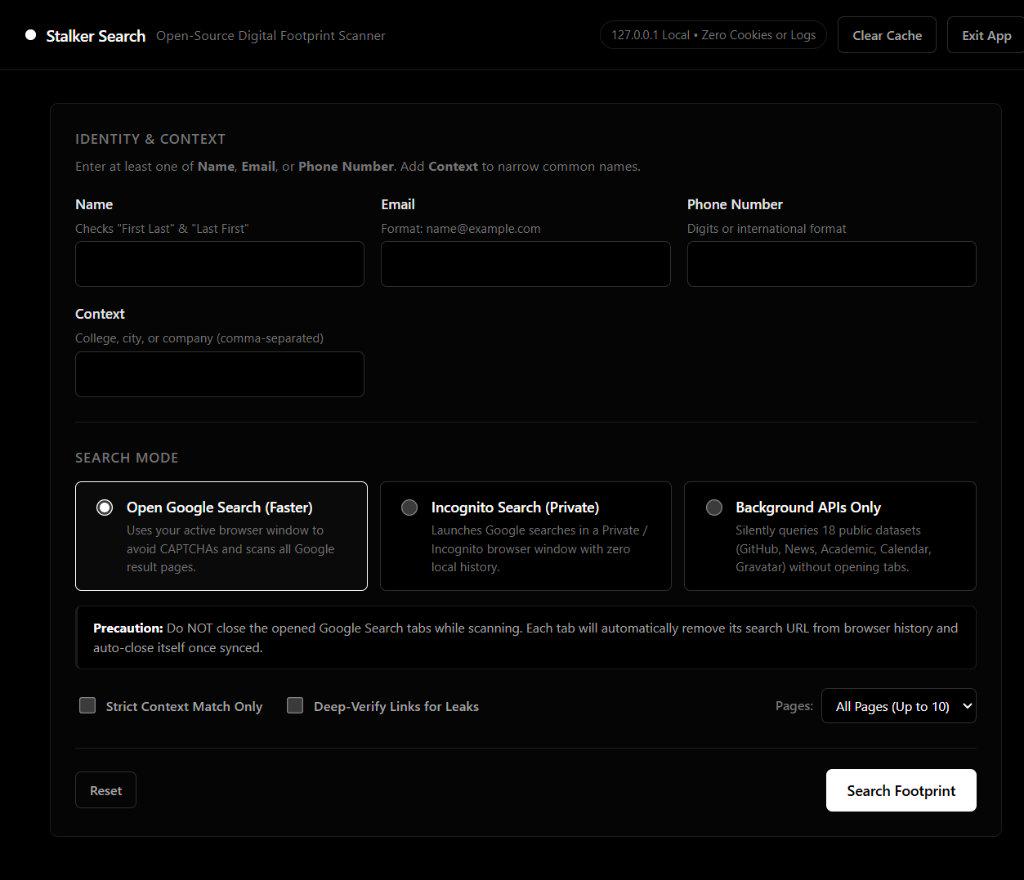
Most people only ever search their name on page 1 of Google and think their personal info is private. Meanwhile, a stalker who checks up to page 10 of Google dorks and correlates public databases can often pull your phone number, old college or government PDFs, leaked commit emails, and even public Google calendars in less than a minute.
I built Stalker Search in Rust so you can run that exact deep check on yourself locally with zero telemetry and without handing your personal details to shady online footprint websites.
It scans 18 public datasets concurrently and uses a lightweight temporary addon on LibreWolf or Firefox to pull up to 10 pages of Google results, then automatically deletes the search queries from your browser history and closes the tabs for you. It flags every exposed phone number , email, and document with direct links to get them removed.
100% Free and open source, tested on Arch Linux and Windows.
GitHub: https://github.com/Venky7514/Stalker-Search
Update: The companion extension just got officially approved on Mozilla Addons, so you can now install it directly in LibreWolf or Firefox in one click instead of loading it manually through about:debugging u can find the link on my github.
r/coolgithubprojects • u/anantnrg • 3h ago
r/coolgithubprojects • u/gFean04 • 4h ago

Hey everyone!
We've been working on Bundle Drop, an open-source OTA update SDK for React Native and Expo.
The idea was to make shipping JavaScript and asset updates easier, without requiring a new app store release for every compatible change or dealing with MAU-based pricing.
Some of the things we've built into it:
One of the more interesting challenges has been making recovery reliable across different React Native versions, Hermes, and native startup scenarios.
The SDK is open source, published on npm, and the project is already being used in production applications.
GitHub: https://github.com/GFean/react-native-bundle-drop
Would love to hear feedback from anyone working with React Native, SDK development, or mobile release infrastructure.
Especially interested in suggestions around compatibility, recovery, and delta delivery.
r/coolgithubprojects • u/developer6 • 4h ago
r/coolgithubprojects • u/saimdeniz • 4h ago