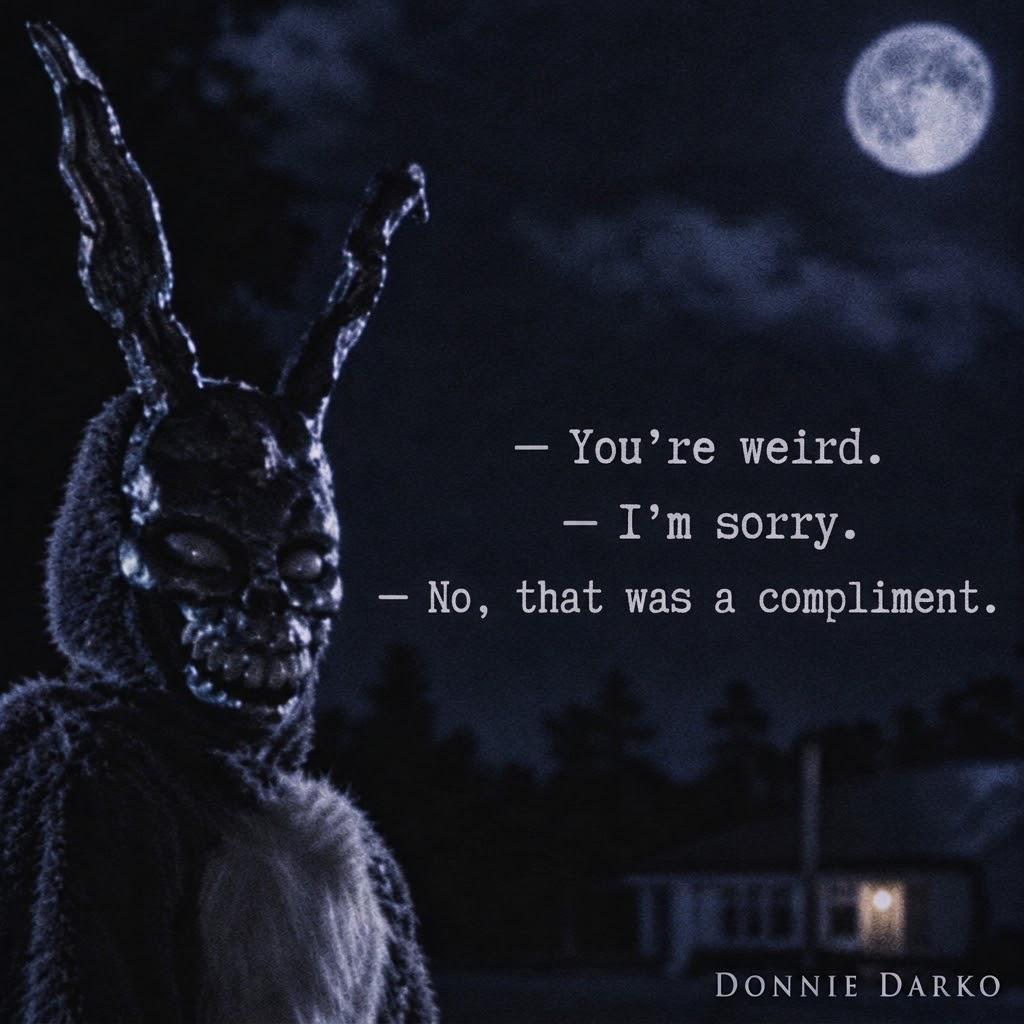
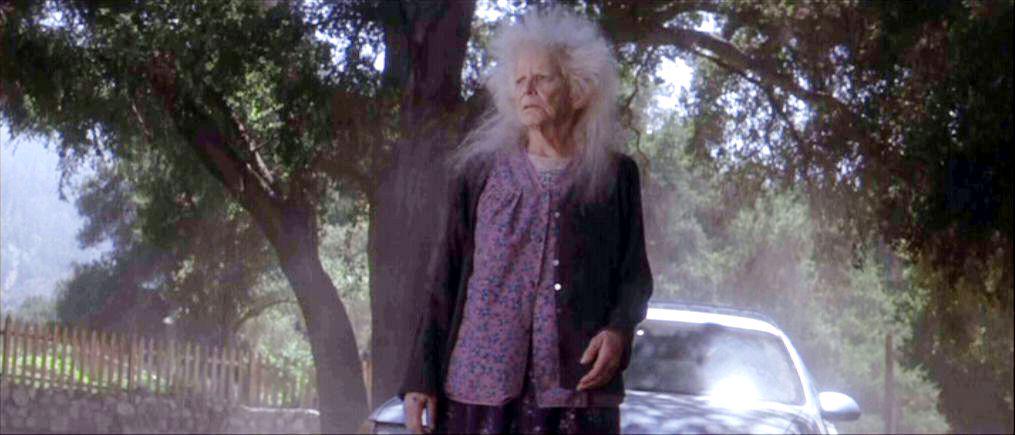
When I first finished Donnie Darko and dug into the lore of Roberta Sparrow’s The Philosophy of Time Travel, my rating for the movie actually dropped.
On paper, the time-travel mechanics feel like a massive plot hole. When Donnie rips the jet engine off Flight 2806 in the Tangent Universe and sends it back through a wormhole to October 2nd, there is no scientific guarantee that it breaks the loop. Two identical engines technically exist in the Primary Universe for 28 days, and Donnie has zero physical proof that staying in bed and letting the engine crush him will actually save Gretchen or his family.
If you judge Donnie Darko strictly as a mechanical sci-fi puzzle, the ending feels like a leap of blind faith rather than a logical resolution.
However, when you look at the film through the lens of quantum observation and existential philosophy, every "plot hole" disappears—and becomes the entire point of the movie.
- The Tangent Universe Is a Quantum Superposition
In quantum mechanics, a system can exist in a state of superposition—multiple conflicting possibilities happening at once—until a conscious observer measures or experiences it, forcing reality to collapse into a single fixed outcome.
That is the exact nature of the Tangent Universe. For 28 days, reality exists in an uncertain, fragile state where Donnie is simultaneously alive and dead. There is no external "proof" of how the loop ends because the universe itself has not resolved into a single state yet.
2. Conscious Observation Collapses Reality
Guided by the fourth-dimensional Manipulated Dead (Frank and Gretchen), Donnie becomes the sole conscious observer who sees the entire picture. When he watches Gretchen die, tears the engine off the plane, and consciously chooses to stay in bed when time resets, his observation is the exact mechanism that collapses the unstable Tangent Universe and locks the Primary Universe into place.
Donnie doesn't need an external guarantee that the loop will break; his conscious act of observing and choosing his fate is what forces the universe to resolve itself.
3. Determinism vs. Existential Free Will
This also bridges the film’s deepest philosophical conflict. Throughout the movie, Donnie sees liquid paths leading out of people's chests, showing where they are predetermined to go. Philosophically, this represents a deterministic universe where every action is already mapped out on a fixed track.
Donnie realizes he cannot escape his final destination—death—so he exercises the ultimate form of free will: he chooses the meaning of his death. He transforms a random, meaningless accident into a conscious act of love.
4. Quantum Entanglement in the Final Montage
Look at the ending sequence through this perspective. Even after the Tangent Universe collapses, the characters wake up weeping, and Gretchen waves to Donnie’s mother despite never having met her. It is a cinematic depiction of quantum entanglement—proving that conscious observation and human connection leave a permanent imprint on reality that even resetting time cannot erase.
TL;DR
Richard Kelly wrote Donnie Darko decades before modern pop-culture conversations around quantum consciousness became mainstream, yet he intuitively captured one of the deepest truths in both science and philosophy. Donnie doesn't laugh at the end because he has a mathematical guarantee that the loop is broken—he laughs because he has observed the whole truth of his existence, made his choice, and found peace.