r/LocalLLaMA • u/Imaonaise • 5h ago
News Yann LeCun on Dario's framing of open weight models
x.com
162
Upvotes
r/LocalLLaMA • u/rm-rf-rm • 7d ago
Its time for another Best Audio Models megathread - its already been 9 months since the last one!
Share what your favorite ASR, TTS, STT, Text to Music models are right now and why.
Given the the amount of ambiguity and subjectivity in rating/testing these models, please be as detailed as possible in describing your setup, nature of your usage (how much, personal/professional use), tools/frameworks etc. Production use cases with long lengths/stability requirements are relatively rare compared to cherry picked/short clip demos that are plentiful - so real world empirical comparisons are very welcome
Rules
Please use the top level comments to thread your responses.
r/LocalLLaMA • u/Imaonaise • 5h ago
r/LocalLLaMA • u/jacek2023 • 55m ago
https://x.com/realchendahuang/status/2125153472450527440
(I personally have no idea who Theo is, but I know some people here are his fans and aren't on X, so this is probably news to them)
(translated with google translate, because on X I see version in Polish)
"Recently, a bunch of people on X have been promoting T3 Code, an open-source project by theo , touting it as a free and open-source local AI programming tool.
I casually dug through its source code from beginning to end, and after reading it, I felt a chill down my spine.
This is hardly a conscientious open source project; it's clearly a blatant data harvesting operation.
It all started in March of this year. On March 6th, T3 Code merged PR #174, directly inserting the default PostHog telemetry. At that time, there was no documentation in the repository, no pop-ups in the software, and no toggle in the settings. The environment variables for disabling it were quietly hidden deep within the code. Ordinary users could install and run it, and data would start being transmitted.
But for over three months during which the default telemetry was running, the T3 Code website homepage blatantly displayed two lines of text promising: "No telemetry / Unless you opt in. Full stop." The meaning was clear: unless you actively agreed, there would be zero telemetry, no exceptions.
After garnering a wave of positive feedback from privacy-conscious developers by leveraging this prestigious reputation, theo silently removed those two promises in a homepage redesign commit on June 18th, without issuing any announcement or notification to existing users, as if nothing had happened. Many might have tolerated it if it were just a matter of secretly collecting version numbers. However, in October, theo personally submitted PR #15028, directly switching the batch reporting every 10 seconds to his self-hosted server (...)"
r/LocalLLaMA • u/seraschka • 17h ago
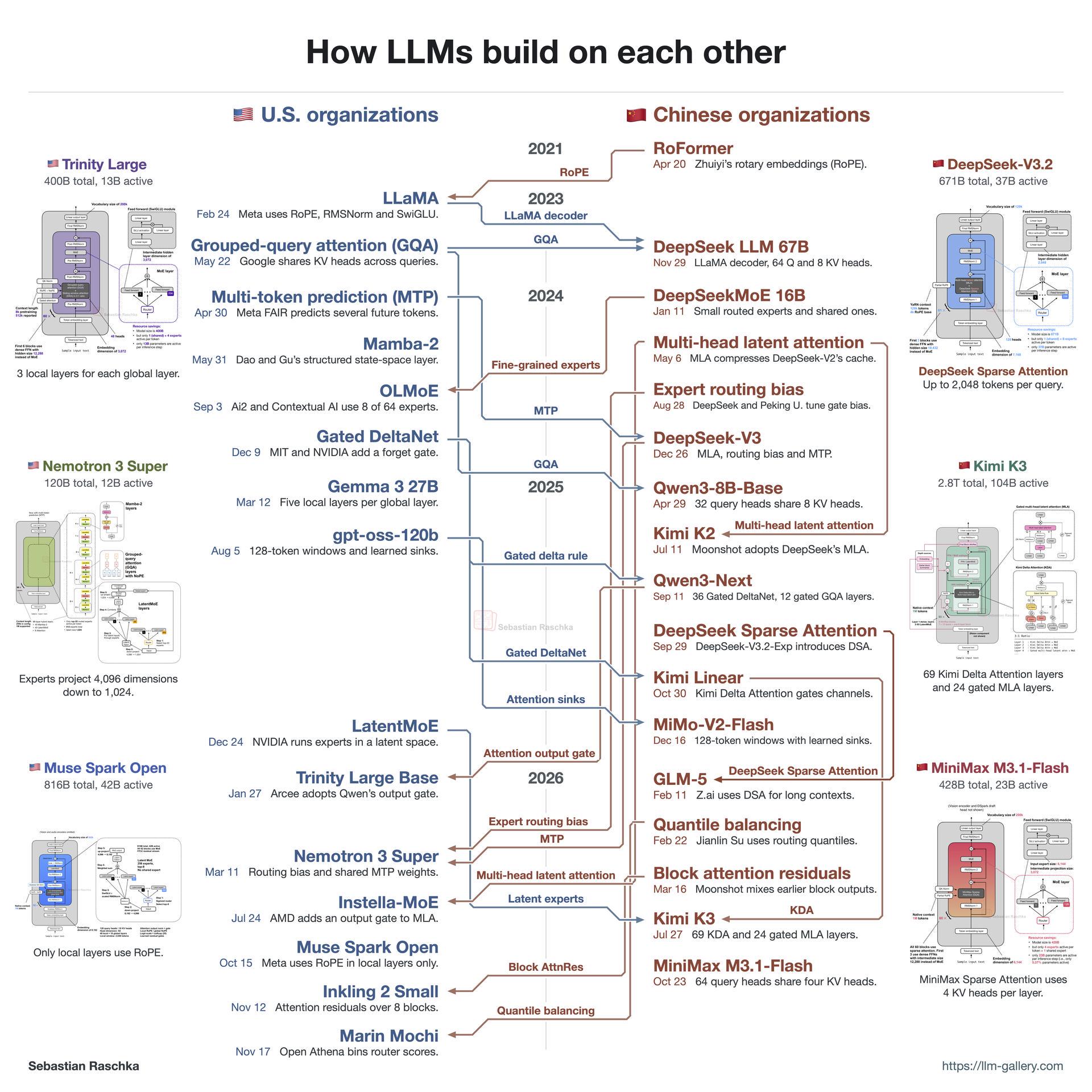
I seriously think US open-weight models wouldn't be this good without Chinese open-weight models and vice versa. And proprietary models wouldn't be this good (and cheap) without open-weight models.
Competition is a good thing.
The figure below shows just a small slice of how architecture ideas flow back and forth, to illustrate what I mean :)
r/LocalLLaMA • u/maternion • 8h ago
https://huggingface.co/baidu/ERNIE-5.5-Flash-Preview is open weights now.

ERNIE 5.5 Flash Preview is the first post-trained model built on ERNIE 5.5 Flash Base, which we released earlier. It is a Mixture-of-Experts (MoE) language model with 280B total parameters, 14B of them active per token, and a 1M-token context window. It does well at coding, 3D modeling, knowledge work and content creation, scores competitively on major benchmarks, and still decodes quickly.
r/LocalLLaMA • u/jacek2023 • 8h ago

ERNIE 5.5 Flash Preview is the first post-trained model built on ERNIE 5.5 Flash Base, which we released earlier. It is a Mixture-of-Experts (MoE) language model with 280B total parameters, 14B of them active per token, and a 1M-token context window. It does well at coding, 3D modeling, knowledge work and content creation, scores competitively on major benchmarks, and still decodes quickly.
The Preview shares its architecture and tokenizer with ERNIE 5.5 Flash Base. Its new capabilities come from mid-training and post-training, and mid-training also extends the training context length from 128K to 1M tokens. Our blog post shows work the model completed end to end in an agent harness.
ERNIE 5.5 Flash Preview is an intermediate checkpoint from post-training. It already performs competitively among models of its size, but some capabilities may still fall short because training is not finished. Post-training is ongoing and ERNIE 5.5 Flash is improving quickly. We will watch how the Preview performs in real use, listen to user feedback, and address what we learn in the official release.
The Preview is trained for the following kinds of work.
Coding and game development: Handles coding work that ranges from fixes in real codebases to building complex applications from scratch, and plans, executes and iterates steadily over long tasks. It knows how development is done in Unreal Engine, Unity and Godot. In a single 11-hour coding task it wrote a complete third-person wuxia game in C++ on Unreal Engine 5.8, and from game design documents it built nearly 100 mobile mini-games.
3D modeling and design: Works out shape, proportion and spatial relationships from a text description, then writes scripts that drive Blender and CAD software to build anything from engine parts to buildings. It can also bring existing assets into the same workflow to assemble large, detailed scenes.
Knowledge work: Takes scattered material, works through the steps a request calls for, and delivers professional-quality spreadsheets, documents or slide decks. It was trained in 300,000 workspaces for domains such as finance and law, holding 10 million reference files in more than 40 file types.
Video creation: Gathers, generates and arranges material, sets the visuals and pacing, and delivers a finished video, working for one to two hours on a single piece. It was trained in more than 150,000 creation environments for popular-science explainers, motion comics, creative edits and takes on trending topics.
Fast to serve, easy to build on: FP4 expert weights and the DSpark draft head make long-running agent tasks much faster, with little loss in accuracy. The architecture and tokenizer match ERNIE 5.5 Flash Base, so tooling built for the Base model carries over.
ERNIE 5.5 Flash Preview keeps the architecture of ERNIE 5.5 Flash Base and adds a DSpark draft head for speculative decoding. See the Base model card for architecture details.
| Key | Value |
|---|---|
| Modality | Text in, text out |
| Total Params | 280B |
| Activated Params per Token | 14B |
| Layers | 43 (1 dense + 42 MoE) |
| Hidden Size | 4096 |
| Attention | 37 × HCA (head dim 512) + 6 × MLA-DSA (head dim 256), 64 heads |
| Experts | 512 routed (top-10) + 1 shared |
| Vocabulary | 201,216 |
| Context Length | 1,048,576 |
| Thinking | Always on; reasoning is returned in reasoning_content |
| Precision | Blockwise FP8; routed experts in MXFP4 (W4A8, quantization-aware trained); FP8 KV cache; FP4 DSA indexer |
r/LocalLLaMA • u/Rare_Subject2343 • 20h ago

Am I insane in thinking there has to be SOME kind of use for LLM's besides solely coding? There's research, scientific discovery, education, data analysis, market research, business, historical analysis. ANYTHING besides just solely codemaxxing!
It's overly pedantic, tonedeaf and almost autistic in how literal it takes anything (like a coding model).
It has the WORST writing of any recent Chinese model. The sloppiest, cringiest "breath hitches, spine shivers, body jolts" I've ever seen. When it's not busy outputting the sloppiest garbage known to mankind it spends half of its chain of thought wasting tokens on reasoning whether something is okay, an obvious trait shared with GPT-OSS and GPT 6 which Zhipu clearly distilled from.
It's like the Zhipu team deliberately made it absolute garbage at any kind of natural language.
r/LocalLLaMA • u/MK_L • 3h ago
Given Strata's approach to DRAM utilization, expert caching, and GPU memory management, do you think llama.cpp will eventually incorporate similar techniques, or will Strata become the de facto replacement for serving MoE models?
Especially as MoE architectures become more prevalent, I'm curious whether we're witnessing a temporary performance advantage or a fundamental shift in inference engine design.
r/LocalLLaMA
•
u/Glittering-Hand-3359
•
12h ago
We just open-sourced Songe, a tool that fine-tunes your local model on your own traces while your machine sits idle. We call this "dreaming": while you're away, the model goes over what went wrong during the day and learns from it. Everything stays local: no account, no telemetry, no cloud.
What it does
Songe sits between your agent (opencode, pi, or any OpenAI-compatible tool) and your model server. After each model action, it records what happened next: the tool result, the error, your follow-up message. When your agent has been idle for a while, it uses those signals to teach the model what you actually wanted.
How it works
Capture: a local proxy in front of your server (LM Studio, Ollama, vLLM, llama.cpp, mlx-lm) logs the outcome of each model action.
Extract: it pulls out the lessons (corrections, rules you stated, tool errors) and turns them into practice scenarios. Your raw chats are never trained on directly.
Dream: when you're idle, it trains a small LoRA adapter using on-policy self-distillation, so the model learns from its own improved outputs rather than from imitating your transcripts.
Gate: a new adapter only goes live if it beats the current one on held-out examples without regressing on what already worked. Otherwise it's discarded. songe undo rolls back anytime.
Early result
We asked Inkling-2-Mini to light a room with 12 different-colored orbs in Bevy 0.20, which is newer than its training data. Every orb came out red: it passed hue as 0–1, but Bevy expects degrees. We corrected it once. After one night of dreaming, all 12 colors render correctly.
Requirements
Memory: before the first training run, Songe measures what your machine can handle and sizes the training to fit. Reference points:
Limitations
That last point is where we'd most like feedback: how would you tell whether a personal fine-tune is actually helping vs. just overfitting to recent sessions?
Happy to answer anything in the comments!
Install: pip install songe && songe init (also via uv tool install songe or brew install sous-labs/tap/songe)
GitHub: github.com/sous-labs/songe
Discord: https://discord.gg/cBEywVkXjY
r/LocalLLaMA • u/mythikal03 • 5h ago
About a month ago, nvidia dropped Bolt-E4B and a few people (myself included) seemed to really take to it. It's trained for a specific workload (not coding) and it's been phenomenal as my quick inline summarizer utility model among a few other quick QoL supporting use cases around my homelab. I noticed tonight nvidia added a commit for vision and audio and it isn't noted anywhere on on the model card; since I've been waiting for this I thought a few of you using this model may be as well.
r/LocalLLaMA • u/SarcasticBaka • 3h ago

r/LocalLLaMA
•
u/petuman
•
1d ago

GLM 5.4 blog post, found by changing 5.3 to 5.4 in URL.
To mods, open weights release announced the post:
Open Weights: We plan to open-source the model weights responsibly after completing necessary safety hardening.
r/LocalLLaMA • u/jacek2023 • 11h ago

lower VRAM usage for speculative decoding (Qwen3.8 27B recurrent state: 2.34 GB -> 0.20 GB)
r/LocalLLaMA
•
u/yehyakar
•
4h ago
TL;DR
Hardware
RTX 5080 16GB at its stock 360W
Core Ultra 9 285K (8P + 16E), 2x32GB DDR5-7200, PCIe 5.0 x16, Fedora
Pack: Inkling-2-Mini-NVFP4-DQ8.basalt (19.7 GB), int8 KV cache, 262K context, drafting on (the pack's DSpark drafter)
basalt-bench (the engine's standard benchmark, short context, seed 7; anyone can run it with bin/basalt-bench):
| test | tok/s | drafts accepted | tokens per draft |
|---|---|---|---|
| prompt read, 16K | 8,914 | - | - |
| prompt read, 64K | 6,997 | - | - |
| tg conv (sampled chat) | 231 | 55% | 2.0 |
| tg struct (JSON / code / tool calls) | 451 | 96% | 5.6 |
| tg prose (sampled long text) | 190 | 41% | 1.7 |
Generation speed depends a lot on how predictable the text is, because the drafter guesses several tokens ahead and the model checks them in one pass: structured output and tool calls run more than twice as fast as free prose.
Speed by context (free-text answers about source code, so drafting is near its worst case; real server, a fresh prompt at each depth so nothing comes from the cache, 384 tokens generated, the model's own sampling: temp 1.0 / top_p 0.95 / top_k 20)
| context | prompt read (pp) | generation (tg) |
|---|---|---|
| 1.2K | 4,472 tok/s | 195 tok/s |
| 5.8K | 7,505 tok/s | 218 tok/s |
| 30K | 7,466 tok/s | 184 tok/s |
| 66K | 6,224 tok/s | 167 tok/s |
| 147K | 4,353 tok/s | 153 tok/s |
| 239K | 3,275 tok/s | 132 tok/s |
What my PRs change (all open upstream too, keep tracking there too!)
Quality: every PR is checked against the BF16 model (KLD / top-1 through the decode path); the ones that change numerics are within noise of upstream.
Guide
Branch with the exact engine (upstream v0.5.7 + the 5 PRs): https://github.com/xyehya/basalt/tree/inkling2-5080-setup
git clone -b inkling2-5080-setup https://github.com/xyehya/basalt && cd basalt
cmake -S . -B build -DCMAKE_BUILD_TYPE=Release -DBASALT_MODELS=inkling2
cmake --build build -j
pip install -r requirements.txt
hf download jesdga/Inkling-2-Mini-Basalt Inkling-2-Mini-NVFP4-DQ8.basalt --local-dir models
bin/basalt serve --config basalt_config.json
basalt_config.json:
You need a Blackwell RTX card (sm_120) with CUDA 13, about 12 GB of RAM and ~25 GB of disk. The default pack upstream is now NVFP4-MX8; it should read prompts ~5% faster, but my numbers are from DQ8.
Caveats: Linux only tested (Windows compiles in CI but I haven't run it); numbers are from one machine at 360 W.
Huge thanks to jesdga95 for Basalt (go star the repo), Thinking Machines for Inkling 2, and the folks on the PRs (giveen, tjm8874) for reviews and ideas.
r/LocalLLaMA • u/fuckAIbruhIhateCorps • 1h ago
The model used is text only EmbeddingGemma2 270m (around 125MB) and the inference is very fast even on a mid range phone.
r/LocalLLaMA • u/windows_error23 • 49m ago

r/LocalLLaMA • u/mawcopolow • 3h ago

If the performance follows, this could be a very nice addition to one's toolset
r/LocalLLaMA • u/jacek2023 • 13h ago

announced by googlegemma today:
gBench is an open-source benchmarking and evaluation suite for open large language models (LLMs) and vision-language models (VLMs). It measures serving performance on the hardware it runs on, and model capability in three tiers: academic eval suites, the Golden Set smoke tests and the agentic quality suite.
It works with any OpenAI-compatible /v1 server through --remote-endpoint (validated on vLLM and Ollama; on Cloud Run, a service that allows unauthenticated calls), or starts and stops a local vLLM server itself.
/v1 endpoint with --remote-endpoint <URL>/v1 (validated on vLLM and Ollama; on Cloud Run, a service that allows unauthenticated calls; see Remote Endpoint Mode).Three capability tiers:
--evals): 86 canonical Python suites in --evals all (plus ui_control_osworld and swe_lancer, which run only when named) across 6 core capability pillars (General Knowledge & Scientific Reasoning, Mathematics & Proofs, Coding & Algorithmic Design, Long Context & Retrieval, Tool Use & Agentic Workflows, Multimodal Vision & Grounding) with the model's reasoning mode on request (--eval-thinking), images sent as their original bytes where the dataset stores them (no re-encoding), plugin discovery (--eval-plugins-dir) and custom JSONL datasets (--eval-custom-jsonl).--golden-only): 16 deterministic capability checks (code_canonical, function_call_single, structured_json, etc.) with two-sided presence assertions and python_exec unit-test matching, including a labelled chat template subset that separates a broken chat template from a weak model.--quality-only): the GemmaClaw / OpenClaw QA suite (the QA scenarios of the pinned GemmaClaw commit, 60 at d8bc6989; scenarios that need another model provider are listed apart and not scored) testing multi-turn tool calling, session memory and plugin routing, run in gBench's local gbench-quality Docker image (built once per GemmaClaw commit).config.json (parameter count, MoE topology, vision/audio tokens), a recommended GPU tier per model size (1 GPU up to 20B, 2 GPUs up to 80B, 8 GPUs above) that is checked against the required --num-gpus (a warning when off the tier, a refusal when the model will not fit), and a server startup timeout that scales with model size (max(600, min(3600, (300 + params_b * 10) * 3 * (1.3 if MoE)))).--max-cv-percent (default 5.0).--stress-test): one merged Poisson schedule per rate point at increasing rates (x2 per step) until a point fails; each of --stress-reps repeats gives a bracket [pass, fail], and the median repeat's limit is then certified with probes sized for the P99 SLO (a cohort of >= 1099 requests, about 1400 sent, the same rule on every device) to +-9% when that resolution is reached (otherwise a certified lower bound with its resolution, a lower bound censored at --stress-max-qps, or no limit when certification refutes the sweep), or reported UNCERTIFIED with the time certifying would need (--stress-certify-budget). A point passes when, on the requests planned after the point's ramp-up: the queue is not growing, >= 90% finish within the end-to-end time the SLOs imply, P99 TTFT and P99 ITL meet their SLOs, failures stay under 2% and the client kept to its schedule. The queue-growth test reads TTFT; overload that shows only as longer end-to-end times (for example KV-cache preemption) is left to the completion-fraction and ITL gates. SLOs are per campaign (5000 ms TTFT and 200 ms ITL without --campaign), overridden by --stress-threshold and --itl-slo-ms.r/LocalLLaMA • u/Creative-Type9411 • 8h ago

Xeon W3275M
X11-SPA-T (NOT TF)
128GB RAM at the moment, I can fill it but spillover is too slow on this hardware
7xTesla T4 (16gb x 7 = 112gb vram)
4x 512Gb Sata SSD
Corsair HX1500i
and assorted connecters/accessories etc
(WIP)
Got it to Post without the cards. I just have to get cooling installed and it's off to the races...
r/LocalLLaMA • u/festr__ • 14h ago
Local Inference Lab signed runtime package for DeepSeek-V4.1-Flash-1017 (TP4 on 4× RTX PRO 6000 Blackwell 96 GB) running on NVIDIA Flare
701–766 tok/s full end-to-end average over a ~40k-token reasoning + full HTML5 Tetris code generation, 6.76 ms/step / 147.4 steps/s with MTP draft-7 + adaptive verification α=0.6)1.97 s) and 128k prompt in 4.1 seconds, completely cold (zero prefix cache)ctx=0, MTP draft 7, α=0.6, 2-run average)| Concurrency | Aggregate tok/s | Per-User tok/s | Mean ITL | Step Time |
|---|---|---|---|---|
| C1 (synthetic, ~68% d1 accept) | 421.2 tok/s | 421.2 tok/s | 2.46 ms | 6.12 ms (140.1 steps/s) |
| C1 (real coding / Tetris, ~40k tok) | 701–766 avg / 1,076 peak | 701–766 avg / 1,076 peak | — | 6.77 ms (147.4 steps/s) |
| C4 | 1,026.2 tok/s | 256.6 tok/s | 3.96 ms | 8.57 ms |
| C8 | 1,312.7 tok/s | 164.1 tok/s | 6.11 ms | 10.70 ms |
| C16 | 1,894.5 tok/s | 118.4 tok/s | 8.38 ms | 12.57 ms |
| C32 | 2,651.8 tok/s | 82.9 tok/s | 11.73 ms | 14.57 ms |
| Prompt Length | Cold Prefill | TTFT |
|---|---|---|
| 8k tokens | 31,026 tok/s | 0.264 s |
| 32k tokens | 31,939 tok/s | 1.010 s |
| 64k tokens | 32,724 tok/s | 1.967 s |
| 128k tokens | 31,308 tok/s | 4.106 s |
(Test system: 4× NVIDIA RTX PRO 6000 Blackwell Workstation Edition 96 GB, single-socket AMD EPYC 9575F, NVIDIA driver 615.71.10, PCIe Relaxed Ordering enabled.)
modprobe)Because RTX PRO 6000 Blackwell communicates over PCIe P2P (no NVLink), enabling PCIe Relaxed Ordering in the NVIDIA kernel module is essential for full TP4 collective speed.
Create /etc/modprobe.d/nvidia-relaxed-ordering.conf:
|
(Optional — only if your motherboard/BIOS restricts PCIe P2P or Resizable BAR between GPUs, you can also enable P2P override in /etc/modprobe.d/nvidia-p2p-override.conf:)
|
Verify after reboot or nvidia driver reload (must show EnablePCIERelaxedOrderingMode: 1 and working P2P in topo -m):
The signed runtime package (~524 GB, downloaded automatically on first start) is hosted on Hugging Face under Local Inference Lab:
https://huggingface.co/local-inference-lab/DeepSeek-V4.1-Flash-1017-FLARE (--revision gb202)
--embedding-table-storage disk to --embedding-table-storage ram to keep the entire 188.8 GiB Engram table in RAM for the fastest decode/prefill shown above (and you can drop --security-opt seccomp=unconfined).flare-inference package and run the same flare run ... command directly on the host.DeepSeek-V4.1-Flash) on http://127.0.0.1:8000/v1/chat/completions.RMSNorm (ClusterMhcPostYNorm) onto the critical path and overlaps the fn projection + 20-step Sinkhorn on an auxiliary stream right behind PCIe AllReduce (+0.07 us overlap penalty).MXFP8MultiRowTCGemvKernel (eliminates 51 Triton RoPE launches/step).split_k=5, 10 for K=5120 router GEMVs, plus fused residual addend on dependency-bearing PCIe AllReduce and 2-microbatch interleaved prefill pipelining (8192-token chunks).
Links:gb202): https://huggingface.co/local-inference-lab/DeepSeek-V4.1-Flash-1017-FLARE/tree/gb202local inference lab discord: https://discord.gg/gmvKSN3tVy
r/LocalLLaMA • u/Hot_Example_4456 • 20h ago

r/LocalLLaMA • u/Legitimate-Dog5690 • 2h ago
I'm currently running a single W2145 server, 160gb of quad channel memory (32x4 + 8x4), with a 3090 on Cachy Linux. Getting very solid token generation, about 40-50 with QFN Q8, 15 or so with DeepSeek V4.1 Flash 2.25bpw, 90 with Inkling 2 Mini.
I get about 75gb/s in Aida64 on the memory, which isn't far off my theoretical limit, so it's running fairly efficiently.
I'm seeing lots of very cheap dual Xeon Silver/Gold servers at the moment (the DDR4 variants), dual 6 channel memory sounds potentially very tempting. Do any of the engines support it particularly well? I've seen mention of Strata supporting it in some form?
Has anyone compared the token generation of single vs dual Xeon in these cases? Do the 6 channel scalable Xeons get anywhere near their potential 128gb/s x 2 bandwidth?
Thanks!
r/LocalLLaMA • u/General-Spite1222 • 6h ago
Lots of people complain on here when models come out, because there’s an influx benchmark result posts. Reddit has no answer for this, there are way too many variations to bring into something like a mega thread. it’s just the wrong tool for it.
If anyone is interested, I think the way to go about it is to have a tool that is dead simple to use. it should track by hardware combos (GPU(s), pcie lane configs, memory size, memory speed, memory lanes, CPU, engine and engine version, model, quant, and kv quant. And it should track prefill and decode speeds. Maybe TTFT too
I‘m probably missing a bunch of variables, but that highlights why it’s so difficult get a good picture of what runs well on your hardware. And it‘s always a running target.
I’m a software engineer, but this is far from my specialty. I figured I’d throw it out there if anyone wants to think about it more and make something.
Lastly, I don’t know if it’s Reddit or my phone bugging, so sorry for the spelling and such. Autocomplete is going nuts on me.
r/LocalLLaMA • u/gladkos • 12h ago

Refusals dropped from 100% to 0% in our test and kept 98% of its original accuracy on MMLU
An uncensored build of thinkingmachines/Inkling-2-Mini by AtomicChat (26.4B MoE, 3.4B active, looped core; text and image input; Apache-2.0, LICENSE in this repo). It comes as a LoRA adapter for any GGUF of AtomicChat/Inkling-2-Mini-GGUF and as three ready-made GGUF files with the edit baked in. We released 3 GGUFs from 8.67 to 16.53 GB. Made by atomic.chat local ai